
Skip to Content
  • Bureaux

    Bureaux

    Amérique du Nord et Amérique du Sud
    • Atlanta
    • Austin
    • Bogota
    • Boston
    • Buenos Aires
    • Chicago
    • Dallas
    • Denver
    • Houston
    • Los Angeles
    • Mexico City
    • Minneapolis
    • Monterrey
    • Montreal
    • New York
    • Rio de Janeiro
    • San Francisco
    • Santiago
    • São Paulo
    • Seattle
    • Silicon Valley
    • Toronto
    • Washington, DC
    Europe, Moyen-Orient et Afrique
    • Amsterdam
    • Athens
    • Berlin
    • Brussels
    • Copenhagen
    • Doha
    • Dubai
    • Dusseldorf
    • Frankfurt
    • Helsinki
    • Istanbul
    • Johannesburg
    • Kyiv
    • Lisbon
    • London
    • Madrid
    • Milan
    • Munich
    • Oslo
    • Paris
    • Riyadh
    • Rome
    • Stockholm
    • Vienna
    • Warsaw
    • Zurich
    Asie et Australie
    • Bangkok
    • Beijing
    • Bengaluru
    • Brisbane
    • Ho Chi Minh City
    • Hong Kong
    • Jakarta
    • Kuala Lumpur
    • Manila
    • Melbourne
    • Mumbai
    • New Delhi
    • Perth
    • Shanghai
    • Singapore
    • Sydney
    • Tokyo
    Voir tous les bureaux
  • Alumni
  • Presse
  • S’abonner
  • Contacter
  • Canada | Français

    Sélectionnez votre région et votre langue

    Global
    • Global (English)
    Amérique du Nord et Amérique du Sud
    • Brazil (Português)
    • Argentina (Español)
    • Canada (Français)
    • Chile (Español)
    • Colombia (Español)
    Europe, Moyen-Orient et Afrique
    • France (Français)
    • DACH Region (Deutsch)
    • Italy (Italiano)
    • Spain (Español)
    • Greece (Elliniká)
    Asie et Australie
    • China (中文版)
    • Korea (한국어)
    • Japan (日本語)
  • Saved items (0)
    Saved items (0)

    You have no saved items.

    Bookmark content that interests you and it will be saved here for you to read or share later.

    Explore Bain Insights
  • Expertises Sectorielles
    Menu principal

    Expertises Sectorielles

    • Aerospace et Défense
    • Agroalimentaire
    • Chimie
    • Infrastructures, BTP et Matériaux de Construction
    • Grande Consommation
    • Services Financiers
    • Santé
    • Engins & Equipements Industriels
    • Media et Divertissement
    • Metals
    • Mining
    • Pétrole & Gaz
    • Papier et Emballage
    • Private Equity
    • Secteur Public
    • Distribution
    • Technologie
    • Télécommunications
    • Transportation
    • Travel & Leisure
    • Utilities & Energies Renouvelables
  • Expertises Fonctionnelles
    Menu principal

    Expertises Fonctionnelles

    • Expérience Client
    • ESG
    • Innovation
    • Fusions et Acquisitions
    • Opérations
    • People & Organization
    • Private Equity
    • Sales & Marketing
    • Stratégie
    • IA, Perspectives et Solutions
    • Technology
    • Transformation
  • Digital
  • Points de Vue
  • About
    Menu principal

    About

    • Notre Activité
    • Nos Valeurs
    • Nos Collaborateurs et Notre Équipe Dirigeante
    • Notre Impact
    • Prix & Récompenses
    • Partenariats Internationaux
    Further: Our global responsibility
    • Sustainability
    • Impact Social
    • World Economic Forum
    Learn more about Further
  • Carrières
    Menu principal

    Carrières

    • Rejoignez-nous
      Carrières
      Rejoignez-nous
      • Find Your Place
      • Nos domaines d’expertise
      • Equipes multidisciplinaires
      • Étudiants
      • Stages et programmes
      • Événements de recrutement
    • La vie chez Bain
      Carrières
      La vie chez Bain
      • Blog: Inside Bain
      • Récits de carrière
      • Nos collaborateurs
      • Nos bureaux
      • Soutenir votre évolution professionnelle
      • Groupes d’affinités
      • Avantages chez Bain
    • Histoires d’impact
    • Notre processus de recrutement
      Carrières
      Notre processus de recrutement
      • Ce que vous pouvez attendre
      • Entretiens
    Trouver un poste
  • Bureaux
    Menu principal

    Bureaux

    • Amérique du Nord et Amérique du Sud
      Bureaux
      Amérique du Nord et Amérique du Sud
      • Atlanta
      • Austin
      • Bogota
      • Boston
      • Buenos Aires
      • Chicago
      • Dallas
      • Denver
      • Houston
      • Los Angeles
      • Mexico City
      • Minneapolis
      • Monterrey
      • Montreal
      • New York
      • Rio de Janeiro
      • San Francisco
      • Santiago
      • São Paulo
      • Seattle
      • Silicon Valley
      • Toronto
      • Washington, DC
    • Europe, Moyen-Orient et Afrique
      Bureaux
      Europe, Moyen-Orient et Afrique
      • Amsterdam
      • Athens
      • Berlin
      • Brussels
      • Copenhagen
      • Doha
      • Dubai
      • Dusseldorf
      • Frankfurt
      • Helsinki
      • Istanbul
      • Johannesburg
      • Kyiv
      • Lisbon
      • London
      • Madrid
      • Milan
      • Munich
      • Oslo
      • Paris
      • Riyadh
      • Rome
      • Stockholm
      • Vienna
      • Warsaw
      • Zurich
    • Asie et Australie
      Bureaux
      Asie et Australie
      • Bangkok
      • Beijing
      • Bengaluru
      • Brisbane
      • Ho Chi Minh City
      • Hong Kong
      • Jakarta
      • Kuala Lumpur
      • Manila
      • Melbourne
      • Mumbai
      • New Delhi
      • Perth
      • Shanghai
      • Singapore
      • Sydney
      • Tokyo
    Voir tous les bureaux
  • Alumni
  • Presse
  • S’abonner
  • Contacter
  • Canada | Français
    Menu principal

    Sélectionnez votre région et votre langue

    • Global
      Sélectionnez votre région et votre langue
      Global
      • Global (English)
    • Amérique du Nord et Amérique du Sud
      Sélectionnez votre région et votre langue
      Amérique du Nord et Amérique du Sud
      • Brazil (Português)
      • Argentina (Español)
      • Canada (Français)
      • Chile (Español)
      • Colombia (Español)
    • Europe, Moyen-Orient et Afrique
      Sélectionnez votre région et votre langue
      Europe, Moyen-Orient et Afrique
      • France (Français)
      • DACH Region (Deutsch)
      • Italy (Italiano)
      • Spain (Español)
      • Greece (Elliniká)
    • Asie et Australie
      Sélectionnez votre région et votre langue
      Asie et Australie
      • China (中文版)
      • Korea (한국어)
      • Japan (日本語)
  • Saved items  (0)
    Menu principal
    Saved items (0)

    You have no saved items.

    Bookmark content that interests you and it will be saved here for you to read or share later.

    Explore Bain Insights
  • Expertises Sectorielles
    • Expertises Sectorielles

      • Aerospace et Défense
      • Agroalimentaire
      • Chimie
      • Infrastructures, BTP et Matériaux de Construction
      • Grande Consommation
      • Services Financiers
      • Santé
      • Engins & Equipements Industriels
      • Media et Divertissement
      • Metals
      • Mining
      • Pétrole & Gaz
      • Papier et Emballage
      • Private Equity
      • Secteur Public
      • Distribution
      • Technologie
      • Télécommunications
      • Transportation
      • Travel & Leisure
      • Utilities & Energies Renouvelables
  • Expertises Fonctionnelles
    • Expertises Fonctionnelles

      • Expérience Client
      • ESG
      • Innovation
      • Fusions et Acquisitions
      • Opérations
      • People & Organization
      • Private Equity
      • Sales & Marketing
      • Stratégie
      • IA, Perspectives et Solutions
      • Technology
      • Transformation
  • Digital
  • Points de Vue
  • Carrières
    Recherches les plus fréquentes
    • Agile
    • Digital
    • Stratégie
    Vos recherches précédentes
      Pages récemment visitées

      Content added to saved items

      Saved items (0)

      Removed from saved items

      Saved items (0)

      Global Healthcare Private Equity Report

      Value-Based Care: Opportunities Expand

      Value-Based Care: Opportunities Expand

      Value-based care adoption increases across a growing spectrum of payment models.

      Par Sharon Fry, Dave Nierenberg, Grace Wynn, Kara Murphy, et Nirad Jain

      • min
      }

      Rapport

      Value-Based Care: Opportunities Expand
      en
      At a Glance
      • Sustained macro trends continue to drive value-based care adoption across a spectrum of care models.
      • While investment activity remains focused on primary care and Medicare Advantage, opportunities across other payer and specialty segments are expanding.
      • Enabler models represent an attractive investment path, with adoption driven by a need for traditionally fee-for-service groups to participate in risk-based arrangements.
      • Providers and value-based care enablers that can bend the cost curve with differentiated care models and advanced analytics are positioned to succeed.

      This article is part of Bain's 2023 Global Healthcare Private Equity and M&A Report.

      EXPLORE THE REPORT

      For more than a decade, value-based care (VBC) has been positioned as healthcare’s “next big thing.” And while progress has been uneven until now, multiple forces are converging to inflect growth across an expanding set of risk-bearing models. Rising costs of care are putting pressure on stakeholders while key VBC enablers have matured—including data availability, analytics, and care management models.

      Regulatory forces have also spurred growth. While only 7% of healthcare spending was in population-based payment models in 2021, the Centers for Medicare & Medicaid Services (CMS) has set a goal for all traditional Medicare beneficiaries to be in a care relationship with accountability for quality and total cost of care by 2030. Increased participation from other payers will be needed to unlock the full market potential.

      Bain research shows that physician interest in VBC is high, but risk appetite is still a work in progress. It’s true that the performance of participants in value-based models has varied. The number of accountable care organizations (ACOs) plateaued at around 1,000 in recent years, while 15 of the 53 entities participating in CMS’s direct contracting program in 2021 experienced net savings losses.

      Still, the longer-term outlook remains favorable. Value-based care stakeholders are doubling down on their commitment as healthcare spending outpaces GDP growth and CMS leans further into VBC models. This momentum is likely to accelerate as we see further regulation, more data from early adopters, and more capability-enhancing technology.

      There is plenty of runway for investors to participate in VBC initiatives

      It is no surprise that primary care to date has been the focus of VBC. Primary care providers (PCPs) serve as “gatekeepers” within the healthcare landscape, playing a key role in preventative care, screening, chronic condition management, and navigation to other providers.

      There is still ample headroom for growth in value-based care adoption in the PCP space. As of 2021, nearly 60% of healthcare payments had at least some linkage to quality and value, but less than 20% incorporated two-sided risk (and capitated models are still under 8% of spending).

      Many VBC models adopted to date benefit from heavy Medicare exposure where there is a large total addressable market, and where both payer-pull and the primary care relationships create opportunities for providers to inflect the cost curve.

      This included some of the largest deals in 2022:

      • In April 2022, Optum announced its acquisition of Houston-based Kelsey-Seybold Clinic for around $2 billion. Kelsey-Seybold operates multispecialty care centers and also owns its own Medicare Advantage plan for seniors, KelseyCare Advantage. The deal provided an exit for TPG Capital.
      • In May 2022, Humana and Welsh, Carson, Anderson & Stowe (WCAS) announced a reinvestment of $1.2 billion in CenterWell Senior Primary Care, a network of value-based care clinics, to develop 100 new senior-focused primary care clinics by 2025.
      • In July 2022, Amazon announced a $3.9 billion takeover of publicly listed One Medical, a membership-based primary care practice. One Medical owns the Iora Health clinics, which provide comprehensive primary care services for Medicare patients, and aims to move patients to a capitated reimbursement model.

      Much of the focus of pure-play “disruptive primary care” providers is on Medicare Advantage, where up to 25% of all payments are through capitated models. There is significant upside for adoption across other payers—including commercial, Medicaid, and fee-for-service Medicare (such as ACO REACH).

      Increasingly, the market will reward models that generate more meaningful savings and benefits for the population. Investors should look for winning models that have clear clinical pathways to impact patient health, a proven ability to adapt to multiple geographies, and flexibility to adapt to evolving regulatory landscapes. Sophisticated data analytics and risk adjustment are necessary but not sufficient on their own for long-term viability. Regardless of the model, patience is critical: Risk-based models take time to turn profitable for any patient population.

      Investors are increasingly finding ways to extend value-based care to specialty care, but selective interest demonstrates the variable addressability across specialties

      Meaningful adoption of value-based care has been slower outside of primary care, but stakeholders are eyeing the possibilities. Categories with more standardized and time-bound interventions (such as orthopedics, cardiology, OB/GYN maternal care, and others) have witnessed growth in episode-based payment models over the past few years:

      • Orthopedics: Linden Capital Partners’ Healthcare Outcomes Performance Company (HOPCo) has been growing its value-based care platform, including the 2020 acquisition of Stryker Performance Solutions’ value-based care unit.
      • Cardiology: Webster Equity Partners has continued to expand its Cardiovascular Associates of America (CVAUSA) platform, investing in its practices to add new services, support infrastructure development, and prepare for risk-based reimbursement arrangements.

      The approach varies for other specialties that manage chronic or indeterminate-length conditions with high costs of care. For example, oncology and nephrology groups participate in specific Medicare VBC programs in addition to subcontracted models with other payers. Examples include:

      • Oncology: WCAS-backed Valtruis owns Oncology Care Partners, a cancer care provider purpose-built for value-based care.
      • Nephrology: InterWell Health finalized a $2.4 billion merger with Fresenius Health Partners and Cricket Health to combine and expand their kidney care with advanced technology and value-based care capabilities.

      Overall, the VBC “fit” and approach vary by specialty, but some common considerations apply (see Figure 1).

      Figure 1
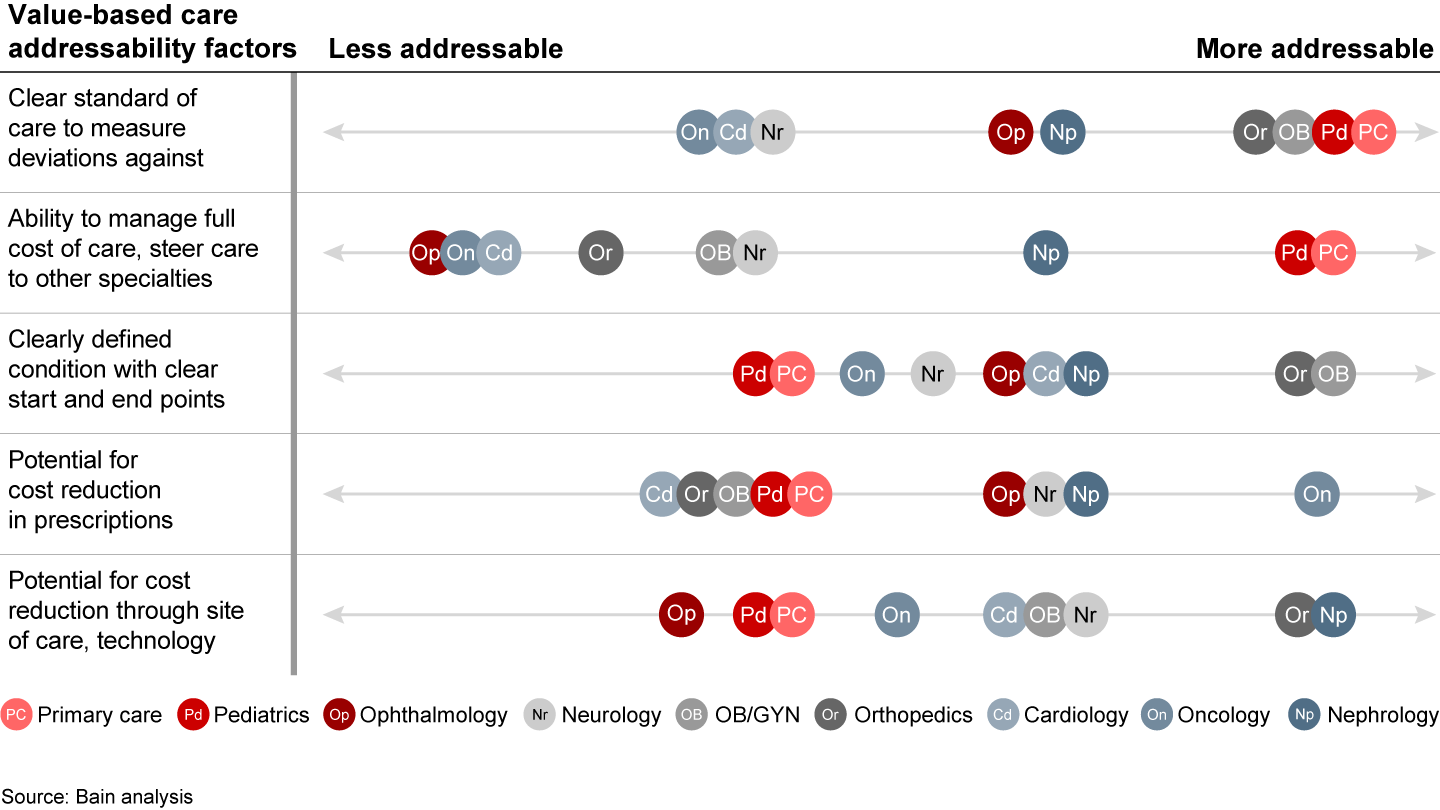
      While value-based care is broadening, some specialties may be more addressable than others

      Beyond the physical health-focused specialties discussed above, we are seeing growing interest in VBC models in behavioral health in light of the interconnected nature of physical and mental health. For instance, in 2021, WCAS-backed Valtruis announced it would invest in Wayspring, which provides a value-based medical home model for substance abuse disorder treatment.

      As investors look outside Medicare-focused primary care, there is no one-size-fits-all model. Other specialties may require different payment models or operating models as a result of their served populations and reimbursement rates; investors are looking to emerging plays in behavioral health and pediatrics as examples given their role in serving Medicaid patients. Investors interested in specialty value-based care models should pay attention to where experimentation is occurring, and which models are most repeatable. As with all categories of VBC, the ability to truly measure, predict, and inflect health outcomes will be key to the success of these platforms.

      Providers participating in value-based care need to have the right infrastructure to succeed

      Research by Bain found that around 80% of PCPs are interested in value-based payment models but report technological and administrative constraints as the biggest barriers. Consequently, payers have historically struggled to find sufficiently sophisticated provider counterparties to enable global risk contracts.

      This need has created high demand for both technology and services that enable VBC. There are few full-service tech platforms that enable value-based care; instead, physicians are pulling together a range of point solutions, spanning a mix of tech-centric and services-centric models. These enablers may be an attractive way to play VBC for investors interested in participating without taking on the direct financial risk associated with patient outcomes.

      The key for investors is identifying the best entry point, given the breadth of solutions and business models available. Some examples are listed below.

      • Data and analytics: services for risk stratification, care transitions, and data synthesis
      • Care management: platforms that connect patients, providers, and other lines of service to align preventive care and ensure treatment plans are followed
      • Contract development: services that create contract parameters, take on risk-based contracts, and facilitate third-party participation

      Established companies like agilon health and Privia Health continue to enable the movement of traditional providers to VBC models. Three prominent examples of this angle on value-based care enablers in 2022 are Aledade’s $123 million series E funding round for a reported $3.1 billion valuation, Edifecs’ acquisition of Talix backed by TA Associates and Francisco Partners announced in 2021, and Vera Whole Health’s completion of its acquisition of Castlight Health.

      Looking ahead

      The potential of value-based care models remains unrealized. As the VBC landscape evolves, there will be winners and losers. That said, we expect the transition toward capitated and other risk-bearing reimbursement models to continue. Our analysis suggests fee-for-value arrangements will capture 15%–20% market share from traditional FFS providers in primary care by 2030, creating strong macro tailwinds and supporting further investment in the space.

      Potential VBC investors should consider two ways to play: (1) assets that participate directly in VBC models or (2) services and/or technology that enable the VBC transition.

      Investors interested in provider assets that participate directly in VBC models will need to ensure that the businesses they acquire have the right data infrastructure and the appropriate risk models for the population they serve. The market will increasingly reward models that are generating more meaningful savings and better care outcomes. Similarly, enablers—whether tech or services-focused—that generate a compelling return on investment and reduce provider pain points around VBC are likely to be attractive.

      As the darlings of the industry continue to await profitability, it raises questions for investors. Are current valuations aligned with these businesses’ true value? Are business models appropriately nuanced to the specialty, payers, and populations they serve? When building a VBC-focused platform, what care model or enabler is the right point of departure? Incumbent investors are doubling down. What remains to be seen is if new sponsors will invest in the long-term potential, or choose to wait on the sidelines.

      Read the Next Chapter

      North America: Strong Start, Weak End for Healthcare Private Equity Megadeals

      Read our 2023 Global Healthcare Private Equity and M&A Report

      Download the PDF EXPLORE THE REPORT
      Auteurs
      • Headshot of Sharon Fry
        Sharon Fry
        Partner, New York
      • Headshot of Dave Nierenberg
        Dave Nierenberg
        Partner, Boston
      • Headshot of Grace Wynn
        Grace Wynn
        Partner, Washington, DC
      • Headshot of Kara Murphy
        Kara Murphy
        Partner, Boston
      • Headshot of Nirad Jain
        Nirad Jain
        Partner, New York
      Contactez-nous
      Synergies sectorielles
      • Healthcare Providers and Services
      • Private Equity
      • Santé
      Global Healthcare Private Equity Report
      Healthcare IT Hits a Speed Bump

      Despite the slowdown in dealmaking in 2023, healthcare IT retains its appeal to private equity investors.

      Voir plus
      Global Healthcare Private Equity Report
      What Differentiates Winning Healthcare IT Investments

      Amidst continued high-valuation multiples and competitive deal processes, a disciplined focus on value-creation levers distinguishes winning bids and successful exits.

      Voir plus
      Private Equity
      Healthcare IT Spending: Innovation, Integration, and AI

      Providers and payers are more willing to experiment with advanced technologies.

      Voir plus
      Global Healthcare Private Equity Report
      Healthcare Private Equity Market 2025: Resurgence and Record Growth

      Healthcare private equity investment posted a very strong year for deal value and volume, paired with a strong rebound in exits.

      Voir plus
      Private Equity
      Takeaways from Bain’s 2024 Healthcare Private Equity Report

      Bain partners Nirad Jain and Kara Murphy share key insights from our annual report.

      Voir plus

      Overview

      • Welcome Letter: Healthcare Private Equity Is Down but Not Out

      • Healthcare Private Equity Market 2022: The Year in Review

      Hot Topics

      • Healthcare Private Equity in a Downturn

      • Provider Information Technology: Mind the Gap

      • Corporate M&A: Pressing “Pause”

      • Exits: Economic Environment Shapes Landscape

      • Life Sciences: White-Hot Competition to Win the Right Deals

      • Value-Based Care: Opportunities Expand

      • Healthcare Private Equity Outlook: 2023 and Beyond

      Regions

      • North America: Strong Start, Weak End for Healthcare Private Equity Megadeals

      • Europe: Healthcare Private Equity's First Six Months Flattened by Weak Second Half

      • Asia-Pacific: Growing Signs of Healthcare Private Equity Strength and Maturity

      Sectors

      • Biopharma: Healthcare Private Equity Scores a Record Year in Deal Value

      • Providers: Healthcare Private Equity Narrows Its Deal Focus

      • Payers: After Two Bumper Years, Healthcare Private Equity Payer Buyouts Grew Scarce

      • Medtech: Healthcare Private Equity Deals Bounced Back to End 2022

      • Life Sciences Tools: Carve-outs, Mature Assets, and Innovative Growth Draw Interest

      • Healthcare IT: Two Very Different Half Years

      First published in avril 2023
      Mots clés
      • Global Healthcare Private Equity Report
      • Healthcare Providers and Services
      • Private Equity
      • Santé

      Comment nous avons aidé nos clients

      A Medical Imaging Company’s CX Overhaul Boosts Customer Satisfaction and Revenue

      Lire l’étude de cas

      Pharma oncology growth strategy

      Lire l’étude de cas

      Review focuses biotech on portfolio potential

      Lire l’étude de cas

      Vous souhaitez continuer cette conversation ?

      Nous aidons des dirigeants du monde entier à matérialiser des impacts et des résultats pérennes et créateurs de valeur dans leurs organisations.

      Les points de vue de Bain : notre perspective sur des problématiques auxquelles sont confrontées les entreprises à travers le monde, envoyés chaque mois dans votre boîte de réception. 

      *J’ai lu la politique de confidentialité et j’accepte les conditions.

      Merci de lire notre politique de confidentialité.
      Bain & Company
      Contactez-nous Sustainability Accessibility Conditions d’utilisation Politique de Confidentialité Cookie Policy Mentions Légales Sitemap Log In

      © 1996-2026 Bain & Company, Inc.

      Contacter Bain

      Comment pouvons-nous vous aider ?

      • Business inquiry
      • Career information
      • Press relations
      • Partnership request
      • Speaker request
      Voir tous les bureaux