
Skip to Content
  • Bureaux

    Bureaux

    Amérique du Nord et Amérique du Sud
    • Atlanta
    • Austin
    • Bogota
    • Boston
    • Buenos Aires
    • Chicago
    • Dallas
    • Denver
    • Houston
    • Los Angeles
    • Mexico City
    • Minneapolis
    • Monterrey
    • Montreal
    • New York
    • Rio de Janeiro
    • San Francisco
    • Santiago
    • São Paulo
    • Seattle
    • Silicon Valley
    • Toronto
    • Washington, DC
    Europe, Moyen-Orient et Afrique
    • Amsterdam
    • Athens
    • Berlin
    • Brussels
    • Copenhagen
    • Doha
    • Dubai
    • Dusseldorf
    • Frankfurt
    • Helsinki
    • Istanbul
    • Johannesburg
    • Kyiv
    • Lisbon
    • London
    • Madrid
    • Milan
    • Munich
    • Oslo
    • Paris
    • Riyadh
    • Rome
    • Stockholm
    • Vienna
    • Warsaw
    • Zurich
    Asie et Australie
    • Bangkok
    • Beijing
    • Bengaluru
    • Brisbane
    • Ho Chi Minh City
    • Hong Kong
    • Jakarta
    • Kuala Lumpur
    • Manila
    • Melbourne
    • Mumbai
    • New Delhi
    • Perth
    • Shanghai
    • Singapore
    • Sydney
    • Tokyo
    Voir tous les bureaux
  • Alumni
  • Presse
  • S’abonner
  • Contacter
  • Canada | Français

    Sélectionnez votre région et votre langue

    Global
    • Global (English)
    Amérique du Nord et Amérique du Sud
    • Brazil (Português)
    • Argentina (Español)
    • Canada (Français)
    • Chile (Español)
    • Colombia (Español)
    Europe, Moyen-Orient et Afrique
    • France (Français)
    • DACH Region (Deutsch)
    • Italy (Italiano)
    • Spain (Español)
    • Greece (Elliniká)
    Asie et Australie
    • China (中文版)
    • Korea (한국어)
    • Japan (日本語)
  • Saved items (0)
    Saved items (0)

    You have no saved items.

    Bookmark content that interests you and it will be saved here for you to read or share later.

    Explore Bain Insights
  • Expertises Sectorielles
    Menu principal

    Expertises Sectorielles

    • Aerospace et Défense
    • Agroalimentaire
    • Chimie
    • Infrastructures, BTP et Matériaux de Construction
    • Grande Consommation
    • Services Financiers
    • Santé
    • Engins & Equipements Industriels
    • Media et Divertissement
    • Metals
    • Mining
    • Pétrole & Gaz
    • Papier et Emballage
    • Private Equity
    • Secteur Public
    • Distribution
    • Technologie
    • Télécommunications
    • Transportation
    • Travel & Leisure
    • Utilities & Energies Renouvelables
  • Expertises Fonctionnelles
    Menu principal

    Expertises Fonctionnelles

    • Expérience Client
    • ESG
    • Innovation
    • Fusions et Acquisitions
    • Opérations
    • People & Organization
    • Private Equity
    • Sales & Marketing
    • Stratégie
    • IA, Perspectives et Solutions
    • Technology
    • Transformation
  • Digital
  • Points de Vue
  • About
    Menu principal

    About

    • Notre Activité
    • Nos Valeurs
    • Nos Collaborateurs et Notre Équipe Dirigeante
    • Notre Impact
    • Prix & Récompenses
    • Partenariats Internationaux
    Further: Our global responsibility
    • Sustainability
    • Impact Social
    • World Economic Forum
    Learn more about Further
  • Carrières
    Menu principal

    Carrières

    • Rejoignez-nous
      Carrières
      Rejoignez-nous
      • Find Your Place
      • Nos domaines d’expertise
      • Equipes multidisciplinaires
      • Étudiants
      • Stages et programmes
      • Événements de recrutement
    • La vie chez Bain
      Carrières
      La vie chez Bain
      • Blog: Inside Bain
      • Récits de carrière
      • Nos collaborateurs
      • Nos bureaux
      • Soutenir votre évolution professionnelle
      • Groupes d’affinités
      • Avantages chez Bain
    • Histoires d’impact
    • Notre processus de recrutement
      Carrières
      Notre processus de recrutement
      • Ce que vous pouvez attendre
      • Entretiens
    Trouver un poste
  • Bureaux
    Menu principal

    Bureaux

    • Amérique du Nord et Amérique du Sud
      Bureaux
      Amérique du Nord et Amérique du Sud
      • Atlanta
      • Austin
      • Bogota
      • Boston
      • Buenos Aires
      • Chicago
      • Dallas
      • Denver
      • Houston
      • Los Angeles
      • Mexico City
      • Minneapolis
      • Monterrey
      • Montreal
      • New York
      • Rio de Janeiro
      • San Francisco
      • Santiago
      • São Paulo
      • Seattle
      • Silicon Valley
      • Toronto
      • Washington, DC
    • Europe, Moyen-Orient et Afrique
      Bureaux
      Europe, Moyen-Orient et Afrique
      • Amsterdam
      • Athens
      • Berlin
      • Brussels
      • Copenhagen
      • Doha
      • Dubai
      • Dusseldorf
      • Frankfurt
      • Helsinki
      • Istanbul
      • Johannesburg
      • Kyiv
      • Lisbon
      • London
      • Madrid
      • Milan
      • Munich
      • Oslo
      • Paris
      • Riyadh
      • Rome
      • Stockholm
      • Vienna
      • Warsaw
      • Zurich
    • Asie et Australie
      Bureaux
      Asie et Australie
      • Bangkok
      • Beijing
      • Bengaluru
      • Brisbane
      • Ho Chi Minh City
      • Hong Kong
      • Jakarta
      • Kuala Lumpur
      • Manila
      • Melbourne
      • Mumbai
      • New Delhi
      • Perth
      • Shanghai
      • Singapore
      • Sydney
      • Tokyo
    Voir tous les bureaux
  • Alumni
  • Presse
  • S’abonner
  • Contacter
  • Canada | Français
    Menu principal

    Sélectionnez votre région et votre langue

    • Global
      Sélectionnez votre région et votre langue
      Global
      • Global (English)
    • Amérique du Nord et Amérique du Sud
      Sélectionnez votre région et votre langue
      Amérique du Nord et Amérique du Sud
      • Brazil (Português)
      • Argentina (Español)
      • Canada (Français)
      • Chile (Español)
      • Colombia (Español)
    • Europe, Moyen-Orient et Afrique
      Sélectionnez votre région et votre langue
      Europe, Moyen-Orient et Afrique
      • France (Français)
      • DACH Region (Deutsch)
      • Italy (Italiano)
      • Spain (Español)
      • Greece (Elliniká)
    • Asie et Australie
      Sélectionnez votre région et votre langue
      Asie et Australie
      • China (中文版)
      • Korea (한국어)
      • Japan (日本語)
  • Saved items  (0)
    Menu principal
    Saved items (0)

    You have no saved items.

    Bookmark content that interests you and it will be saved here for you to read or share later.

    Explore Bain Insights
  • Expertises Sectorielles
    • Expertises Sectorielles

      • Aerospace et Défense
      • Agroalimentaire
      • Chimie
      • Infrastructures, BTP et Matériaux de Construction
      • Grande Consommation
      • Services Financiers
      • Santé
      • Engins & Equipements Industriels
      • Media et Divertissement
      • Metals
      • Mining
      • Pétrole & Gaz
      • Papier et Emballage
      • Private Equity
      • Secteur Public
      • Distribution
      • Technologie
      • Télécommunications
      • Transportation
      • Travel & Leisure
      • Utilities & Energies Renouvelables
  • Expertises Fonctionnelles
    • Expertises Fonctionnelles

      • Expérience Client
      • ESG
      • Innovation
      • Fusions et Acquisitions
      • Opérations
      • People & Organization
      • Private Equity
      • Sales & Marketing
      • Stratégie
      • IA, Perspectives et Solutions
      • Technology
      • Transformation
  • Digital
  • Points de Vue
  • Carrières
    Recherches les plus fréquentes
    • Agile
    • Digital
    • Stratégie
    Vos recherches précédentes
      Pages récemment visitées

      Content added to saved items

      Saved items (0)

      Removed from saved items

      Saved items (0)

      Article

      When a Nudge Is Not Enough

      When a Nudge Is Not Enough

      Aligning three sources of reinforcement helps organizations master complex change.

      Par Tracy Thurkow et Adélaïde Hubert

      • min
      }

      Article

      When a Nudge Is Not Enough
      en

      A few years ago, Google hung a sign in its famously gourmet cafeteria explaining that people with bigger dishes are inclined to eat more. Small-plate use quickly jumped by one-half, to 32% of all plate traffic. The sign is a “nudge,” a simple, subtle cue that prompts people to make a better decision, to behave in a different way.

      Grounded in insights from the field of behavioral economics, nudges have had broad impact in recent years. In one form or another, they’ve helped workers increase their rate of retirement savings in the US, tuberculosis patients stick to treatment plans in Moldova, police avoid phishing attacks in London, and teachers apply for hard-to-fill rural posts in Australia. The popularity of nudges as a tool for changing behavior dates in large part to the 2009 publication of Nudge: Improving Decisions About Health, Wealth, and Happiness by Nobel Prize–winning economist Richard Thaler and Harvard Law School professor Cass Sunstein. Last year, the duo updated their bestseller, publishing Nudge: The Final Edition.

      Well-designed nudges influence behavior and the choices people make in helpful ways, but they may not always be enough. “Nudge is part of the solution to almost any problem,” Thaler has said, “but is not the solution to any problem.”

      For complex behavior or behavior occurring in a complex context, supplement nudges with other steps that activate and sustain behavior change. We know quite a lot about habits and behavior change today thanks to the work of academic scholars including Wendy Wood, BJ Fogg, and Katy Milkman, among others. Insights from cognitive behavioral science also underpin tools supporting personal habit changes like Noom for diet and Fitbit for exercise. Organizational change is complicated, depending on hundreds, or even thousands, of people shifting their behaviors in complex and varied contexts. The challenge is to design approaches that make it easy to do the “right” thing and hard to do the “wrong” thing, and are fulfilling when people succeed.

      Traditional approaches to facilitating organizational change—like communication and training campaigns—are necessary, but often insufficient. Nudges help. So does something B.F. Skinner, a pioneer of behavior analysis, recognized the importance of long ago: reinforcement. We behave in a certain way because it works for us, because it’s easier, faster, safer, or appreciated. It is reinforced. If we want to change that behavior to something more aligned with our organization’s long-term goals, but perhaps harder, slower, or awkward, we must find ways to reinforce the new behavior.

      There are three categories of reinforcers: intrinsic satisfaction, interpersonal recognition, and institutional rewards (see Figure 1).

      Intrinsic satisfaction is a natural consequence of behavior that a person finds important and leads to personal accomplishment. Whether it’s helping a customer solve a problem or making progress toward a goal one small step at a time, intrinsic satisfaction keeps us going. It can be eroded by sources of friction, including competing priorities, complex processes, ineffective tools, lack of appropriate autonomy, or the absence of a shared sense of purpose.

      Interpersonal recognition works because it’s rooted in the human need to connect with the important people in our life. Sincere appreciation from a peer, customer, manager, or direct report is valuable, and one way to make sure people hear it is to embed rapid feedback loops into daily routines, the way the Net Promoter System℠, for example, connects employees with customer feedback.

      Formal institutional rewards, including monetary and nonmonetary incentives or consequences for adhering to professional standards, are important but generally not sufficient to change behavior on their own. These mechanisms are limited by their focus on outcomes rather than behavior and because they occur relatively infrequently. A pay review, for example, is likely to occur at the end of the fiscal year, making it harder to link to specific behavior as it occurs.

      Figure 1
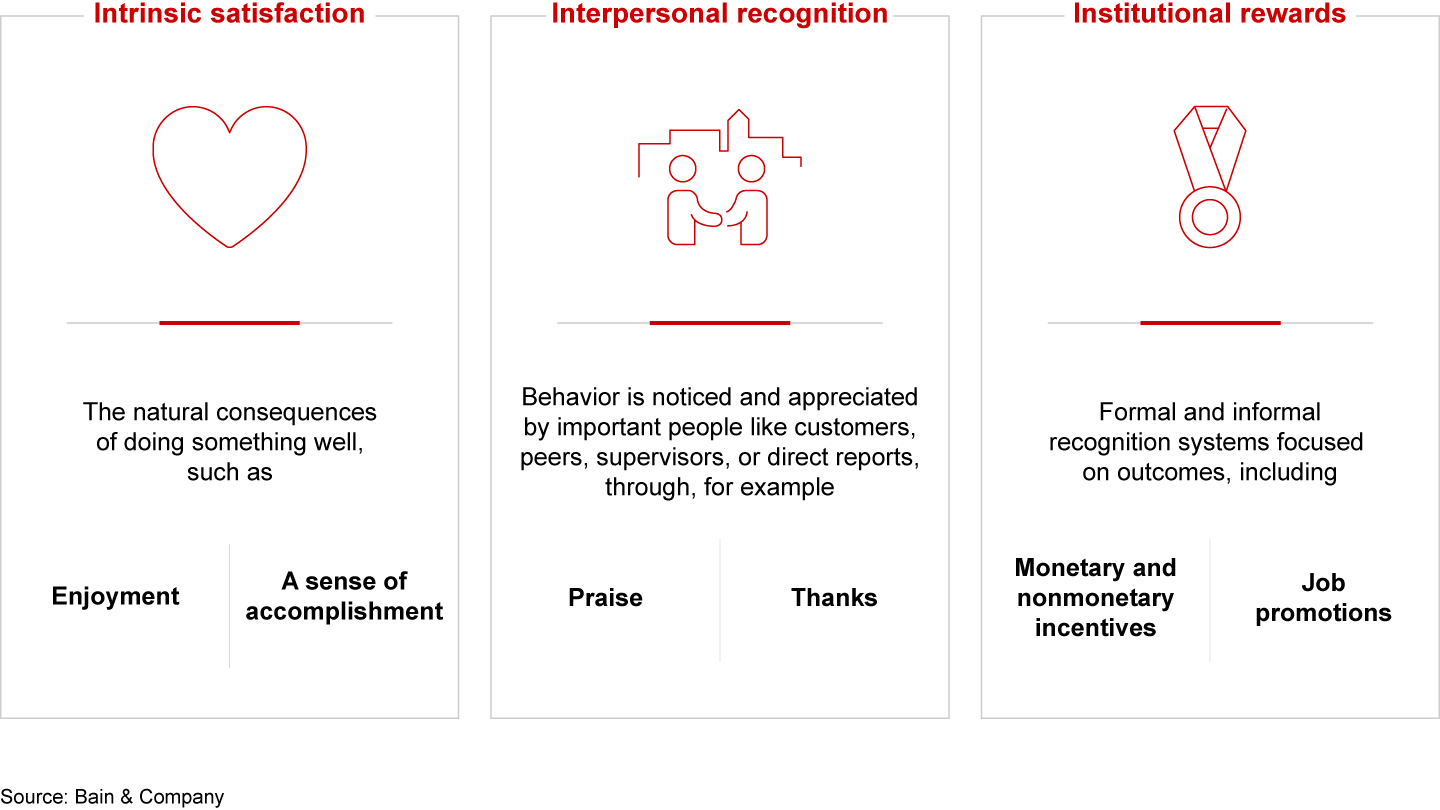
      New behavior can be reinforced in three ways

      By aligning reinforcers from all three categories, organizations give themselves the best chance of successfully supporting important new behaviors. An organization adopting an Agile operating model, for example, taps into all three. Intrinsic satisfaction is boosted because Agile links an individual’s work to important, larger organizational goals while breaking that work into smaller, achievable steps. Agile rituals tap into interpersonal reinforcement. The retro (from “retrospective”), for example, is an Agile practice of openly sharing feedback at the end of a sprint about what worked and what could have been done better. And in time, many Agile organizations end up rethinking their institutional rewards too, redesigning how they measure and compensate individual contributions in a way that keeps institutional friction from interfering with an Agile approach to work.

      Several years ago, a global consumer products company’s leaders discovered from a staff survey that their teams didn’t find them inspirational. This came as a surprise, and the leaders took the feedback seriously. Together they agreed on a half-dozen specific behaviors they’d cultivate in the hopes of empowering their teams and improving engagement. They then designed upward feedback loops to help assess progress, interpersonal reinforcers in which direct reports could comment anonymously on managers’ leadership behaviors. Quarterly surveys asked how trusting, respectful, and inspiring leaders were, and how frequently employees saw their leaders exhibit those behaviors. Acting on that feedback paid off: Employee engagement scores improved in the parts of the business where leaders made the most progress. These loops were one aspect of an overall behavior change approach that also included a number of nudges, capability building, and better communication.

      A steady stream of insights from the growing field of behavioral science is helping organizations learn new and useful approaches to behavior change challenges all the time. By learning from scholars, including those mentioned earlier, and by combining strategies, including nudges and reinforcers, organizations can effect robust behavior change, benefiting employees, customers, and the business overall.


      Net Promoter®, NPS®, NPS Prism®, and the NPS-related emoticons are registered trademarks, and Net Promoter Score℠, NPSx℠, and Net Promoter System℠ are service marks of Bain & Company, Inc., NICE Systems, Inc., and Fred Reichheld.

       
      Auteurs
      • Headshot of Tracy Thurkow
        Tracy Thurkow
        Partner, Atlanta
      • Adélaïde Hubert
        Practice Director, Paris
      Contactez-nous
      Expertises fonctionnelles transverses
      • Leadership & Talent
      • Organisation
      Blog Management du Changement
      AI Is Changing Work. Is Your Talent Strategy Evolving Too?

      The Archetype Effect asks why companies know so little about their employees—and offers a path to a more inspired workforce.

      Voir plus
      Blog Management du Changement
      M&A’s Leadership Moment

      Why the world’s most effective executives now treat dealmaking as a test of adaptability, not ambition.

      Voir plus
      Organisation
      Leading with Dynamism: AI and the Future of Top Teams

      In the age of AI, dynamic leadership—not just digital tools—is a true competitive advantage.

      Voir plus
      Blog Management du Changement
      In the Rush to Harness AI, Don’t Lose Sight of Your Corporate Purpose

      It’s time to worry a little less about gen AI and a little more about purpose.

      Voir plus
      Organisation
      The Great Talent Recalibration: How Macroeconomic Shifts Are Reshaping the CHRO Agenda

      Insights from Bain’s Chief People Officer Forum with economist Karen Harris, covering geopolitics, automation, demographic decline, and the future of global talent.

      Voir plus
      First published in janvier 2022
      Mots clés
      • Blog Management du Changement
      • Leadership & Talent
      • Organisation

      Comment nous avons aidé nos clients

      A Video Game Company Levels Up With a New Operating Model

      Lire l’étude de cas

      Building a winning media salesforce

      Lire l’étude de cas

      Powering a mining company's growth through cultural change

      Lire l’étude de cas

      Vous souhaitez continuer cette conversation ?

      Nous aidons des dirigeants du monde entier à matérialiser des impacts et des résultats pérennes et créateurs de valeur dans leurs organisations.

      Les points de vue de Bain : notre perspective sur des problématiques auxquelles sont confrontées les entreprises à travers le monde, envoyés chaque mois dans votre boîte de réception. 

      *J’ai lu la politique de confidentialité et j’accepte les conditions.

      Merci de lire notre politique de confidentialité.
      Bain & Company
      Contactez-nous Sustainability Accessibility Conditions d’utilisation Politique de Confidentialité Cookie Policy Mentions Légales Sitemap Log In

      © 1996-2026 Bain & Company, Inc.

      Contacter Bain

      Comment pouvons-nous vous aider ?

      • Business inquiry
      • Career information
      • Press relations
      • Partnership request
      • Speaker request
      Voir tous les bureaux