
Skip to Content
  • Bureaux

    Bureaux

    Amérique du Nord et Amérique du Sud
    • Atlanta
    • Austin
    • Bogota
    • Boston
    • Buenos Aires
    • Chicago
    • Dallas
    • Denver
    • Houston
    • Los Angeles
    • Mexico City
    • Minneapolis
    • Monterrey
    • Montreal
    • New York
    • Rio de Janeiro
    • San Francisco
    • Santiago
    • São Paulo
    • Seattle
    • Silicon Valley
    • Toronto
    • Washington, DC
    Europe, Moyen-Orient et Afrique
    • Amsterdam
    • Athens
    • Berlin
    • Brussels
    • Copenhagen
    • Doha
    • Dubai
    • Dusseldorf
    • Frankfurt
    • Helsinki
    • Istanbul
    • Johannesburg
    • Kyiv
    • Lisbon
    • London
    • Madrid
    • Milan
    • Munich
    • Oslo
    • Paris
    • Riyadh
    • Rome
    • Stockholm
    • Vienna
    • Warsaw
    • Zurich
    Asie et Australie
    • Bangkok
    • Beijing
    • Bengaluru
    • Brisbane
    • Ho Chi Minh City
    • Hong Kong
    • Jakarta
    • Kuala Lumpur
    • Manila
    • Melbourne
    • Mumbai
    • New Delhi
    • Perth
    • Shanghai
    • Singapore
    • Sydney
    • Tokyo
    Voir tous les bureaux
  • Alumni
  • Presse
  • S’abonner
  • Contacter
  • Canada | Français

    Sélectionnez votre région et votre langue

    Global
    • Global (English)
    Amérique du Nord et Amérique du Sud
    • Brazil (Português)
    • Argentina (Español)
    • Canada (Français)
    • Chile (Español)
    • Colombia (Español)
    Europe, Moyen-Orient et Afrique
    • France (Français)
    • DACH Region (Deutsch)
    • Italy (Italiano)
    • Spain (Español)
    • Greece (Elliniká)
    Asie et Australie
    • China (中文版)
    • Korea (한국어)
    • Japan (日本語)
  • Saved items (0)
    Saved items (0)

    You have no saved items.

    Bookmark content that interests you and it will be saved here for you to read or share later.

    Explore Bain Insights
  • Expertises Sectorielles
    Menu principal

    Expertises Sectorielles

    • Aerospace et Défense
    • Agroalimentaire
    • Chimie
    • Infrastructures, BTP et Matériaux de Construction
    • Grande Consommation
    • Services Financiers
    • Santé
    • Engins & Equipements Industriels
    • Media et Divertissement
    • Metals
    • Mining
    • Pétrole & Gaz
    • Papier et Emballage
    • Private Equity
    • Secteur Public
    • Distribution
    • Technologie
    • Télécommunications
    • Transportation
    • Travel & Leisure
    • Utilities & Energies Renouvelables
  • Expertises Fonctionnelles
    Menu principal

    Expertises Fonctionnelles

    • Expérience Client
    • ESG
    • Innovation
    • Fusions et Acquisitions
    • Opérations
    • People & Organization
    • Private Equity
    • Sales & Marketing
    • Stratégie
    • IA, Perspectives et Solutions
    • Technology
    • Transformation
  • Digital
  • Points de Vue
  • About
    Menu principal

    About

    • Notre Activité
    • Nos Valeurs
    • Nos Collaborateurs et Notre Équipe Dirigeante
    • Notre Impact
    • Prix & Récompenses
    • Partenariats Internationaux
    Further: Our global responsibility
    • Sustainability
    • Impact Social
    • World Economic Forum
    Learn more about Further
  • Carrières
    Menu principal

    Carrières

    • Rejoignez-nous
      Carrières
      Rejoignez-nous
      • Find Your Place
      • Nos domaines d’expertise
      • Equipes multidisciplinaires
      • Étudiants
      • Stages et programmes
      • Événements de recrutement
    • La vie chez Bain
      Carrières
      La vie chez Bain
      • Blog: Inside Bain
      • Récits de carrière
      • Nos collaborateurs
      • Nos bureaux
      • Soutenir votre évolution professionnelle
      • Groupes d’affinités
      • Avantages chez Bain
    • Histoires d’impact
    • Notre processus de recrutement
      Carrières
      Notre processus de recrutement
      • Ce que vous pouvez attendre
      • Entretiens
    Trouver un poste
  • Bureaux
    Menu principal

    Bureaux

    • Amérique du Nord et Amérique du Sud
      Bureaux
      Amérique du Nord et Amérique du Sud
      • Atlanta
      • Austin
      • Bogota
      • Boston
      • Buenos Aires
      • Chicago
      • Dallas
      • Denver
      • Houston
      • Los Angeles
      • Mexico City
      • Minneapolis
      • Monterrey
      • Montreal
      • New York
      • Rio de Janeiro
      • San Francisco
      • Santiago
      • São Paulo
      • Seattle
      • Silicon Valley
      • Toronto
      • Washington, DC
    • Europe, Moyen-Orient et Afrique
      Bureaux
      Europe, Moyen-Orient et Afrique
      • Amsterdam
      • Athens
      • Berlin
      • Brussels
      • Copenhagen
      • Doha
      • Dubai
      • Dusseldorf
      • Frankfurt
      • Helsinki
      • Istanbul
      • Johannesburg
      • Kyiv
      • Lisbon
      • London
      • Madrid
      • Milan
      • Munich
      • Oslo
      • Paris
      • Riyadh
      • Rome
      • Stockholm
      • Vienna
      • Warsaw
      • Zurich
    • Asie et Australie
      Bureaux
      Asie et Australie
      • Bangkok
      • Beijing
      • Bengaluru
      • Brisbane
      • Ho Chi Minh City
      • Hong Kong
      • Jakarta
      • Kuala Lumpur
      • Manila
      • Melbourne
      • Mumbai
      • New Delhi
      • Perth
      • Shanghai
      • Singapore
      • Sydney
      • Tokyo
    Voir tous les bureaux
  • Alumni
  • Presse
  • S’abonner
  • Contacter
  • Canada | Français
    Menu principal

    Sélectionnez votre région et votre langue

    • Global
      Sélectionnez votre région et votre langue
      Global
      • Global (English)
    • Amérique du Nord et Amérique du Sud
      Sélectionnez votre région et votre langue
      Amérique du Nord et Amérique du Sud
      • Brazil (Português)
      • Argentina (Español)
      • Canada (Français)
      • Chile (Español)
      • Colombia (Español)
    • Europe, Moyen-Orient et Afrique
      Sélectionnez votre région et votre langue
      Europe, Moyen-Orient et Afrique
      • France (Français)
      • DACH Region (Deutsch)
      • Italy (Italiano)
      • Spain (Español)
      • Greece (Elliniká)
    • Asie et Australie
      Sélectionnez votre région et votre langue
      Asie et Australie
      • China (中文版)
      • Korea (한국어)
      • Japan (日本語)
  • Saved items  (0)
    Menu principal
    Saved items (0)

    You have no saved items.

    Bookmark content that interests you and it will be saved here for you to read or share later.

    Explore Bain Insights
  • Expertises Sectorielles
    • Expertises Sectorielles

      • Aerospace et Défense
      • Agroalimentaire
      • Chimie
      • Infrastructures, BTP et Matériaux de Construction
      • Grande Consommation
      • Services Financiers
      • Santé
      • Engins & Equipements Industriels
      • Media et Divertissement
      • Metals
      • Mining
      • Pétrole & Gaz
      • Papier et Emballage
      • Private Equity
      • Secteur Public
      • Distribution
      • Technologie
      • Télécommunications
      • Transportation
      • Travel & Leisure
      • Utilities & Energies Renouvelables
  • Expertises Fonctionnelles
    • Expertises Fonctionnelles

      • Expérience Client
      • ESG
      • Innovation
      • Fusions et Acquisitions
      • Opérations
      • People & Organization
      • Private Equity
      • Sales & Marketing
      • Stratégie
      • IA, Perspectives et Solutions
      • Technology
      • Transformation
  • Digital
  • Points de Vue
  • Carrières
    Recherches les plus fréquentes
    • Agile
    • Digital
    • Stratégie
    Vos recherches précédentes
      Pages récemment visitées

      Content added to saved items

      Saved items (0)

      Removed from saved items

      Saved items (0)

      World Economic Forum

      Why Technology is Key to Decarbonizing the Middle East and North Africa

      Why Technology is Key to Decarbonizing the Middle East and North Africa

      Technology-based solutions can unlock the pathway for MENA region to decarbonize via the region’s natural resources and climatic conditions.

      Par Kelsey Goodman, Dharmendra Hiranandani, Akram Alami, Raja Atoui, et Maroun Kairouz

      • min
      }

      Article

      Why Technology is Key to Decarbonizing the Middle East and North Africa
      en
      At a Glance
      • The optimal pathway for decarbonization varies between countries based on the cost of abatement measures and the available natural resources.
      • In the Middle East and North Africa (MENA), decarbonization focuses on technology-based solutions, driven by economics and the limited availability of nature-based pathways.
      • Many technology-based solutions, such as carbon capture and storage and green hydrogen, however, are not mature enough or are too expensive to scale, emphasizing the need to maximize existing avoidance strategies to cut emissions.
      • MENA’s climate also has remarkable potential for renewable and emerging energy sources, which could help MENA and other regions advance their decarbonization journeys.

      This article originally appeared in the World Economic Forum.

      The world is facing an energy trilemma of access, cost, and emissions. As we drive toward a decarbonized future, we are also witnessing more frequent blackouts and fuel-price spikes from global supply chain disruptions and extreme weather events. Geopolitical tensions exposed the fragility of global energy systems—and the importance of a consistent and affordable supply of energy as we move toward net zero.

      The MENA region sits at the fulcrum of this trilemma. As a reliable source of global energy for decades, the region’s oil is among the cheapest to produce and the least polluting globally. On average, each barrel produced in the Gulf Cooperation Council (GCC) countries of MENA produces 40 kilograms of carbon dioxide, compared to a global average of 60 kilograms of carbon dioxide per barrel. Countries in the MENA region produce about one-third of the global oil supply and will continue to play a pivotal role in the global energy mix. At the same time, they must demonstrate results on the decarbonization commitments they made in their Nationally Determined Contributions and net-zero pledges.

      How can MENA’s countries rapidly cut emissions and ensure the world’s energy needs?

      By thinking locally

      Every country seeks to reduce their emissions. The optimal pathway for decarbonization is different for each country, however. This is dependent on local environmental factors that determine the reduction potential and abatement costs. Each region should tailor its decarbonization strategies accordingly.

      To illustrate the impact of regional differences, we compared the abatement cost and abatement potentials of decarbonization pathways for two archetypal countries: one in the Gulf Cooperation Council (GCC) and one from North America/Europe. We chose archetypes with comparable energy exports, similar gross emissions, and a significant share of global oil production. More importantly, they have vastly different climates, topographies, and natural resources, which resulted in different choices for decarbonization.

      We compared abatement costs and resource availability across two broad pathways: technology-based solutions and nature-based solutions. Both contain emissions avoidance and emissions removal strategies.

      1. Technology-based solutions include:
      • Emissions-avoiding technologies that reduce emissions intensity, including measures that reduce energy consumption, renewables that replace the primary source of energy, and carbon capture that reduces emissions from point sources; and
      • Emissions-removing technologies known as direct air capture techniques that capture and remove carbon dioxide from the atmosphere.
      1. Nature-based solutions include afforestation and forest and vegetation management initiatives that create “carbon sinks” and draw carbon dioxide out of the atmosphere and into plant life. Within nature-based solutions, we will see:
      • Emissions avoidance protects existing ecosystems from further destruction; and
      • Emission removal involves fresh afforestation efforts (or developing new ecosystems) to incrementally remove carbon dioxide from the atmosphere.
      Figure 1
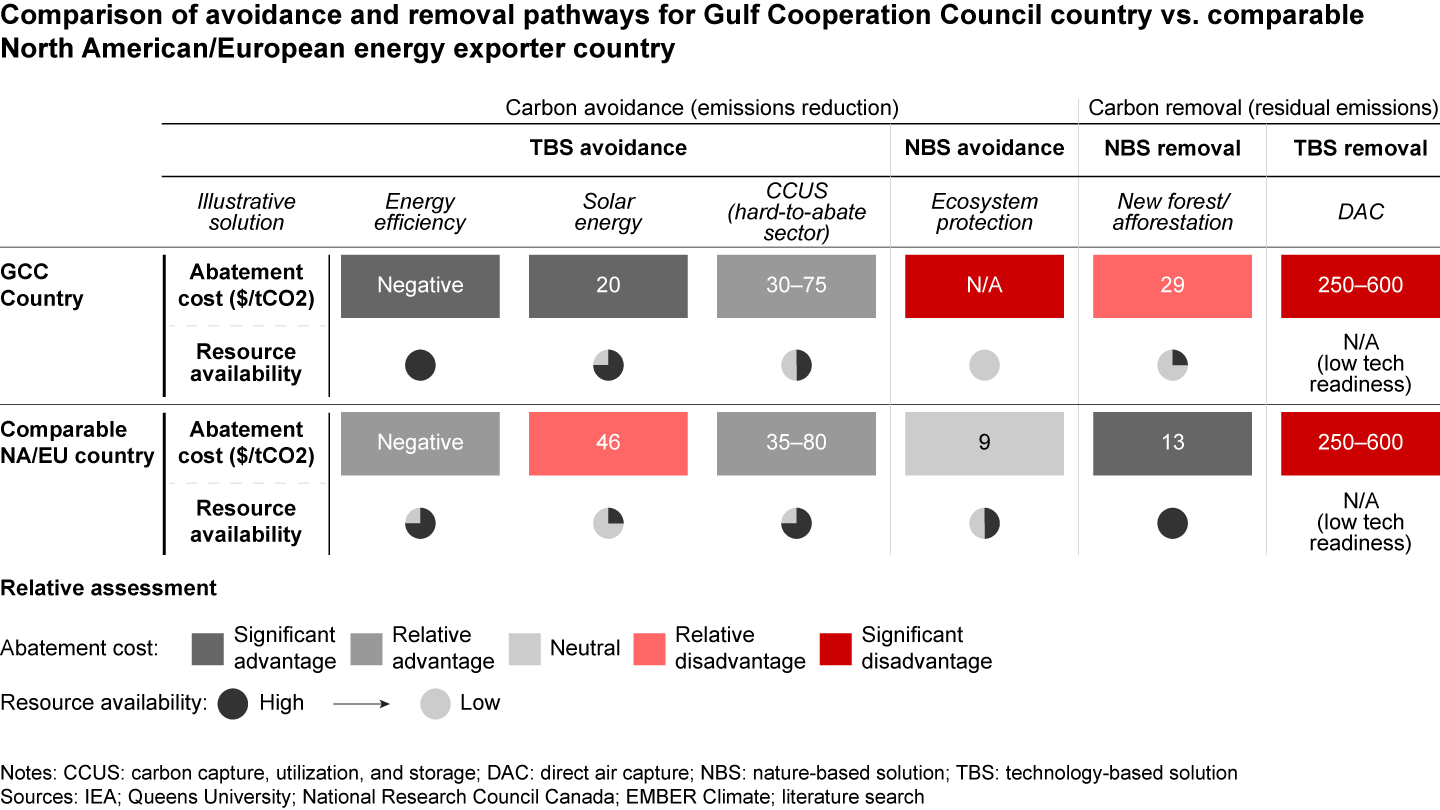
      Choice of optimal pathway will differ for regions based on abatement cost and resource availability

      This exercise demonstrated how regional differences affect the direction, cost, and scale of emissions abatement. We learned that:

      • Regions with natural carbon sinks and abundant vegetation have cost-effective, nature-based options to remove residual emissions.
      • Technology-based avoidance solutions are better choices for regions such as MENA that lack natural carbon sinks. Removal strategies such as direct air capture are cost-prohibitive.
      • Companies in the GCC and the MENA region must prioritize emissions avoidance and minimize emissions across their value chains because removal strategies are more expensive.

      Lifetime abatement potential per unit of investment

      The operational life, capital expenditure, and operational expenditure of each pathway vary, too. We measured the lifetime abatement potential per unit of investment for each strategy to determine how companies can get the biggest “bang for their buck” and identify optimal pathways to net zero.


      Figure 2
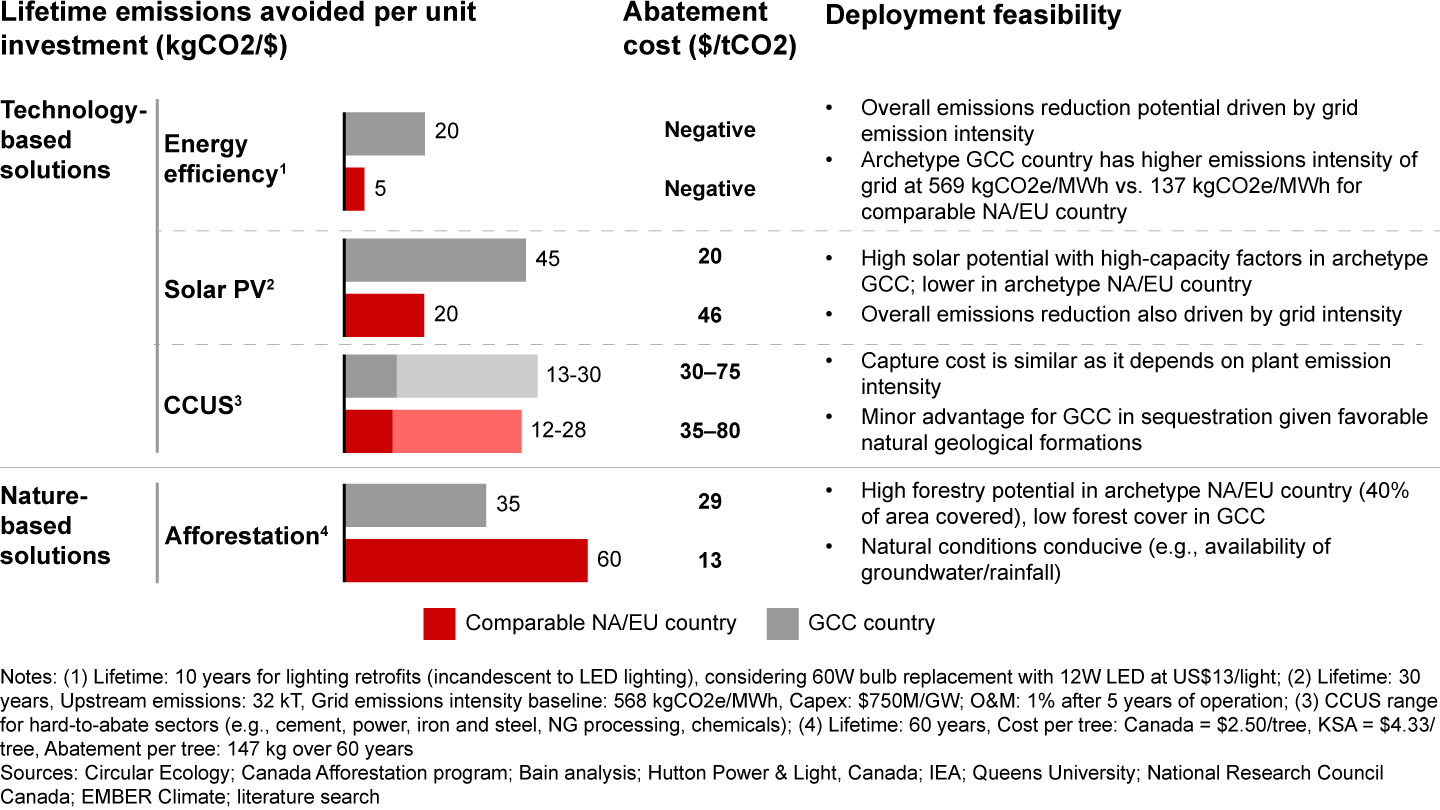
      The lifetime abatement potential—when normalized for investment—varies by region

      Our analysis revealed a wide variation in lifetime abatement potential across the two archetypes:

      • Afforestation and other nature-based solutions are relatively more attractive for the North American/European energy producer archetype. There, each dollar of investment would result in a 70% higher lifetime abatement potential.
      • In the MENA archetype, each unit of investment in solar energy would reduce emissions by twice as much as it would in a comparable North American/ European country.

      A MENA route to abatement

      Based on this analysis, the optimal pathway to emissions reduction in MENA will differ from other regions. Its natural resources and climatic conditions require MENA countries to focus more on technology-based solutions.

      Emissions reduction is likely to cost significantly more in MENA than in other regions. For example, the optimal decarbonization pathway for the North American/European country was afforestation, which has a 33% higher abatement potential per unit of investment than the optimal pathway in MENA (solar). However, in this journey toward TbS-led decarbonization, there is an inherent need to contextualize global emissions measurements, reporting, and verification (MRV) guidelines and net-zero frameworks to be applied locally to the MENA ecosystem. This must be done in the context of regional optimal pathways and socio-economic development journeys.

      Multiple technology pathways must be pursued simultaneously to drive decarbonization in the MENA region. MENA businesses should pursue five key actions for decarbonization:

      1. Prioritize energy efficiency measures to reduce domestic energy use among households and industries.
      2. Deploy renewable energy at scale to decarbonize the energy mix.
      3. Invest in breakthrough technologies such as green hydrogen and carbon capture that can dramatically decrease emissions in the future.
      4. Scale up direct air capture techniques to remove emissions that cannot be avoided.
      5. Cultivate nature-based solutions where possible in the region (e.g., mangrove forests can act as carbon sinks in arid desert conditions).

      There are signs that the MENA region is taking up the challenge. The Gulf states already account for 10% of carbon captured worldwide, with more investment planned, and various companies are investing in renewables across MENA. As the region prepares to host its second consecutive United Nations Climate Change Conference (COP) summit in the United Arab Emirates this year, there is growing awareness that significantly more investment needs to flow into technology-based solutions for MENA to reach its net zero targets.

      Leaders for a Sustainable MENA, a World Economic Forum community of policymakers, businesses, and investors dedicated to accelerating climate action in the region, has identified the need to contextualize reporting standards and decarbonization frameworks for the MENA region. To drive a meaningful sustainability agenda in the region, leaders must align on a shared roadmap of best practices that can mobilize all segments of society towards a climate-resilient future for the region.

      Auteurs
      • Kelsey Goodman
        Community Lead, Regional and Geopolitical Affairs MENA, World Economic Forum LLC
      • Headshot of Dharmendra Hiranandani
        Dharmendra Hiranandani
        Alumni, Dubai
      • Headshot of Akram Alami
        Akram Alami
        Partner, Middle East
      • Headshot of Raja Atoui
        Raja Atoui
        Partner, Middle East
      • Maroun Kairouz
        Head of the Middle East and North Africa, World Economic Forum
      Contactez-nous
      Expertises fonctionnelles transverses
      • Développement Durable et Responsabilité Sociétale des Entreprises (RSE)
      Comment pouvons-nous vous aider ?
      • Climate Change
      Climate Change
      Financing Climate Solutions in Brazil

      A study conducted by Bain, in partnership with BNDES, highlights both the challenges and the opportunities to accelerate the climate transition.

      Voir plus
      Développement Durable et Responsabilité Sociétale des Entreprises (RSE)
      How AI Is Starting to Transform Circular Packaging

      There are 15 AI use cases companies across the value chain can use today to accelerate circularity.

      Voir plus
      Climate Change
      COP30: What Businesses Need to Do Now

      At this year’s COP30 in Brazil, the message for businesses was clear: Climate strategy can’t just be commitments—it must be about execution.

      Voir plus
      Développement Durable et Responsabilité Sociétale des Entreprises (RSE)
      Exploring AI for Packaging Circularity

      AI is already creating value across the packaging lifecycle, from optimising design and reducing material use to improving sorting and traceability.

      Voir plus
      Climate Change
      Inside the 2025 Visionary CEO's Guide to Sustainability

      Bain experts discuss insights from our latest sustainability guide and how leaders can meet the moment with pragmatism.

      Voir plus
      First published in mai 2023
      Mots clés
      • Climate Change
      • Développement Durable et Responsabilité Sociétale des Entreprises (RSE)

      Comment nous avons aidé nos clients

      Voluntary Carbon Markets: A Bank Moves Early to Seize the Opportunity

      Lire l’étude de cas

      A Manufacturer Vows to “Push to Zero” Carbon Emissions

      Lire l’étude de cas

      A Powerful Carbon Accounting Platform Helps IndustrialCo Optimize Its ESG Strategy

      Lire l’étude de cas

      Vous souhaitez continuer cette conversation ?

      Nous aidons des dirigeants du monde entier à matérialiser des impacts et des résultats pérennes et créateurs de valeur dans leurs organisations.

      Les points de vue de Bain : notre perspective sur des problématiques auxquelles sont confrontées les entreprises à travers le monde, envoyés chaque mois dans votre boîte de réception. 

      *J’ai lu la politique de confidentialité et j’accepte les conditions.

      Merci de lire notre politique de confidentialité.
      Bain & Company
      Contactez-nous Sustainability Accessibility Conditions d’utilisation Politique de Confidentialité Cookie Policy Mentions Légales Sitemap Log In

      © 1996-2026 Bain & Company, Inc.

      Contacter Bain

      Comment pouvons-nous vous aider ?

      • Business inquiry
      • Career information
      • Press relations
      • Partnership request
      • Speaker request
      Voir tous les bureaux