
Skip to Content
  • Bureaux

    Bureaux

    Amérique du Nord et Amérique du Sud
    • Atlanta
    • Austin
    • Bogota
    • Boston
    • Buenos Aires
    • Chicago
    • Dallas
    • Denver
    • Houston
    • Los Angeles
    • Mexico City
    • Minneapolis
    • Monterrey
    • Montreal
    • New York
    • Rio de Janeiro
    • San Francisco
    • Santiago
    • São Paulo
    • Seattle
    • Silicon Valley
    • Toronto
    • Washington, DC
    Europe, Moyen-Orient et Afrique
    • Amsterdam
    • Athens
    • Berlin
    • Brussels
    • Copenhagen
    • Doha
    • Dubai
    • Dusseldorf
    • Frankfurt
    • Helsinki
    • Istanbul
    • Johannesburg
    • Kyiv
    • Lisbon
    • London
    • Madrid
    • Milan
    • Munich
    • Oslo
    • Paris
    • Riyadh
    • Rome
    • Stockholm
    • Vienna
    • Warsaw
    • Zurich
    Asie et Australie
    • Bangkok
    • Beijing
    • Bengaluru
    • Brisbane
    • Ho Chi Minh City
    • Hong Kong
    • Jakarta
    • Kuala Lumpur
    • Manila
    • Melbourne
    • Mumbai
    • New Delhi
    • Perth
    • Shanghai
    • Singapore
    • Sydney
    • Tokyo
    Voir tous les bureaux
  • Alumni
  • Presse
  • S’abonner
  • Contacter
  • Canada | Français

    Sélectionnez votre région et votre langue

    Global
    • Global (English)
    Amérique du Nord et Amérique du Sud
    • Brazil (Português)
    • Argentina (Español)
    • Canada (Français)
    • Chile (Español)
    • Colombia (Español)
    Europe, Moyen-Orient et Afrique
    • France (Français)
    • DACH Region (Deutsch)
    • Italy (Italiano)
    • Spain (Español)
    • Greece (Elliniká)
    Asie et Australie
    • China (中文版)
    • Korea (한국어)
    • Japan (日本語)
  • Saved items (0)
    Saved items (0)

    You have no saved items.

    Bookmark content that interests you and it will be saved here for you to read or share later.

    Explore Bain Insights
  • Expertises Sectorielles
    Menu principal

    Expertises Sectorielles

    • Aerospace et Défense
    • Agroalimentaire
    • Chimie
    • Infrastructures, BTP et Matériaux de Construction
    • Grande Consommation
    • Services Financiers
    • Santé
    • Engins & Equipements Industriels
    • Media et Divertissement
    • Metals
    • Mining
    • Pétrole & Gaz
    • Papier et Emballage
    • Private Equity
    • Secteur Public
    • Distribution
    • Technologie
    • Télécommunications
    • Transportation
    • Travel & Leisure
    • Utilities & Energies Renouvelables
  • Expertises Fonctionnelles
    Menu principal

    Expertises Fonctionnelles

    • Expérience Client
    • ESG
    • Innovation
    • Fusions et Acquisitions
    • Opérations
    • People & Organization
    • Private Equity
    • Sales & Marketing
    • Stratégie
    • IA, Perspectives et Solutions
    • Technology
    • Transformation
  • Digital
  • Points de Vue
  • About
    Menu principal

    About

    • Notre Activité
    • Nos Valeurs
    • Nos Collaborateurs et Notre Équipe Dirigeante
    • Notre Impact
    • Prix & Récompenses
    • Partenariats Internationaux
    Further: Our global responsibility
    • Sustainability
    • Impact Social
    • World Economic Forum
    Learn more about Further
  • Carrières
    Menu principal

    Carrières

    • Rejoignez-nous
      Carrières
      Rejoignez-nous
      • Find Your Place
      • Nos domaines d’expertise
      • Equipes multidisciplinaires
      • Étudiants
      • Stages et programmes
      • Événements de recrutement
    • La vie chez Bain
      Carrières
      La vie chez Bain
      • Blog: Inside Bain
      • Récits de carrière
      • Nos collaborateurs
      • Nos bureaux
      • Soutenir votre évolution professionnelle
      • Groupes d’affinités
      • Avantages chez Bain
    • Histoires d’impact
    • Notre processus de recrutement
      Carrières
      Notre processus de recrutement
      • Ce que vous pouvez attendre
      • Entretiens
    Trouver un poste
  • Bureaux
    Menu principal

    Bureaux

    • Amérique du Nord et Amérique du Sud
      Bureaux
      Amérique du Nord et Amérique du Sud
      • Atlanta
      • Austin
      • Bogota
      • Boston
      • Buenos Aires
      • Chicago
      • Dallas
      • Denver
      • Houston
      • Los Angeles
      • Mexico City
      • Minneapolis
      • Monterrey
      • Montreal
      • New York
      • Rio de Janeiro
      • San Francisco
      • Santiago
      • São Paulo
      • Seattle
      • Silicon Valley
      • Toronto
      • Washington, DC
    • Europe, Moyen-Orient et Afrique
      Bureaux
      Europe, Moyen-Orient et Afrique
      • Amsterdam
      • Athens
      • Berlin
      • Brussels
      • Copenhagen
      • Doha
      • Dubai
      • Dusseldorf
      • Frankfurt
      • Helsinki
      • Istanbul
      • Johannesburg
      • Kyiv
      • Lisbon
      • London
      • Madrid
      • Milan
      • Munich
      • Oslo
      • Paris
      • Riyadh
      • Rome
      • Stockholm
      • Vienna
      • Warsaw
      • Zurich
    • Asie et Australie
      Bureaux
      Asie et Australie
      • Bangkok
      • Beijing
      • Bengaluru
      • Brisbane
      • Ho Chi Minh City
      • Hong Kong
      • Jakarta
      • Kuala Lumpur
      • Manila
      • Melbourne
      • Mumbai
      • New Delhi
      • Perth
      • Shanghai
      • Singapore
      • Sydney
      • Tokyo
    Voir tous les bureaux
  • Alumni
  • Presse
  • S’abonner
  • Contacter
  • Canada | Français
    Menu principal

    Sélectionnez votre région et votre langue

    • Global
      Sélectionnez votre région et votre langue
      Global
      • Global (English)
    • Amérique du Nord et Amérique du Sud
      Sélectionnez votre région et votre langue
      Amérique du Nord et Amérique du Sud
      • Brazil (Português)
      • Argentina (Español)
      • Canada (Français)
      • Chile (Español)
      • Colombia (Español)
    • Europe, Moyen-Orient et Afrique
      Sélectionnez votre région et votre langue
      Europe, Moyen-Orient et Afrique
      • France (Français)
      • DACH Region (Deutsch)
      • Italy (Italiano)
      • Spain (Español)
      • Greece (Elliniká)
    • Asie et Australie
      Sélectionnez votre région et votre langue
      Asie et Australie
      • China (中文版)
      • Korea (한국어)
      • Japan (日本語)
  • Saved items  (0)
    Menu principal
    Saved items (0)

    You have no saved items.

    Bookmark content that interests you and it will be saved here for you to read or share later.

    Explore Bain Insights
  • Expertises Sectorielles
    • Expertises Sectorielles

      • Aerospace et Défense
      • Agroalimentaire
      • Chimie
      • Infrastructures, BTP et Matériaux de Construction
      • Grande Consommation
      • Services Financiers
      • Santé
      • Engins & Equipements Industriels
      • Media et Divertissement
      • Metals
      • Mining
      • Pétrole & Gaz
      • Papier et Emballage
      • Private Equity
      • Secteur Public
      • Distribution
      • Technologie
      • Télécommunications
      • Transportation
      • Travel & Leisure
      • Utilities & Energies Renouvelables
  • Expertises Fonctionnelles
    • Expertises Fonctionnelles

      • Expérience Client
      • ESG
      • Innovation
      • Fusions et Acquisitions
      • Opérations
      • People & Organization
      • Private Equity
      • Sales & Marketing
      • Stratégie
      • IA, Perspectives et Solutions
      • Technology
      • Transformation
  • Digital
  • Points de Vue
  • Carrières
    Recherches les plus fréquentes
    • Agile
    • Digital
    • Stratégie
    Vos recherches précédentes
      Pages récemment visitées

      Content added to saved items

      Saved items (0)

      Removed from saved items

      Saved items (0)

      Etude

      Winning in the New Normal of Government Services

      Winning in the New Normal of Government Services

      Learn to balance scope, speed and rate to grow in a challenging environment.

      Par Mike Goldberg, Jim Harris and Dan Schwartz

      • min
      }

      Etude

      Winning in the New Normal of Government Services
      en

      Even battle-hardened veterans of government services are unsettled by the challenges they face in the industry today. Gone are the days of rapidly growing federal budgets when a rising tide lifted all contractors. Spending on government services is down more than 25% from its peak and we do not expect much relief for contractors, particularly in non-defense agencies. Price continues to be the No. 1 bid criterion in most competitions. Yet customer needs remain as complex and diverse as ever. Add to this a shifting competitive landscape—with mergers, acquisitions and divestitures by many players as well as disruption by new commercial competitors—and it is no wonder that so many executives are struggling to find their footing.

      To maintain revenue and profits in this environment, contractors have reacted aggressively—but often in ways that do not serve their long-term interests. They have lowballed bids and sacrificed margins to win on cost. They have skimped on the investment needed to build and sustain distinctive capabilities. They have chased all sorts of deals, spreading themselves too thin and depressing returns on business development investment. Even as they pursued these questionable approaches, several long-time incumbents lost franchise programs to competitors. To compensate for revenue and margin hits, some companies have tried M&A, adding new businesses far from their core capabilities or paying unjustifiable premiums for them.

      These moves buy some short-term growth. But they do not add up to a strategy for long-term success. For that, companies need to go back to the basics and determine how to deliver the right capabilities at the lowest total cost.

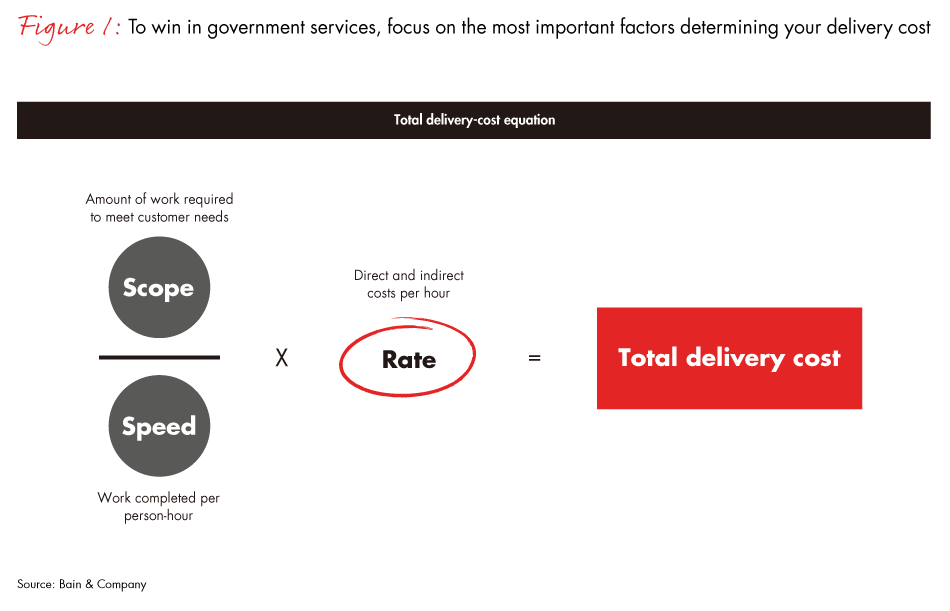
      Contractors that emerge as winners from this period of turbulence will be those that find ways to think and act strategically about cost and customer value. These companies will leverage all three factors in the delivery-cost equation—scope, speed and rate—to succeed more and improve margins (see Figure 1). Scope defines the amount of work required to meet customer needs. Companies win on scope by developing differentiated knowledge of customer needs so they deliver precisely what is required and avoid unnecessary work that adds cost. Speed is the amount of work done per “person-hour” (productivity), which can be optimized with investments in tools, repeatable approaches and off-the-shelf solutions. Rate refers to both direct and indirect labor costs, which companies have far more control over than they typically realize.

      new-normal-of-government-services-fig01_embed

      Getting this equation right presents a challenge for all government services firms and requires trade-offs; no company will be a top performer on all three dimensions. Several government services companies have made a strategic decision to emphasize scope as a way to win while cutting delivery costs too. They realize that not all revenue is created equal, and they’re making very careful decisions about where and when to play. For example, they don’t waste money on long-shot business development efforts, but concentrate on work where they know they can win and deliver efficiently. They go after deals where they have distinctive customer knowledge and walk away from ones where they don’t. One contractor has steered clear of large-scale Department of Defense programs because leadership recognizes that, despite the high revenue potential, such deals divert attention from core intelligence agency customers, for which the firm is sure to deliver profitably. Another company focuses primarily on fraud and claim-management programs for the Department of Health & Human Services and the Social Security Administration. It wins such bids because it knows these missions extremely well and can design cost-effective solutions that are tailored tightly to what those customers need.

      Speed is the source of strategic advantage—and lower cost—for many companies. The basic approach is simply to codify best practices. But contractors that outperform on this dimension go much further. They invest in software tools and new capabilities that make processes repeatable, rapid and inexpensive. For example, one contractor has developed a robust software tool that allows the company to complete “should-cost” analysis in a fraction of the time that it takes competitors. Other companies are investing in in-house software development capabilities so they can build basic solutions for case management, resource planning, performance tracking and other common applications that can then be modified and used with many different customers.

      Another speed strategy is to “leverage the balance sheet” by investing capital in assets that can be shared across customers. Legacy commercial IT providers lead the way here, offering their government customers shared data and call centers as well as network operations facilities—taking hours and costs out of delivering IT infrastructure projects. Finally, companies have begun redirecting some of their high-end data science and advanced analytics capabilities internally to find ways to improve efficiency.

      Even the approach to labor rates—the third factor in the equation—can be far more strategic. A common trap for government contractors is to place too much emphasis on cutting indirect costs, such as support functions and investments in business development. The assumption seems to be that direct labor costs are more or less fixed. That leaves a lot of money on the table. If companies think strategically about how they deploy top talent, they can reduce labor costs without jeopardizing revenue. For example, they can often shift projects from highly paid resources to lower-cost or less experienced workers as soon as the start-up phase is over. Companies can also think more strategically about the work they do directly vs. the work they can subcontract. By striking the right balance, companies can maintain differentiation while reducing overall delivery cost.

      Dan Schwartz, a partner in Bain's Aerospace, Defense and Government Services practice, outlines three ways that companies can approach their strategy in order to achieve long-term success.

      Regardless of how a company chooses to trade off the three dimensions of scope, speed and rate, for a contractor to be successful long term, it must also do three things:

      • Be clear. An important first step is understanding where the company will differentiate on the total delivery-cost equation. However, to execute that strategy, the company must also be able to clearly articulate why it’s the right strategy, how the company plans to execute it and what specific actions it will take. Top leaders can raise the odds that all stakeholders—board members, investors and employees—will follow them along a new strategic path if they make sure everyone knows where that path leads.
      • Be bold. Driving a differentiated strategy takes more than minor one-off investments or small initiatives at the margin. Companies need to think about all the levers at their disposal to drive the strategy— including M&A and major capital investments. Companies may need to accept short-term hits to profitability as they reinvest operating dollars in new solutions. Some players may need to walk away from long-term programs or relationships that don’t align with the new strategic approach.
      • Be disciplined. Moving a company aggressively in a new strategic direction is not for the faint of heart. Many forces can pull companies off their strategic paths—opportunistic M&A, for example. Companies that want to succeed for the long haul will need to get comfortable saying no in the short term to drive differentiation, stronger profits and growth.

      In today’s environment, competing on the total delivery cost is not optional. However, that does not mean contractors are locked into a rate-based race to the bottom. By viewing the total delivery-cost equation strategically and picking the right spots to differentiate with speed, scope and rate, top companies will uncover opportunities to deliver better value to their customers and larger profits to their shareholders.

      Mike Goldberg leads the Aerospace, Defense and Government Services practice and is a partner in Los Angeles. Jim Harris and Dan Schwartz, based in Washington, are also partners in the Aerospace, Defense and Government Services practice.


      new-normal-of-government-services-fig01_full
      Auteurs
      • Headshot of Michael Goldberg
        Michael Goldberg
        Advisory Partner, Los Angeles
      • Headshot of Jim Harris
        Jim Harris
        Partner, Washington, DC
      • Headshot of Dan Schwartz
        Dan Schwartz
        Alumni, Washington, DC
      Contactez-nous
      Synergies sectorielles
      • Aerospace et Défense
      • Produits et Services Industriels de pointe
      Logistique et Transports
      It's time for tough choices

      It's time for governments to make tough decisions about where to cut the budget.

      Voir plus
      Logistique et Transports
      Rethink familiar business models

      A new strategy for defense companies seeking to create shareholder value: business model innovation.

      Voir plus
      Produits et Services Industriels de pointe
      Defense M&A

      Bold moves will determine the winners as a continent rearms.

      Voir plus
      Produits et Services Industriels de pointe
      Improving Program Performance in Aerospace and Defense

      At MRO Europe, Bain Parners Katherine Kajzer-Hughes and Massimo Sabella discuss how outcome-driven reform is essential to success.

      Voir plus
      Produits et Services Industriels de pointe
      Defense Investment at a Turning Point

      Private investment in new entrants is up sharply, but large shifts in market share will take years, given long investment and development cycles.

      Voir plus
      First published in avril 2017
      Mots clés
      • Aerospace et Défense
      • Produits et Services Industriels de pointe

      Comment nous avons aidé nos clients

      An Aerospace Leader Bounces Back with a Three-Part Transformation

      Lire l’étude de cas

      A Defense Company Surmounts Industry Challenges with Cost Management

      Lire l’étude de cas

      Airline grounds planes to rise above financial cloud

      Lire l’étude de cas

      Vous souhaitez continuer cette conversation ?

      Nous aidons des dirigeants du monde entier à matérialiser des impacts et des résultats pérennes et créateurs de valeur dans leurs organisations.

      Selected for you

      Global Private Equity Report 2026

      Powering forward in a new era: Our annual report examines key trends shaping the dealmaking landscape.

      For you

      Les points de vue de Bain : notre perspective sur des problématiques auxquelles sont confrontées les entreprises à travers le monde, envoyés chaque mois dans votre boîte de réception. 

      *J’ai lu la politique de confidentialité et j’accepte les conditions.

      Merci de lire notre politique de confidentialité.
      Bain & Company
      Contactez-nous Sustainability Accessibility Conditions d’utilisation Politique de Confidentialité Cookie Policy Mentions Légales Sitemap Log In

      © 1996-2026 Bain & Company, Inc.

      Contacter Bain

      Comment pouvons-nous vous aider ?

      • Business inquiry
      • Career information
      • Press relations
      • Partnership request
      • Speaker request
      Voir tous les bureaux