
Skip to Content
  • Bureaux

    Bureaux

    Amérique du Nord et Amérique du Sud
    • Atlanta
    • Austin
    • Bogota
    • Boston
    • Buenos Aires
    • Chicago
    • Dallas
    • Denver
    • Houston
    • Los Angeles
    • Mexico City
    • Minneapolis
    • Monterrey
    • Montreal
    • New York
    • Rio de Janeiro
    • San Francisco
    • Santiago
    • São Paulo
    • Seattle
    • Silicon Valley
    • Toronto
    • Washington, DC
    Europe, Moyen-Orient et Afrique
    • Amsterdam
    • Athens
    • Berlin
    • Brussels
    • Copenhagen
    • Doha
    • Dubai
    • Dusseldorf
    • Frankfurt
    • Helsinki
    • Istanbul
    • Johannesburg
    • Kyiv
    • Lisbon
    • London
    • Madrid
    • Milan
    • Munich
    • Oslo
    • Paris
    • Riyadh
    • Rome
    • Stockholm
    • Vienna
    • Warsaw
    • Zurich
    Asie et Australie
    • Bangkok
    • Beijing
    • Bengaluru
    • Brisbane
    • Ho Chi Minh City
    • Hong Kong
    • Jakarta
    • Kuala Lumpur
    • Manila
    • Melbourne
    • Mumbai
    • New Delhi
    • Perth
    • Shanghai
    • Singapore
    • Sydney
    • Tokyo
    Voir tous les bureaux
  • Alumni
  • Presse
  • S’abonner
  • Contacter
  • Canada | Français

    Sélectionnez votre région et votre langue

    Global
    • Global (English)
    Amérique du Nord et Amérique du Sud
    • Brazil (Português)
    • Argentina (Español)
    • Canada (Français)
    • Chile (Español)
    • Colombia (Español)
    Europe, Moyen-Orient et Afrique
    • France (Français)
    • DACH Region (Deutsch)
    • Italy (Italiano)
    • Spain (Español)
    • Greece (Elliniká)
    Asie et Australie
    • China (中文版)
    • Korea (한국어)
    • Japan (日本語)
  • Saved items (0)
    Saved items (0)

    You have no saved items.

    Bookmark content that interests you and it will be saved here for you to read or share later.

    Explore Bain Insights
  • Expertises Sectorielles
    Menu principal

    Expertises Sectorielles

    • Aerospace et Défense
    • Agroalimentaire
    • Chimie
    • Infrastructures, BTP et Matériaux de Construction
    • Grande Consommation
    • Services Financiers
    • Santé
    • Engins & Equipements Industriels
    • Media et Divertissement
    • Metals
    • Mining
    • Pétrole & Gaz
    • Papier et Emballage
    • Private Equity
    • Secteur Public
    • Distribution
    • Technologie
    • Télécommunications
    • Transportation
    • Travel & Leisure
    • Utilities & Energies Renouvelables
  • Expertises Fonctionnelles
    Menu principal

    Expertises Fonctionnelles

    • Expérience Client
    • ESG
    • Innovation
    • Fusions et Acquisitions
    • Opérations
    • People & Organization
    • Private Equity
    • Sales & Marketing
    • Stratégie
    • IA, Perspectives et Solutions
    • Technology
    • Transformation
  • Digital
  • Points de Vue
  • About
    Menu principal

    About

    • Notre Activité
    • Nos Valeurs
    • Nos Collaborateurs et Notre Équipe Dirigeante
    • Notre Impact
    • Prix & Récompenses
    • Partenariats Internationaux
    Further: Our global responsibility
    • Sustainability
    • Impact Social
    • World Economic Forum
    Learn more about Further
  • Carrières
    Menu principal

    Carrières

    • Rejoignez-nous
      Carrières
      Rejoignez-nous
      • Find Your Place
      • Nos domaines d’expertise
      • Equipes multidisciplinaires
      • Étudiants
      • Stages et programmes
      • Événements de recrutement
    • La vie chez Bain
      Carrières
      La vie chez Bain
      • Blog: Inside Bain
      • Récits de carrière
      • Nos collaborateurs
      • Nos bureaux
      • Soutenir votre évolution professionnelle
      • Groupes d’affinités
      • Avantages chez Bain
    • Histoires d’impact
    • Notre processus de recrutement
      Carrières
      Notre processus de recrutement
      • Ce que vous pouvez attendre
      • Entretiens
    Trouver un poste
  • Bureaux
    Menu principal

    Bureaux

    • Amérique du Nord et Amérique du Sud
      Bureaux
      Amérique du Nord et Amérique du Sud
      • Atlanta
      • Austin
      • Bogota
      • Boston
      • Buenos Aires
      • Chicago
      • Dallas
      • Denver
      • Houston
      • Los Angeles
      • Mexico City
      • Minneapolis
      • Monterrey
      • Montreal
      • New York
      • Rio de Janeiro
      • San Francisco
      • Santiago
      • São Paulo
      • Seattle
      • Silicon Valley
      • Toronto
      • Washington, DC
    • Europe, Moyen-Orient et Afrique
      Bureaux
      Europe, Moyen-Orient et Afrique
      • Amsterdam
      • Athens
      • Berlin
      • Brussels
      • Copenhagen
      • Doha
      • Dubai
      • Dusseldorf
      • Frankfurt
      • Helsinki
      • Istanbul
      • Johannesburg
      • Kyiv
      • Lisbon
      • London
      • Madrid
      • Milan
      • Munich
      • Oslo
      • Paris
      • Riyadh
      • Rome
      • Stockholm
      • Vienna
      • Warsaw
      • Zurich
    • Asie et Australie
      Bureaux
      Asie et Australie
      • Bangkok
      • Beijing
      • Bengaluru
      • Brisbane
      • Ho Chi Minh City
      • Hong Kong
      • Jakarta
      • Kuala Lumpur
      • Manila
      • Melbourne
      • Mumbai
      • New Delhi
      • Perth
      • Shanghai
      • Singapore
      • Sydney
      • Tokyo
    Voir tous les bureaux
  • Alumni
  • Presse
  • S’abonner
  • Contacter
  • Canada | Français
    Menu principal

    Sélectionnez votre région et votre langue

    • Global
      Sélectionnez votre région et votre langue
      Global
      • Global (English)
    • Amérique du Nord et Amérique du Sud
      Sélectionnez votre région et votre langue
      Amérique du Nord et Amérique du Sud
      • Brazil (Português)
      • Argentina (Español)
      • Canada (Français)
      • Chile (Español)
      • Colombia (Español)
    • Europe, Moyen-Orient et Afrique
      Sélectionnez votre région et votre langue
      Europe, Moyen-Orient et Afrique
      • France (Français)
      • DACH Region (Deutsch)
      • Italy (Italiano)
      • Spain (Español)
      • Greece (Elliniká)
    • Asie et Australie
      Sélectionnez votre région et votre langue
      Asie et Australie
      • China (中文版)
      • Korea (한국어)
      • Japan (日本語)
  • Saved items  (0)
    Menu principal
    Saved items (0)

    You have no saved items.

    Bookmark content that interests you and it will be saved here for you to read or share later.

    Explore Bain Insights
  • Expertises Sectorielles
    • Expertises Sectorielles

      • Aerospace et Défense
      • Agroalimentaire
      • Chimie
      • Infrastructures, BTP et Matériaux de Construction
      • Grande Consommation
      • Services Financiers
      • Santé
      • Engins & Equipements Industriels
      • Media et Divertissement
      • Metals
      • Mining
      • Pétrole & Gaz
      • Papier et Emballage
      • Private Equity
      • Secteur Public
      • Distribution
      • Technologie
      • Télécommunications
      • Transportation
      • Travel & Leisure
      • Utilities & Energies Renouvelables
  • Expertises Fonctionnelles
    • Expertises Fonctionnelles

      • Expérience Client
      • ESG
      • Innovation
      • Fusions et Acquisitions
      • Opérations
      • People & Organization
      • Private Equity
      • Sales & Marketing
      • Stratégie
      • IA, Perspectives et Solutions
      • Technology
      • Transformation
  • Digital
  • Points de Vue
  • Carrières
    Recherches les plus fréquentes
    • Agile
    • Digital
    • Stratégie
    Vos recherches précédentes
      Pages récemment visitées

      Content added to saved items

      Saved items (0)

      Removed from saved items

      Saved items (0)

      Rapport

      Young Workers Are Increasingly Overwhelmed
      en

      Not only has Covid-19 led to a tragic loss of life around the world, but it has also caused immense psychological strain. Individuals have coped with grief, adapted to social isolation, and reconfigured the way they work, all at the same time. The portion of American adults exhibiting signs of an anxiety disorder leaped from 8% in 2019 to a peak of 36% by December 2020. The pandemic has undoubtedly been an example of what sociologists call a “collective trauma” event.

      However, stress levels have been rising for some time now, particularly for younger generations. Although longitudinal data over an extended time period is sparse, even in the last decade, the reported stress levels across generations has started to diverge. Generation X, Generation Y, also known as millennials, and Generation Z no longer experience the steady decline in stress that has historically been associated with aging (see Figure 5.1).
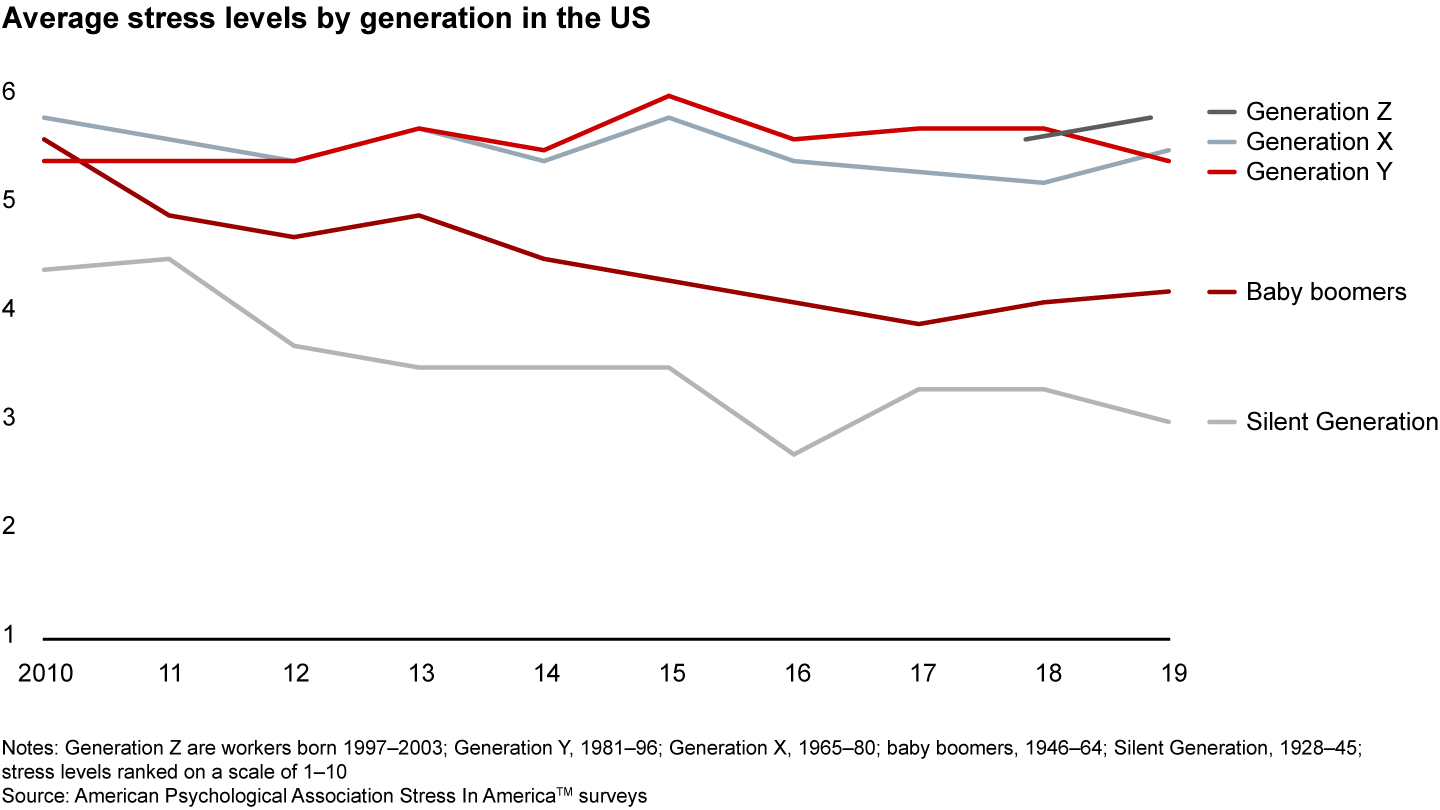
      Figure 5.1
      Stress levels are diverging across generations

      Unlike older cohorts, younger generations are grappling with a new mix of stressors. The combination of slowing economic growth, rising inequality, and declining housing affordability across the West has made it far more difficult for younger workers to attain financial stability. The dark sides of recent technological progress add to these challenges: Email blurs the lines between work and personal time, an issue only compounded by working from home. Social media pushes younger generations to constantly compare their lifestyles with those of their peers. And the acceleration of innovation cycles creates the illusion of life at twice the speed.

      DOWNLOAD THE FULL REPORT (PDF)

      Younger workers have also been exposed to broader turbulence over the past decade, including greater political polarization, geopolitical tensions, and concerns about climate change, not to mention a pandemic. The lives of younger generations are characterized by a far higher degree of ambiguity and uncertainty—and they simply haven’t been educated on how to cope with it.

      Of all these issues, the economic stressors matter most to young workers. When we asked workers across Western markets to share their biggest concerns for the next 5 to 10 years, 61% of respondents under 35 cited financial issues, job security, or failing to meet their career goals. Only 40% of those over 35 cited the same concerns.

      %

      of workers under 35 expressed concerns about financial issues, job security, or failure to meet career goals

      %

      of workers over 35 cited the same concerns

      The odds of achieving absolute upward mobility—earning more than one’s parents—are the lowest they have been in the US for any generation since World War II. For the Silent Generation, about 90% of workers could expect to earn more than their parents, with the figure even higher for all but the wealthiest families. For Generation X, this figure had fallen to about 50%, with the biggest decline in the middle class. The emerging data for Generation Y suggests the picture is worsening. This trend is consistent across the West, with absolute upward mobility at levels equal to or below the lowest on record, which stretches back to the beginning of the 20th century.

      Two factors have contributed to the decline in absolute upward mobility: slowing growth and rising inequality. The youngest generation of workers has seen inequality skyrocket, as the earnings gap between those who enter high-skill professions and those who do not continues to widen. The growing income premium for a college degree certainly plays a role in this story. But it’s now estimated that more than 40% of recent college graduates end up in jobs that don’t require higher education. Today’s labor markets are increasingly characterized by a winner-takes-all dynamic, where a small number of graduates capture a vast majority of the returns on education.

      “The lives of younger generations are characterized by a far higher degree of ambiguity and uncertainty—and they simply haven’t been educated on how to cope with it.”

      In places like the US, where higher education receives limited public funding, universities are also saddling workers with crippling debt. In Europe, younger workers are often spared the burden of student debt, but youth unemployment has reached crushing levels—37% in Spain, 29% in Italy, and 19% in France—as the fallout of the financial crisis more than a decade ago continues to limit opportunities.

      On top of everything else, younger workers will grapple with the burden of caring for an aging population. They also face the challenge of paying down public debt, which has ballooned as a result of the pandemic, at a time of slowing macroeconomic growth.

      The psychological effects of these pressures should not be underestimated. To see what could be in store for the West, one can look to Japan. In the 1990s, the term hikikomori was added to the lexicon to describe the growing phenomenon of young adults who had failed to secure jobs during Japan’s prolonged economic slowdown known as the Lost Decade. Their feelings of shame and defeat led them to withdraw from the labor market permanently and become recluses who lived with their parents well into their adult years. Since then, the number of hikikomori has steadily grown to more than a million people, according to government estimates.

      Interactive

      Six Worker Archetypes for the World Ahead

      There’s no such thing as the “average” worker. Understanding six archetypes can help firms build an effective talent strategy.

      Given cultural differences, such a pattern may or may not emerge in the West. But it’s evident that many young people have become disillusioned with the prevailing economic system and mainstream politics. As a result, some have gravitated toward radical political movements. Others are seeking change through economic, rather than democratic, processes. This includes consuming and investing based on their individual beliefs, although the impact tends to be diffuse. Many young people sense that the best way to achieve change is by encouraging their employers to take more active stances on social and political issues. In some cases, these workers are willing to vote with their feet.

      Looking at the emerging economies of the world, the youngest generations have had a very different experience. In countries like China, Indonesia, and Nigeria, younger workers are experiencing less instability than their predecessors, while economic liberalization and convergence are rapidly increasing their prospects for upward income mobility. According to our survey, 81% of workers in emerging markets said they felt optimistic that their lives would be better 5 to 10 years from now, compared with only 63% in developed economies. It may be too early to say how much these diverging experiences could reshape global competitiveness in the coming decade, but it does reinforce the point that the hopes and fears of workers in the developed and developing world are distinct.

      Continue Reading

      Rehumanizing Work: The Journey Ahead


      About the Research

      Data powered by Dynata, a leading global first-party data and insights platform.

      Auteurs
      • Headshot of Andrew Schwedel
        Andrew Schwedel
        Partner, New York
      • Headshot of James Root
        James Root
        Partner, Hong Kong
      • Headshot of James Allen
        James Allen
        Advisory Partner, London
      • Headshot of John Hazan
        John Hazan
        Partner, Paris
      • Eric Almquist
        Former Advisory Partner, Boston
      • Thomas Devlin
        Former Director, Bain Futures, London
      • Headshot of Karen Harris
        Karen Harris
        Managing Director, Macro Trends Group, New York
      Contactez-nous
      The Firm of the Future
      AI and Power: A Marriage of Necessity

      Tech and utilities are an unlikely pair, but how well they balance data center electricity demand and finite energy resources will have huge implications.

      Voir plus
      The Firm of the Future
      How to Feed AI’s Hunger for Power

      The explosive growth of artificial intelligence will need a lot of electricity from a utility industry that hasn’t seen demand grow for 20 years.

      Voir plus
      The Firm of the Future
      The Working Future In Gulf Cooperation Council Countries

      It's time to humanize how we think about work to appeal to today's talent.

      Voir plus
      The Firm of the Future
      Automation May Not Come for Everyone's Job After All

      Uniquely human skills are becoming more important as the composition of the workforce shifts.

      Voir plus
      The Firm of the Future
      Working Women and the War for Talent

      By addressing deeply rooted gender imbalances, firms can overcome the labor shortage.

      Voir plus
      First published in janvier 2022
      Mots clés
      • Leadership & Talent
      • Organisation
      • Stratégie
      • The Firm of the Future

      Comment nous avons aidé nos clients

      A Bold New Strategy Restores a Bank to a Leadership Position

      Lire l’étude de cas

      A Video Game Company Levels Up With a New Operating Model

      Lire l’étude de cas

      A global manufacturer's reorganization restores high profits

      Lire l’étude de cas

      Vous souhaitez continuer cette conversation ?

      Nous aidons des dirigeants du monde entier à matérialiser des impacts et des résultats pérennes et créateurs de valeur dans leurs organisations.

      Les points de vue de Bain : notre perspective sur des problématiques auxquelles sont confrontées les entreprises à travers le monde, envoyés chaque mois dans votre boîte de réception. 

      *J’ai lu la politique de confidentialité et j’accepte les conditions.

      Merci de lire notre politique de confidentialité.
      Bain & Company
      Contactez-nous Sustainability Accessibility Conditions d’utilisation Politique de Confidentialité Cookie Policy Mentions Légales Sitemap Log In

      © 1996-2026 Bain & Company, Inc.

      Contacter Bain

      Comment pouvons-nous vous aider ?

      • Business inquiry
      • Career information
      • Press relations
      • Partnership request
      • Speaker request
      Voir tous les bureaux