
Skip to Content
  • Offices

    Offices

    North & Latin America
    • Atlanta
    • Austin
    • Bogota
    • Boston
    • Buenos Aires
    • Chicago
    • Dallas
    • Denver
    • Houston
    • Los Angeles
    • Mexico City
    • Minneapolis
    • Monterrey
    • Montreal
    • New York
    • Rio de Janeiro
    • San Francisco
    • Santiago
    • São Paulo
    • Seattle
    • Silicon Valley
    • Toronto
    • Washington, DC
    Europe & Africa
    • Amsterdam
    • Athens
    • Berlin
    • Brussels
    • Copenhagen
    • Dusseldorf
    • Frankfurt
    • Helsinki
    • Istanbul
    • Johannesburg
    • Kyiv
    • Lisbon
    • London
    • Madrid
    • Milan
    • Munich
    • Oslo
    • Paris
    • Rome
    • Stockholm
    • Vienna
    • Warsaw
    • Zurich
    Middle East
    • Doha
    • Dubai
    • Riyadh
    Asia & Australia
    • Bangkok
    • Beijing
    • Bengaluru
    • Brisbane
    • Ho Chi Minh City
    • Hong Kong
    • Jakarta
    • Kuala Lumpur
    • Manila
    • Melbourne
    • Mumbai
    • New Delhi
    • Perth
    • Seoul
    • Shanghai
    • Singapore
    • Sydney
    • Tokyo
    See all offices
  • Alumni
  • Media Center
  • Subscribe
  • Contact
  • Global

    Select your region and language

    Global
    • Global (English)
    North & Latin America
    • Brazil (Português)
    • Argentina (Español)
    • Canada (Français)
    • Chile (Español)
    • Colombia (Español)
    Europe, Middle East, & Africa
    • France (Français)
    • DACH Region (Deutsch)
    • Italy (Italiano)
    • Spain (Español)
    • Greece (Elliniká)
    Asia & Australia
    • China (中文版)
    • Korea (한국어)
    • Japan (日本語)
  • Saved items (0)
    Saved items (0)

    You have no saved items.

    Bookmark content that interests you and it will be saved here for you to read or share later.

    Explore Bain Insights
  • Industries
    Main menu

    Industries

    • Aerospace & Defense
    • Agribusiness
    • Chemicals
    • Construction & Infrastructure
    • Consumer Products
    • Financial Services
    • Healthcare & Life Sciences
    • Industrial Machinery & Equipment
    • Media & Entertainment
      Industries
      Media & Entertainment
      • Media Lab
    • Metals
    • Mining
    • Oil & Gas
    • Paper & Packaging
    • Private Equity
      Industries
      Private Equity
      • Due Diligence
      • Exit Planning
      • Firm Strategy & Operations
      • Portfolio Value Creation
    • Social Impact
    • Retail
    • Technology
    • Telecommunications
      Industries
      Telecommunications
      • Capital Expenditure
      • Telco Digital Transformation
    • Transportation
    • Travel & Leisure
    • Utilities & Renewables
  • Consulting Services
    Main menu

    Consulting Services

    • Customer Experience
    • Sustainability
    • Innovation
    • M&A
    • Operations
    • People & Organization
    • Private Equity
    • Sales & Marketing
    • Strategy
    • AI, Insights, and Solutions
    • Technology
    • Transformation
  • Digital
  • Insights
    Main menu

    Insights

    • Industry Insights
    • Services Insights
    • Bain Books
    • Webinars
    • Bain Futures
    View all Insights
    Featured topics
    • Tariff Response
    • Artificial Intelligence
    • Thriving in Uncertainty
    • Executive Conversations
    • Macro Trends
    • M&A Report
    • Healthcare Private Equity Report
    • Paper & Packaging Report
    • Technology Report
    • CEO's Guide to Sustainability
    • CEO Insights
    • CFO Insights
    • COO Insights
    • CIO Insights
    • CMO Insights
    View all featured topics
  • About
    Main menu

    About

    • What We Do
    • What We Believe
    • Our People & Leadership
    • Client Results
    • Awards & Recognition
    • Global Affiliations
    Further: Our global responsibility
    • Sustainability
    • Social Impact
    • World Economic Forum
    Learn more about Further
  • Careers
    Main menu

    Careers

    • Work with Us
      Careers
      Work with Us
      • Find Your Place
      • Our Work Areas
      • Integrated Teams
      • Students
      • Internships & Programs
      • Recruiting Events
    • Life at Bain
      Careers
      Life at Bain
      • Blog: Inside Bain
      • Career Stories
      • Our People
      • Where We Work
      • Supporting Your Growth
      • Affinity Groups
      • Benefits
    • Impact Stories
    • Hiring Process
      Careers
      Hiring Process
      • What to Expect
      • Interviewing
    FIND JOBS
  • Offices
    Main menu

    Offices

    • North & Latin America
      Offices
      North & Latin America
      • Atlanta
      • Austin
      • Bogota
      • Boston
      • Buenos Aires
      • Chicago
      • Dallas
      • Denver
      • Houston
      • Los Angeles
      • Mexico City
      • Minneapolis
      • Monterrey
      • Montreal
      • New York
      • Rio de Janeiro
      • San Francisco
      • Santiago
      • São Paulo
      • Seattle
      • Silicon Valley
      • Toronto
      • Washington, DC
    • Europe & Africa
      Offices
      Europe & Africa
      • Amsterdam
      • Athens
      • Berlin
      • Brussels
      • Copenhagen
      • Dusseldorf
      • Frankfurt
      • Helsinki
      • Istanbul
      • Johannesburg
      • Kyiv
      • Lisbon
      • London
      • Madrid
      • Milan
      • Munich
      • Oslo
      • Paris
      • Rome
      • Stockholm
      • Vienna
      • Warsaw
      • Zurich
    • Middle East
      Offices
      Middle East
      • Doha
      • Dubai
      • Riyadh
    • Asia & Australia
      Offices
      Asia & Australia
      • Bangkok
      • Beijing
      • Bengaluru
      • Brisbane
      • Ho Chi Minh City
      • Hong Kong
      • Jakarta
      • Kuala Lumpur
      • Manila
      • Melbourne
      • Mumbai
      • New Delhi
      • Perth
      • Seoul
      • Shanghai
      • Singapore
      • Sydney
      • Tokyo
    See all offices
  • Alumni
  • Media Center
  • Subscribe
  • Contact
  • Global
    Main menu

    Select your region and language

    • Global
      Select your region and language
      Global
      • Global (English)
    • North & Latin America
      Select your region and language
      North & Latin America
      • Brazil (Português)
      • Argentina (Español)
      • Canada (Français)
      • Chile (Español)
      • Colombia (Español)
    • Europe, Middle East, & Africa
      Select your region and language
      Europe, Middle East, & Africa
      • France (Français)
      • DACH Region (Deutsch)
      • Italy (Italiano)
      • Spain (Español)
      • Greece (Elliniká)
    • Asia & Australia
      Select your region and language
      Asia & Australia
      • China (中文版)
      • Korea (한국어)
      • Japan (日本語)
  • Saved items  (0)
    Main menu
    Saved items (0)

    You have no saved items.

    Bookmark content that interests you and it will be saved here for you to read or share later.

    Explore Bain Insights
  • Industries
    • Industries

      • Aerospace & Defense
      • Agribusiness
      • Chemicals
      • Construction & Infrastructure
      • Consumer Products
      • Financial Services
      • Healthcare & Life Sciences
      • Industrial Machinery & Equipment
      • Media & Entertainment
      • Metals
      • Mining
      • Oil & Gas
      • Paper & Packaging
      • Private Equity
      • Social Impact
      • Retail
      • Technology
      • Telecommunications
      • Transportation
      • Travel & Leisure
      • Utilities & Renewables
  • Consulting Services
    • Consulting Services

      • Customer Experience
      • Sustainability
      • Innovation
      • M&A
      • Operations
      • People & Organization
      • Private Equity
      • Sales & Marketing
      • Strategy
      • AI, Insights, and Solutions
      • Technology
      • Transformation
  • Digital
  • Insights
    • Insights

      • Industry Insights
      • Services Insights
      • Bain Books
      • Webinars
      • Bain Futures
      View all Insights
      Featured topics
      • Tariff Response
      • Artificial Intelligence
      • Thriving in Uncertainty
      • Executive Conversations
      • Macro Trends
      • M&A Report
      • Healthcare Private Equity Report
      • Paper & Packaging Report
      • Technology Report
      • CEO's Guide to Sustainability
      • CEO Insights
      • CFO Insights
      • COO Insights
      • CIO Insights
      • CMO Insights
      View all featured topics
  • About
    • About

      • What We Do
      • What We Believe
      • Our People & Leadership
      • Client Results
      • Awards & Recognition
      • Global Affiliations
      Further: Our global responsibility
      • Sustainability
      • Social Impact
      • World Economic Forum
      Learn more about Further
  • Careers
    Popular Searches
    • Agile
    • Digital
    • Strategy
    Your Previous Searches
      Recently Visited Pages

      Content added to saved items

      Saved items (0)

      Removed from saved items

      Saved items (0)

      Brief

      A Customer-Centric Approach to Commercial Excellence

      A Customer-Centric Approach to Commercial Excellence

      Leading oil, gas and chemical companies are unlocking new value by improving customer experiences and loyalty.

      By Dale Hardcastle, Andrea Ioannilli and Jason McLinn

      • min read
      }

      Brief

      A Customer-Centric Approach to Commercial Excellence
      en

      CEOs of industrial companies hear it from their customers every day: Why can’t they deliver service as convenient as Amazon, as transparent as Uber, and as innovative and well designed as Apple? They may have brushed it off the first few times they heard it, but at some point most executives begin to understand: Customer expectations are rising.

      Even in oil, gas and chemicals, where the business model has relied on a traditional sequence of drawing hydrocarbons out of the ground, then processing and selling them, the expectations of commercial and retail customers are evolving to match what they experience online.

      For many industrial companies, responding to new expectations represents a significant challenge. Over the past 10 to 15 years, they have focused on achieving operational excellence, improving the productivity, performance and safety of their assets and personnel. It has proven to be time and money well spent, delivering many benefits, including millions of extra barrels of oil and gas recovered, higher utilization of assets, improvements for worker safety and the environment, and greater efficiency for customers.

      With these gains captured, many leading oil, gas and chemical companies are focusing on a new prize: commercial excellence. Commercial excellence is the design and delivery of commercial best practices that maximize profitable revenue, including programs to consistently improve pricing, salesforce effectiveness, product mix, customer selection and focus, and distributor management.

      Andrea Ioannilli, a partner with Bain’s Oil & Gas practice, shares some critical factors companies should consider when pursuing a commercial excellence program.

      Until recently, most executives in these industries have not prioritized improving commercial efforts, partly because it seemed unnecessary and the potential prize was uncertain. But some companies have begun to show that the prize is material and worth the investment—even if it requires a better grasp on softer issues, such as understanding customer preferences and needs, managing creative people and customizing solutions where necessary. Undoubtedly, the shift requires a new mindset among traditional technical managers, but the payoff is well worth it.

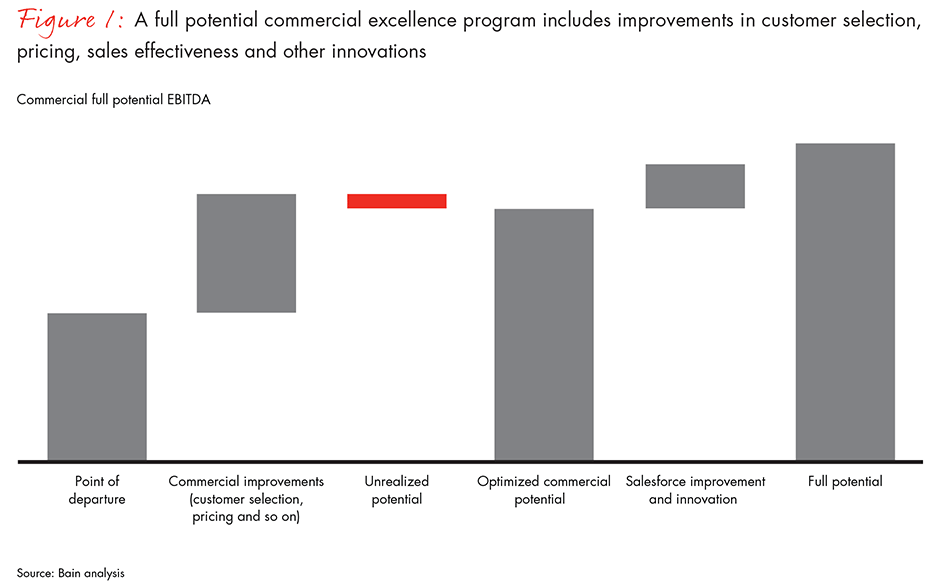
      In fact, there is tremendous value in pursuing commercial excellence, and it comes as a natural follow-up to success with operational excellence (see Figure 1). Both efforts balance improvements in the art of the business (focusing on the culture and necessary behaviors) and the science (more analytical, fact-based approaches). Many executives do not know who their best customers are, what it costs to serve them or how well satisfied these customers are. By bringing those facts into focus, companies can improve customer experience and loyalty, unlocking new value.

      customer-centric-commercial-excellence-fig01_embed

      Commercial excellence builds on some of the same capabilities that oil and gas companies have developed in their pursuit of operational excellence. In both cases, leadership from the top is essential, and behavioral transformation across the organization is key. In some ways, commercial excellence aspires to bring the same scientific approach to the customer side of the business that operational excellence brought to operations. It may require a slightly different mindset and tools, but it is measurable and requires a similar journey of several years to fully transform an organization. Sometimes, it’s a challenge for technically minded executives to make the switch, but doing so benefits the whole organization.

      Retail and commercial business can often see earnings rise by 20% to 25% as a result of focusing sales efforts on the right customers, and they can enhance margins by optimizing cost-to-serve and improving price realization.

      A comprehensive commercial excellence transformation program sets out to create value in several ways. One chemical producer in Southeast Asia identified the potential to raise profits by 11% through 15 initiatives implemented over 2 years, including:

      • Identifying the most promising customers and focusing sales coverage, pricing strategy and technical service support on them
      • Shifting volumes toward more profitable applications and regions
      • Optimizing pricing by product and customer
      • Restructuring the salesforce and improving management processes
      • Selecting and managing distributors more rigorously
      • Improving cost-to-serve ratios through collaborative shipment planning
      • Building new capabilities among marketing and sales staff

      Better pricing is one of the fastest ways to see results. Although pricing is often transparent in commodity industries, a producer’s competitive position can vary significantly based on size, location, product properties or fungibility. An in-depth analysis of pricing power, mapped against products and customers, can inform pricing adjustments that deliver earnings results in as little as one or two quarters.

      Value can also come from collaborating more closely with customers. Another chemical producer started to work closely with its largest customers to plan shipments well in advance. This forward planning allowed the consolidation of shipments to multiple large customers, which in turn became an “anchor” for smaller customers’ shipments, too. This generated cost savings of 15% on a key product, part of which could be passed back to the customers.

      For a specialty chemical producer, the largest portion of new value came from improving its customer-planning and management process. This started with mapping potential value by customer, machine and product, subsequently defining the level of ambition, and orchestrating the short-, medium- and long-term actions to capture the value. Customized product development and a detailed engagement plan also helped generate value.

      Putting the customer at the center


      Any of these measures can help bank early gains, but a deeper understanding of customers’ needs and preferences will take the program further. Sometimes what customers say they value is different from what they actually value in practice. One company was pricing two products at the same level, even though one was more expensive to produce. The rationale? Sales teams insisted that if they adjusted prices to reflect actual costs, clients would go to a competitor. As part of a commercial excellence program, the teams asked clients how much the products were worth to their business and discovered they were frequently willing to pay even more than the company had expected, provided it could deliver some additional benefits.

      Discoveries like these are valuable on their own, but a comprehensive program of commercial excellence allows companies to put these insights at the center of what they do. A truly customer-centric organization takes a systematic approach, talking to customers to create a fact-based assessment of what customers want and which things they value over others. Understanding such trade-offs is key to prioritizing action. For example, if you ask drivers what they would like in a service station—low prices, convenient location, clean restrooms, well-stocked convenience store—they are likely to say “all of the above.” Companies can prioritize investments only when they know which things are more important than others. In this way, true customer centricity changes how companies design products and services by identifying those most likely to fulfill customers’ needs and boost profits rapidly and significantly.

      Customer centricity also changes the delivery and go-to-market models by identifying the most promising customers and segments based on a more comprehensive and accurate picture of the true costs to serve. Customer service and after-sales support change, too, as companies rethink how employees engage with customers. Closing the loop on customer feedback ensures that the company can act on the insights.

      Through these processes, oil, gas and chemical companies learn to identify new opportunities and unlock the potential in their relationships with current customers. These processes also help companies identify customer segments that are unprofitable, showing the true cost of sales and technical support to customers.

      As with operational excellence, improving commercial excellence through better customer centricity requires a cultural change for oil, gas and chemical companies that may not have had to adapt to this level of customer engagement before. Instilling a customer-centric culture guides action at all levels of the organization and sheds light on what learning is necessary. It also engages employees in the mission and empowers them to continuously improve the customer experience. Targeting new segments of customers can require a high degree of customization, and executives need to learn how to evaluate whether it is worthwhile financially.

      Learning from leaders


      Leading energy and chemical companies follow a few common steps to unlock the commercial potential within their organizations.

      • First, they recognize that few companies are fully tapping the commercial potential of their customers. Even without launching a customer crusade, leaders can start by assessing how they serve major customers and what they could do to deliver more value. A profit pool analysis is typically part of this assessment, as it helps identify the most profitable customers. This exercise identifies the places where sales teams and managers should focus—and frequently identifies unprofitable segments where companies can justify spending less time.
      • Second, raising the game in enhancing customer experience is a nonnegotiable in the new competitive environment. Customer expectations are rising, and suppliers need to respond with better service and in many cases a deeper understanding of what customers are looking for, which can help suppliers provide that in a cost-effective way. For example, if customers say they want real-time tracking of their shipment in an app, the same way they can see their hired car arriving on their mobile device, the supplier might try to learn more about what they really need. It may not be cost effective for the supplier to build and provide its own app. But the customer might be satisfied with text-based updates when shipments reach specific checkpoints in their journey. There are often simpler ways to deliver what a customer wants.
      • Third, few companies have all the skills, data and analytics necessary to raise their game. While the marketing team often has a wealth of untapped insight at hand, bringing it together requires reconsidering the customer experience through design thinking, employing new metrics for customer advocacy (such as the Net Promoter Score®) and tapping advanced analytics to combine internal and external sources to gain an advantage in the marketplace. Leading firms identify the gaps in their capabilities and look externally where necessary to fill them, while also building them up internally.
      • Finally, leaders work to create the kind of culture that not only meets customers’ needs, but also builds loyalty over the long term. Commercial excellence is a multiyear journey that unites senior management, operations, the supply chain, sales and marketing in a common effort to improve customer experience. As with operational excellence, only a concerted, sustainable, companywide effort can hope to achieve the results necessary to build strong customer relationships in an era of rising expectations.

      Dale Hardcastle is a partner with Bain & Company in Singapore, Andrea Ioannilli is a Bain partner in Kuala Lumpur and Jason McLinn is a partner in Chicago. Dale and Andrea work with Bain’s Global Oil & Gas practice, and Jason works with Bain’s Global Chemicals practice.

      Net Promoter Score® is a registered trademark of Bain & Company, Inc., Fred Reichheld and Satmetrix Systems, Inc.


      customer-centric-commercial-excellence-fig01_full
      Authors
      • Headshot of Dale Hardcastle
        Dale Hardcastle
        Partner, Singapore
      • Headshot of Andrea Ioannilli
        Andrea Ioannilli
        Alumni, London
      • Headshot of Jason McLinn
        Jason McLinn
        Partner, Chicago
      Contact us
      Related Industries
      • Chemicals
      • Energy & Natural Resources
      • Oil & Gas
      Related Consulting Services
      • Go-to-Market Strategy
      • Sales and Marketing
      Advanced Manufacturing & Services
      Do Your Industrial Customers Love Their Experience?

      An excellent experience can support a price premium.

      Read More
      Chemicals
      Profitable Growth in Chemicals Through Commercial Excellence

      Commercial transformations often falter when customers fail to react as expected. Successful executives anticipate customers’ reactions and plan for round two.

      Read More
      Chemicals
      Digital Opportunities for Chemical Producers

      Executives, awash with digital possibilities, need to identify and focus on those that will help them meet customer needs.

      Read More
      Chemicals
      Three Changes in Chemical Sales That Aren’t Changing Back

      Covid-19 speeded up transitions already underway: more technical and virtual sales, the rise of online marketplaces and faster product development cycles.

      Read More
      Oil & Gas
      Sustaining Capital: From Chaos to Discipline

      Fragmented budgets, poor visibility, and missed forecasts are fixable with the right approach.

      Read More
      Published in styczeń 2017
      Tags
      • Chemicals
      • Energy & Natural Resources
      • Go-to-Market Strategy
      • Oil & Gas
      • Sales and Marketing

      How We've Helped Clients

      Moving Beyond an Operating Model Redesign to Live the Model

      Read case study

      An OFS captures post-merger growth synergies

      Read case study

      Broader market plus tighter sales strategy equals big success for a portfolio company

      Read case study

      Ready to talk?

      We work with ambitious leaders who want to define the future, not hide from it. Together, we achieve extraordinary outcomes.

      Stay ahead in a rapidly changing world. Subscribe to Bain Insights, our monthly look at the critical issues facing global businesses.

      *I have read and understand Bain’s Privacy Notice.

      Please read and agree to the Privacy Policy.
      Bain & Company
      Contact us Sustainability Accessibility Terms of use Privacy Modern Slavery Act Statement Cookie Policy Sitemap Log In

      © 1996-2026 Bain & Company, Inc.

      Contact Bain

      How can we help you?

      • Business inquiry
      • Career information
      • Press relations
      • Partnership request
      • Speaker request
      See all offices