
Skip to Content
  • Offices

    Offices

    North & Latin America
    • Atlanta
    • Austin
    • Bogota
    • Boston
    • Buenos Aires
    • Chicago
    • Dallas
    • Denver
    • Houston
    • Los Angeles
    • Mexico City
    • Minneapolis
    • Monterrey
    • Montreal
    • New York
    • Rio de Janeiro
    • San Francisco
    • Santiago
    • São Paulo
    • Seattle
    • Silicon Valley
    • Toronto
    • Washington, DC
    Europe & Africa
    • Amsterdam
    • Athens
    • Berlin
    • Brussels
    • Copenhagen
    • Dusseldorf
    • Frankfurt
    • Helsinki
    • Istanbul
    • Johannesburg
    • Kyiv
    • Lisbon
    • London
    • Madrid
    • Milan
    • Munich
    • Oslo
    • Paris
    • Rome
    • Stockholm
    • Vienna
    • Warsaw
    • Zurich
    Middle East
    • Doha
    • Dubai
    • Riyadh
    Asia & Australia
    • Bangkok
    • Beijing
    • Bengaluru
    • Brisbane
    • Ho Chi Minh City
    • Hong Kong
    • Jakarta
    • Kuala Lumpur
    • Manila
    • Melbourne
    • Mumbai
    • New Delhi
    • Perth
    • Seoul
    • Shanghai
    • Singapore
    • Sydney
    • Tokyo
    See all offices
  • Alumni
  • Media Center
  • Subscribe
  • Contact
  • Global

    Select your region and language

    Global
    • Global (English)
    North & Latin America
    • Brazil (Português)
    • Argentina (Español)
    • Canada (Français)
    • Chile (Español)
    • Colombia (Español)
    Europe, Middle East, & Africa
    • France (Français)
    • DACH Region (Deutsch)
    • Italy (Italiano)
    • Spain (Español)
    • Greece (Elliniká)
    Asia & Australia
    • China (中文版)
    • Korea (한국어)
    • Japan (日本語)
  • Saved items (0)
    Saved items (0)

    You have no saved items.

    Bookmark content that interests you and it will be saved here for you to read or share later.

    Explore Bain Insights
  • Industries
    Main menu

    Industries

    • Aerospace & Defense
    • Agribusiness
    • Chemicals
    • Construction & Infrastructure
    • Consumer Products
    • Financial Services
    • Healthcare & Life Sciences
    • Industrial Machinery & Equipment
    • Media & Entertainment
      Industries
      Media & Entertainment
      • Media Lab
    • Metals
    • Mining
    • Oil & Gas
    • Paper & Packaging
    • Private Equity
      Industries
      Private Equity
      • Due Diligence
      • Exit Planning
      • Firm Strategy & Operations
      • Portfolio Value Creation
    • Social Impact
    • Retail
    • Technology
    • Telecommunications
      Industries
      Telecommunications
      • Capital Expenditure
      • Telco Digital Transformation
    • Transportation
    • Travel & Leisure
    • Utilities & Renewables
  • Consulting Services
    Main menu

    Consulting Services

    • Customer Experience
    • Sustainability
    • Innovation
    • M&A
    • Operations
    • People & Organization
    • Private Equity
    • Sales & Marketing
    • Strategy
    • AI, Insights, and Solutions
    • Technology
    • Transformation
  • Digital
  • Insights
    Main menu

    Insights

    • Industry Insights
    • Services Insights
    • Bain Books
    • Webinars
    • Bain Futures
    View all Insights
    Featured topics
    • Tariff Response
    • Artificial Intelligence
    • Thriving in Uncertainty
    • Executive Conversations
    • Macro Trends
    • M&A Report
    • Healthcare Private Equity Report
    • Paper & Packaging Report
    • Technology Report
    • CEO's Guide to Sustainability
    • CEO Insights
    • CFO Insights
    • COO Insights
    • CIO Insights
    • CMO Insights
    View all featured topics
  • About
    Main menu

    About

    • What We Do
    • What We Believe
    • Our People & Leadership
    • Client Results
    • Awards & Recognition
    • Global Affiliations
    Further: Our global responsibility
    • Sustainability
    • Social Impact
    • World Economic Forum
    Learn more about Further
  • Careers
    Main menu

    Careers

    • Work with Us
      Careers
      Work with Us
      • Find Your Place
      • Our Work Areas
      • Integrated Teams
      • Students
      • Internships & Programs
      • Recruiting Events
    • Life at Bain
      Careers
      Life at Bain
      • Blog: Inside Bain
      • Career Stories
      • Our People
      • Where We Work
      • Supporting Your Growth
      • Affinity Groups
      • Benefits
    • Impact Stories
    • Hiring Process
      Careers
      Hiring Process
      • What to Expect
      • Interviewing
    FIND JOBS
  • Offices
    Main menu

    Offices

    • North & Latin America
      Offices
      North & Latin America
      • Atlanta
      • Austin
      • Bogota
      • Boston
      • Buenos Aires
      • Chicago
      • Dallas
      • Denver
      • Houston
      • Los Angeles
      • Mexico City
      • Minneapolis
      • Monterrey
      • Montreal
      • New York
      • Rio de Janeiro
      • San Francisco
      • Santiago
      • São Paulo
      • Seattle
      • Silicon Valley
      • Toronto
      • Washington, DC
    • Europe & Africa
      Offices
      Europe & Africa
      • Amsterdam
      • Athens
      • Berlin
      • Brussels
      • Copenhagen
      • Dusseldorf
      • Frankfurt
      • Helsinki
      • Istanbul
      • Johannesburg
      • Kyiv
      • Lisbon
      • London
      • Madrid
      • Milan
      • Munich
      • Oslo
      • Paris
      • Rome
      • Stockholm
      • Vienna
      • Warsaw
      • Zurich
    • Middle East
      Offices
      Middle East
      • Doha
      • Dubai
      • Riyadh
    • Asia & Australia
      Offices
      Asia & Australia
      • Bangkok
      • Beijing
      • Bengaluru
      • Brisbane
      • Ho Chi Minh City
      • Hong Kong
      • Jakarta
      • Kuala Lumpur
      • Manila
      • Melbourne
      • Mumbai
      • New Delhi
      • Perth
      • Seoul
      • Shanghai
      • Singapore
      • Sydney
      • Tokyo
    See all offices
  • Alumni
  • Media Center
  • Subscribe
  • Contact
  • Global
    Main menu

    Select your region and language

    • Global
      Select your region and language
      Global
      • Global (English)
    • North & Latin America
      Select your region and language
      North & Latin America
      • Brazil (Português)
      • Argentina (Español)
      • Canada (Français)
      • Chile (Español)
      • Colombia (Español)
    • Europe, Middle East, & Africa
      Select your region and language
      Europe, Middle East, & Africa
      • France (Français)
      • DACH Region (Deutsch)
      • Italy (Italiano)
      • Spain (Español)
      • Greece (Elliniká)
    • Asia & Australia
      Select your region and language
      Asia & Australia
      • China (中文版)
      • Korea (한국어)
      • Japan (日本語)
  • Saved items  (0)
    Main menu
    Saved items (0)

    You have no saved items.

    Bookmark content that interests you and it will be saved here for you to read or share later.

    Explore Bain Insights
  • Industries
    • Industries

      • Aerospace & Defense
      • Agribusiness
      • Chemicals
      • Construction & Infrastructure
      • Consumer Products
      • Financial Services
      • Healthcare & Life Sciences
      • Industrial Machinery & Equipment
      • Media & Entertainment
      • Metals
      • Mining
      • Oil & Gas
      • Paper & Packaging
      • Private Equity
      • Social Impact
      • Retail
      • Technology
      • Telecommunications
      • Transportation
      • Travel & Leisure
      • Utilities & Renewables
  • Consulting Services
    • Consulting Services

      • Customer Experience
      • Sustainability
      • Innovation
      • M&A
      • Operations
      • People & Organization
      • Private Equity
      • Sales & Marketing
      • Strategy
      • AI, Insights, and Solutions
      • Technology
      • Transformation
  • Digital
  • Insights
    • Insights

      • Industry Insights
      • Services Insights
      • Bain Books
      • Webinars
      • Bain Futures
      View all Insights
      Featured topics
      • Tariff Response
      • Artificial Intelligence
      • Thriving in Uncertainty
      • Executive Conversations
      • Macro Trends
      • M&A Report
      • Healthcare Private Equity Report
      • Paper & Packaging Report
      • Technology Report
      • CEO's Guide to Sustainability
      • CEO Insights
      • CFO Insights
      • COO Insights
      • CIO Insights
      • CMO Insights
      View all featured topics
  • About
    • About

      • What We Do
      • What We Believe
      • Our People & Leadership
      • Client Results
      • Awards & Recognition
      • Global Affiliations
      Further: Our global responsibility
      • Sustainability
      • Social Impact
      • World Economic Forum
      Learn more about Further
  • Careers
    Popular Searches
    • Agile
    • Digital
    • Strategy
    Your Previous Searches
      Recently Visited Pages

      Content added to saved items

      Saved items (0)

      Removed from saved items

      Saved items (0)

      Brief

      Breaking New Ground: The Efficiency Gains of Industrialized Design and Construction

      Breaking New Ground: The Efficiency Gains of Industrialized Design and Construction

      Leading markets are adopting modular construction techniques, but significant challenges make it hard to reach scale.

      By Houssem Jemili, Adrien Bron, Nate Anderson, and Karim Shariff

      • min read
      }

      Brief

      Breaking New Ground: The Efficiency Gains of Industrialized Design and Construction
      en
      At a Glance
      • Off-site modular construction of buildings and homes is efficient and less expensive, significantly saving time as well as material and labor costs.
      • But the industry’s fragmented nature among investors, architects, manufacturers, and construction companies has slowed adoption.
      • Incentives and regulations can help spur the industry to invest in more off-site construction, as has happened in Sweden and Singapore.
      • Designers and manufacturers can prepare for these shifts by investing in digital capabilities, while the construction workforce skills up in assembly techniques.

      Although manufacturing industries moved to assembly-line efficiency decades ago, the construction industry is just beginning its transition to more efficient forms of production, as builders begin to adopt techniques for off-site, modular construction—sometimes called industrial design and construction (IDC). Off-site construction is, as the name suggests, the manufacture of building components (including panels, sections, or whole apartments) in a factory; from there, they are transported to a building site for assembly.

      The benefits of IDC, especially in large, greenfield projects such as those in the Middle East, are clear. IDC can save as much as 20% in labor and material costs, reduce the need for on-site labor up to 30%, and condense the time for construction by 20% to 50%. Other benefits include design that focuses more on residents’ needs, better quality of construction, and full adherence to design specifications due to the more controlled production environment. Modular construction can also be more sustainable, as efficient processes generate less waste and fewer emissions, and as improved designs use less material and may be more recyclable.

      This transition will shift profit pools, benefiting some industry players more than others (see Figure 1). For example, real estate developers could see higher margins due to better executed projects, but they could also see pricing pressure as risk levels drop.

      Figure 1
      Construction profit pools will shift as off-site construction methods grow and capture higher margins

      Despite clear benefits, modular construction accounts for less than 10% of projects in many countries. In some places, market triggers have helped increase the trend. Singapore and Sweden, for example, are forerunners with higher adoption levels, above 30% for new residential buildings. In both countries, regulators and incentives helped kick-start off-site construction. In Singapore, a 2014 rule mandating the use of modular construction on state property helped increase adoption levels from 19% in 2017 to 39% in 2020. In Sweden, a study by Luleå University of Technology found that industrialized housebuilding is more efficient than conventional housebuilding, with 10% greater labor productivity and costs that are about 19% lower. It also allows for construction to continue inside factories, regardless of the weather outside.

      Challenges to scale

      Market leaders like these are the exception. For the most part, a fragmented landscape of contractors still assembles homes and buildings piece by piece, in unpredictable and unforgiving environments, often with an unreliable labor supply—structural issues that make construction notably unproductive and less attractive to investors.

      Other inefficiencies in the construction industry include bespoke project requirements, economic cycles, fluctuating interest rates, and the inherent uncertainty of multi-year projects. The highly fragmented value chain of sub-scale players, varying building codes across geographies, and legacy issues between core stakeholders create disincentives, impede productivity, and slow the adoption of off-site construction.

      To encourage adoption, industry players will need to work together and share transitional costs in the interest of generating better returns on investments in the long run. None of the main stakeholders (investors, designers, manufacturers, and builders) have incentives to adopt modular construction on their own. But through shared action, the industry can move in this direction.

      The first area requiring cooperation is designing more new buildings for modular, off-site construction, a skill that most architecture and design firms lack. Architects and designers tend to think more about function and aesthetics and less about production techniques. Designers will need to work closely with manufacturers to better understand their production systems, and with construction companies further downstream, to develop expertise in assembly. Strengthening those capabilities and developing a pipeline of designers skilled in prefab architecture will take time and money.

      Also, construction remains a mostly local business, but the transition to modular construction will require capabilities that may not be available locally. Builders will need to hire and train workers with these new skills, and this scale-up will require coordination to ensure the labor pool grows at pace with investment and design of IDC buildings.

      Finally, construction is highly regulated, and rules differ from one place to another. Modular home builders will need to work closely with regulators in target destinations to understand the requirements, adjust manufacturing processes accordingly, and likely alter standard designs for some projects, based on local needs.

      Positioning for success

      While different industry segments will need to cooperate to increase adoption, each organization will need to act to ensure its success, depending on its position in the value chain.

      • Real estate developers are in a strong position to shape demand for modular construction, more than most other industry players. A long-term focus on higher returns could help many real estate firms weather a period of higher investments, as the industry climbs the experience curve. By deeply cluing into residents’ needs, developers can set construction requirements to guide the design of standardized modules. With their eye on higher replicability, more standardization, and ultimately higher returns on their investments in future buildings, developers could create incentives for designers and architects to adopt innovative, off-site construction methods.
      • Architects and designers will have to work at levels of detail more precise than they were used to. In traditional construction, builders can work within parameters to make the pieces of the puzzle come together. But manufactured components offer less wiggle room. Architects often don’t have the experience or technology to raise their designs to the levels that will allow manufacturers to make flawless products. They will need to skill up in digital design, so that they can produce plans for fully engineered products and modules. Building closer relationships with manufacturers will also be vital, as in every other industrial value chain, so that architects can understand the possibilities available for production and collaborate on designs.
      • Manufacturers have a rare opportunity to rethink completely how they construct buildings and their components. This is a brief moment when innovations are likely to set new standards—and those who set them will be poised to capture a greater share of the profit pool. To land these opportunities, manufacturers will want to identify the most strategic parts or sections that they should own, while partnering or acquiring makers of other necessary prefabricated modules. This will shift industry boundaries. And in choosing where to focus, manufacturers should determine where they can add most value; some components require more complexity than others. For example, exterior walls are typically more complex than interior walls, offering more potential for adding value (see Figure 2). To encourage the adoption of innovative new standards, manufacturers will need to offer engineering support to designers, architects, and construction firms along with installation guidance.
      • Construction companies will expand their business beyond on-site construction, moving increasingly into off-site assembly and even manufacturing. Many builders already use a combination of standardized, prefabricated components, and many already perform some off-site assembly. With the growth of prefabrication, the boundary between the builders and the manufacturers will blur further, and scale will matter more, leading to a consolidation of companies that today may have 50 to 200 employees. Like architects, builders will need to improve their digital design capabilities so they can understand and use plans. A bigger challenge will be reskilling the huge field force, retraining millions of workers on new assembly techniques. Construction jobs will look more like system integration jobs. For some European companies that have already begun to integrate preassembled components, the learning curve for their own and subcontracted workforces lasted a decade or more before expertise reached levels comparable with the new technology.
      Figure 2
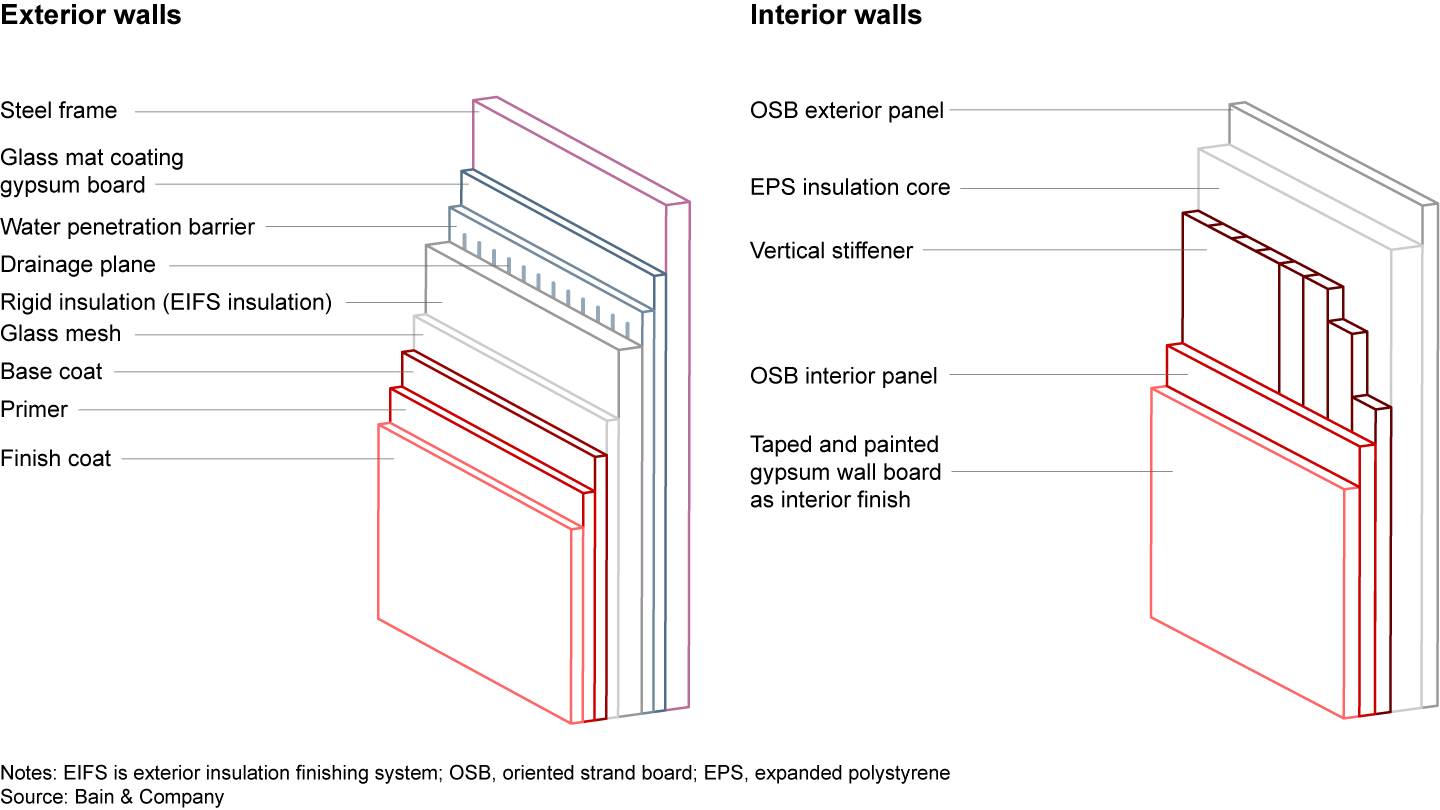
      Exterior walls are more complex and can add more value in prefabrication

      Off-site modular construction promises to transform the construction industry, especially for large, greenfield projects where the benefits of standardization and efficiency can be fully realized. If industry players can find ways to share transitional costs, then adoption of modular construction techniques will eventually increase, shifting profit pools. Companies that see the wave coming and can adapt their investment portfolios, design capabilities, or building techniques will be well positioned to make the most of it.

      Authors
      • Headshot of Houssem Jemili
        Houssem Jemili
        Partner, Middle East
      • Headshot of Adrien Bron
        Adrien Bron
        Partner, Zurich
      • Headshot of Nate Anderson
        Nate Anderson
        Partner, Chicago
      • Headshot of Karim Shariff
        Karim Shariff
        Partner, Middle East
      Contact us
      Related Industries
      • Advanced Manufacturing & Services
      • Building Products & Technologies
      • Construction & Infrastructure
      Related Consulting Services
      • Innovation & Design
      • Strategy
      • Transformation
      Advanced Manufacturing & Services
      The CEO Playbook for Climate Resilience

      Build to bend, not break, when managing climate adaptation.

      Read More
      Advanced Manufacturing & Services
      European Construction Outlook: Tracking Growth Rates

      A patchy recovery is underway, fueled by pent-up residential demand and infrastructure investment.

      Read More
      Strategy
      Get Off the Transformation Treadmill

      Too much change can traumatize your organization. The remedy is to minimize the need.

      Read More
      Advanced Manufacturing & Services
      Constructing an M&A Strategy in Building Products

      Most building products companies play in mature markets, with low long-term growth. M&A can help them achieve growth ambitions.

      Read More
      Strategy
      From Sapling to Forest, Master Deliver and Develop: Nirav Tolia, CEO & Co-Founder, Nextdoor

      What does it take to "refound" a company that you started, this time in the public spotlight?

      Read More
      Published in marzec 2024
      Tags
      • Advanced Manufacturing & Services
      • Building Products & Technologies
      • Construction & Infrastructure
      • Innovation & Design
      • Strategy
      • Transformation

      How We've Helped Clients

      Supply Chain Security Mitigates a Sovereign Wealth Fund’s Construction Disruptions

      Read case study

      Building a Smart City Demands a Strategy and Tools for Industrialized Design and Construction

      Read case study

      Tata Steel Helps Home Builders Break New Ground

      Read case study

      Ready to talk?

      We work with ambitious leaders who want to define the future, not hide from it. Together, we achieve extraordinary outcomes.

      Stay ahead in a rapidly changing world. Subscribe to Bain Insights, our monthly look at the critical issues facing global businesses.

      *I have read and understand Bain’s Privacy Notice.

      Please read and agree to the Privacy Policy.
      Bain & Company
      Contact us Sustainability Accessibility Terms of use Privacy Modern Slavery Act Statement Cookie Policy Sitemap Log In

      © 1996-2026 Bain & Company, Inc.

      Contact Bain

      How can we help you?

      • Business inquiry
      • Career information
      • Press relations
      • Partnership request
      • Speaker request
      See all offices