

Brief

For investors and corporate leaders in an ever-increasing number of industries, Amazon.com resembles nothing so much as The Blob—the alien antihero in the classic 1958 movie with the tagline "It eats you alive!" Amazon already controls roughly 40% of the US e-commerce market and is on track to own 50% by 2021. That implies that the Seattle-based retail disrupter will capture around 70% of all e-commerce growth over the next five years.
But that's hardly the end of it. Extending into business-to-business (B2B) commerce and distribution, cloud services, media and hardware, the Amazon ecosystem now covers a huge part of the economy. The double-digit monthly percentage growth of its Amazon Business commercial distribution unit provides ample evidence of how hard it is pushing.
Whether Amazon's sprawl presents a threat or an opportunity for a given company depends on the context. For consumer products companies looking for quick online distribution to a mass audience, the Amazon platform might be a game changer. The same could be said for B2B companies looking to build cloud services without having to make noncore investments in server infrastructure. The threats, on the other hand, are obvious.
Amazon achieves this growth by offering the world's largest selection, lowering the cost of goods and fulfillment, and providing a best-in-class customer experience. Add in an incredibly nimble organization, and Amazon seems able to disrupt businesses at will.
What all this means for private equity firms is that Amazon has become a factor in the due diligence of almost any target asset across the industrial, consumer and retail sectors. In more and more cases, underwriting future value means, at least in part, assessing the "Amazon factor"—good or bad. Firms need a systematic approach for understanding what Amazon is likely to do in a given sector, product category or business and how a company stacks up against the potential threat or opportunity. The good news is that advanced analytics, combined with deep pools of customer and market data, allows firms to measure impacts and opportunities as never before. But the process begins with some relatively straightforward questions. In the retail sphere, for instance, top firms start with four key inquiries:
Where are the target company's product categories on the e-commerce penetration curve?
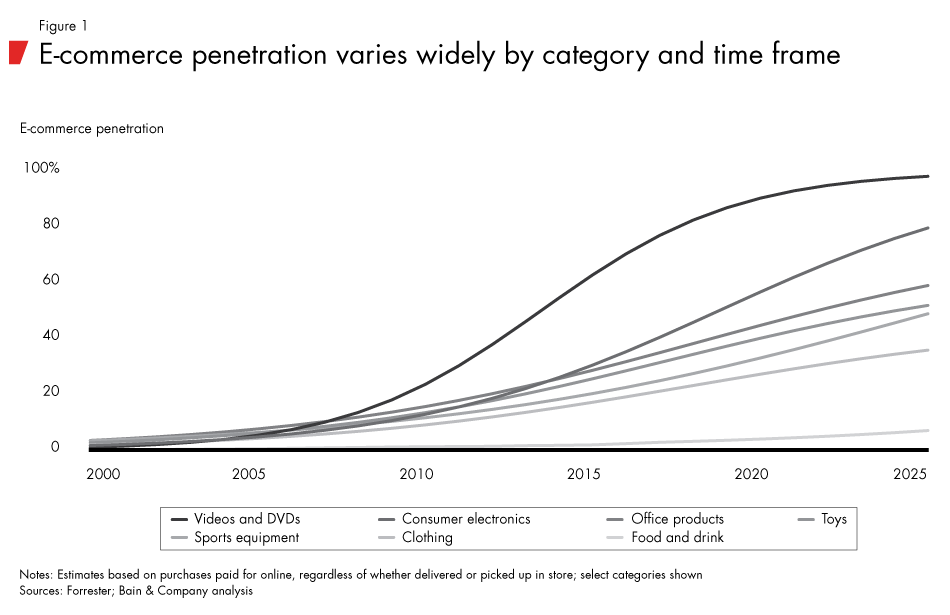
The e-commerce freight train is bearing down on all sectors, but it's important to distinguish between those that have already felt its full impact and those that are feeling it now. An e-commerce penetration curve shows where a category's sales growth is coming from (online vs. in store) and where the trend is headed (see Figure 1). Predicting future penetration takes into account factors like online pricing, customers' ability to find what they are looking for in stores, and how easy it is to deliver or return goods. The landscape is always shifting, as retailers constantly innovate to lift the constraints on e-commerce adoption and improve their omnichannel experiences.
Knowledge of the major players in each category is critical. What investments are they making to shift sales online or increase in-store purchases? How is Amazon likely to play its hand? Amazon CEO Jeff Bezos is known to say, "Your margin is my opportunity." Considering that the company's stock price is fueled by growth, big profit pools, especially those with limited online penetration, are most at risk of Amazon investing heavily to win.
While penetration for large categories may be readily known, target companies frequently play in specific subcategories that deviate from the aggregated category curve. Mass beauty and luxury beauty, basic apparel and fashion apparel, pet food and pet toys—each have different penetration curves. For the grocery business, overall e-commerce penetration is projected to rise slightly by 2025, to just 6% to 8%, due to challenging economics and logistics. But online penetration for shelf-stable products, specialty items and household goods should grow to a higher percentage than that, while penetration for fresh and frozen items will likely be lower. Of course, as Amazon absorbs Whole Foods and retailers react, the situation could change in ways that are highly unpredictable and potentially game changing.
Does the target have a compelling assortment at a good value?
Among Amazon's great strengths is the ability to offer the widest possible assortment at great prices. Factor in free two-day shipping through an Amazon Prime membership, and the advantage can be overwhelming. Whether a target company can compete often depends on whether it can offer customers a unique set of products at a good value. Assessing how the company's brand and product offering overlap with Amazon's is critical to understanding how vulnerable its sales are.
The task can be daunting. For any retailer, the number of SKUs can easily run into the many thousands. Matching these one by one against Amazon and other direct competitors can be a massive effort. Amazon offers hundreds of millions of SKUs, so there is bound to be overlap. The challenge in due diligence is to compare items based on an array of data points, such as price, Prime participation, availability of two-day shipping and whether the item is a third-party product fulfilled by Amazon. If the overlap is extensive, the target offers more expensive products than Amazon does, and Amazon competes with features such as Prime or fulfillment services, then the picture doesn't look good.
That said, even if there is substantial product overlap with Amazon, it isn't game over. A retailer with a well-curated assortment may still be the customer's first choice. Consumers of baby products, for example, may opt for a retailer that offers a wide selection of high-quality goods deemed safe, chemical-free and nonallergenic because they trust that retailer's specialized knowledge and experience. Ultimately, due diligence should identify how well a target company is positioned against Amazon, based on a clear measurement of assortment overlap and the key factors that can mitigate that threat.
Does the target have a differentiated and valued customer experience?
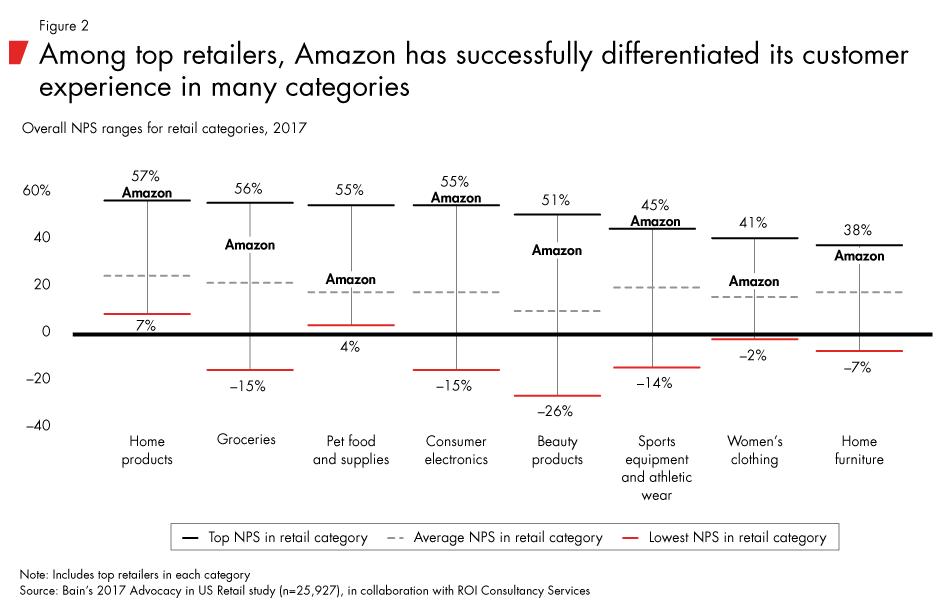
Amazon's customer experience is hardly flashy, but it clearly delivers on the things that matter most to customers. Bain's 2017 Advocacy in US Retail study, conducted in collaboration with ROI Consultancy Services, looked at the Net Promoter Score® (NPS®), a measure of customer advocacy and satisfaction, across top retailers (see Figure 2). The study revealed that Amazon has the highest Net Promoter Score among top retailers for many categories, including home products, consumer electronics and sports equipment. Even in women's clothing, where Amazon has its lowest NPS, it remains among the top 50% of retailers.
Amazon is relentless in its quest for an improved customer experience, and it isn't shy about exploring a multitude of options to see what sticks. Consider the company's approach to apparel sales. Amazon knows that brick-and-mortar stores attract customers who like to try things on. So in relatively short order it has tried a wide variety of tactics to replicate this—offering fit reviews, acquiring Shoefitr and testing Prime Wardrobe, to name a few.
Companies can fight back with a more compelling customer experience, as long as it presents a discernible and defensible advantage. The retailers that are having the most success offer services Amazon can't match—a uniform retailer featuring high-quality tailoring services, for instance, or a retailer offering an omnichannel customer experience that seamlessly blends a full suite of digital features with the advantages of a physical store.
Does the target have a reliable way to drive traffic?
Approximately half of all consumers start their online searches for goods at Amazon. That can be an instant advantage for companies that sell through the online retail giant. For others, it presents a major challenge. Investors need to know where search traffic starts for each category a target company plays in and how the company plans to boost its visibility. Amazon itself is very good at ensuring that its offerings rise to the top of Google searches when it enters a category. But there are highly effective search optimization tools and strategies that companies can use to fight back.
Retailers can also develop an advantage with aggressive strategies to drive people into brick-and-mortar locations. Beauty retailers, for instance, attract foot traffic by offering free consultations and tutorials in person. The key is to analyze traffic holistically to understand how a target generates traffic and whether it will be able to sustain its current flow of customers over time.
The issue of defensibility is at the heart of all four of these questions. If a target company has developed an advantage, how likely is it to persist? Can others (Amazon included) simply replicate it? Context matters a lot. Even if the picture doesn't look great for a target in the face of Amazon, it might look better than it does for competitors, presenting an opportunity to gain share that others lose.
Diligence case study: Big Box Co.
When a big-box category killer put itself up for sale, the Amazon question loomed large for a PE firm considering a bid. The company had a healthy balance sheet and a strong brand relative to its peers. Amazon hadn't made a major move in the category yet, but the firm wanted to understand where the target was vulnerable to a more forceful incursion.
Due diligence centered on building a comprehensive model by marrying Big Data analytic techniques with direct consumer research to determine Amazon's likely impact across 12 product groupings. It measured how defensible the target's position was and what percentage of its margin was at risk.
After defining a set of six key competitors, including Amazon and several traditional retailers, the firm tapped a river of data from the web, using advanced analytics to determine SKU overlap and pricing gaps by product grouping. The data showed where the target company was the price leader, where it trailed and what percentage of its business fell in each category. Extensive customer surveys and industry interviews provided an in-depth look at what spurred different customer segments to shop online, by product grouping. It also quantified how strong the company's overall customer experience was relative to competitors, signaling where it was vulnerable and where it had an advantage despite pricing gaps.
This was less rocket science than digitally enhanced heavy lifting to pry open a view on the company's competitiveness.
The next step was measuring its digital readiness using an omnichannel fitness assessment. This tool scored the target company against Amazon and the others across 50 different metrics, from price and selection to search engine relevance and quality of user interface. It determined how well the target was blending digital offerings with its physical-store advantage to attract customers and create a bulwark against rivals. These insights could then be translated into market share assumptions. They also suggested where improvement might yield upside for a new owner.
An online penetration analysis showed that Internet sales in the category were on the steep part of the curve, growing at 17% compounded annually vs. 5% growth for the category overall. The effect wasn't uniform across product groupings, however. A number of the retailer's more price-sensitive products were seeing a strong pull online. But others, mostly those that customers like to touch and feel before buying, weren't. These factors, adjusted using the company's online and in-store customer experience scores, allowed the firm to develop the clearest view possible of the percentage of revenue and profits at risk—and how soon. The firm could also see how specific factors like price, convenience and a customer appetite for online shopping were affecting the company's competitiveness.
The diligence concluded that the company definitely had exposure to Amazon's growing presence, especially if the Seattle giant decided to expand its assortment to include more items offering price and Prime advantages. But the company also had many competitive advantages vs. its traditional rivals: a more compelling assortment, a higher-quality brand image and an omnichannel customer experience that generated loyalty. These strengths suggested the company might actually benefit if Amazon began to knock off weaker brick-and-mortar rivals, leading to a "last man standing" thesis that gave the firm confidence to keep pursuing the target. In the end, the company's owners pulled the asset off the market, but the diligence turned out to be spot on: As other brick-and-mortar rivals have since fallen by the wayside, the retailer remains a viable player in an attractive category.
This Bain Brief is excerpted from the Bain & Company Global Private Equity Report 2018, which was prepared by Hugh MacArthur, head of Bain & Company’s Global Private Equity practice, and a team led by Brenda Rainey, director of Bain’s Global Private Equity practice, with contributions from Johanne Dessard. The authors thank Graham Elton, Daniel Haas, Mike McKay and Suvir Varma for their contributions. They are also grateful to Karen Harris for her insights as managing director of Bain’s Macro Trends Group; William Dong, Christina Kohlmann and Chris Riha for their analytic support; Emily Lane and John Peverley for their research assistance; and Michael Oneal for his editorial support.
Aaron Cheris, a Bain partner based in San Francisco, leads the firm's Retail practice in the Americas. Monisha De La Rocha is a partner with Bain's Retail practice and is based in New York. Suzanne Tager, a Bain partner based in New York, is the senior director of the Retail and Consumer Products practices in the Americas.
Net Promoter Score® and NPS® are registered trademarks of Bain & Company, Inc., Fred Reichheld and Satmetrix Systems, Inc.
Copyright © 2018 Bain & Company, Inc. All rights reserved. Reprinted with permission.
Published in marzec 2018