

Brief

At a Glance
- As a whole, the consumer packaged goods (CPG) industry is in artificial intelligence (AI) infancy.
- CPG companies struggle to evaluate their AI maturity compared with peers.
- CPGs stand to gain a wide range of benefits across business functions when they apply AI as a means, not an end.
- We have identified five AI maturity archetypes and classified AI use case categories according to scalability and potential value to provide CPGs with a starting point.
Most consumer packaged goods companies (CPGs) have struggled to find solid footing in a turbulent industry. Bain research has found that 34 of the world's top 50 consumer goods companies experienced a decline in revenues, profits or both in recent years,1 forcing CPG executives to find new ways to compete.
Emerging technologies, including AI, have given a sharp advantage to firms in other sectors. Companies at the forefront of AI are household names, known for changing the playing field and reinventing their industries: Amazon, Facebook, Microsoft, Apple. To stay ahead, these leaders are investing heavily in technology. Amazon, for example, ranks No. 1 in R&D, spending more than 10% of its revenues on IT while retailers manage 1% to 2%.
Likewise, insurgent CPG brands with little operational history but deep data are investing in AI to develop an edge. Smaller firms have used data to engage customers through personalization at scale.
Compared with other industries, large CPGs have lagged in AI adoption, possibly put off by early buzz that fizzled into disappointing results (see Figure 1). Despite an uneven track record, CPGs are still expected to increase the number of AI use case attempts over the next three years.
Figure 1


While AI is seen as a way forward, the roadmap at most CPG firms is unclear.
Measuring AI maturity
AI is defined as a machine’s ability to autonomously perceive, understand, make decisions about and react to its environment. In this report we focused on the forerunner to this ultimate vision: advanced analytics and automation technologies aimed at solving one narrowly defined task or problem. We included applications of advanced machine learning in our study.
As a whole, the CPG industry is in AI infancy and lags far behind about a dozen other industries. Of note, industries that are leading in AI, such as retail and tech, are investing more in AI than CPGs—but still not mastering the technology.
To determine where CPGs stand in terms of AI maturity, we assessed the AI landscape to create a baseline. We measured our sample set of companies against two criteria: AI portfolio size and scale realization.
- Portfolio size accounted for the number of AI use case categories a company planned to implement or currently had in progress, as well as any use case categories it had attempted over the past three years.
- Scale realization was calculated by dividing the number of successfully scaled use cases by the total number of use cases attempted. A use case was determined successful if it was later implemented on a larger scale (e.g., across multiple business units or markets) and the results were measured and achieved, even if only partially.
From this data, five AI maturity archetypes emerged (see Figure 2):
Figure 2


AI Scale Leaders
By definition, AI Scale Leaders attempted and scaled more use cases than any other group, and they explored a variety of use cases across functional areas (see Figure 3). With multiple victories and more than half of their use cases scaled, Scale Leaders are eyeing higher-value AI applications. About 12% of respondents fell into this category.
AI Focus Leaders
Compared with other archetypes, AI Focus Leaders invested in fewer use cases but spent a higher percentage of their budget on each use case. AI Focus Leaders scaled nearly half of their attempted use cases, which were targeted on select parts of the organization. Another 12% of respondents matched this profile.
AI Experimenters
AI Experimenters are accomplished in AI in terms of volume, but struggle to achieve consistent results. This group, which comprised about 30% of respondents, scaled only 15% of their AI initiatives.
AI Optimists
AI Optimists are enthusiastic about AI, but have failed to scale any use cases over the past three years. They had the second-largest AI portfolio (19 use cases), although most use cases were planned rather than completed or in progress. About 18% of respondents fell into the AI Optimists category.
AI Starters
About 28% of companies in our sample set were either new to AI and its applications or skeptical about its feasibility and impact. Called the AI Starters, this set tried and planned the fewest use cases of any archetype and didn’t achieve scale on any AI projects. AI Starters are distinguished from Optimists by their lack of interest or intent to pursue AI in the future.
All CPGs, regardless of archetype, struggled to evaluate their AI maturity compared with peers. Most self-assessed their AI maturity as high and believed they were performing above their peers. In reality, fewer than a quarter of CPGs earned leadership status.
Besides the perception gap, other deltas exist. Within the CPG industry, there are deep divides between categories and AI maturity; for example, consumer electronics and food and nutrition are at the forefront, while cosmetics and luxury products are further behind. This points to a link between overall digital maturity and AI readiness.
Learning from AI Leaders
First and foremost, AI leaders use technology to create bespoke solutions to business problems, rather than applying new, powerful technology generically.
Here are two examples where a distinct business problem was solved by AI:
Excessive perishable waste—five times above the industry average—was costing a global packaged food company as much as $100 million per year. Before applying a technology solution to the issue, the company engaged its front line to understand the existing process and its shortcomings. They found that manual forecasting and order processing methods were inaccurate and labor-intensive. The company needed a more streamlined and efficient ordering process to reduce waste and set a clear target to define success.
Then came the technology. To address the business problem, the company created an advanced model platform to forecast demand more accurately. A prototype of a new order management system was built from the model platform and then extensively tested and modified. More than 250 changes were made to the solution over a three-month period before a pilot was launched in four key locations.
The proof of concept showed a 40% to 50% reduction in waste, as well as a 50% reduction in dedicated labor hours. The solution also proved repeatable and additional functionality was identified for scale over an 18-month period.
As a second example, a major apparel maker was faced with high supply chain costs and complex product variations. Those challenges resulted in poor availability, making lost sales a major issue. Even a 1% improvement could provide sizable benefits to its bottom line.
With a good IT infrastructure and enabling technologies in place, the firm deployed AI to analyze its products for sales transferability from the customer’s point of view. The firm also used data to automate size curve planning and to predict more accurate breakdowns by item and by store. Using AI rather than a manual planning process, excess inventory and manpower both declined. And customers experienced better availability.
Pilots and build-out phases leveraged business and functional experts, and country-specific teams helped embed the technology and the new, underlying processes in each market. The apparel firm succeeded, in part, because it had effective change management in place to support the shift. The company understood it wasn’t enough to deliver the right technology; it needed to bring its people on the journey to reach its fullest potential.
These examples, combined with comments from the executives we surveyed and experts we interviewed, helped us identify six key factors that repeatedly contribute to successful AI implementations: a specific business problem with a clearly defined target or goal; availability of high quality data; sufficient time and budget; agile ways of working; enabling technologies; and a compelling AI vision.
The importance of each factor changes with AI maturity. Leaders should assess their firm’s current AI maturity (and vision) to determine which factors are most influential to their journey. Focusing on a few enabling factors at the right time will reap the most benefit.
Where to begin
Thousands of potential AI use cases exist. Without a clear starting point, most CPGs have invested in AI use cases randomly. Of the use case categories surveyed, the most frequently trialed were neither the highest value nor the easiest to implement. Clearly, CPG leaders need to develop an AI strategy.
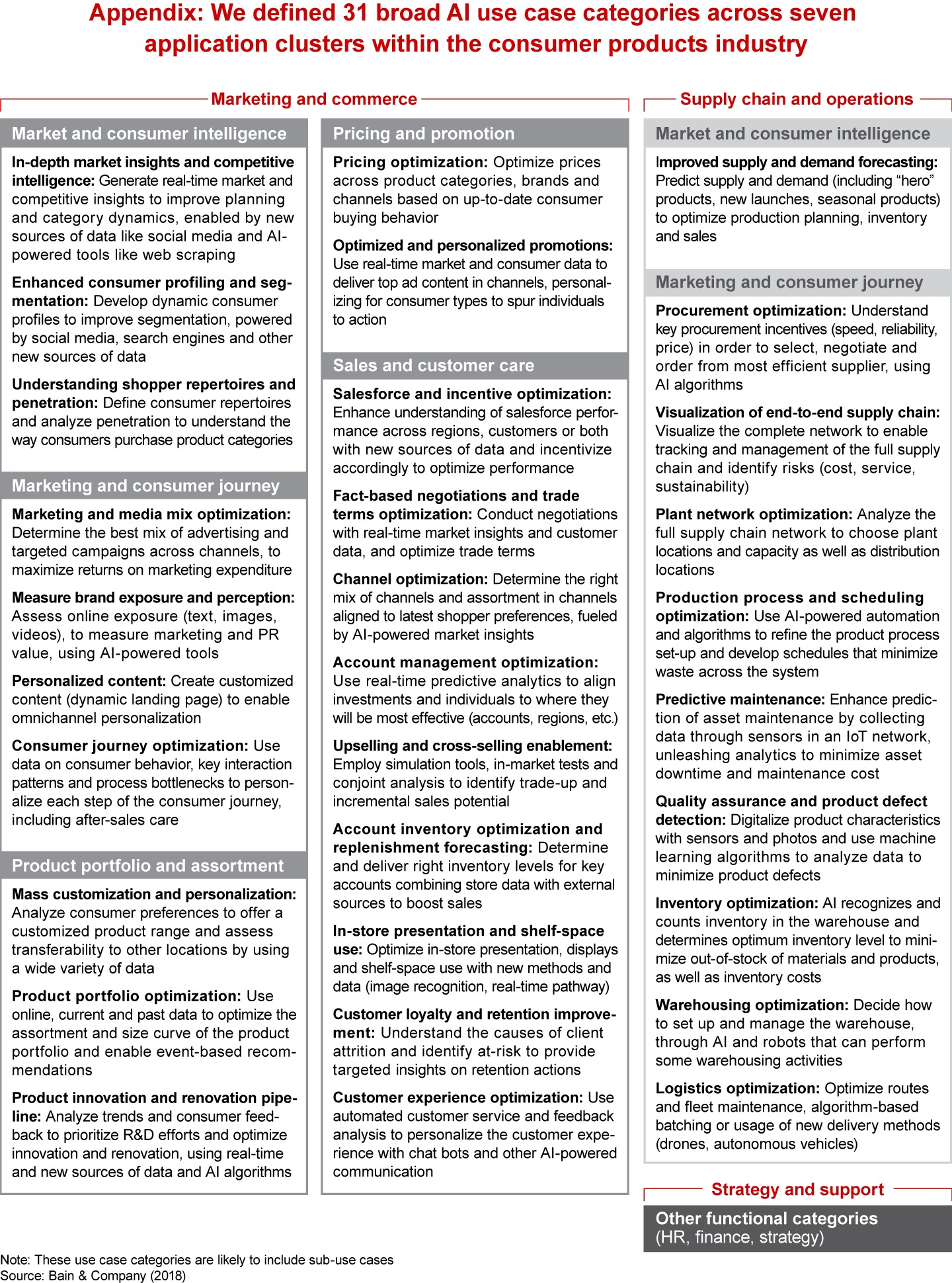
To identify trends, we grouped hundreds of use cases into 31 categories. The categories covered seven applications, which we clustered into three operational buckets—marketing, supply chain and support:

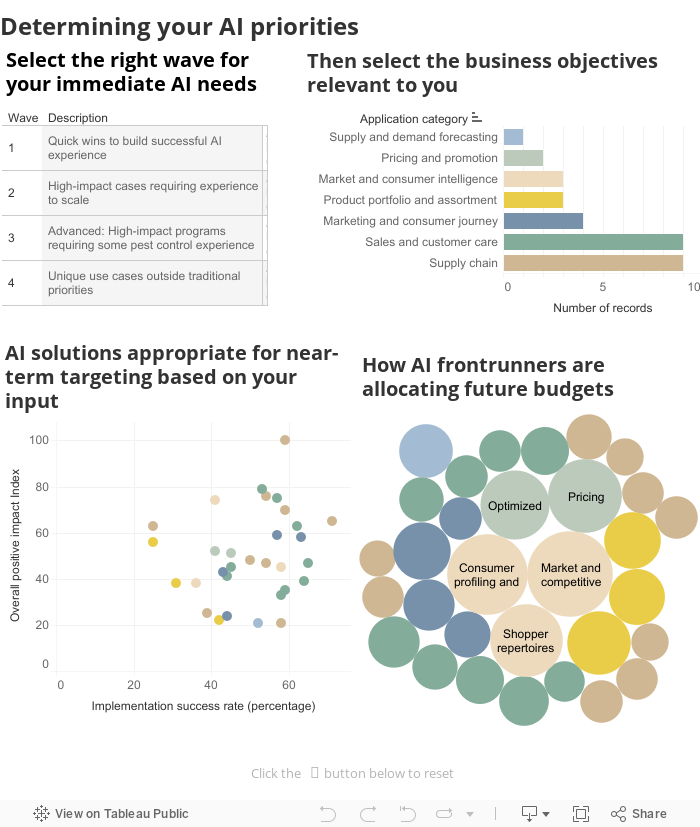
We further classified these use case categories according to scalability and potential value to provide CPG leaders with a starting point for their AI journeys (see Figure 4). Each wave has a dominant functional area; marketing and consumer intelligence use case categories are relevant across all stages of AI maturity because they form a basis for understanding key business needs.
Less-experienced CPGs should build experience and excitement in lower-wave use case categories and then apply their success to larger endeavors found in later waves. With each wave, complexity and the need for cross-departmental collaboration increases.
As CPGs gain AI experience, they can progress across three waves:
Wave 1: Proven AI Moves are easier to implement and consistently achieve scale compared with other use case categories. These experiences build momentum and enthusiasm, which is critical to getting organizational buy-in.
Trade relationships are a key theme among Proven AI Moves and serve as a typical starting point. In this functional area, AI can be applied to address tougher trade negotiations, pricing pressure and competition for shelf space.
Wave 2: Differentiators create higher returns for the organization but are more difficult to coordinate and scale. Procurement, logistics and operations are key themes in this wave and have the potential to differentiate firms. For example, AI could be deployed to drive manufacturing agility or customer responsiveness among larger CPGs that are forced to compete with smaller, more nimble firms.
Wave 2 use case categories include predictive maintenance, customer loyalty and retention programs, and procurement.
Wave 3: Potential Disrupters are “next frontier” implementations, including innovation and R&D work. They require extensive AI experience to successfully scale, as well as cross-functional coordination. While higher risk, Potential Disrupters help AI frontrunners “future-proof” their portfolios and maintain their leadership positions through innovation and R&D.
Examples include product innovations, mass personalization and customization efforts, consumer profiling and segmentation, brand measurement and sophisticated promotions. Achieved at scale, these AI use cases pay off: For example, Crobox is an Amsterdam-based firm that combines psychology and AI to optimize online buying experiences. Online retailers that use Crobox’s machine learning algorithms to generate customer intelligence and detailed shopper profiles have seen average order values increase from 5% to 10% and experienced ROIs of 6x–7x.
Finding your path to leadership
The path to AI leadership varies based on a company’s current AI maturity (see Figure 5). To start, apply our portfolio size and scale realization ratio to pinpoint your archetype (using data to deter overestimation). From there:
Figure 5


- AI Starters should focus on the strategic groundwork needed to support an AI program: data availability, clearly defined metrics of success and agile work processes. Enabling technologies and quality requirements must be established before AI Starters can implement, improve or scale AI. Data and platform investments have driven AI success among the leaders.
- AI Optimists need to test, learn and repeat. Before investing in a broad portfolio of use cases, AI Optimists should pursue small and quick wins to build a learning mindset and a culture of purposeful iteration. For this archetype, optimism must turn into momentum.
- AI Experimenters should aim for greater consistency. As they notch wins, they should transfer their “lessons learned” into best practices. Throughout the organization, there should be a ruthless pursuit of improvement. Leveraging agile work methods and experiences, this group should quickly launch—or halt—pilots to solve differentiating business problems.
- AI Focus Leaders can decide to deepen or broaden their focus. They may choose to remain a Focus Leader by successfully scaling more use cases in a narrow set of categories. Or they can develop into Scale Leaders, reaching AI scale across functional areas. Importantly, AI Focus Leaders are likely to need to fill capability gaps as they advance.
- AI Scale Leaders should extend AI across functional areas and across the value chain. To maintain leadership status, they must pursue cross-functional investment, involvement and governance, as well as the right mix of talent. By doing so, they can gain disruptive competitive advantages.
Across all archetypes, two needs are common: budget and strategy.
AI needs to be sufficiently resourced. For some groups, more funding is needed to be successful. AI Experimenters, for example, could stand to double their current AI investment. Other groups need to reallocate or spread their resources across use cases to accelerate their programs.
Aside from funding, AI programs need to be supported by the right mix of talent and capabilities. “Build or buy” is always going to be a critical decision, according to one expert, who urged executives to evaluate their current and future internal capabilities and decide who is best equipped to build and scale the technology.
Establishing an AI strategy: Practical questions for CEOs
Strategy is paramount to any AI endeavor, regardless of a company’s maturity or ambition. Upfront, leaders must set an AI vision that is in sync with the overall business strategy. Across every archetype, experts also recommended cross-functional collaboration.
As part of the strategy, CEOs must ask:
- Based on trends, gaps or benchmarks, where do we need to improve performance?
- What is the business case for improving performance?
- What are the critical business issues hindering performance? Is a model the bottleneck, or is it something else?
- Do we have the right quantity and quality of data to apply AI?
- How well do our current models perform?
- How do we put predictive ideas and hypotheses to work?
- Is there an existing AI solution that is readily available or easy to deploy?
- Do we have the right mix of talent and capabilities to maintain and evolve such a solution?
Conclusions
If hype often precedes progress, then CPGs may be right on time to benefit from the AI boom. The technology and advantages have been widely accepted. Now, CPGs can dive directly into best practices and proven methodologies forged by other industries.
By examining companies that have charged ahead, we know that:
- CPGs stand to gain a wide range of benefits across a number of business functions when they apply AI as a means, not an end.
- AI should be implemented as the right tool for the job, not applied generically to every business problem.
- Experience matters; CPGs should match use cases to both their business needs and their AI maturity.
One of the experts we spoke to asserted that “any problem solved with AI is actually a human problem.” That is, organizations must effectively address the human element along with the technical, or else the solution will fail to reach its full potential.
To be successful, leaders must stop thinking about AI as “projects” and embrace AI as a way of doing business. Change management and sponsorship play important roles in successfully deploying AI. “Employees are used to operating on experience and intuition,” said one expert. “Switching to data-driven models can be a difficult and contentious change. Ensure that strong sponsorship is established and that you are bringing everyone along on the journey.”
With results, internal momentum will build. But excitement and enthusiasm aren’t substitutes for strategy. Leading AI companies need clear vision, firm leadership commitment and dedicated financial and human resources. Change will persist in the industry. But with AI in its arsenal, CPGs may have the means to ride out—or thrive through—the turbulence.
Research approach
This is the first report produced by Bain & Company on AI and the global CPG industry. Bain defined AI as a machine’s ability to autonomously perceive, understand, decide about and react to its environment. Narrow applications of advanced analytics and automation technologies were the focus of our study.
Bain surveyed 350 executives globally to inform these recommendations. The interviewees were all C-level executives in CPG companies with more than $500 million in annual revenue who had exposure to AI within their organizations. We surveyed their current and historical AI investments, use cases, outcomes and future plans.
In addition, we consulted four experts in the global CPG industry and leaders from an Amsterdam-based AI start-up with experience in the CPG industry. Bain experts were also interviewed extensively, and we leveraged the company’s Advanced Analytics use case library.
Excerpted comments from our interviews are included in the report. In most cases, the identities of participants have been anonymized at the request of the interviewees or their organization.
We developed a framework to evaluate AI maturity that accounts for both effort and result; and distinguishes five distinct levels of AI maturity among CPGs. We also identified six criteria that significantly enable successful AI deployments.
With this insight, we offer concrete steps and strategic questions to help CPG leaders in each phase of AI maturity advance their programs and realize a competitive advantage.
Cesar Brea is a Bain & Company partner and a leader in the firm’s Advanced Analytics practice. He is based in Bain’s Boston office. Jeroen Hegge is a partner in Bain’s Consumer Products and Private Equity practices and is based in Amsterdam. Laurent Hermoye is a partner in the Consumer Products practice and is based in Brussels. Michael Jongeneel is a partner in the firm’s Financial Services practice. He is based in Amsterdam.
Acknowledgments
The authors would like to acknowledge Isabelle Inder, Thijs Bootsma and Isabella Smulders for their contributions to this report. Thanks also to Sanjin Bicanic, Sumner Makin, Florian Mueller, Suzanne Tager and Joëlle de Montgolfier for their contributions.
Notes
- Meacham, Matthew, François Faelli, Eduardo Giménez and John Blasberg. “Overcoming the Existential Crisis in Consumer Goods.” Bain.com, March 7, 2018.
Published in październik 2019