

Brief

At a Glance
- Upstart insurgent brands have met changing consumer needs more quickly than major brands. As a result, they have been capturing a significant share of the growth in consumer goods.
- Based on our research, no consumer product category is immune. And insurgent brands aren't going away, so incumbents will need to understand what makes them successful and how to compete.
- Three critical steps that incumbents can take to stay in the game are finding new ways to leverage their scale, adopting a nimble mindset and becoming the acquirer of choice for insurgent brands.
Brands such as Noosa, Bai and Halo Top didn’t exist 10 years ago, but within a decade, they’ve changed the competitive landscape and become a major thorn in the side of big consumer products companies by capturing a disproportionate share of growth and, in some cases, radically disrupting profit pools.
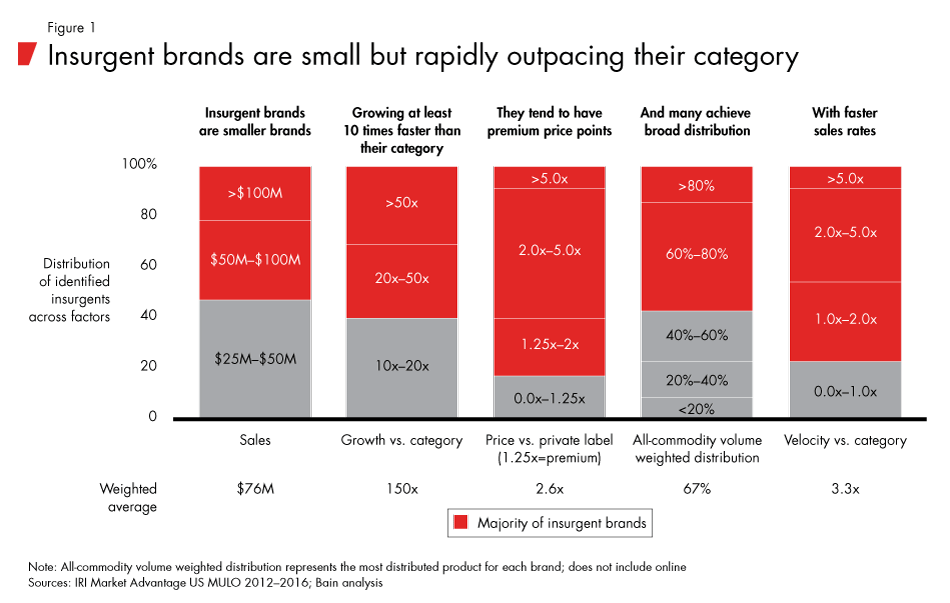
We call these types of brands insurgents. They are dynamic brands with a clear vision and an entrepreneurial mission, committed to fulfilling an unmet need—whether it is for organic peanut butter (Justin’s), more affordable beauty products (e.l.f. Cosmetics), or probiotic beverages (KeVita). Such brands have achieved more than $25 million in annual sales and have outpaced their category growth rates by more than 10 times over the past five years. Some achieved $50 million in annual sales within five years of launch; a few are generating annual revenue in excess of $500 million. While some of these brands have recently been acquired, they achieved their growth largely as independent brands (see Figure 1).
These insurgent brands may only account for 2% of the market share across the 45 categories that they’ve disrupted, yet they captured around 25% of the growth from 2012 to 2016. While they are more prevalent in larger and more fragmented product categories, the reality is that no category is immune to disruption. We’ve seen the consequences play out. Chobani picked up 20% of the US yogurt market within 10 years; Dollar Shave Club and Harry’s led to substantial price drops and market share loss to leaders in the razor category, reshaping profit pools.
As consumer needs change and as these small, nimble brands are able to meet those needs at an increasingly lower cost and faster pace, it is hard to imagine a future in which these brands will not continue to gain meaningful share.
To better understand insurgent brands—to determine who these winners are and why they are booming—we analyzed US brand sales data from IRI for more than 90 fast-moving consumer goods categories, interviewed insurgent brand senior executives, surveyed nearly 5,000 consumers across 10 categories and 57 brands in partnership with Research Now, and drew on our own experience working with private equity funds and major brands that have acquired or manage small brands. While this research reflects the status of insurgents in the US, we are seeing similar trends in other developed markets.1
A number of well-known factors have paved the way for insurgents. Digital technology, contract manufacturing and a ready pool of venture capital have lowered the barriers to entry. Consumer expectations for tailored and specific offerings have increased. Meanwhile, the proliferation of channels, especially online, opens access to consumers outside the bounds of traditional retail.
Insurgent brands also benefit from the intrinsic advantages of being small. They can rely on increasing distribution alone as a path to growth. Unlike new brands at most large consumer goods companies, they have the freedom to pursue niche opportunities and to remain small for a while.
Lessons from insurgents
These factors alone, however, don’t guarantee success. Insurgent brands differentiate themselves by having the traits of what we call a Founder’s Mentality®—an insurgent mission, a frontline obsession and an owner mindset—and provide the following valuable lessons for large consumer packaged goods companies.
Offer a compelling consumer proposition backed by an authentic brand story. Insurgents are competing for the same consumers as established brands. What sets them apart is a compelling offer that addresses a real, unmet consumer need. Our research indicates that consumers rank insurgent brands more highly than incumbent brands on many aspects of brand value, as defined by our Elements of ValueSM approach. The most meaningful differences in which insurgents outperform are on emotional and life-changing benefits.
Two models have emerged. Many insurgents, such as low-calorie ice cream Halo Top, offer higher quality or distinctive attributes at more premium price points. Others, such as shaving goods company Harry’s, feature greater convenience and a better purchase experience by using alternative channels, often at more competitive price points.
Across both of these models, the founders themselves typically embody the brand’s mission, creating a sense of identity that inspires consumer advocacy. Their missions often spur category growth, either by bringing in new consumers or increasing price points, which becomes the backdrop for a positive growth story for retailers. And employees rally behind the brand’s mission, fueling a sense of purpose and conviction at the front line.
Activate brand assets in innovative ways to achieve focused and steady growth. Across categories and countries, increasing penetration is the primary way to build big brands. This is a key insight from the research of the Ehrenberg-Bass Institute for Marketing Science, summarized by Professor Byron Sharp, director of the Institute, in his book How Brands Grow, which is based on decades of observations of buying behavior. In Bain’s view, the three key brand assets for increasing penetration are brand memorability, shopper visibility and range productivity—these are the three assets we emphasize in The Bain Brand Accelerator®, an approach designed to help brands unlock growth.
For large brands, this means scale media campaigns, full distribution across channels, and broad product portfolios covering multiple formats and occasions. Insurgent brands, on the other hand, are winning in large part because their lack of size has forced them to take a unique approach with all three of these brand assets.
- Brand memorability: To bring their brands into consumers’ consideration sets, insurgents build advocacy through targeted sampling and by their presence at local events, both of which encourage consumer-driven, earned media. They complement these efforts by focusing on a core set of likely consumers at a low cost using digital marketing tools. Direct-to-consumer beauty brand Glossier amassed a vibrant community of users who share images of its products on social media. Even its packaging design promotes Instagramable “shelfies.”
-
Shopper visibility: Insurgents recognize that using traditional mass channels early on would risk diluting their brand with lower price points or national scale distribution. Protein bar Quest targeted consumers by selling on specialized bodybuilding websites and partnering with GNC to gain a foothold in specialty channels. Beauty brand e.l.f. Cosmetics created space within retail stores by using its own branded endcaps in order to demonstrate high turns on its SKUs before gaining shelf space in the aisles. Halo Top generated higher velocity on the shelf by using Ibotta and other direct-to-shopper coupon mechanisms to drive top-line growth and encourage retailers to expand distribution while simultaneously expanding its target consumer base from weight-loss dieters to bodybuilders to the broader general public.
Each of these tactics allowed these brands to test and refine their products in the marketplace while building consumer advocacy, maintaining high price points and retaining control over their brand. Insurgents are willing to play a long-term game, learning and adapting their offerings over time. In essence, they limit their growth until they can afford to grow with the right proposition and consumer support. Unlike brands launched by large consumer goods companies, they don’t feel pressure to launch nationally in order to reach significant scale in year one.
- Range productivity: Insurgent brands maintain a disciplined focus on growing their most productive “hero” SKUs, often with the benefit of maintaining high price points and avoiding unnecessary complexity. For example, SkinnyPop focused on achieving high levels of distribution for its core popped popcorn offering before expanding into new formats and adjacent products such as popcorn cakes and microwaveable popcorn.
Build nimble organizations with an owner mindset. Targeting unmet consumer needs and uniquely deploying key brand assets are important ingredients, but they are not enough to account fully for insurgents’ winning models. The ways in which they work, the talent that they bring on board, the ecosystems that they build and the mindset that they instill are the real contributors to their success. Our research has found that insurgent brands can launch new product ideas and get them on store shelves three times faster than their larger competitors.
Insurgents outpace incumbents by having lean, cross-functional organizations and by establishing an ecosystem of partnerships, including co-manufacturers, thereby creating the flexibility and the freedom to adapt in-market. This enables them to test and learn and to rapidly change their course as needed without locking in significant capital expenditures. For example, in response to consumer feedback and in-market performance, Halo Top redesigned its label to highlight calorie count, and Rxbar continually changes the formulation on products that are in-market, even hero SKUs, to make them incrementally better.
As they grow, insurgents attract key talent, increasingly tapping into heavy hitters of the consumer products industry who are looking for high-growth environments. As a result, these brands often have access to much better and more experienced talent than a big consumer goods company would put against a nascent brand. Insurgents are also attracting tech-savvy younger talent who wouldn’t typically consider traditional consumer products companies, and these employees bring with them new capabilities, such as advanced analytics.
Finally, these high-growth brands have an insurgent mindset. Employees throughout the entire organization behave as though they own the business, and they have a conviction that they can redefine a category and solve a real consumer need.
The road ahead for incumbents
So how can large consumer products companies respond? Incumbents can take three critical steps to rejuvenate their brands and access new sources of growth: Redefine the benefits of scale; regain an insurgent mindset; and become the acquirer of choice for insurgent brands.
Redefine the benefits of scale. Make no mistake about it: Big brands still matter. Indeed, they account for significant market share in all categories, and many are still growing. As the landscape around them changes, however, they need to rethink how to create new advantages of scale.
Given their size, major brands have the ability to outinvest not just in traditional areas where scale still matters but in new areas as well—for example, data analytics, digital marketing, nutrition science, emerging technologies, new capabilities and talent. One global brand harnessed its access to Big Data to reduce spoilage that represented upward of 10% of sales. By designing an artificial intelligence–driven demand forecast model that greatly improved the efficiency of its ordering process, paired with a new tool for its sales team that helped spur behavior change, it has been able to reduce waste by 30% to 50% to date. Another global consumer products manufacturer generated revenue 10% to 15% above the status quo by bringing its e-commerce operations in-house and working with FRWD, a digital marketing capability builder, to accelerate its performance on Amazon. The company’s dedicated e-commerce team enabled it to move toward continuous test and learn, hands-on execution and rapid decision making in order to have a more productive partnership with Amazon. This included strategies such as winning priority product placements at times when search rates were highest for its products.
Regain an insurgent mindset as a brand and as a company. Big brands can take a page out of the insurgent playbook—namely, refocusing on what makes them unique to their consumers, embedding that purpose back into the front line and reviving the sense of insurgency that once gave them their entrepreneurial drive. Remember, most big brands were once insurgents themselves.
For big consumer product companies, this means instilling agility into the organization, using cross-functional teams to tackle issues such as key account management or innovation, deploying top talent to address the biggest problems, and launching micro-battles to test and learn before scaling findings across the organization. This is at the core of Bain’s Founder’s Mentality.
One beauty company focused its resources on solving the problem of low consumer engagement with its brand. By applying a micro-battles approach, it developed a minimum viable product within two days and launched a new click-through social media campaign within four weeks. When a consumer products company redefined its forecasting processes with Agile teams, it reduced non-value-added transactional activity by 40% and redeployed these resources to key decision support. The approach allowed the company to rapidly scale these new ways of working across the organization.
Become the acquirer of choice for insurgent brands. Insurgent brands are here to stay, and incumbents have no option but to participate in order to access growth. Unfortunately, large consumer goods companies do not have a strong record for launching new brands that can compete head-to-head against insurgents. In fact, our study of dynamic brands that have achieved annual revenue greater than $25 million and outpaced their category growth rates by more than 10 times over the past five years found that big companies incubated less than 1% of these insurgents.
Incumbents have a higher chance of success by pursuing repeatable M&A, provided they are clear on their strategy and integrate thoughtfully. There are different ways to get into the M&A game, including buying scale insurgents or taking a venture capital approach. Regardless of the path, there needs to be a clear competitive advantage that positions the company as the acquirer of choice. For example, consumer goods companies with unique assets, such as chilled logistics networks or large consumer data sets, can offer clear scale advantages, while companies with a repeatable international expansion approach can target local brands looking for global expansion.
Where we see most acquisitions fail is in integration.
Many consumer goods companies inevitably try to scale insurgent brands too quickly by rapidly integrating them within the core business. Some functions such as sourcing and distribution most likely will create scale advantages and should be integrated. Other areas, however, including HR incentives and headquarter locations, must remain separate to protect a small brand’s creative core. And in areas such as sales, marketing, research and development, and production, allowing the insurgent brand the freedom to opt into integrating, to access some services or to remain fully independent will help ensure that it retains its entrepreneurial culture.
While it is too early to call successes, some major consumer goods companies are showing signs of getting insurgent acquisitions right. Anheuser-Busch InBev, for example, has repeatedly been able to accelerate the growth of craft brands such as Goose Island, Elysian and Blue Point following their acquisitions.
As insurgent brands continue to grow and take share, consumer product companies looking to reassert themselves are rethinking their brand growth playbook, reigniting the entrepreneurial spirit that was once at the heart of their success and acquiring strategically. These steps are key for incumbents hoping to capture a greater share of future growth and defend against insurgents’ advances.
1 The information contained herein is based in part on data reported by IRI through its Market Advantage service as interpreted solely by Bain & Company, Inc. Any opinions expressed herein reflect the judgment of Bain & Company, Inc. and are subject to change.
Brian McRoskey and John Blasberg are Bain & Company partners based in Boston and members of the firm’s Consumer Products practice. Charlotte Apps is the Americas Consumer Products & Retail practice manager based in Toronto.
The authors would like to thank Cameron Murphy, Vinayak Modi and Janelle Tam for their contributions to this work.
Founder’s Mentality® and The Bain Brand Accelerator® are registered trademarks of Bain & Company, Inc. Elements of ValueSM is a service mark of Bain & Company, Inc.
Published in maj 2018