
Skip to Content
  • Offices

    Offices

    North & Latin America
    • Atlanta
    • Austin
    • Bogota
    • Boston
    • Buenos Aires
    • Chicago
    • Dallas
    • Denver
    • Houston
    • Los Angeles
    • Mexico City
    • Minneapolis
    • Monterrey
    • Montreal
    • New York
    • Rio de Janeiro
    • San Francisco
    • Santiago
    • São Paulo
    • Seattle
    • Silicon Valley
    • Toronto
    • Washington, DC
    Europe & Africa
    • Amsterdam
    • Athens
    • Berlin
    • Brussels
    • Copenhagen
    • Dusseldorf
    • Frankfurt
    • Helsinki
    • Istanbul
    • Johannesburg
    • Kyiv
    • Lisbon
    • London
    • Madrid
    • Milan
    • Munich
    • Oslo
    • Paris
    • Rome
    • Stockholm
    • Vienna
    • Warsaw
    • Zurich
    Middle East
    • Doha
    • Dubai
    • Riyadh
    Asia & Australia
    • Bangkok
    • Beijing
    • Bengaluru
    • Brisbane
    • Ho Chi Minh City
    • Hong Kong
    • Jakarta
    • Kuala Lumpur
    • Manila
    • Melbourne
    • Mumbai
    • New Delhi
    • Perth
    • Seoul
    • Shanghai
    • Singapore
    • Sydney
    • Tokyo
    See all offices
  • Alumni
  • Media Center
  • Subscribe
  • Contact
  • Global

    Select your region and language

    Global
    • Global (English)
    North & Latin America
    • Brazil (Português)
    • Argentina (Español)
    • Canada (Français)
    • Chile (Español)
    • Colombia (Español)
    Europe, Middle East, & Africa
    • France (Français)
    • DACH Region (Deutsch)
    • Italy (Italiano)
    • Spain (Español)
    • Greece (Elliniká)
    Asia & Australia
    • China (中文版)
    • Korea (한국어)
    • Japan (日本語)
  • Saved items (0)
    Saved items (0)

    You have no saved items.

    Bookmark content that interests you and it will be saved here for you to read or share later.

    Explore Bain Insights
  • Industries
    Main menu

    Industries

    • Aerospace & Defense
    • Agribusiness
    • Chemicals
    • Construction & Infrastructure
    • Consumer Products
    • Financial Services
    • Healthcare & Life Sciences
    • Industrial Machinery & Equipment
    • Media & Entertainment
      Industries
      Media & Entertainment
      • Media Lab
    • Metals
    • Mining
    • Oil & Gas
    • Paper & Packaging
    • Private Equity
      Industries
      Private Equity
      • Due Diligence
      • Exit Planning
      • Firm Strategy & Operations
      • Portfolio Value Creation
    • Social Impact
    • Retail
    • Technology
    • Telecommunications
      Industries
      Telecommunications
      • Capital Expenditure
      • Telco Digital Transformation
    • Transportation
    • Travel & Leisure
    • Utilities & Renewables
  • Consulting Services
    Main menu

    Consulting Services

    • Customer Experience
    • Sustainability
    • Innovation
    • M&A
    • Operations
    • People & Organization
    • Private Equity
    • Sales & Marketing
    • Strategy
    • AI, Insights, and Solutions
    • Technology
    • Transformation
  • Digital
  • Insights
    Main menu

    Insights

    • Industry Insights
    • Services Insights
    • Bain Books
    • Webinars
    • Bain Futures
    View all Insights
    Featured topics
    • Tariff Response
    • Artificial Intelligence
    • Thriving in Uncertainty
    • Executive Conversations
    • Macro Trends
    • M&A Report
    • Healthcare Private Equity Report
    • Paper & Packaging Report
    • Technology Report
    • CEO's Guide to Sustainability
    • CEO Insights
    • CFO Insights
    • COO Insights
    • CIO Insights
    • CMO Insights
    View all featured topics
  • About
    Main menu

    About

    • What We Do
    • What We Believe
    • Our People & Leadership
    • Client Results
    • Awards & Recognition
    • Global Affiliations
    Further: Our global responsibility
    • Sustainability
    • Social Impact
    • World Economic Forum
    Learn more about Further
  • Careers
    Main menu

    Careers

    • Work with Us
      Careers
      Work with Us
      • Find Your Place
      • Our Work Areas
      • Integrated Teams
      • Students
      • Internships & Programs
      • Recruiting Events
    • Life at Bain
      Careers
      Life at Bain
      • Blog: Inside Bain
      • Career Stories
      • Our People
      • Where We Work
      • Supporting Your Growth
      • Affinity Groups
      • Benefits
    • Impact Stories
    • Hiring Process
      Careers
      Hiring Process
      • What to Expect
      • Interviewing
    FIND JOBS
  • Offices
    Main menu

    Offices

    • North & Latin America
      Offices
      North & Latin America
      • Atlanta
      • Austin
      • Bogota
      • Boston
      • Buenos Aires
      • Chicago
      • Dallas
      • Denver
      • Houston
      • Los Angeles
      • Mexico City
      • Minneapolis
      • Monterrey
      • Montreal
      • New York
      • Rio de Janeiro
      • San Francisco
      • Santiago
      • São Paulo
      • Seattle
      • Silicon Valley
      • Toronto
      • Washington, DC
    • Europe & Africa
      Offices
      Europe & Africa
      • Amsterdam
      • Athens
      • Berlin
      • Brussels
      • Copenhagen
      • Dusseldorf
      • Frankfurt
      • Helsinki
      • Istanbul
      • Johannesburg
      • Kyiv
      • Lisbon
      • London
      • Madrid
      • Milan
      • Munich
      • Oslo
      • Paris
      • Rome
      • Stockholm
      • Vienna
      • Warsaw
      • Zurich
    • Middle East
      Offices
      Middle East
      • Doha
      • Dubai
      • Riyadh
    • Asia & Australia
      Offices
      Asia & Australia
      • Bangkok
      • Beijing
      • Bengaluru
      • Brisbane
      • Ho Chi Minh City
      • Hong Kong
      • Jakarta
      • Kuala Lumpur
      • Manila
      • Melbourne
      • Mumbai
      • New Delhi
      • Perth
      • Seoul
      • Shanghai
      • Singapore
      • Sydney
      • Tokyo
    See all offices
  • Alumni
  • Media Center
  • Subscribe
  • Contact
  • Global
    Main menu

    Select your region and language

    • Global
      Select your region and language
      Global
      • Global (English)
    • North & Latin America
      Select your region and language
      North & Latin America
      • Brazil (Português)
      • Argentina (Español)
      • Canada (Français)
      • Chile (Español)
      • Colombia (Español)
    • Europe, Middle East, & Africa
      Select your region and language
      Europe, Middle East, & Africa
      • France (Français)
      • DACH Region (Deutsch)
      • Italy (Italiano)
      • Spain (Español)
      • Greece (Elliniká)
    • Asia & Australia
      Select your region and language
      Asia & Australia
      • China (中文版)
      • Korea (한국어)
      • Japan (日本語)
  • Saved items  (0)
    Main menu
    Saved items (0)

    You have no saved items.

    Bookmark content that interests you and it will be saved here for you to read or share later.

    Explore Bain Insights
  • Industries
    • Industries

      • Aerospace & Defense
      • Agribusiness
      • Chemicals
      • Construction & Infrastructure
      • Consumer Products
      • Financial Services
      • Healthcare & Life Sciences
      • Industrial Machinery & Equipment
      • Media & Entertainment
      • Metals
      • Mining
      • Oil & Gas
      • Paper & Packaging
      • Private Equity
      • Social Impact
      • Retail
      • Technology
      • Telecommunications
      • Transportation
      • Travel & Leisure
      • Utilities & Renewables
  • Consulting Services
    • Consulting Services

      • Customer Experience
      • Sustainability
      • Innovation
      • M&A
      • Operations
      • People & Organization
      • Private Equity
      • Sales & Marketing
      • Strategy
      • AI, Insights, and Solutions
      • Technology
      • Transformation
  • Digital
  • Insights
    • Insights

      • Industry Insights
      • Services Insights
      • Bain Books
      • Webinars
      • Bain Futures
      View all Insights
      Featured topics
      • Tariff Response
      • Artificial Intelligence
      • Thriving in Uncertainty
      • Executive Conversations
      • Macro Trends
      • M&A Report
      • Healthcare Private Equity Report
      • Paper & Packaging Report
      • Technology Report
      • CEO's Guide to Sustainability
      • CEO Insights
      • CFO Insights
      • COO Insights
      • CIO Insights
      • CMO Insights
      View all featured topics
  • About
    • About

      • What We Do
      • What We Believe
      • Our People & Leadership
      • Client Results
      • Awards & Recognition
      • Global Affiliations
      Further: Our global responsibility
      • Sustainability
      • Social Impact
      • World Economic Forum
      Learn more about Further
  • Careers
    Popular Searches
    • Agile
    • Digital
    • Strategy
    Your Previous Searches
      Recently Visited Pages

      Content added to saved items

      Saved items (0)

      Removed from saved items

      Saved items (0)

      Article

      If Not Now, When?

      If Not Now, When?

      The pandemic forced companies to operate differently to survive. Those that keep using what they’ve learned will thrive.

      By Leslie Carroll and John Hazan

      • min read
      }

      Article

      If Not Now, When?
      en

      For large incumbent companies, 2020 began much like any other year. In pursuit of growth, executive teams focused on reducing the complexity and bureaucracy that had crept into their companies over time and slowed them down. They hoped to take their companies’ performance to the next level, but in unfiltered moments, some wondered if they had the organization they would need to get there.

      Since Covid-19 hit, however, many of these leaders have been amazed by the response of their organizations and people. Employees are demonstrating agility, innovation and resilience. Leaders are effectively managing the urgency of the crisis while also preparing for the longer-term recovery. Companies have redoubled their focus on customers, employees and their local communities.

      In short, incumbents have behaved in this crisis as what we call “scale insurgents.” They are leveraging the benefits of size while at the same time displaying the scrappiness more commonly associated with start-ups. In the US consumer products sector, for example, established companies have taken advantage of their supply chain infrastructure, retailer relationships and consumer brand confidence to capture a larger-than-normal slice of category growth this year. Prior to Covid-19, insurgents garnered 35% of sector growth while representing only 3.3% of the market. Since the pandemic, however, their share of sector growth has dropped to just 5% as incumbents have leaned in.

      While employees have had to adjust to drastic changes in the ways they work, they nevertheless report feeling energized by the fact that their companies are acting like start-ups. They are putting purpose at the forefront, focusing on progress over perfection and innovating with the consumer in mind. Overall, employee satisfaction as measured by the Net Promoter SystemSM has increased.

      Of course, many of us are exhausted, and sometimes it feels like chaos—but the good overall results are motivating executives to take a close look at how their organizations have responded to the pandemic and think proactively (see Figure 1).

      Figure 1
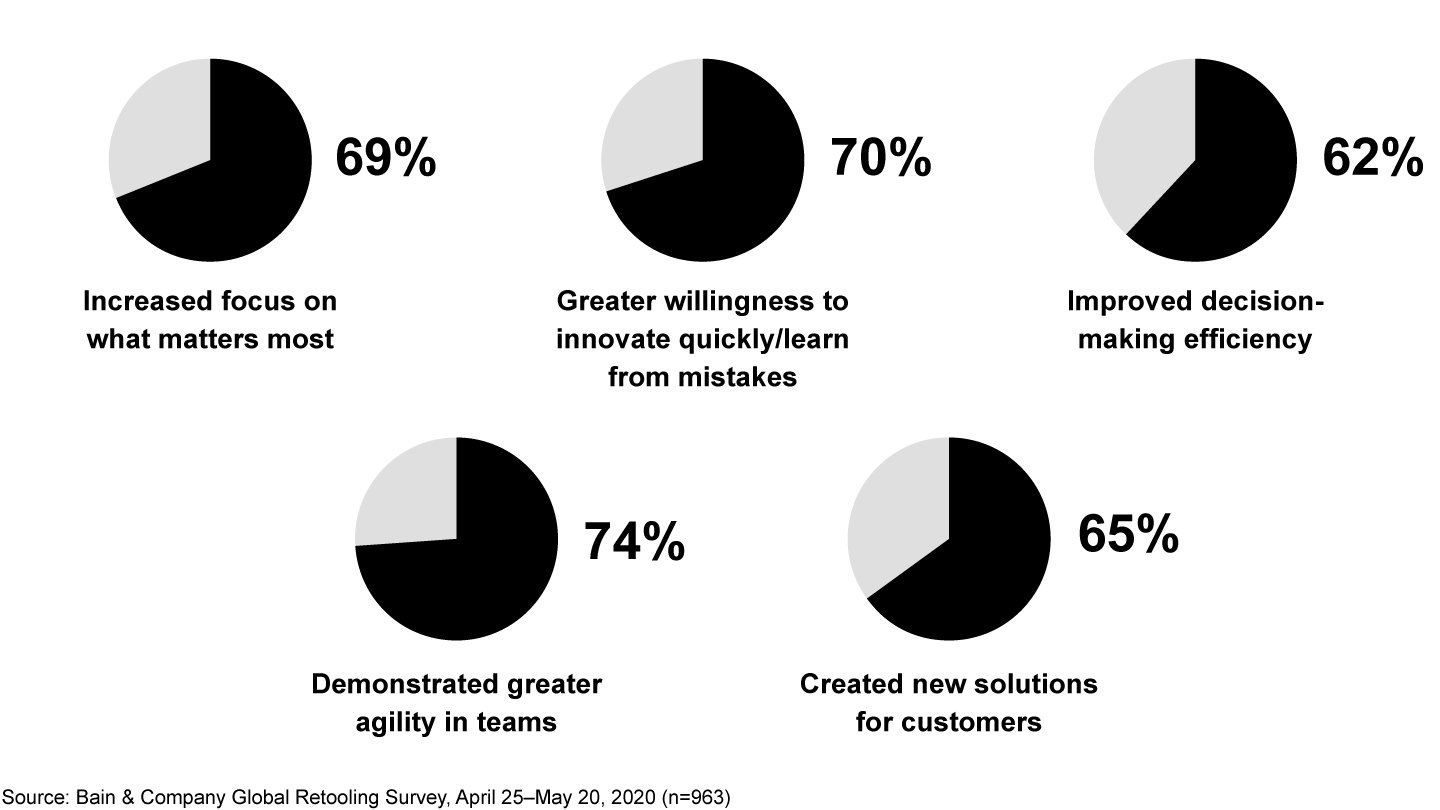
      Workers see companies changing for the better since Covid-19
      Workers see companies changing for the better since Covid-19
      Workers see companies changing for the better since Covid-19

      In the past few months, executives and managers have drastically changed how they work. They have focused on what’s critical and eliminated what’s of little value. This has empowered their teams to become more agile and effective. Many have organically adopted agile methods like holding daily stand-ups, working in fast cycles and creating minimum viable products with customer feedback. All of these challenge slower, traditional waterfall approaches.

      Remote work has also tested how managers engage with employees, access talent and create corporate culture. And in their response to communities in crisis, many organizations have discovered a deeper purpose.

      Four steps to accelerate progress

      Executives hope to capture and nurture the agility, speed and focus their organizations have displayed during the crisis, using it to accelerate progress and emerge from the pandemic stronger. To do this, forward-thinking CEOs are focusing on four Covid-19 lessons to recharge their organizations for the future.

      Make purpose the imperative. To keep employees inspired and motivated, managers are working to reveal, champion and scale behavior and decisions that prioritize the company’s deeper purpose.

      Prior to the crisis, only three in ten employees could identify their company‘s purpose. It was often too generic, lacking depth and meaning, and not clearly tied to corporate expertise. All too often, it simply was not “lived” in key moments.

      For many, Covid-19 has changed that. Employees have noticed companies expanding their sphere of purpose, and a majority report feeling proud of their company’s support of the community through the crisis. Responding to our recent survey, 64% of employees said they were proud of the actions their company has taken to support the broader community, and 75% were proud of how their company supported its employees. 

      After the onset of the pandemic, and facing a big drop in industry sales, Ford Motor Company halted its automobile production and asked the question “How can we help?” Ford rapidly restructured its assembly lines to manufacture tens of thousands of ventilators for Covid-19 patients, which it is selling to the government at cost―a way to do good while riding out a sharp downturn. In many other categories, manufacturers and retailers have come together with the singular purpose of getting product to customers in need.    

      Tap the advantages of a distributed workforce. Companies can increase their capabilities by broadening their talent pool, accessing talent wherever it is, and leveraging remote collaboration, ecosystem partnerships and the gig economy.

      This was already true before Covid-19, as digital technology and new business models supported the emergence of more fluid talent models. These new approaches to talent loosen the historical connection between work and location and better match the aspirations of people in their 20s and 30s. They are flexible and provide continuous access to the newest skills, often incubated outside the company’s walls. As jobs decouple from location, talent pools open up. Companies will increasingly find the skills they need in the ecosystem of partnerships they have formed in recent years.

      The pandemic has drastically accelerated distributed working, revealing it to be a credible alternative even in situations in which it would have been inconceivable only a few months ago. According to Bain & Company research, since Covid-19, 72% of white-collar employees have been required to work remotely, an experiment in distributed work unparalleled in modern times. The sudden mandated migration of so many has forced companies to manage talent in new ways, and they are―perhaps to their own surprise―succeeding at it. The challenge will be to find ways to continue to do it well, sustainably.

      Employees are open to the idea. Before the pandemic, only 14% of white-collar employees preferred to work remotely three or more days per week. Now that they have lived the experience, 41% say they are likely to accept a remote position in the future. 

      Make the most of frontline managers. Frontline managers are best equipped to help frontline workers, who in turn can best meet the needs of customers. This is not a new insight, but the large number of companies acting on it is. Some 62% of respondents to our survey report that decision making has improved in their organization since the crisis hit and that more of it has moved to the front line. Rather than simply provide direction based on experience and expertise, executives are clarifying objectives and priorities, and then helping employees execute them and realize their own potential. That includes removing roadblocks so frontline managers can make better decisions faster.

      After the pandemic forced Chinese cosmetics retailer Lin Qingxuan to close 40% of its stores, the company redeployed over 100 beauty advisers from retail stores to become online influencers. They quickly expanded the brand’s digital presence, hosting livestreamed sessions to recommend products for sale on e-commerce channels. On Valentine’s Day, during a livestreamed shopping event, one adviser’s sales in just two hours equaled that of four retail stores. The company’s February sales climbed 120% over the prior year’s.

      Embrace agile at scale. Nearly three-quarters of employees surveyed report that their teams are working with greater agility. Teams are prioritizing better, embracing the concept of creating a minimum viable product and then improving on it, and doing more cross-functional teaming. Agile ways of working nurture faster decision making and a focus on the customer that will foster innovation.

      During the crisis, use of agile tactics has been ad hoc (or sporadic), but to really capture the full value over time, it needs to be systematic. By formally embedding agile rituals and routines, and implementing agile principles in a more structured fashion, companies can minimize some of the chaos of combining old and new ways of working, further increasing the metabolic rate of the organization.

      Although some companies were hesitant to use agile in the past, their experience during the pandemic has given them faith that they can successfully adopt pretty significant shifts in their ways of working. As a result, experimenting with persistent and project-based agile teams has risen to the top of many executives’ agendas.

      Moving forward stronger

      Companies are at an inflection point. When the urgency of Covid-19 subsides, some will migrate back to familiar, and often bureaucratic, patterns and behaviors. Others will take their pandemic lessons to heart and use those insights to recharge their business.

      The companies that will thrive have learned from the natural experiments of the crisis and come to understand that enduring positive change is within reach. Executives can fight against backsliding by focusing on the four areas outlined above, using them to permanently embed in their organizational DNA the extraordinary behavior and action sparked by the crisis.


      Net Promoter®, NPS®, NPS Prism®, and the NPS-related emoticons are registered trademarks, and Net Promoter Score℠, NPSx℠, and Net Promoter System℠ are service marks of Bain & Company, Inc., NICE Systems, Inc., and Fred Reichheld.

      Authors
      • Leslie Carroll
        Former Partner, Chicago
      • Headshot of John Hazan
        John Hazan
        Partner, Paris
      Contact us
      Related Consulting Services
      • Operating Model & Org Design
      • People and Organization
      People and Organization
      Linking Organizational Effectiveness and Employee Engagement

      A Bain analysis shows that efforts to make an organization more effective also improve employee engagement.

      Read More
      People and Organization
      Consumer Products Companies, Your Strategy Evolves, So Why Doesn’t Your Organization?

      What’s needed now is an organization that can meet the unexpected.

      Read More
      People and Organization
      A Modern Organization For Modern Technology

      In a digital world, the challenge isn’t adopting new technologies. It’s integrating them across organizational silos.

      Read More
      People and Organization
      Taking a Globally Orchestrated Approach to Digital Disruption

      New technologies such as generative AI, quantum computing, and climate technology require unique but complementary managerial muscles.

      Read More
      People and Organization
      Are You Organized to Reap Value from Generative AI?

      The right operating model can speed up return on investment.

      Read More
      Published in wrzesień 2020
      Tags
      • Operating Model & Org Design
      • People and Organization

      How We've Helped Clients

      Moving Beyond an Operating Model Redesign to Live the Model

      Read case study

      Building a winning media salesforce

      Read case study

      A Regional Operating Model Lifts European Sales for a Medical Device Maker

      Read case study

      Ready to talk?

      We work with ambitious leaders who want to define the future, not hide from it. Together, we achieve extraordinary outcomes.

      Stay ahead in a rapidly changing world. Subscribe to Bain Insights, our monthly look at the critical issues facing global businesses.

      *I have read and understand Bain’s Privacy Notice.

      Please read and agree to the Privacy Policy.
      Bain & Company
      Contact us Sustainability Accessibility Terms of use Privacy Modern Slavery Act Statement Cookie Policy Sitemap Log In

      © 1996-2026 Bain & Company, Inc.

      Contact Bain

      How can we help you?

      • Business inquiry
      • Career information
      • Press relations
      • Partnership request
      • Speaker request
      See all offices