
Skip to Content
  • Offices

    Offices

    North & Latin America
    • Atlanta
    • Austin
    • Bogota
    • Boston
    • Buenos Aires
    • Chicago
    • Dallas
    • Denver
    • Houston
    • Los Angeles
    • Mexico City
    • Minneapolis
    • Monterrey
    • Montreal
    • New York
    • Rio de Janeiro
    • San Francisco
    • Santiago
    • São Paulo
    • Seattle
    • Silicon Valley
    • Toronto
    • Washington, DC
    Europe & Africa
    • Amsterdam
    • Athens
    • Berlin
    • Brussels
    • Copenhagen
    • Dusseldorf
    • Frankfurt
    • Helsinki
    • Istanbul
    • Johannesburg
    • Kyiv
    • Lisbon
    • London
    • Madrid
    • Milan
    • Munich
    • Oslo
    • Paris
    • Rome
    • Stockholm
    • Vienna
    • Warsaw
    • Zurich
    Middle East
    • Doha
    • Dubai
    • Riyadh
    Asia & Australia
    • Bangkok
    • Beijing
    • Bengaluru
    • Brisbane
    • Ho Chi Minh City
    • Hong Kong
    • Jakarta
    • Kuala Lumpur
    • Manila
    • Melbourne
    • Mumbai
    • New Delhi
    • Perth
    • Seoul
    • Shanghai
    • Singapore
    • Sydney
    • Tokyo
    See all offices
  • Alumni
  • Media Center
  • Subscribe
  • Contact
  • Global

    Select your region and language

    Global
    • Global (English)
    North & Latin America
    • Brazil (Português)
    • Argentina (Español)
    • Canada (Français)
    • Chile (Español)
    • Colombia (Español)
    Europe, Middle East, & Africa
    • France (Français)
    • DACH Region (Deutsch)
    • Italy (Italiano)
    • Spain (Español)
    • Greece (Elliniká)
    Asia & Australia
    • China (中文版)
    • Korea (한국어)
    • Japan (日本語)
  • Saved items (0)
    Saved items (0)

    You have no saved items.

    Bookmark content that interests you and it will be saved here for you to read or share later.

    Explore Bain Insights
Bain.com Homepage
Founder's Mentality®
  • Overview
  • About
    Bain.com Homepage
    Founder's Mentality®

    About

    • About Founder's Mentality
    • About Micro-battles
  • Podcast
  • Book
  • Blog
  • Offices
    Main menu

    Offices

    • North & Latin America
      Offices
      North & Latin America
      • Atlanta
      • Austin
      • Bogota
      • Boston
      • Buenos Aires
      • Chicago
      • Dallas
      • Denver
      • Houston
      • Los Angeles
      • Mexico City
      • Minneapolis
      • Monterrey
      • Montreal
      • New York
      • Rio de Janeiro
      • San Francisco
      • Santiago
      • São Paulo
      • Seattle
      • Silicon Valley
      • Toronto
      • Washington, DC
    • Europe & Africa
      Offices
      Europe & Africa
      • Amsterdam
      • Athens
      • Berlin
      • Brussels
      • Copenhagen
      • Dusseldorf
      • Frankfurt
      • Helsinki
      • Istanbul
      • Johannesburg
      • Kyiv
      • Lisbon
      • London
      • Madrid
      • Milan
      • Munich
      • Oslo
      • Paris
      • Rome
      • Stockholm
      • Vienna
      • Warsaw
      • Zurich
    • Middle East
      Offices
      Middle East
      • Doha
      • Dubai
      • Riyadh
    • Asia & Australia
      Offices
      Asia & Australia
      • Bangkok
      • Beijing
      • Bengaluru
      • Brisbane
      • Ho Chi Minh City
      • Hong Kong
      • Jakarta
      • Kuala Lumpur
      • Manila
      • Melbourne
      • Mumbai
      • New Delhi
      • Perth
      • Seoul
      • Shanghai
      • Singapore
      • Sydney
      • Tokyo
    See all offices
  • Alumni
  • Media Center
  • Subscribe
  • Contact
  • Global
    Main menu

    Select your region and language

    • Global
      Select your region and language
      Global
      • Global (English)
    • North & Latin America
      Select your region and language
      North & Latin America
      • Brazil (Português)
      • Argentina (Español)
      • Canada (Français)
      • Chile (Español)
      • Colombia (Español)
    • Europe, Middle East, & Africa
      Select your region and language
      Europe, Middle East, & Africa
      • France (Français)
      • DACH Region (Deutsch)
      • Italy (Italiano)
      • Spain (Español)
      • Greece (Elliniká)
    • Asia & Australia
      Select your region and language
      Asia & Australia
      • China (中文版)
      • Korea (한국어)
      • Japan (日本語)
  • Saved items  (0)
    Main menu
    Saved items (0)

    You have no saved items.

    Bookmark content that interests you and it will be saved here for you to read or share later.

    Explore Bain Insights
Founder's Mentality®
  • Industries
    • Industries

      • Aerospace & Defense
      • Agribusiness
      • Chemicals
      • Construction & Infrastructure
      • Consumer Products
      • Financial Services
      • Healthcare & Life Sciences
      • Industrial Machinery & Equipment
      • Media & Entertainment
      • Metals
      • Mining
      • Oil & Gas
      • Paper & Packaging
      • Private Equity
      • Social Impact
      • Retail
      • Technology
      • Telecommunications
      • Transportation
      • Travel & Leisure
      • Utilities & Renewables
  • Consulting Services
    • Consulting Services

      • Customer Experience
      • Sustainability
      • Innovation
      • M&A
      • Operations
      • People & Organization
      • Private Equity
      • Sales & Marketing
      • Strategy
      • AI, Insights, and Solutions
      • Technology
      • Transformation
  • Digital
  • Insights
    • Insights

      • Industry Insights
      • Services Insights
      • Bain Books
      • Webinars
      • Bain Futures
      View all Insights
      Featured topics
      • Tariff Response
      • Artificial Intelligence
      • Thriving in Uncertainty
      • Executive Conversations
      • Macro Trends
      • M&A Report
      • Healthcare Private Equity Report
      • Paper & Packaging Report
      • Technology Report
      • CEO's Guide to Sustainability
      • CEO Insights
      • CFO Insights
      • COO Insights
      • CIO Insights
      • CMO Insights
      View all featured topics
  • About
    • About

      • What We Do
      • What We Believe
      • Our People & Leadership
      • Client Results
      • Awards & Recognition
      • Global Affiliations
      Further: Our global responsibility
      • Sustainability
      • Social Impact
      • World Economic Forum
      Learn more about Further
  • Careers
    Popular Searches
    • Agile
    • Digital
    • Strategy
    Your Previous Searches
      Recently Visited Pages

      Content added to saved items

      Saved items (0)

      Removed from saved items

      Saved items (0)

      Founder's Mentality Blog

      Micro-battles and Building New Businesses

      Micro-battles and Building New Businesses

      Business building is already in your DNA—or you would never have become a large successful company. But you need to find it again.

      By James Allen

      • min read
      }

      Article

      Micro-battles and Building New Businesses
      en

      As we’ve worked with companies on micro-battles, we’ve recognized a common pattern: Most large firms have lost the art of business building. What do we mean by business building? Business building is the act of taking an innovative new product or service and determining a go-to-market strategy and ecosystem position that will create a sustainable competitive advantage. The overall health of that ecosystem, or the ability for all industry players to make money, is a critical factor.

      The drift away from business building has been a long-standing issue for incumbents. Yet many multinational companies only recently realized that they had a problem. When these CEOs started to prioritize China in their growth strategies, they discovered that it’s like a secondary domestic market—a huge place to play with huge local players. China is full of nimble scale insurgents, or firms that compete on the basis of both scale and speed. They are large, fast and disruptive. In order to win in China, CEOs needed more than an extension of their existing business model; they needed a new business. But they found out that their organizations weren’t very good at building them.

      Your China problem isn’t just about China; it is a proxy for your lost art. As the nature of strategy continues to evolve, it is increasingly about building new businesses rather than running existing businesses. In order to compete with the fast and fearless firms of the future, companies will need to rediscover the importance of business building and launch efforts to institutionalize this critical skill. CEOs can engage the organization in these efforts by taking four courses of action.

      No. 1: Develop a robust scaling community

      The most effective business builders recognize and nurture three communities. To innovate, you rely on your Agile/disruptive/innovator community. The members of this community focus on disrupting your current company. They are your key to creating a new business model. To deliver innovation to customers through the right route to market, you need your expert/execution community. They execute flawlessly through daily routines. The scaling community is the critical link between these two groups. Scalers translate disruptive ideas into something that can exist in the world of routines. Establishing a robust scaling community is a crucial first step in relearning how to build businesses. Without scalers, your innovations are likely to stall or remain regionally confined, deprived of scale benefits. In our profiling work with The Chemistry Group, a London-based research firm that helps organizations get the most out of their people, we found that scalers are built, not born. Companies can build their scaling communities by presenting the right opportunities for members to learn and grow. Micro-battles are one way to create these experiences.

      No. 2: Launch micro-battles

      These fast-moving, cross-functional initiatives provide a structured way to flex your business-building muscles and grow your scaling community. Micro-battles require organizations to hone three necessary skills.

      • Scaling: In micro-battles, teams translate bold strategic initiatives into prototypes that customers can assess. They also learn how to scale a winning prototype into a business that creates a competitive advantage. Ultimately, by running micro-battles, teams learn how to scale ideas. They help their organization think beyond innovation. They not only think about what the new product or service is but also how to build a business that delivers the product or service across multiple markets.
      • Learning: Companies that engage in micro-battles also rediscover the experience curve in their businesses by reintroducing a learning agenda. Several authors have focused on business learning recently—most notably, Cal Newport, with his notion of “deep work”; Matthew Syed, with his notion of “purposeful practice”; and Malcolm Gladwell, with his notion of “10,000 hours.” Through micro-battles, we want companies to learn by focusing their best people on deep work, those cognitively demanding tasks that contribute to the organization’s insurgent mission. Micro-battle teams can develop skills (particularly scaling) through experience, or purposeful practice. Senior leaders can dedicate at least 10,000 hours to master business building.
      • Leading: Senior leaders must also learn how to amplify the impact of each individual micro-battle. Our micro-battles approach incorporates a founder’s mindset—that is, the desire to constantly improve and grow an idea with each round of test and learn. Through micro-battles, senior leaders gradually shift their behaviors. They refrain from shutting down ideas and adopt the more insurgent attitudes of business builders.

      No. 3: Build Engine 2

      The goal of micro-battles is to pursue the foundational building blocks of a scale insurgent. Large incumbent companies that have lost their sense of insurgency can focus on building what we call Engine 2. Engine 1 is your core business and your primary source of cash. It’s often a mature business. Profitable growth depends on everyone working hard to sweat the assets, pulling every benefit of scale. Engine 2 is your newer growth businesses. It has great potential, but it won’t generate cash for years to come. It is an ideal platform for rediscovering business building.

      This isn’t to say that innovation doesn’t matter in Engine 1. In fact, you can’t be a leader in Engine 1 without constant renewal. You’re always innovating with new products and services. But you’re offering them through an existing business, in which you understand how to go to market and know your role in the ecosystem. As a result, all of your financial models around innovation bank on gross margin or operating margin economics. Your teams must predict the price of the product and compare it with the cost of goods sold (gross margin). They must sort out selling costs (operating margin), forecast forward and discount back to determine a positive or negative net present value for the investment. The Engine 1 team must engage in endless iterations of pricing predictions over three to five years. They want to control variance. They want a predictable pattern before they approve a business model.

      Engine 2, on the other hand, is about building new businesses. In business building, predicting gross margin and operating margin is often less than 10% of the value that will be created. The modeling of gross margin assumptions perpetuates false predictability and distracts you from the critical task of creating a new market. It is far more important to determine a go-to-market strategy and ecosystem position (see Figure 1). Both of these factors help companies create a sustainable competitive advantage and command a significant share of the market profit pool.

      Nurturing Engine 2 is critical for sustainable, profitable growth. As CEOs rediscover the importance of business building, Engine 2 can be a place to experiment and reinvent ways of learning. It can generate new ideas that can apply to Engine 1. The CEO becomes a portfolio manager between the two engines. We have found that this idea helps CEOs realize the need to liberate time from delivering today’s business and devote it to helping develop tomorrow’s business.

      Figure 1
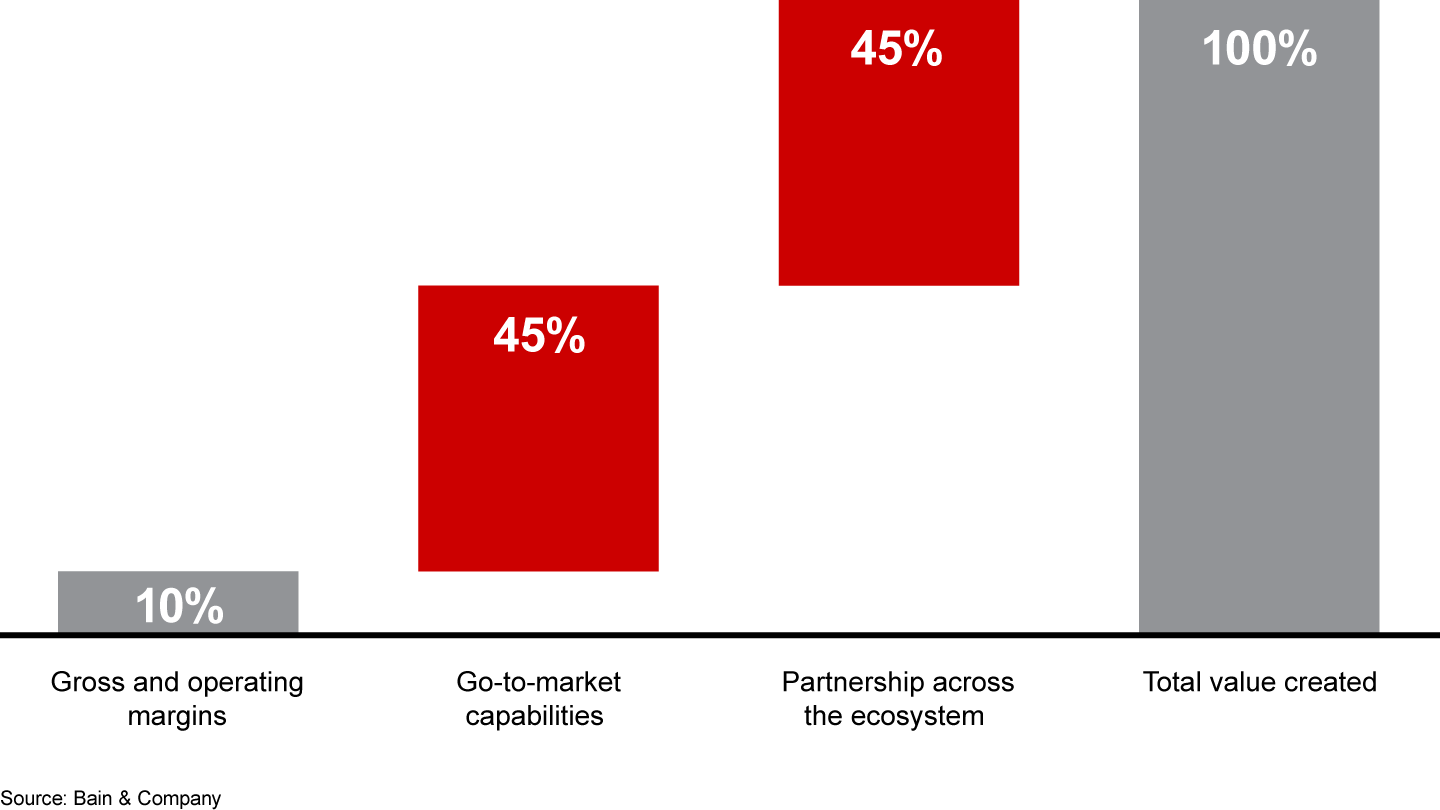
      The value created by business building depends largely on new markets and ecosystem roles
      The value created by business building depends largely on new markets and ecosystem roles
      The value created by business building depends largely on new markets and ecosystem roles

      No. 4: Balance your delivery and development agendas

      To build new businesses, firms need to tackle the unknowns in their long-term planning, or their development agenda. The capabilities built in Engine 2 are all about development. In Engine 1, however, you primarily focus on what the current business can deliver, or the delivery agenda. This agenda takes a huge amount of time and energy from Engine 1. It also comes at a cost. The leaders of Engine 1 spend significantly less time on the development agenda—namely, building new businesses.

      But you absolutely need business-building capabilities in Engine 1 because you have to manage the unknowns. Conversely, as Engine 2 matures, it will require delivery capabilities. Engine 2 is a terrific place to exercise your business-building mojo and hardwire it into your everyday processes. Once mastered, these business-building capabilities can board the mother ship, Engine 1.

      As we discuss in our book, The Founder’s Mentality, when you rediscover the art of business building, you’re often going back to the first generation of your company. You’re returning to a time when your leaders were incredibly disruptive and committed to building a new and varied business. Business building is in your DNA—or you would never have become a large successful company. You simply need to rediscover and embed the skill set.

      James Allen is a senior partner with Bain’s Global Strategy practice, and he is based in London. James coauthored The Founder’s Mentality.

      Founder's Mentality®

      Micro-battles

      Want to learn more about the journey to scale insurgency? Explore the Bain Micro-battles System℠, step by step.

      Related

      Rediscover the Insurgency and Capability Spikes to Accelerate Growth

      Core leadership principles lie at the foundation of a company’s success.

      Authors
      • Headshot of James Allen
        James Allen
        Advisory Partner, London
      Contact us
      Related Consulting Services
      • Business Strategy
      How We Can Help
      • Bain Micro-battles System®
      Change Management
      Micro-battles and the Journey to Scale Insurgency

      Discrete, fast-moving initiatives bring focus to strategic choices and help companies rediscover the art of getting stuff done.

      Read More
      Strategy
      Rediscover the Insurgency and Capability Spikes to Accelerate Growth

      Core leadership principles lie at the foundation of a company’s success.

      Read More
      Strategy
      Build Engine 2 to Challenge Industry Rules and Boundaries

      Sustainable growth demands the ability to explore and commit to new revenue streams to offset the natural slowing of a mature core business.

      Read More
      Founder's Mentality
      Covid-19: Is Your Board Hitting the Brakes on CEO Succession?

      Crises slow the most critical leadership decisions.

      Read More
      Founder's Mentality
      The Magic of Founder-led Companies

      Companies with their founder present performed twice as well as their peers in the S&P 500 over the past decade.

      Read More
      Published in kwiecień 2019
      Tags
      • Bain Micro-battles System®
      • Business Strategy
      • Founder's Mentality

      How We've Helped Clients

      Springtime for April as a Digital Transformation Takes Root

      Read case study

      Better Forecasts, Less Waste Boost Grupo Bimbo’s Profitability

      Read case study

      How Micro-battles Powered a Brand and Sales Lift at BeautyCo

      Read case study

      Ready to talk?

      We work with ambitious leaders who want to define the future, not hide from it. Together, we achieve extraordinary outcomes.

      Bain Micro-battles System® is a registered trademark of Bain & Company, Inc.

      Stay ahead in a rapidly changing world. Subscribe to Bain Insights, our monthly look at the critical issues facing global businesses.

      *I have read and understand Bain’s Privacy Notice.

      Please read and agree to the Privacy Policy.
      Bain & Company
      Contact us Sustainability Accessibility Terms of use Privacy Modern Slavery Act Statement Cookie Policy Sitemap Log In

      © 1996-2026 Bain & Company, Inc.

      Contact Bain

      How can we help you?

      • Business inquiry
      • Career information
      • Press relations
      • Partnership request
      • Speaker request
      See all offices