

Paper & Packaging Report

At a Glance
- While many companies have toned down external sustainability messaging, a large number are still investing significantly in circularity.
- In the packaging market globally, 59% of those surveyed said they would switch suppliers if they weren’t meeting their sustainability criteria in three years.
This article is part of Bain's 2026 Paper & Packaging Report.
Reading media articles today, it may seem sustainability is losing momentum, though in paper and packaging, that would be a serious strategic miscalculation. In reality, a gap has opened between what companies say publicly and what leaders are doing internally. While many companies have toned down external messaging on circularity, a large number are still investing significantly.
For packaging, circularity and carbon emissions reduction remain the two most material topics, and regulation is now reshaping economics at scale. In Europe, the Packaging and Packaging Waste Regulation (PPWR) has introduced plastic levies and recycling mandates that meaningfully alter cost competitiveness. Similar trends are emerging in select US states and across parts of Asia.
At the same time, the era of setting ambitions is over and the hard work has just begun. Five years ago, targets were enough to earn credibility. Today, packaging customers are falling behind in their sustainability commitments, and they need help with consistent, cost-effective delivery and systematic monetization of sustainability offerings (see Figure 1). Packaging companies that combine long-term vision with pragmatic execution are already outperforming. Growth leaders in the sector are also leaders in sustainability.
Figure 1
Against this backdrop, three strategic actions stand out.
Preempt the fight of the substrates
The debate over whether to substitute substrates—particularly whether to replace plastic—has been swirling for years. Over time companies are making transitions and more fundamentally rethinking substrates when facing regulatory triggers. Consumers strongly prefer select substrates for perceived environmental reasons, and they tend to associate the sustainability of the packaging with the sustainability of the product.
Meanwhile, regulations such as the PPWR are imposing greater costs on specific substrates and altering the relative cost competitiveness of one substrate vs. another. Finally, in an increasingly saturated consumer goods market, major packaging players are using substitution substrates, especially paper ones, as their main method of growth and putting their full weight behind it.
Leading companies segment the markets with precision. That is, they assess threats and opportunities by application, geography, and substrate economics. They use scenario planning to identify signposts and act early. They also seize near-term opportunities by aligning propositions to the applications where shifts are happening fastest, such as certain beverage categories moving from plastic to fiber or aluminum. Finally, they shape long-term resilience by defining the target substrate portfolio, aligning R&D priorities, and positioning M&A strategy to capture growth while hedging against risk.
Strengthen the value chain proposition
Large consumer packaged goods (CPG) companies are no longer the only ones that drive sustainable innovation. Insurgent brands—often building their identity around sustainability—are setting new standards with creative packaging.
Retailers are following suit, using private labels to differentiate themselves and expand margin. Private labels already account for more than 75% of fast-moving consumer goods growth in Europe, and companies are disproportionately demanding sustainable solutions.
To strengthen their position, winning packaging companies map the value chain. Specifically, they assess relative strength across innovation, customer access, and control points, identifying where competitive pressure is intensifying. They broaden their engagement, going beyond traditional CPG clients to include insurgent brands, retailers, and distributors, who often take a substrate-agnostic view. They also collaborate upstream, by partnering with materials producers on joint innovation and commercial approaches that create win–win–win outcomes across the chain. Finally, they address resilience by securing access to scarce recycled inputs such as rPET and recycled fiber, which are becoming strategic choke points.
Master the art of selling sustainability
Sustainability is no longer just a compliance issue—it is a top purchasing criterion for customers. In our 2025 B2B survey, packaging customers ranked sustainability of offering and supplier sustainability among their top five key purchasing criteria, and 59% of packaging market respondents said they would switch suppliers if they weren’t meeting their sustainability criteria in three years. Meanwhile, about 65% of respondents indicated they would be willing to pay a price premium of 5% or more for sustainable options in three years.
Leaders in selling sustainability distinguish themselves by prioritizing commercialization over compliance. They are quickly mastering how to weave sustainability into their sales approach, and it’s giving them a meaningful competitive edge (see Figure 2). They use granular market data and advanced analytics to segment customers, craft differentiated value propositions, and equip sales teams to sell sustainability convincingly. Importantly, they incentivize their salesforces not only to hit volume targets but also to grow sustainable offerings.
Figure 2
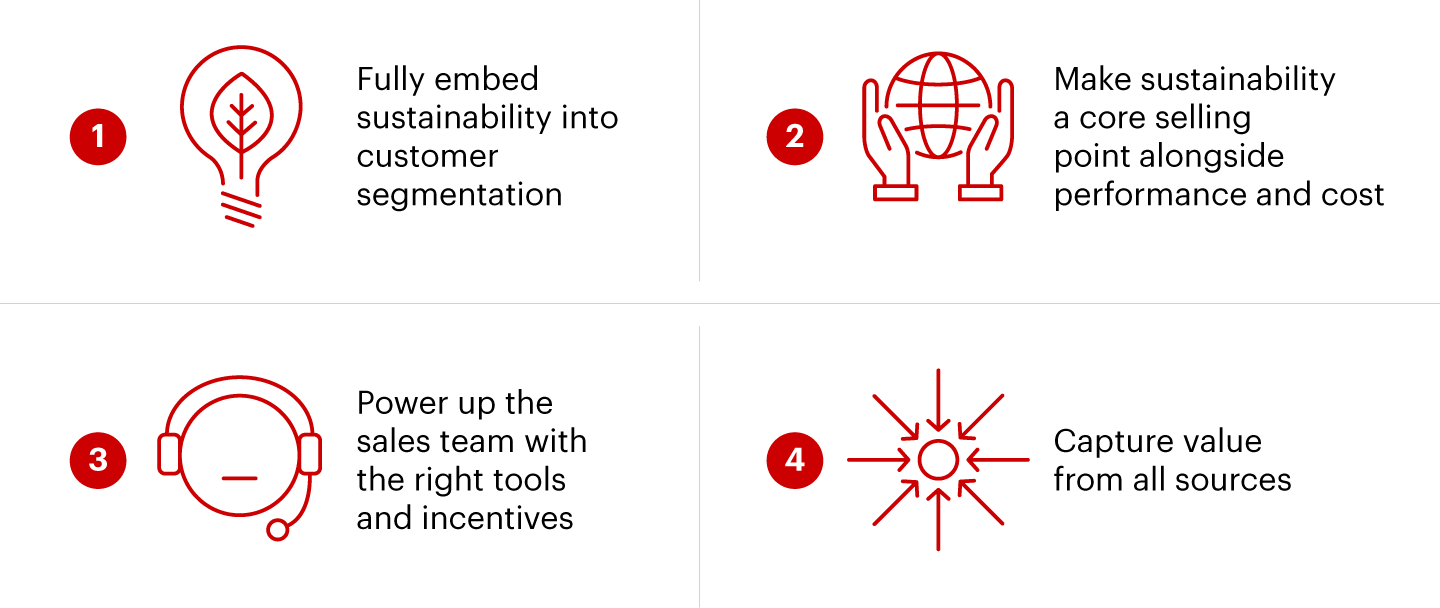

To sell sustainability, winners segment with analytics. They use data and AI to deaverage customers, identifying which are most willing to pay for sustainability. They embed sustainability into the value proposition and link sustainability directly with performance and cost, supported by tangible credentials like product carbon footprints and recycled content percentages.
It is also necessary to upskill and enable the salesforce by providing tools, playbooks, and AI-powered aids to help sales teams articulate the value of sustainability in concrete business terms.
Sustainability isn’t an optional agenda item; it is central to value creation in packaging. Growth leaders are proving that those who excel at sustainability also outperform on financial metrics. The path forward requires moving beyond ambition and compliance to consistent delivery and monetization. The next wave of winners will be those who act now—shaping substrate choices, securing value chain partnerships, and commercializing sustainability as a core growth engine. Those who hesitate risk being left behind in a market that is moving decisively toward sustainable value creation.