


Brief


|
At a Glance
Post-globalization, tighter capital markets, and labor supply challenges have made resilience more crucial than ever for downstream oil and gas companies, but not in the defensive sense the word normally carries. The volatility punishing some refiners is what’s paying others. Going forward, a resilient downstream oil and gas company will be built to thrive through disruption, not simply withstand it. It’ll be cost competitive at the asset level, commercially capable of managing price volatility and risk, disciplined in its low-carbon investments, and deliberate about developing the technical talent needed to win. AI accelerates all four, which is why the refiners moving first will be hardest to catch. It's a large prize. Our experience suggests a median refiner pursuing those four imperatives together—achieving full asset potential, integrated trading, disciplined low-carbon investment, and a rebuilt workforce—can increase its profit margin by at least $2 to $3 per barrel. At a 150,000 barrel-per-day site, that’s about $110 million to $165 million a year. For some refiners, that could be the difference between thriving and closing the gates. How we got hereThree macroeconomic shifts have intensified the pressures on fuel refiners and marketers. First, the historic rules-based trading order is fracturing. Tariffs, export controls, sanctions, and industrial policies are fundamentally restricting the movement of goods, capital, and energy, not just making them more expensive. Supply and trade are becoming less reliable, and governments are prioritizing energy security. For refiners, a footprint built for supply-side cost advantage must now be weighed against one built for demand-centric market access. Second, capital is no longer cheap or abundant. Fifteen years of near-zero interest rates have given way to climbing rates, tighter credit, and harder questions about returns, with capital flowing toward assets that look scarce or inevitable. Capital increasingly follows refiners that have clearer, more credible pathways to cash flow. Third, baby boomer retirement is shrinking the labor supply in advanced economies, potentially affecting productivity and growth. AI and automation can offset some of the attrition, however. This labor constraint is sharpest in capital-intensive industries like refining. Six consequences for downstream oil and gasThis industry feels these forces more acutely than some others because of its role in industrial supply chains, the global nature of trade, and the massive amounts of capital involved. Six consequences of the macroeconomic shifts will define the sector’s new era of resilience. 1. Demand growth slows, and the product mix diverges. Anticipated growth of 0.5% per year through the end of the decade hides a sharp product-level split (see Figure 1). Gasoline is in structural decline as electric vehicles take share. Diesel is flat, with growth in emerging markets such as India, Southeast Asia, and Latin America offsetting decreases in China and OECD countries. Naphtha, liquified petroleum gas (LPG), and jet fuel are expected to grow slightly above 2% per year due to demand for petrochemicals and air travel. Refiners without the right mix or configuration flexibility will watch spreads compress around them.
Figure 1
Note: LPG is liquified petroleum gas Sources: IEA; Bain analysis2. Competitive boundaries expand. The cost-efficient frontier of global refining is moving east. Refiners are expanding capacity in Asia (particularly China), the Middle East, and Africa, where scale, integration, and feedstock advantages compound the most. Meanwhile, closures of less-advantaged refineries have accelerated in Europe and on the US West Coast due to compliance costs, aging assets, and energy transition pressures. The gap between the regions with the highest and lowest profit margins is widening (see Figure 2).
Figure 2
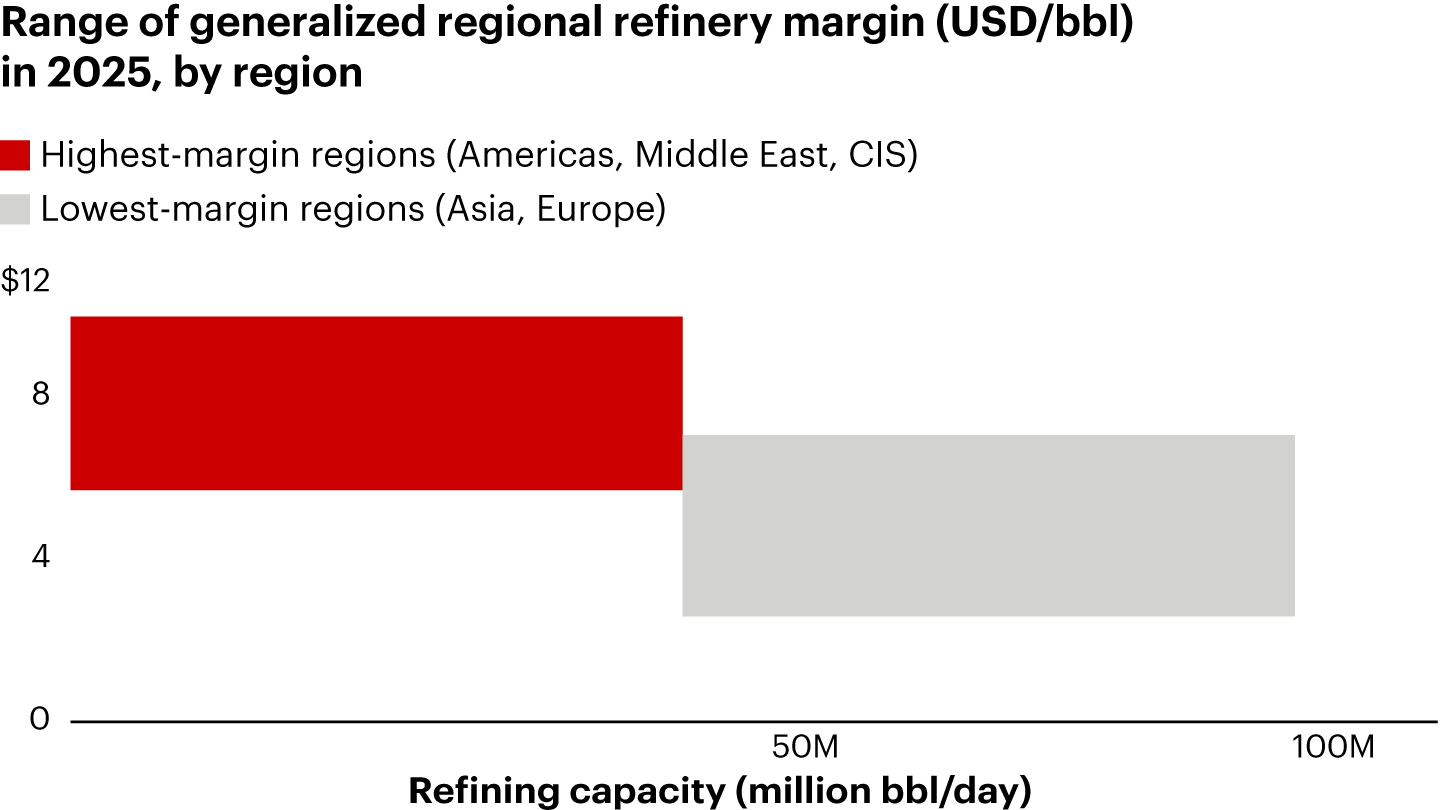

Notes: Refining capacity as of 2024; margins based on P10/P90 values from a sampling of representative refineries across focus regions; margins estimated by classifying refineries into complexity-based archetypes, mapping to crude slates, and modeling using product yields, pricing, and regional cost assumptions; margin ranges represent the minimum and maximum values; CIS is Commonwealth of Independent States Sources: GlobalData; World Bank; EIA; S&P Global; Eni World Energy Review 2025; Carbon Credits; European Commission; Energex; refiners’ annual reports; news articles; other public reports; Bain analysisThis dynamic is playing out in real time. Valero's 435,000-barrel-per-day Port Arthur refinery—among the largest and most complex on the US Gulf Coast—now competes with Saudi Aramco's Jazan refinery for the same cargoes into Asian trading hubs. It’s no surprise that refiners continue to hunt productivity and efficiency gains. Among a sample of 16 refiners representing a quarter of global supply, more than 70% announced major cost reduction programs in the past three years. 3. Trade flows disperse and get riskier. US refined product exports grew 56% over the past decade, with exports to Asia up more than 200%. The US and Middle East, already the largest net exporters of oil products, are expected to grow their exports the fastest through 2030, while Europe, Latin America, and Africa become even more dependent on imports (see Figure 3). (There are, of course, nuances. Europe is a net exporter of gasoline but a net importer of jet fuel.)
Figure 3
Note: Refined product trade data includes natural gas liquids Sources: IEA; EIA; Bain analysisThese changes to trade flows create demand pull for globally competitive exporters, but tariffs, geopolitics, logistical constraints, and regional supply preferences add new basis risk to every cargo. For example, the Strait of Hormuz closure prompted Europe to diversify jet fuel imports beyond the Middle East. Commercial agility and flexible logistics now matter as much as conversion economics. 4. Price volatility becomes structural, and trading captures the upside. Crack spread volatility has increased fourfold in recent years, both in frequency and amplitude (see Figure 4). This isn’t cyclical noise; it reflects capacity rationalization, rerouted trade flows, and geopolitical shocks such as the Russia–Ukraine war, US–China oil tariff conflict, and escalating military conflicts in the Gulf.
Figure 4
As a result, trading profits, total volume traded, and the average number of times an individual product is traded all roughly doubled over the past decade, while trading profit margins widened by 20% to 30% (see Figure 5). The clearest signal comes from Europe's integrated majors, which spent decades building large trading organizations and are now compounding the advantage. Shell and BP both highlighted strong trading contributions to their sharply higher first-quarter 2026 earnings.
Figure 5
Note: Profit margins used to derive trading profits inferred from market structure (trade flows, liquidity, and volatility) and triangulated against industry disclosures Sources: IEA Oil Market Report; ICE and CME product benchmarks; expert interviews; Bain analysis5. Low-carbon fuel demand is real; returns aren’t automatic. Investment keeps rising, particularly in Europe and Asia-Pacific (see Figure 6). But project economics remain difficult. Sustainable aviation fuel (SAF) still costs considerably more than conventional jet fuel, and today’s supply of waste oils and other feedstocks cover less than 20% of projected 2030 demand. Policy is diverging, too. EU SAF blending mandates rise toward 70% by 2050, while US SAF credits have fallen about 40%. Capital follows projects with clear paths to cash flow, structural competitive advantages, and financial discipline, not sector exposure.
Figure 6
Notes: 2026E reflects estimated investment based on announced projects and policy outlook; biofuel mandate assumptions applied where available, otherwise estimated based on national blending policies; biofuels include biodiesel, ethanol, biojet kerosene, biogas, and biomethane Sources: IEA World Energy Investment 2026; Bain analysis6. The workforce retires faster than it replenishes. The median refining worker is 44 years old, vs. 39 in technology (see Figure 7). Experienced operators retire faster than replacements can be trained, and the inflow of entry-level workers has slowed. Meanwhile, the capabilities now required to compete—AI-enabled process optimization, data-driven trading, low-carbon engineering, and integrated commercial operations—require skills that sit outside the traditional refinery profile. Refiners can’t treat this as a recruiting problem. It requires transformation: reskilling programs and redesigned roles and operating models.
Figure 7
Note: Technology reflects US Bureau of Labor Statistics data for the category Computing Infrastructure Providers, Data Processing, and Related Services Sources: US Bureau of Labor Statistics; Bain analysisAI presents opportunities across all sixThe AI opportunity in downstream oil and gas is real and broad. In an industry where physical assets are relatively fixed and differentiation increasingly comes from how companies operate and commercialize those assets, AI could become a source of competitive advantage, not merely a productivity tool. Refiners that move early to embed AI into maintenance and reliability, yield optimization, and trading decisions will compound efficiency and margin gains over time. Those that delay—whether due to workforce readiness, data quality, or organizational complexity—will find the gap increasingly difficult to close. Already facing demographic headwinds and capital pressure, many oil and gas executives may feel growing urgency to adopt AI as part of the solution. So far, AI optimism outruns ROI in oil and gas. A 2026 Bain survey found that 71% of oil and gas executives have high expectations for AI’s effect on business performance over the next decade, and 61% said that their companies have progressed beyond small-scale experimentation. However, only 23% are seeing the desired results. The new resilience playbookThe most successful oil and gas companies in this new era will focus on four key actions. Redefine each asset’s full potential using AI. The leading companies will go beyond standard industry benchmarking for target setting, instead reimagining each site’s true operational potential. A clean-slate approach—line-led, anchored in the company’s own operational data, with AI finding patterns rather than confirming a hypothesis—could boost site profit margins by $1 to $1.50 per barrel. Marathon Petroleum illustrates the upside. AI investments in recent years across maintenance, scheduling, and other operational areas helped it achieve 94% refinery utilization and 105% commercial margin capture in 2025. Maximize trading value creation with an agile, integrated operating model. Most refiners leave $0.50 to $1 per barrel on the table because trading, supply, and production teams aren’t well coordinated. For refiners with commercial flexibility, the fix is more integrated planning tied to strategy, with a single source of truth and clear cross-functional accountability. The most successful companies will link existing linear programming models with their assets’ operational realities (asset availability, production plans, maintenance schedules, logistics). AI can help facilitate and strengthen this link. As the number of opportunities increases and pace accelerates, production and maintenance will also need to adjust to different rhythms and standards to ensure availability while maintaining integrity. For refiners with an in-house trading organization, a growing desk without matching governance threatens the balance sheet. The most successful companies will define their risk tolerance and set decision rights before they build or expand the book. Partnerships are a viable alternative. Eni's new 50/50 joint venture with independent trading house Mercuria pairs Eni's asset knowledge with Mercuria’s global trading expertise, risk management, and market intelligence. The structure reflects a different risk profile and capital model vs. a traditional international oil company, but it’s the same underlying logic: treating commercial capability as a strategic asset, not a back-office function. Mitigate risk in low-carbon business models. The most effective companies apply rigorous investment criteria before committing capital. They prioritize positions with secured feedstock, contracted offtake, and conservative capex to build competitive moats. Repsol built its renewable fuels position inside existing refineries at Cartagena and Bilbao, moved more than 90% of its renewable diesel and SAF through its own channels in 2025, and is scaling to 1.5 million metric tons per year by 2028. It’s now the largest producer of these renewable fuels in Spain and Portugal, thanks to genuinely integrated positions, not policy timing. Build the talent strategically. The industry has discussed its workforce problem for a decade without solving it, largely because it keeps framing the answer as a hiring issue. It isn't. In most refining organizations, a small group of operators and engineers generate a disproportionate share of the value. That recognition turns an impossible recruiting target into a solvable development problem. Identify that group of key technical talent and develop it deliberately. Use AI to absorb routine work and help offset labor shortages while training the existing workforce in digital, analytics, and energy transition capabilities. Leading companies will replace their typical year-by-year approach to workforce planning with a 5- to 10-year view of the evolving talent and skills needed to win in this new era. The leadership agendaThe macroeconomic forces reshaping downstream oil and gas won’t moderate. Trade is fragmenting, demand growth is decelerating, and capital discipline is here to stay. The gains from the new resilience playbook compound, but they compound slowly. It took decades for Europe’s majors to hone their trading capabilities. Technical mastery in oil and gas takes years to develop and dissipates one retirement at a time. Every year a refiner waits to adopt AI is a year of missed operating data and efficiency improvements, while competitors pull ahead. Resilience isn’t built in good times or bad. It’s built now. The authors wish to thank Lane Shelley, Lynden Unger, Emma Allen, Kia Young, Sonal Tripathy, Yash Pandey, and Andrew Baby Alex for their contributions to this analysis. |