

Brief

At a Glance
- As their sector consolidates and digitalizes, some regional grocers are poised to keep winning, but others may be too small and undifferentiated to succeed—or even survive.
- Using new customer advocacy data, we’ve identified what it takes to be a regional gem that can thrive in retail’s challenging future.
- Regional gems nurture a crisply differentiated value proposition, outhustle bigger players, create virtual scale and rigorously manage costs to fuel investment.
It's brutal in grocery. Led by Walmart, the biggest grocers are finding ways to get bigger. Many are exploiting their enhanced scale to fund the huge investments necessary to master online grocery and innovation. From another flank, hard discounters Aldi and Lidl are also gaining share, thanks to their aggressive store opening programs.
Having held the middle ground so profitably for so long, regional grocers are fighting to secure their future. Their local scale is losing the power to sustain outsized earnings on its own. At the same time, the low prices and surprising quality of the hard discounters’ products erode regional players’ broad appeal. Cost hikes and other industry pressures add to the grim outlook.
Globally, Bain & Company analysis suggests that five strategic models will thrive across retail in the future (see the Bain Brief "The Future of Retail: Winning Models for a New Era"). Yet only two of them are likely to help regional grocers out of their bind. The first model, the value champion, is an option for a few low-cost players that can get by on “good enough” service levels. Most regional grocers will need to shoot for the other model: the regional gem. It’s a tricky formula to get right, but it’s not impossible. Some chains are regional gems already, and more can form amid the intensifying pressure in the sector.
Using our latest Advocacy in Retail study, in which we surveyed more than 14,000 US grocery shoppers in partnership with ROIRocket, we identified what it takes to be a regional gem in grocery. Today’s gems have a strong bond with their shoppers, as evidenced by a Net Promoter Score® of more than 30. They turn customers into advocates for their brand, and are gaining market share. Tight cost control often enables them to keep their operating margin in the 4% to 6% range. They are also strong in private label, which accounts for 30% or more of their sales, and they are not hopelessly adrift on price, remaining no more than 15% more expensive than their lowest-priced local competitor.
What’s more, our analysis shows that regional grocery gems prioritize three actions to maintain their momentum and survive the transition to a more digital and concentrated industry. They nurture a crisply differentiated value proposition, they minimize their size disadvantage by outhustling bigger players and creating virtual scale, and they redouble cost management efforts to fuel investment. This approach could lead to a bright future, even for the weaker regional grocers that have so far been struggling to adapt to change.
Nurturing a crisply differentiated value proposition
Regional grocery gems lack the resources to excel on all fronts, so they must make the necessary trade-offs to excel on at least one or two dimensions. Many stand out by mastering assortment, aided by an intimate understanding of their customers that, in many cases, has been built up over decades of doing business in their neighborhood. Mastering assortment means high-quality and attractively presented fresh produce—the top driver of store trips. It also means nailing private label, which creates brand-specific loyalty and offers plenty of room for growth in the US, where private label penetration is relatively low compared with other countries.
The most powerful assortment tactic for regional grocers is leaning into everything local at the product, supplier and community level. Take the gem that led the US grocery sector in our customer advocacy study. Texas’s H-E-B enjoys a remarkable Net Promoter Score of 69, 11 points clear of its nearest rival (see Figure 1). Superficially, H-E-B is famed for products shaped like the Lone Star State: cooking pans, cutting boards, even tortilla chips. Yet its commitment to the Southwest permeates everything: The “True Texas” hot food available in stores includes boiled crawfish, it celebrates Hatch chile season and customers rave about its fresh tortillas.
Similar to other regional gems, H-E-B has reinforced its neighborhood credentials by embracing local suppliers. Over the past five years, for instance, it has run a “Quest for Texas Best” competition to showcase and reward leading Texas food and drink makers, burnishing its own authenticity in the process. It also shows a corporate-level commitment to the community, donating 5% of pretax earnings to public and charitable causes, such as local schools.
Like H-E-B, Wegmans excels at assortment. Its third-place Net Promoter Score of 54 reflects its distinctive private label products and prepared foods. Easily accessible stores are another way to stand out. When we asked shoppers what matters in a grocer, “convenient location” was ranked third after price and value. Regional gems tend to carpet their heartland in stores, creating a sense of local ubiquity. They also differentiate themselves on what happens when shoppers step inside those conveniently located stores. Publix’s fourth-place standing in our advocacy survey, with a Net Promoter Score of 52, reflects its strong customer service, for example.
Figure 1
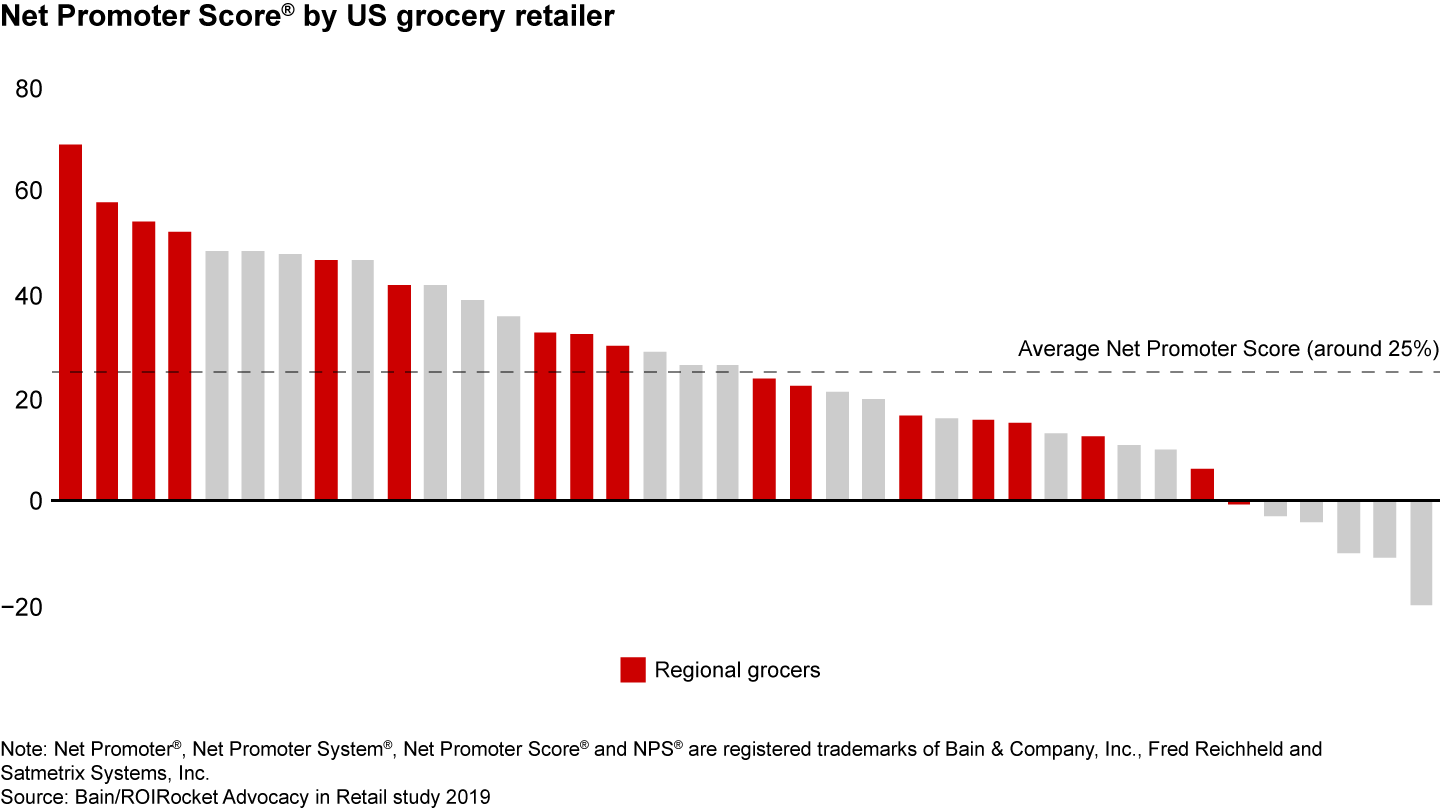

Occasionally, regional grocers differentiate themselves on low prices. The second-place grocer in our advocacy study, regional discounter WinCo Foods, often charges less than even Walmart, making it a value champion rather than a regional gem. Most of the time, though, regional grocers are just trying to stay in touch with the lowest-priced competitors in town rather than beat them, while employing various tactics to manage price perception, such as deep promotions on select items using bold signage.
Overall, though, regional grocery gems face a battle to maintain a crisply differentiated value proposition. Most of their current advantages in this area—in assortment, convenience and customer service—don’t translate easily into defensible positions online. That’s a challenge as adoption of online grocery shopping begins to accelerate after a slow start in some countries. Whereas only 3% of US grocery spending was online in 2017, we predict penetration will at least triple over the next decade. How can regional gems keep their edge?
That will depend on how they develop their omnichannel presence in spite of scale-related funding constraints, which we’ll cover in the next section. Yet there’s also a bonus to being a regional gem in online grocery’s infancy: It’s called home-store bias.
We talked to US shoppers who had not bought groceries online over the past year and asked which grocer they would choose if they had to shop online for home delivery: 85% said they would look first to their current brick-and-mortar chain. Once grocery shoppers have tried an online retailer, three-quarters stick with the first they used. So if they don’t fumble the all-important first trial, regional players can at least buy themselves time to start figuring out how to hone their value proposition online.
Outhustling bigger players and creating virtual scale
For many years, retailers could rely on strong local relative market share (RMS), a measure of size advantage over immediate competitors. Being No. 1 or No. 2 locally drove higher profitability; for US regional grocers, it could mean operating margins of 4% or more, well ahead of smaller rivals (see Figure 2). Local RMS is still vital—regional players risk being outflanked if they neglect it. Increasingly, though, the largest retailers around the world are building and then leveraging absolute scale rather than just local scale.
Some of these retailers are bulking up through M&A, such as the merger that created Ahold Delhaize; others are using partnerships, such as the purchasing alliances formed by Tesco and Carrefour as well as by Kroger and Walgreens. Retailers with absolute scale can slash prices by using their bulk to get bigger cost savings while investing heavily in the analytics expertise that can identify yet more efficiencies. They can also spend more on cutting-edge omnichannel capabilities, such as the online order pickup facilities that Walmart has been rolling out aggressively at its stores.
Figure 2
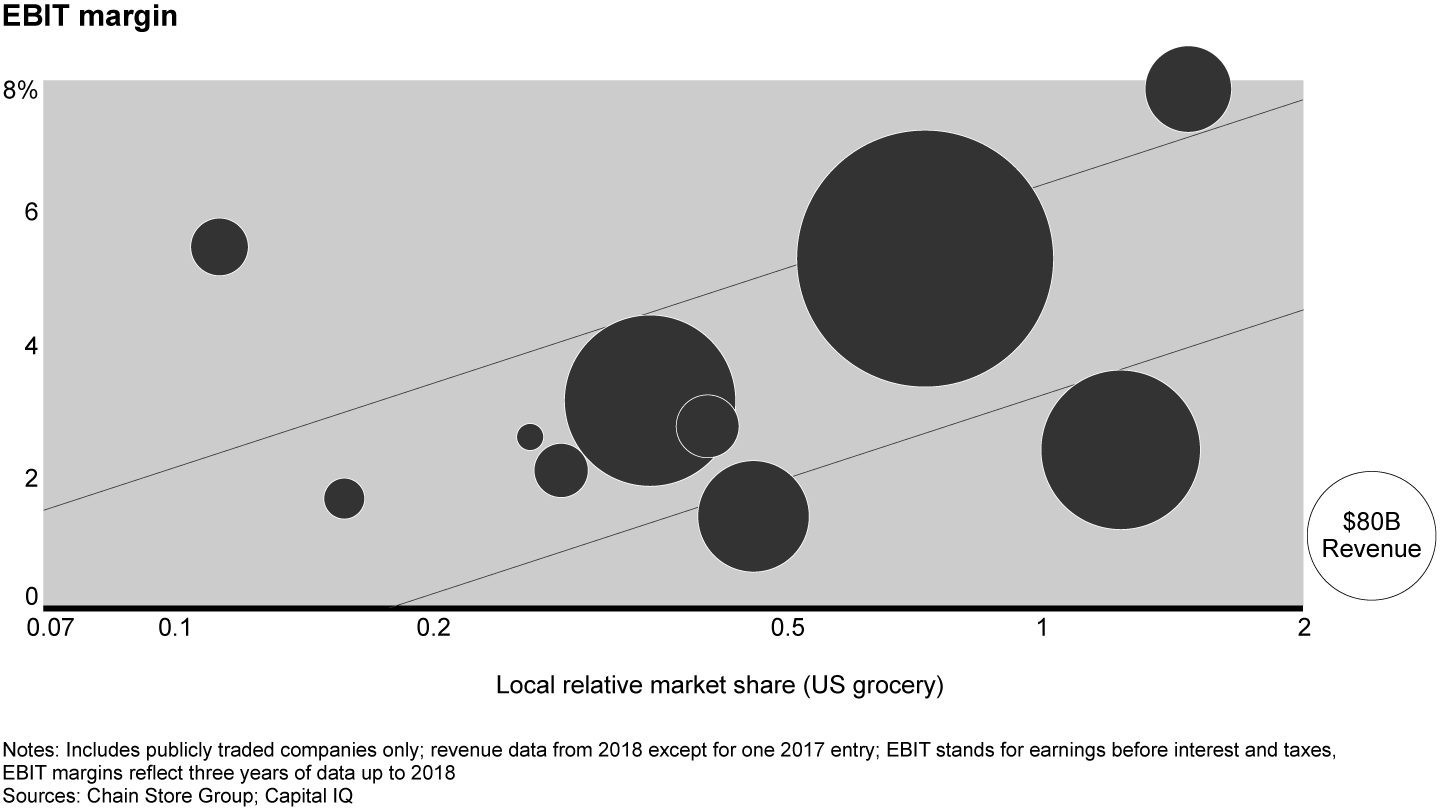

Although well-judged M&A could ease a little of the pressure on regional grocers, most won’t be able to buy or merge their way to the extensive presence that’s now the threshold for true scale. Regional gems are responding to this limitation in two key ways: by outhustling bigger players and by creating virtual scale.
The first of these actions turns a grocer’s smaller size into an advantage. It might not get as good pricing deals from suppliers as its larger competitors, but it can certainly move more nimbly. Regional gems are increasingly skilled at taking an idea from concept to pilot to rollout at a speed that outhustles larger players. They are also embracing a test-and-learn mentality that can yield results and insights quicker than backward-looking analysis.
One way to create virtual scale is to join a buying consortium or to create a buying alliance akin to Tesco and Carrefour’s. Yet the biggest need for virtual scale is online. Most regional grocers can’t afford to build a slick web operation in-house, nor would it be the best use of capital. It might make more sense to deconstruct the elements of a successful digital business and then find partners to deliver capabilities that are unachievable in-house. The key is to plug in external expertise on a modular basis while staying in control of the overall digital transformation. A regional grocer that strains to keep all digital capabilities in-house is likely to pay more for them than its larger rivals would, without delivering a best-in-class online service to customers. But it will also struggle if it just outsources its entire digital strategy to others.
With adoption of in-store grocery pickup and home delivery still at an early stage, various US regional grocers have partnered with the likes of Instacart and Shipt to provide these services, sometimes in tandem with their own operations. Plenty of other areas have little appeal for going it alone—cashier-less stores, for instance. With the deep-pocketed Amazon setting the pace, Giant Eagle has instead teamed up with Grabango, a cashier-less technology start-up. The modular approach can also involve M&A, as H-E-B showed when it bought an on-demand delivery company to develop its own online grocery service. However, the right acquisition targets tend to be in short supply.
In any virtual scale collaboration, retailers need to structure the relationship in a way that does not make them dependent on their partner. Consider how early partnerships are breaking up in the UK, where online grocery is more mature than in the US. Waitrose is moving all deliveries in-house after almost 20 years of using Ocado’s vans in parallel with its own. Morrisons is selling more through Amazon after loosening an online partnership with Ocado. As they manage the early stages of their own partnerships, executives at other regional grocers need to envisage a similar divorce. Could they easily integrate a new partner? And which party would the customer feel loyal to in the split: the regional grocer or its ex-partner?
Rigorously managing costs to fuel investment
Scale retailers may be leading the way on cost management, but regional players must still be bold and scour their entire cost base for savings (see the Bain Brief "Funding the Future of Retail through Cost Transformation"). They need to find more fuel for investment at a time of mounting industry headwinds. Bain analysis suggests that downward pricing pressure, rising wages and other factors could erode operating margins by between 2 percentage points and 5 percentage points over the next five years (see Figure 3).
Figure 3


Here’s some good news, though: Midsize grocers can be surprisingly effective at unlocking savings, especially those with a growth story to tell, as shown by one US regional player. It saved more than 3% on cost of goods sold (COGS) through a data-led approach to supplier negotiations. The pinpoint analysis of category performance identified win-wins for retailer and supplier, highlighting areas in which the retailer could strike a better deal.
These COGS savings were part of a broad package of cost measures. The same grocer cut labor costs by introducing robotic floor cleaners and remote monitoring temperature sensors on food cases. It moved some deli and bakery tasks out of stores. A new, advanced analytics-driven workforce management model based on sophisticated demand forecasts ensured that schedules were more standardized. Executives also reined in nonwage selling, general and administrative expenses by reducing the use of store supplies and renegotiating with suppliers, saving more than 20% on bags, for instance.
For any retailer, the ultimate aim of cost transformation programs is to embed the new disciplines into the culture of the company. Employee-owned WinCo wholeheartedly embraces that goal. Its bargains reflect an all-pervasive thrift. It doesn’t take credit cards to avoid merchant’s fees; it doesn’t employ baggers to limit labor costs (it even advises its customers on the appropriate way to position their shopping carts while bagging to avoid blocking others). That constant watchfulness over spending has fueled its continued expansion from its Idaho roots.
A starting point for the coming decade
Over the next 10 years, new disruptive trends will emerge in grocery. Virtual reality could replicate the feeling of browsing aisles in a real supermarket. Autonomous delivery could go mainstream. Governments could ban single-use plastic packaging or incentivize the adoption of refillable containers, boosting bulk-sold private label items in the process. There are many other possible sources of upheaval. Scale, on the other hand, is almost certain to be one of the fundamental forces shaping the industry over the coming decade.
Leadership teams at regional grocers still have an opportunity to react to the challenges they face, including the growth of Walmart and other scale players, the rise of value champions such as Aldi and Lidl (not to mention Costco), continued investment in grocery by Amazon, and various other threats. They can start by asking themselves three questions.
- Do we really stand out on any dimension of our value proposition?
- Are we punching above our weight, thanks to our agility and skill at innovating and partnering?
- Is cost management a core strength?
If they can honestly answer yes to all three, then they have a real chance of not only surviving but also thriving in retail’s challenging future.
Stephen Caine, Wes Janson, Karl Zimmermann and Kyle Goldman are members of Bain & Company’s Retail practice. Stephen is a partner based in Chicago; Wes is a partner based in Dallas; Karl is a partner based in Boston; Kyle is a principal based in Chicago.
Net Promoter®, Net Promoter System®, Net Promoter Score® and NPS® are registered trademarks of Bain & Company, Inc., Fred Reichheld and Satmetrix Systems, Inc.
Published in Şubat 2020