
Report


|
|
As America’s largest companies and their CEOs increasingly embrace a new leadership role in advancing racial equity, they face a confounding question: What really works? Despite decades of research and a growing corporate focus on diversity, equity, and inclusion (DEI) over the past few years, many executives are unsure what actions are most effective at increasing diverse representation, improving feelings of inclusion, or making progress on other DEI goals. Written in collaboration withWritten in collaboration with
Integrating DEI into organizational practices is nuanced, complex work—and relatively nascent. Robust, comparable multiyear DEI outcomes data is hard to come by. Even among those companies most committed to defining and measuring DEI progress, results take time, and there are few benchmarks against which to measure them. Many studies exist of specific employer DEI efforts or practices that have led to strong DEI outcomes, but parsing through that literature to make data-driven decisions is challenging. At Bain and at Grads of Life, we frequently hear C-suite leaders say, “I don’t know where to start,” or “the amount of information and tools is overwhelming.” Many simply want a blueprint for what’s been effective for other companies. To that end, we have developed a short list of the strongest evidence-based DEI actions, based on a thorough review of more than 100 research sources, primarily academic literature, and informed by our experiences supporting our clients and engaging with DEI thought leaders (see our methodology below). Ultimately, we found 10 actions worthy of increased employer attention and investment today: Each of the actions above resulted in one or more positive outcomes for an organization’s diverse or underrepresented talent, including:
We also examined how widely implemented these actions are, and, for those not yet widely implemented, we examined the biggest barriers to accelerating adoption. We evaluated these actions within a framework that spans all the core areas of business operations (see Figure 1).
Figure 1
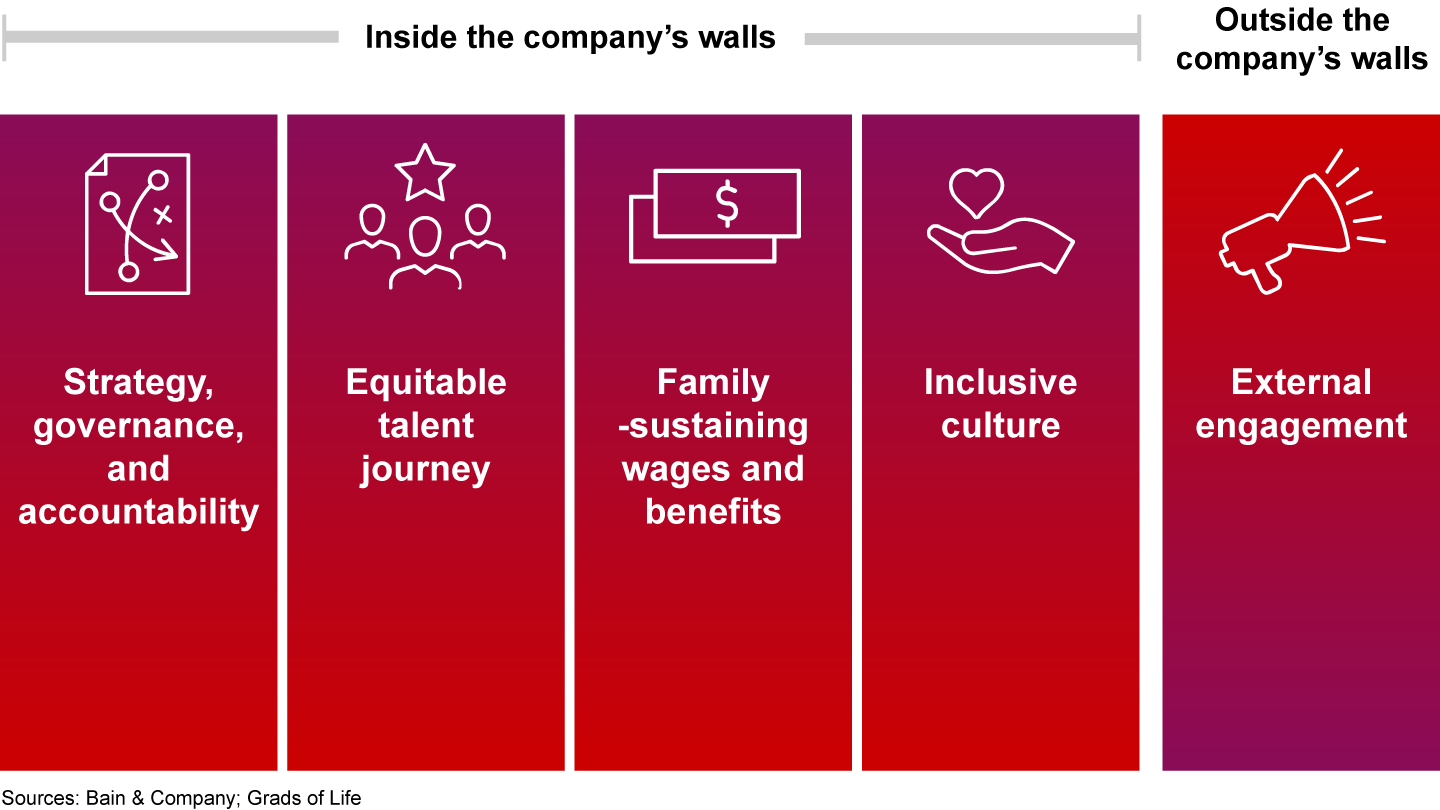

Our analysis also revealed that half of the 10 actions are not yet mainstream despite the strong research behind them. Employers should prioritize these actions and explore how to overcome potential barriers to implementation. The remaining actions are already quite common, yet companies need to be aware of important nuances in order to implement them effectively. While many employers already have experience with these actions, there are ways to connect them more effectively to DEI strategy and outcomes (see Figure 2).
Figure 2
We also found that a combination of several, or all, of these actions is more powerful than any one action on its own. While many of these actions alone can drive improvements, when taken together, the actions are mutually reinforcing: The more you implement, the greater likelihood of seeing strong DEI outcomes. In conjunction with this report, Bain & Company and Grads of Life have released The DEI Opportunity Identifier, a self-assessment tool that allows companies to assess themselves against all the DEI actions described here as well as many others. 
How Is Your Company Doing on Its DEI Journey?To assess your best opportunities to advance, explore this demo version of the DEI Opportunity Identifier built by Bain & Company and Grads of Life. In each of the individual action pages that comprise this report, we present a synthesis of insights from the research about the action, analyze what it takes to successfully implement each action, and explore why some of the actions are not yet pervasive among US employers despite their strong evidence base. How employers can take actionMany employers have already articulated or expanded a commitment to diversity over the past year. There are several concrete ways employers can use the information in this report to help fulfill those commitments.
How investors can take actionInvestors are increasingly interested in, and demanding, meaningful human capital data as one means of assessing a corporation’s total value. Over the past two years, a global outcry for racial justice, coupled with the effects of the Covid-19 crisis, have resulted in increased scrutiny from investors, consumers, and other stakeholders on environmental, social, and corporate governance factors that help paint a picture of a company’s total social impact. We encourage investors to use the data and evidence in this report to monitor and measure key human capital actions and their outcomes among the companies in which they invest and to use their position to influence companies to be more transparent on DEI data. We hope that other stakeholders, including members of the philanthropic community, grassroots organizers, and policymakers, also find value in the findings summarized here and will take the opportunity to share relevant insights with their networks. Investments into DEI have positive effects that go far beyond the four walls of a corporation; they ultimately lead to greater community and national prosperity and well-being. This report would not have been possible without the significant research, analysis, writing and editing support of Kelly Graham, Joana Ortiz, Alanna Rodgers, and Nandita Jariwala. We thank them for their significant contributions. 
About Grads of LifeWe work with leading employers to create inclusive talent strategies that deliver both social impact and business benefits. Through our data-driven approach, we help companies understand their current positioning and create customized engagements to help them achieve their goals. 
Further - Our Global ResponsibilityFurther is our collective ambition to create a more sustainable, equitable, and inclusive world. A journey to transform businesses and communities for the better. |