


Brief


|
At a Glance
Companies spend a lot on information technology every year, but few are achieving what they want from those investments. Bain’s research finds that only 8% of companies say they are getting their money’s worth in terms of good business outcomes and advanced digital capabilities. (For more, read the Bain Brief "Four Myths of Digital Transformation: What Only 8% of Companies Know.") It’s no coincidence that companies in this leading group have a deeper understanding of how their technology budgets are spent and are better at redirecting spending to where it creates value. Our research finds that these leaders are 3.5 times more likely to say they have full transparency over IT spending, compared to the rest. In these companies, technology spending data is available in real time (not last month’s numbers on a PowerPoint slide) and in customized views that provide the right data to each stakeholder, whether they are in finance, technology, or business functions (see Figure 1).
Figure 1
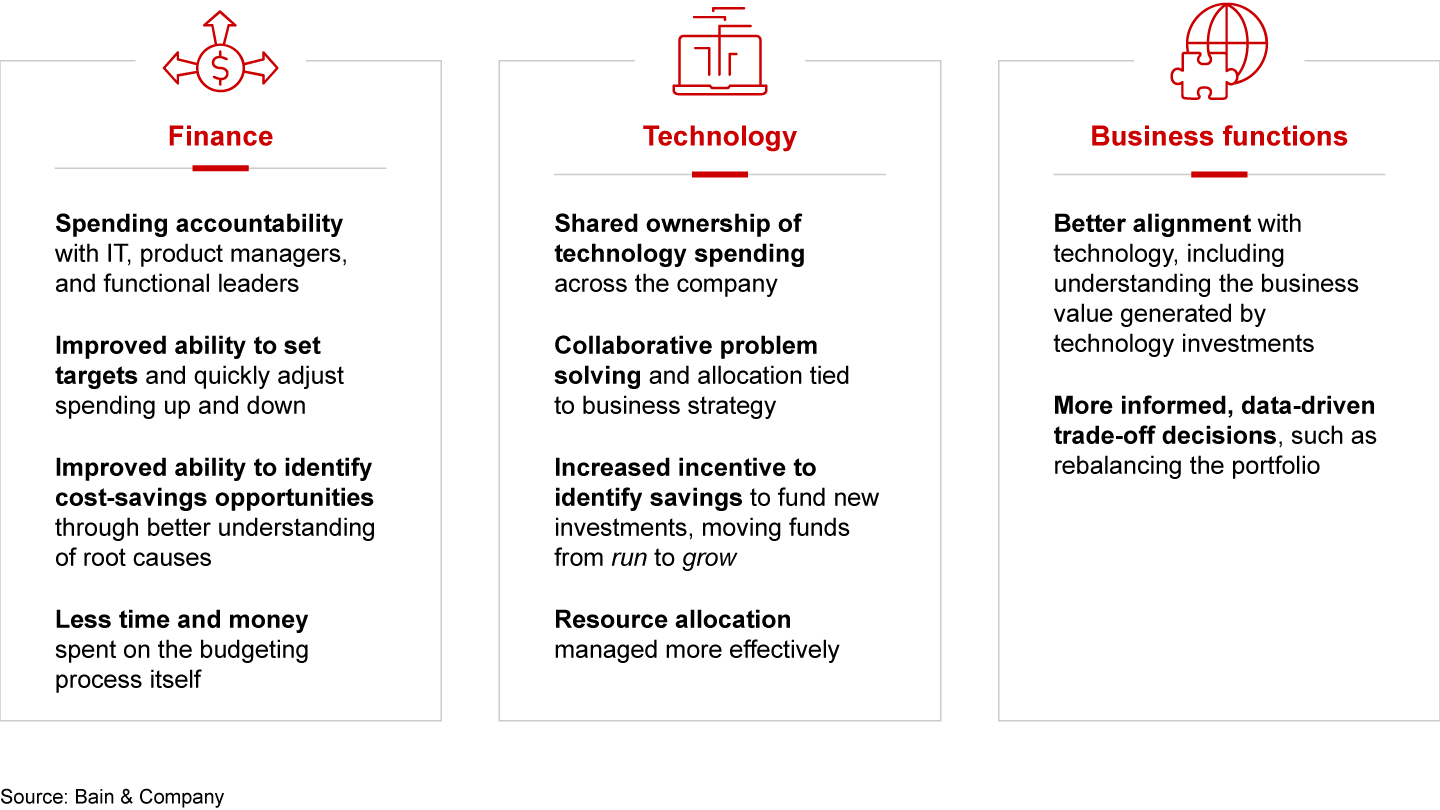

Getting this visibility is hard, and maintaining it over time is harder. Because the technology budget can be spread across several departments and business units, many companies struggle to get a clear picture of where the money is going, how it changes over time, and whether or not the investment is worth it. And yet, every year, the technology budget grows. Moreover, most business and finance executives cannot fully decode the spending information and link it back to the products and services they spearhead. The promise of transparency is only partially fulfilled.
Increasingly, companies are implementing third-party software systems that track spending data in real time and deliver it in customized dashboards across the organization. These IT financial management (ITFM) tools lead to better decisions based on facts, but they are only one part of a three-part program that companies need to follow to move toward transparency.
A major airline implemented this three-part solution recently. Executives wanted to know, for example, how much they were spending on generating revenue compared to operational costs or improved passenger experience. Within any of these categories, they could dive deeper: In passenger experience, they could see how much they’re investing in initial bookings vs. online check-in. This data helps identify opportunities to redirect technology spending where it would be more valuable to the business. They implemented an ITFM solution, Apptio, as part of a broader process aimed at understanding how the technology budget maps to strategy and business goals (see Figure 2).
Figure 2
The airline’s finance and technology departments worked together to identify cost-savings opportunities—for example, by conducting benchmarking analysis across different parts of the IT organization—which could either be reinvested in discretionary “grow” IT efforts or banked as a budget reduction. The bottom line was clear. It became easier for leaders to demonstrate returns on technology investments, and finance grew more confident that the technology budget was being spent on the right things. This journey is not without its share of difficult steps. Buying the tool is the easy part. It takes more effort and is more critical to organize the company into a taxonomy that serves the customer, detail the right set of products and journeys, map accurate technology cost data, and ensure training for senior and mid-level management. The airline invested significant time training leaders from the CFO and CIO down to product managers on how to use this in their daily work. They also invested time defining the taxonomy and making necessary decisions around product manager accountability and decision rights. To get started, companies should take three concrete steps.
Achieving full transparency into IT spending isn’t enough to transform a company into a technology leader. But it is a vital step in that direction, one that provides immediate and long-lasting benefits for companies that achieve it. |