


Brief


|
|
All senior finance executives face difficult challenges, but the data makes it clear: Telecom executives really do face the greatest capital planning challenges. Bain compared concentration of capital investment against capital intensity in 17 industries and found that in no other vertical do finance executives face as severe a challenge in effectively allocating significant capital investment across such a broad range of assets and categories (see Figure 1). Darryn Lowe, a partner in Bain's Telecommunications practice, outlines three approaches that can enable executives to take the fight to the competition and make capital spending a strategic weapon. While some industries, like semiconductor manufacturing and airlines, are almost as capital intensive in terms of the amount of investment, the decisions are fewer and far more monolithic. For example, compare the capital decisions for an executive at an airline and an executive at a telecommunications provider, who are both spending $6 billion of capex over three years. The airline is replacing 60 old aircraft with 60 new aircraft from a mix of four configurations. The telecom executive needs to make many more decisions, on everything from expanding the wireline fiber-to-the-home footprint by a million new premises, to buying spectrum, upgrading 4,000 cell towers to 5G wireless, or replacing 500,000 set-top boxes. Because the complexity is so extreme, it’s no wonder that telecommunications executives struggle to find the right tools to measure and manage capital allocation in their outlying industry. Business school simply didn’t give them the tools they need.
So how do leading telecom executives approach capex, and turn it into their most potent strategic weapon to beat their competition?
It all begins with a clear understanding of the current capex plan. This requires a structured and intuitive articulation that links investments to a competitive objective rather than the long list of idiosyncratic projects that typically defines the annual budget. This allows executives to identify where spending doesn’t align with strategic priorities. It also allows meaningful identification of the hot and cold zones where they may be over- and underinvesting. For more, see "The Fool’s Gold of Capital Efficiency in Telcos." Herbert Blum and Darryn Lowe are partners in Bain & Company’s Toronto office. Franz Bedacht is a partner in Bain’s Rio de Janeiro office. All three work with Bain’s Global Telecommunications practice, which Blum leads in the Americas. 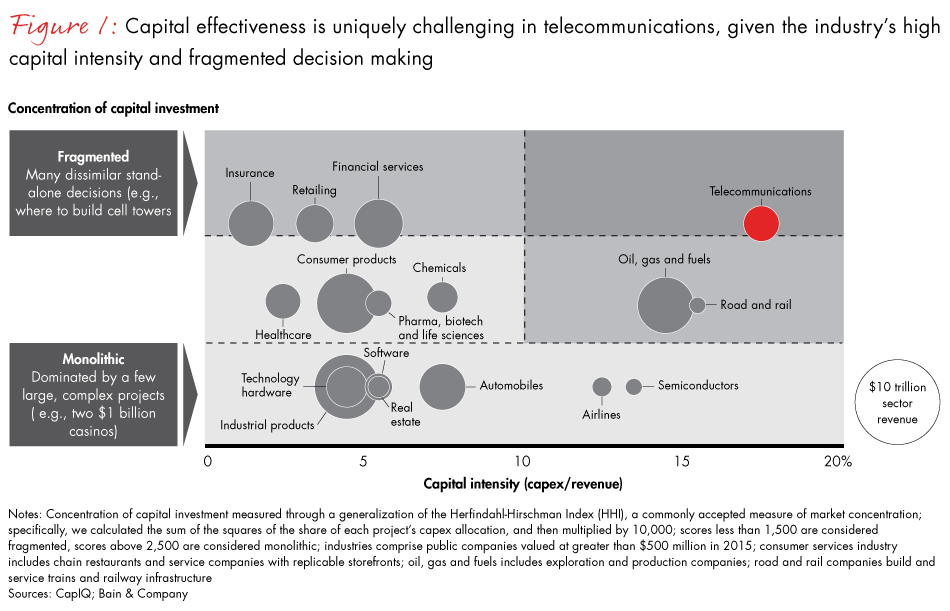 |