

Brief


|
At a Glance
Urban mobility will change rapidly in the next decade as electric vehicles (EVs) become more affordable, ride sharing continues to grow and autonomous vehicles (AVs) enter urban fleets. These changes coincide with an evolution toward cleaner, more decentralized and digitalized energy systems and services, along with increasing electrification in transportation and other sectors. Cities around the world see these changes coming, and many are experimenting with ways to improve air quality, reduce congestion, and provide clean, reliable and affordable energy to their growing populations. Utilities and other energy companies will play a significant role in this transformation. The decisions of policymakers may determine the pace and scope of change, but energy executives are in a position to shape the dialogue and to identify valuable opportunities for their companies and customers. These are among the findings of Bain & Company's recent research with the World Economic Forum's Future of Electricity initiative. Our 2018 report, Electric Vehicles for Smarter Cities: The Future of Energy and Mobility, identifies three primary benefits of the electrification of urban mobility. • Reduced carbon emissions. The electrification of transport supports national and local ambitions for cleaner mobility. Even without significant changes in the sources of electricity generation—primarily coal, natural gas and renewables—EVs can still reduce CO2 emissions by 60% compared with internal combustion engines. In the US, more than 20% of emissions come from light-duty vehicles, so encouraging EVs could improve air quality and the health of urban residents • Lower mobility costs. As battery prices fall, EVs will soon provide cheaper mobility for fleets and individuals. Factoring in lower maintenance and operating costs, the total cost of ownership for EVs—that is, how much owners spend over a vehicle's useful life—should reach parity with internal combustion vehicles over the next five years and continue to decrease. • Increased asset utilization and ancillary services. EVs will make better use of the electricity system's assets through "smart" loading—provided they charge when system demand is low and discharge during peak demand times. Large fleets of EVs may also provide ancillary services, by supplying the electricity stored in their batteries to buildings or the grid. To capture the benefits, policymakers, citizens and stakeholders across sectors will have to decide how aggressively to encourage these changes. Our research identified two clear paths. Maximizing the potentialThe current path toward the electrification of urban mobility has been a steady, gradual change, which we call proliferation. In many locations, economic incentives encourage the purchase of privately owned EVs, which spend 95% of their time parked, limiting the volume of miles actually electrified. Current approaches also deploy EV charging infrastructure based on today's patterns of privately owned vehicles, primarily in residential and business areas. A poorly integrated network of charging stations could hinder the business case for charging operators and lead to grid instability if too many EVs charge at the same time—especially if that coincides with peak demand times, like weekday evenings. Forward-thinking cities will take an approach that envisions future mobility patterns, as AVs and ride sharing become more commonplace. In this paradigm, which we call the mobility transformation, much of the charging infrastructure being built today may become obsolete. Cities that focus on accelerating the transformation will encourage electrification of high-use vehicles, especially fleets of shared AVs, to increase the volume of miles electrified. They will deploy charging stations to meet the needs of future mobility patterns and integrate at logical points with the electricity grid. And they will consider the energy-generation mix that will fuel these EVs, to facilitate smart charging at optimal times. Transformation could bring the share of electrified miles up to 35% in some US cities by 2030 and decrease the cost per mile by up to 40% while also reducing congestion (see Figure 1). 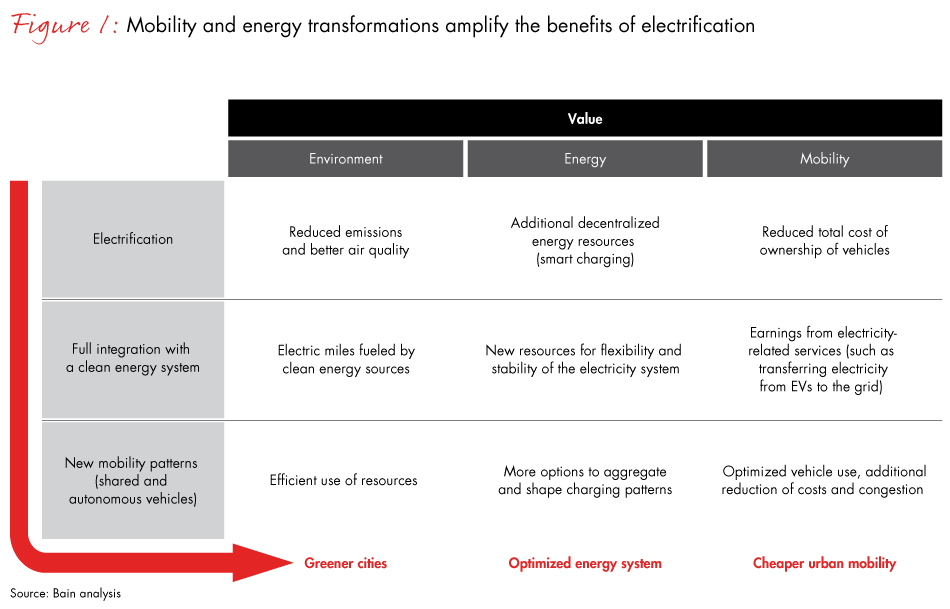
Fleets that are integrated to charge where and when clean, non-dispatchable generation resources are producing will boost consumption of electricity generated by solar and wind, decreasing the need to curtail production and further reducing total emissions. Public and commercial fleets of electrified vehicles will help flatten demand curves through smarter charging, optimizing electricity consumption and generation. At scale, large fleets of EVs may also provide valuable ancillary services to the grid. Taken together, the benefits of transformation could quadruple the value of new mobility patterns for society, compared with proliferation. Utilities and energy companies have a chance to accelerate this transformation and capture a substantial part of the associated value. Major opportunities will include:
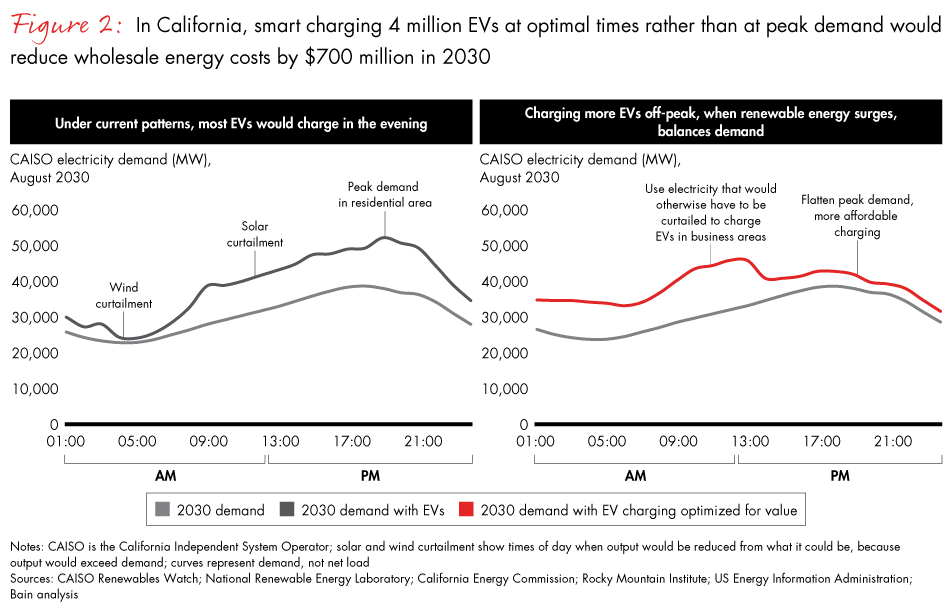
Planning to capture valueFor utility and energy executives, this broad transformation leads to several large opportunities—some that strengthen current positions (greater asset utilization, less renewable curtailment) and others that suggest new potential (load growth, investments in charging infrastructure, expanded customer relationships). Three principles will help executives capture these sources of value.
The proliferation of EVs offers utilities opportunities to deploy new strategies to maximize their benefits. Each utility will want to adapt its approaches to local conditions, in order to produce the greatest benefits for the electricity system. In this way, utilities can ensure that their investments in charging and T&D infrastructure will create the most value for the system over the long run. Christophe Guille is a principal, and Joe Herger and Joseph Scalise are partners, with Bain & Company in San Francisco. All three work with Bain's Global Utilities & Renewables practice, which Joseph leads. The authors would like to thank Stephane Rousselet for his contributions to this work. Copyright © 2018 Bain & Company, Inc. All rights reserved. |