


Brief


|
|
With the Thanksgiving weekend—and many servings of turkey—behind us, holiday halftime scores suggest that e-commerce is gaining share, with a particularly strong reliance on mobile commerce. Retailers are also tapping into more emerging technologies, from augmented reality to robots, in an effort to win shoppers and improve profits. In this issue we recap the Thanksgiving weekend’s sales results and share observations about innovative ways retailers are introducing technology into the customer experience … for better or worse. Thanksgiving weekend sales and the continued shift onlineThe holiday season is in full swing: Deals are prevalent and shoppers are spending. Early estimates of the Thanksgiving weekend (from Thanksgiving Day through Cyber Monday) were slightly up from last year. Reports indicate that much of the growth came from online sales (desktops, smartphones, tablets). Adobe Analytics estimates online sales (excluding apps) for the five-day period were more than $19.5 billion, up 15% from last year. Cyber Monday was the single biggest online shopping day, with online sales exceeding $6.5 billion. The shopping weekend saw a continued shift toward smartphones. On Thanksgiving Day, for example, shoppers placed 48% more orders on their phones compared with last year, according to Salesforce. And for the first time ever, smartphones surpassed computers, capturing 46% of all online orders. We partnered with SimilarWeb to track web traffic at 250 major retailers in November (see Figure 1). Web traffic (desktop and mobile,1 excluding apps) peaked on Black Friday; Cyber Monday and Thanksgiving Day were the next highest traffic days. Over the five-day period, the top 25 retailers accounted for 74% of web traffic at the top 250 retailers, and more than 56% of that traffic came from mobile devices. The use of apps on smartphones and tablets was also on the rise this weekend. On Thanksgiving Day, for example, Amazon.com reported that orders placed through its mobile app were up 50% over last year. In partnership with SimilarWeb, we found that daily active Android mobile app users at the top 25 retailers have increased by 47% over the period from Thanksgiving Day through Cyber Monday, compared to the same period last year (see Figure 2). Moreover, customers spent more time on apps this Thanksgiving holiday, averaging roughly 5 more minutes per app each day compared to last year (17 minutes vs. 12 minutes). 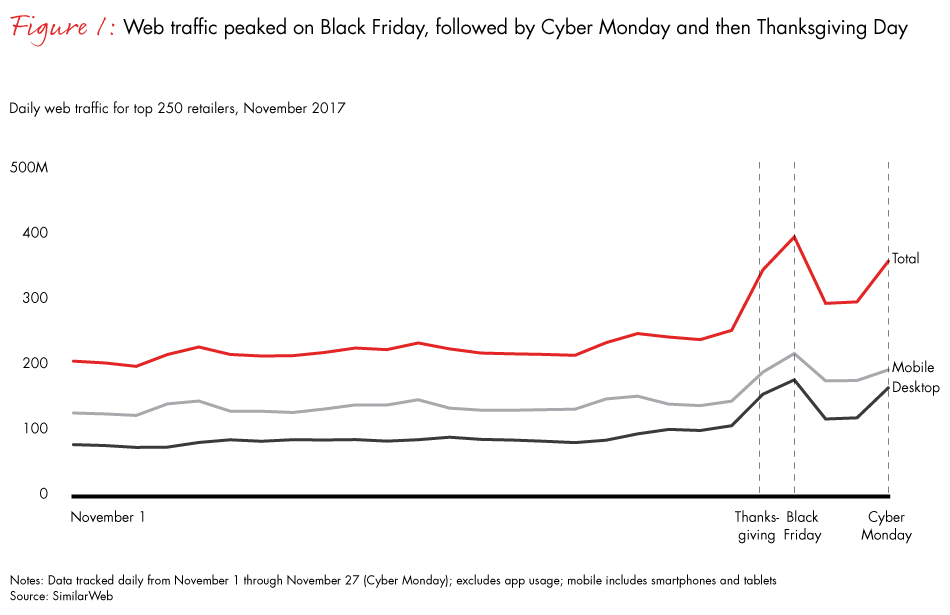 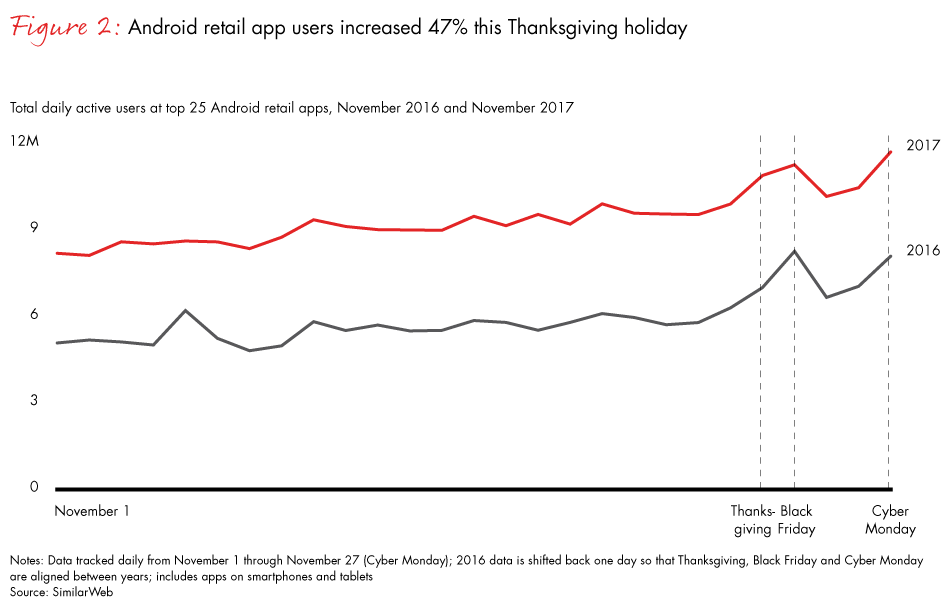 Whether they were using apps or browsing the web, people who shopped online this season were more satisfied with their experience than in-store shoppers. Our 2017 Holiday Shopper Pulse survey, conducted in partnership with Research Now, shows that Amazon shoppers' Net Promoter Score® is 14 points higher than that of in-store shoppers.2 For non-Amazon online shoppers, the Net Promoter Score is 4 points higher than that of in-store shoppers, though this difference is not statistically significant (see Figure 3). More people were browsing online than ever before, but did a higher percentage of visitors actually make a purchase? Apparently so. Working with Jumpshot, we looked at conversion rates—the percentage of unique visitors who actually checked out—for 25 retailers (see Figure 4). On average, conversion rates jumped on high-traffic days. For retailers (excluding Amazon), desktop conversion rates on Black Friday averaged 8.7%, compared to an average of 5.6% for the first three weeks of November. Although conversion rates started going up on Thanksgiving Day and peaked on Black Friday for most brick-and-click players, e-commerce pure plays saw conversion rates peaking on Saturday. The best retailer at driving customers to “check out now” was Amazon, likely due to the simplicity of its user experience. Amazon’s conversion rate on desktops was 18.9% on Saturday, up from an average of 15.4% over the first three weeks of November. 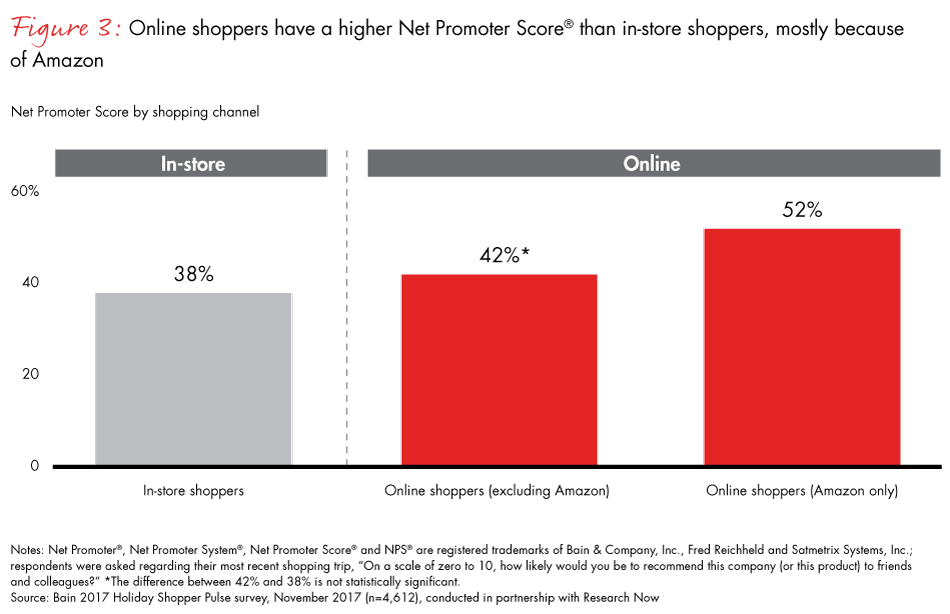 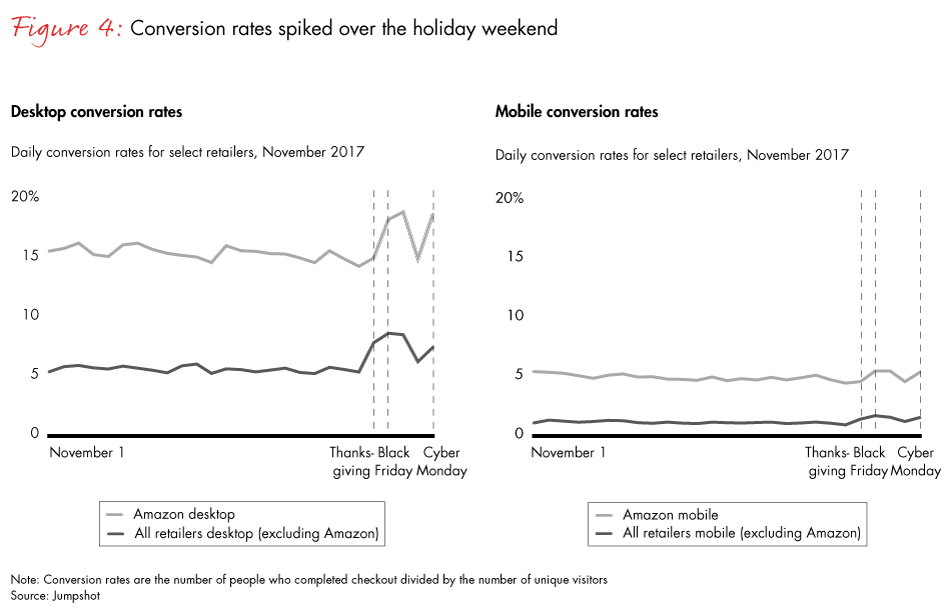 E-commerce has garnered much of the attention this holiday season, but physical stores continue to play a critical role and retailers managed the holiday rush well. According to the National Retail Federation (NRF), over the five-day period from Thanksgiving through Cyber Monday, an estimated 51 million consumers shopped exclusively in stores, and more than 64 million omnichannel shoppers browsed or purchased across channels. Many retailers offered in-store-only deals, extended hours and special events. For example, shoppers at lululemon in Manhattan were treated to live hip-hop music, while some Anthropologie shoppers were greeted by carolers and Santa held office hours in malls across the country. Holiday technology and the customer experienceAs customers hit the stores—both virtual and physical—over the Thanksgiving weekend, their experiences were heavily influenced by technology. Some technology was front and center, clearly visible to shoppers; other technology was behind the scenes, trying to help the process run as smoothly as possible (although for some retailers the technologies underperformed, leading to outages). This season’s technologies offer a glimpse into the future of retail. Imagine this: It’s a brisk day in Boston, and Sarah wants to buy a new winter coat for her husband. She opens Facebook Messenger and starts chatting with her favorite retailer. She asks the retailer to find her a men’s gray wool coat for under $150. Three options immediately pop up, paired with clothing her husband previously bought from the store. Sarah loves one of the coats, adds it to her wish list and effortlessly sets up a price alert in case it drops below $125. That afternoon, Sarah receives an email reminding her about the coat. The email includes a unique, one-time discount code. Sarah can’t resist. She clicks “purchase.” Her husband’s Christmas gift will be delivered in a few hours. Meanwhile Maya is at a café browsing Instagram. She spots a dress perfect for an upcoming holiday party in a sponsored post featuring her favorite instablogger. Little does she know it’s a targeted placement based on her previous shopping behavior and her location near a shopping center. By simply clicking on the photograph, Maya reserves the dress to try on in a nearby store. Later that day, a smart screen in her dressing room reads a radio frequency identification (RFID) tag attached to the dress. The screen displays two pairs of shoes that match the dress. Maya selects one pair, and the right size is quickly delivered to her dressing room. Delighted with the dress and shoes, she takes them to her sales associate, who uses a mobile point-of-sale system to ring her up on the spot. Maya flashes a personalized coupon on her phone offering a complimentary gift and finalizes the purchase by paying with her in-app payment feature. The stories above are fictional, but the capabilities are not. We fully acknowledge that while technology may generate buzz, retailers need to be selective when considering which technologies to test and ultimately perfect and scale. Further, technology is not always the answer for improving the customer experience. There are some areas where technology’s impact is limited or applicable to only a very niche set of customers and occasions. Given those caveats, here are some of the innovative technologies that retailers deployed this holiday season.
Making technology wishes come trueMany retailers are familiar with these technologies like augmented reality and artificial intelligence, but few are using them effectively. They face three big obstacles: Technology can be costly, not all technologies add value and implementation is difficult. First, technology can be expensive, and most retailers don’t spend enough on it. Amazon invests 12% of its sales in technology, product and content generation, compared with less than 2% for average retailers. The difficulties created by shortchanging these investments in technology compound each year, leading to wider capability gaps and the potential for big problems in the stability and security of critical systems. Over the Thanksgiving weekend, social media and news headlines highlighted several major retailers’ technology challenges. Some had their websites crash; others weren’t able to honor their advertised promotions; and some had their point-of-sale systems malfunction. Now more than ever, finding cost efficiencies and reallocating spending away from things that matter more to managers than to customers is essential in retail. Substantial amounts of time and money are inefficiently spent in the debilitating layers of approval required for innovations and in manual processes that could be done better, faster and cheaper. Second, not all technologies actually deliver value. Gartner’s research shows that although more than 87% of retailers are investing in digital change, only 2% of them are seeing the anticipated business results. Retailers must be selective and intentional with their decisions about which technologies to build and when to build them. Winners ignore “shiny objects”—technologies that add little value—focusing instead on improving the experiences and processes that matter most to customers. Third, execution can be difficult. Like Amazon, retailers should work at developing and releasing technologies faster and more frequently. Too often, however, IT is the bottleneck: Systems can’t interface with new applications or data can’t be accessed or IT operations aren’t prepared to quickly test new prototypes in the market. That’s devastating to technological innovation. Instead of giving up in frustration, retailers should position themselves right now to move faster. What actions can you take this holiday season? This is the time of year when ideas for new technologies flow from all directions—customers, employees, vendors, IT departments, even holiday newsletters. The problem: There are so many exciting ideas but so little time (and money) to pursue them. By the end of November, any large investments in technology aren’t likely to impact results this holiday season. And, let’s face it, the unfortunate truth is that many of these exciting ideas will be packed away with the holiday decorations. Still, a number of changes make sense even at this point in the season:
How do you learn from this holiday season to plan for the future? Once retailers create a backlog of opportunities, it’s all about sequencing and execution. Here, speed and frequency are key. To increase the pace of innovation, retailers need to create a more service-oriented IT architecture and adopt Agile ways of working. Creating a more service-oriented IT architecture has to do with improving the speed of software development. The idea involves taking one piece of software and breaking it down into many smaller components that are easier to maintain. These “microservices” function like building blocks that programmers can use and reuse as they develop new technologies. They also speed up the process because bugs in a single microservice have no cascading effects on other components. Adopting Agile ways of working means acting more like a start-up. Agile-ready organizations form teams that are small, colocated, cross-functional and self-managing. They focus on high-priority items from their backlog and test product prototypes with small groups of customers in short cycles called sprints. These teams are remarkably successful. They generate breakthrough ideas and increase the success rates of innovations by 250% to 500%. They build a culture of rapid adaptation, fast recovery from failed experiments and empowered decision making. Moreover, team members are happier and more productive. By employing Agile to launch new experiments and refine business processes, retailers can identify and shift resources toward innovation and position themselves to thrive in future holiday seasons. As this holiday season comes and goes, stories (both good and bad) about technology in retail will continue to make news. Our hope is that as retailers think about where, when and how to bring technology into their business, they focus on the fundamentals, like how to move faster and smarter. Getting this process right can help retailers turn their technology wish list into a reality that delights shoppers. Looking forward: Future release dates and topicsWe wish you all success as the countdown to Christmas continues. In our next issue we examine pricing and promotions from this holiday season. We will also assess the latest holiday sales figures. Here’s the breakdown of the next two issues:
Please let us know if you have any questions or would like to arrange a follow-up discussion on topics addressed in this newsletter or any other retail topics by emailing us at RetailHolidayNewsletter@bain.com. View the full PDF for a list of references About Our Research PartnersJumpshot unlocks the online consumer data needed to provide marketers a complete, up-to-the minute view of the connections between human behavior and purchases. Its global panel of 100 million devices tracks 5 billion actions a day with precision and detail, capturing every aspect of a click and purchase even in the Internet’s most valuable walled gardens like Amazon, Netflix and Google. With consistent real-time behavior, not projections from spotty recruitment panels, Jumpshot provides key insights into how specific audiences behave throughout the entire digital ecosystem to inform marketing strategies and help quantify the impact of campaigns. Visit jumpshot.com to learn more. Research Now is a global leader in digital research data for better insights and business decisions. Founded in 1999, the company was a pioneer in originating online data sampling. The company provides research data solutions for its 3,000 market research, consulting, media and corporate clients through access to more than 11 million deeply profiled business professionals and consumers. Research Now currently operates in more than 40 countries around the globe with locations in the Americas, Europe, the Middle East and Asia-Pacific. For more information, please go to www.researchnow.com. SimilarWeb is a pioneer of market intelligence, providing granular insights about any website or app across all industries in every region to help brands improve their decision making and win market share. The solution is used across organizations and industries to understand industry dynamics, reveal competitor strategies, benchmark performance and identify new opportunities in marketing, sales, strategy, business development, investments and more. SimilarWeb has raised more than $112 million and has nearly 400 employees across eight global offices. Learn more at www.similarweb.com. 1 Mobile devices include smartphones and tablets 2 The Net Promoter Score® is derived by asking consumers, “On a scale of zero to 10, how likely would you be to recommend this company (or this product) to friends and colleagues?” Ratings of 9 or 10 indicate promoters; 7 and 8, passives; and zero through 6, detractors. The score is simply the percentage of promoters minus the percentage of detractors. Net Promoter®, Net Promoter System®, Net Promoter Score® and NPS® are registered trademarks of Bain & Company, Inc., Fred Reichheld and Satmetrix Systems, Inc. |