
Skip to Content
  • Offices

    Offices

    North & Latin America
    • Atlanta
    • Austin
    • Bogota
    • Boston
    • Buenos Aires
    • Chicago
    • Dallas
    • Denver
    • Houston
    • Los Angeles
    • Mexico City
    • Minneapolis
    • Monterrey
    • Montreal
    • New York
    • Rio de Janeiro
    • San Francisco
    • Santiago
    • São Paulo
    • Seattle
    • Silicon Valley
    • Toronto
    • Washington, DC
    Europe & Africa
    • Amsterdam
    • Athens
    • Berlin
    • Brussels
    • Copenhagen
    • Dusseldorf
    • Frankfurt
    • Helsinki
    • Istanbul
    • Johannesburg
    • Kyiv
    • Lisbon
    • London
    • Madrid
    • Milan
    • Munich
    • Oslo
    • Paris
    • Rome
    • Stockholm
    • Vienna
    • Warsaw
    • Zurich
    Middle East
    • Doha
    • Dubai
    • Riyadh
    Asia & Australia
    • Bangkok
    • Beijing
    • Bengaluru
    • Brisbane
    • Ho Chi Minh City
    • Hong Kong
    • Jakarta
    • Kuala Lumpur
    • Manila
    • Melbourne
    • Mumbai
    • New Delhi
    • Perth
    • Seoul
    • Shanghai
    • Singapore
    • Sydney
    • Tokyo
    See all offices
  • Alumni
  • Media Center
  • Subscribe
  • Contact
  • China | 中文版

    Select your region and language

    Global
    • Global (English)
    North & Latin America
    • Brazil (Português)
    • Argentina (Español)
    • Canada (Français)
    • Chile (Español)
    • Colombia (Español)
    Europe, Middle East, & Africa
    • France (Français)
    • DACH Region (Deutsch)
    • Italy (Italiano)
    • Spain (Español)
    • Greece (Elliniká)
    Asia & Australia
    • China (中文版)
    • Korea (한국어)
    • Japan (日本語)
  • Saved items (0)
    Saved items (0)

    You have no saved items.

    Bookmark content that interests you and it will be saved here for you to read or share later.

    Explore Bain Insights
  • Industries
    Main menu

    Industries

    • Aerospace & Defense
    • Agribusiness
    • Chemicals
    • Construction & Infrastructure
    • Consumer Products
    • Financial Services
    • Healthcare & Life Sciences
    • Industrial Machinery & Equipment
    • Media & Entertainment
      Industries
      Media & Entertainment
      • Media Lab
    • Metals
    • Mining
    • Oil & Gas
    • Paper & Packaging
    • Private Equity
      Industries
      Private Equity
      • Due Diligence
      • Exit Planning
      • Firm Strategy & Operations
      • Portfolio Value Creation
    • Social Impact
    • Retail
    • Technology
    • Telecommunications
      Industries
      Telecommunications
      • Capital Expenditure
      • Telco Digital Transformation
    • Transportation
    • Travel & Leisure
    • Utilities & Renewables
  • Consulting Services
    Main menu

    Consulting Services

    • Customer Experience
    • Sustainability
    • Innovation
    • M&A
    • Operations
    • People & Organization
    • Private Equity
    • Sales & Marketing
    • Strategy
    • AI, Insights, and Solutions
    • Technology
    • Transformation
  • Digital
  • Insights
    Main menu

    Insights

    • Industry Insights
    • Services Insights
    • Bain Books
    • Webinars
    • Bain Futures
    View all Insights
    Featured topics
    • Tariff Response
    • Artificial Intelligence
    • Thriving in Uncertainty
    • Executive Conversations
    • Macro Trends
    • M&A Report
    • Healthcare Private Equity Report
    • Paper & Packaging Report
    • Technology Report
    • CEO's Guide to Sustainability
    • CEO Insights
    • CFO Insights
    • COO Insights
    • CIO Insights
    • CMO Insights
    View all featured topics
  • About
    Main menu

    About

    • What We Do
    • What We Believe
    • Our People & Leadership
    • Client Results
    • Awards & Recognition
    • Global Affiliations
    Further: Our global responsibility
    • Sustainability
    • Social Impact
    • World Economic Forum
    Learn more about Further
  • Careers
    Main menu

    Careers

    • Work with Us
      Careers
      Work with Us
      • Find Your Place
      • Our Work Areas
      • Integrated Teams
      • Students
      • Internships & Programs
      • Recruiting Events
    • Life at Bain
      Careers
      Life at Bain
      • Blog: Inside Bain
      • Career Stories
      • Our People
      • Where We Work
      • Supporting Your Growth
      • Affinity Groups
      • Benefits
    • Impact Stories
    • Hiring Process
      Careers
      Hiring Process
      • What to Expect
      • Interviewing
    FIND JOBS
  • Offices
    Main menu

    Offices

    • North & Latin America
      Offices
      North & Latin America
      • Atlanta
      • Austin
      • Bogota
      • Boston
      • Buenos Aires
      • Chicago
      • Dallas
      • Denver
      • Houston
      • Los Angeles
      • Mexico City
      • Minneapolis
      • Monterrey
      • Montreal
      • New York
      • Rio de Janeiro
      • San Francisco
      • Santiago
      • São Paulo
      • Seattle
      • Silicon Valley
      • Toronto
      • Washington, DC
    • Europe & Africa
      Offices
      Europe & Africa
      • Amsterdam
      • Athens
      • Berlin
      • Brussels
      • Copenhagen
      • Dusseldorf
      • Frankfurt
      • Helsinki
      • Istanbul
      • Johannesburg
      • Kyiv
      • Lisbon
      • London
      • Madrid
      • Milan
      • Munich
      • Oslo
      • Paris
      • Rome
      • Stockholm
      • Vienna
      • Warsaw
      • Zurich
    • Middle East
      Offices
      Middle East
      • Doha
      • Dubai
      • Riyadh
    • Asia & Australia
      Offices
      Asia & Australia
      • Bangkok
      • Beijing
      • Bengaluru
      • Brisbane
      • Ho Chi Minh City
      • Hong Kong
      • Jakarta
      • Kuala Lumpur
      • Manila
      • Melbourne
      • Mumbai
      • New Delhi
      • Perth
      • Seoul
      • Shanghai
      • Singapore
      • Sydney
      • Tokyo
    See all offices
  • Alumni
  • Media Center
  • Subscribe
  • Contact
  • China | 中文版
    Main menu

    Select your region and language

    • Global
      Select your region and language
      Global
      • Global (English)
    • North & Latin America
      Select your region and language
      North & Latin America
      • Brazil (Português)
      • Argentina (Español)
      • Canada (Français)
      • Chile (Español)
      • Colombia (Español)
    • Europe, Middle East, & Africa
      Select your region and language
      Europe, Middle East, & Africa
      • France (Français)
      • DACH Region (Deutsch)
      • Italy (Italiano)
      • Spain (Español)
      • Greece (Elliniká)
    • Asia & Australia
      Select your region and language
      Asia & Australia
      • China (中文版)
      • Korea (한국어)
      • Japan (日本語)
  • Saved items  (0)
    Main menu
    Saved items (0)

    You have no saved items.

    Bookmark content that interests you and it will be saved here for you to read or share later.

    Explore Bain Insights
  • Industries
    • Industries

      • Aerospace & Defense
      • Agribusiness
      • Chemicals
      • Construction & Infrastructure
      • Consumer Products
      • Financial Services
      • Healthcare & Life Sciences
      • Industrial Machinery & Equipment
      • Media & Entertainment
      • Metals
      • Mining
      • Oil & Gas
      • Paper & Packaging
      • Private Equity
      • Social Impact
      • Retail
      • Technology
      • Telecommunications
      • Transportation
      • Travel & Leisure
      • Utilities & Renewables
  • Consulting Services
    • Consulting Services

      • Customer Experience
      • Sustainability
      • Innovation
      • M&A
      • Operations
      • People & Organization
      • Private Equity
      • Sales & Marketing
      • Strategy
      • AI, Insights, and Solutions
      • Technology
      • Transformation
  • Digital
  • Insights
    • Insights

      • Industry Insights
      • Services Insights
      • Bain Books
      • Webinars
      • Bain Futures
      View all Insights
      Featured topics
      • Tariff Response
      • Artificial Intelligence
      • Thriving in Uncertainty
      • Executive Conversations
      • Macro Trends
      • M&A Report
      • Healthcare Private Equity Report
      • Paper & Packaging Report
      • Technology Report
      • CEO's Guide to Sustainability
      • CEO Insights
      • CFO Insights
      • COO Insights
      • CIO Insights
      • CMO Insights
      View all featured topics
  • About
    • About

      • What We Do
      • What We Believe
      • Our People & Leadership
      • Client Results
      • Awards & Recognition
      • Global Affiliations
      Further: Our global responsibility
      • Sustainability
      • Social Impact
      • World Economic Forum
      Learn more about Further
  • Careers
    Popular Searches
    • Agile
    • Digital
    • Strategy
    Your Previous Searches
      Recently Visited Pages

      Content added to saved items

      Saved items (0)

      Removed from saved items

      Saved items (0)

      Report

      Beyond Cheaper and Faster: Resilience in Tech Supply Chains

      Beyond Cheaper and Faster: Resilience in Tech Supply Chains

      Covid-19 and growing trade tensions have made revamping supply chains a more urgent priority for many companies.

      By Peter Guarraia and Peter Hanbury

      • min read
      }

      Report

      Beyond Cheaper and Faster: Resilience in Tech Supply Chains
      en

      This article is Chapter 10 of Bain’s global Technology Report 2020. Explore the contents of the report here or download the PDF to read the full report.

      When Covid-19 blew up supply chains around the world, technology executives felt that familiar pit in their stomachs. Although the nature and scale of this pandemic is an unprecedented tragedy, it was the latest in a series of significant blows to the technology supply chain over the past decade (see Figure 1).

      Figure 1
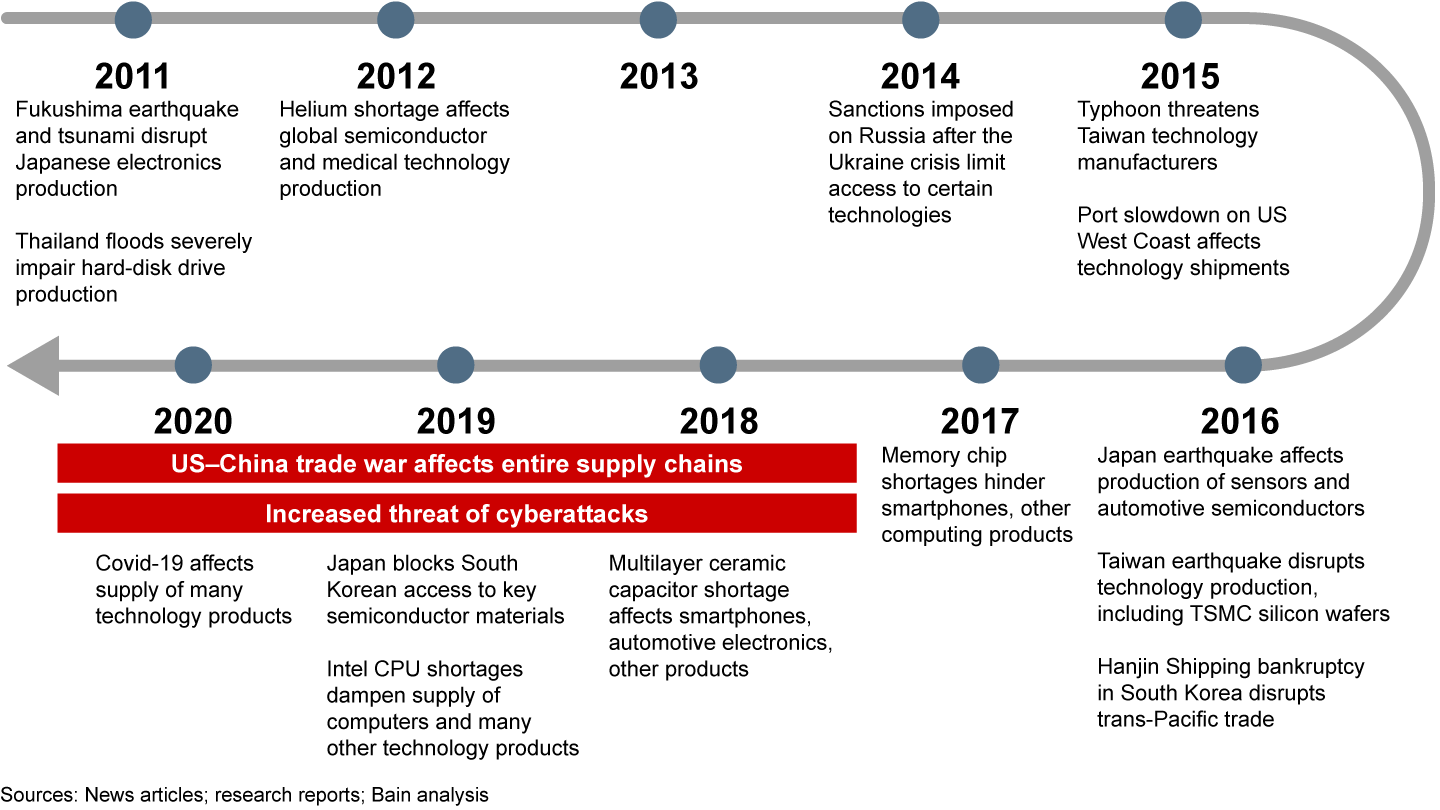
      A series of unpredictable events have disrupted technology supply chains
      A series of unpredictable events have disrupted technology supply chains
      A series of unpredictable events have disrupted technology supply chains

      Most technology companies have dealt with each of these convulsions in a painful, brute-force manner. In response to Covid-19, operations teams spent months in war rooms manually tracking material shipments, trying to map Tier 2 and 3 suppliers, and shifting production to new locations such as Vietnam.

      Those kinds of actions don’t fix the cracks at the foundation of supply chains. At best, they just blunt the impact of disturbances.

      Covid-19 has pushed technology supply chains to their limit. Lockdowns and the disease’s spread have squeezed factory production and created headaches for shipping and other logistics. The pandemic also threw typical demand patterns for technology products off-kilter in the short term. Some segments saw an uptick, such as work-from-home equipment, while others nosedived, such as technology components for the automotive industry.

      All of this has caused massive chaos for supply chains. Consider this: In February, during the height of the lockdown in China to combat the virus, the country recorded its largest one-month drop in manufacturing activity, as measured by the Purchasing Managers Index. The PMI decreased from 50 (indicating a balance between expansion and contraction) in January to a record low of 35.7.

      How did we get here? For the last 30 years, technology firms have wrung out supply chain costs and trimmed as much fat as possible by disaggregating the various steps of the value chain, concentrating each step with a limited number of companies and geographies to improve economies of scale, and reducing inventory across the journey.

      This has made technology supply chains extremely efficient in a normal economic climate. When disaster strikes, they break down. The geographic concentration of production has created single points of failure, such as a reliance on China for motherboards and electronics manufacturing services, and a dependence on the US for semiconductor equipment, central processing units and graphics cards (see Figure 2).

      Figure 2
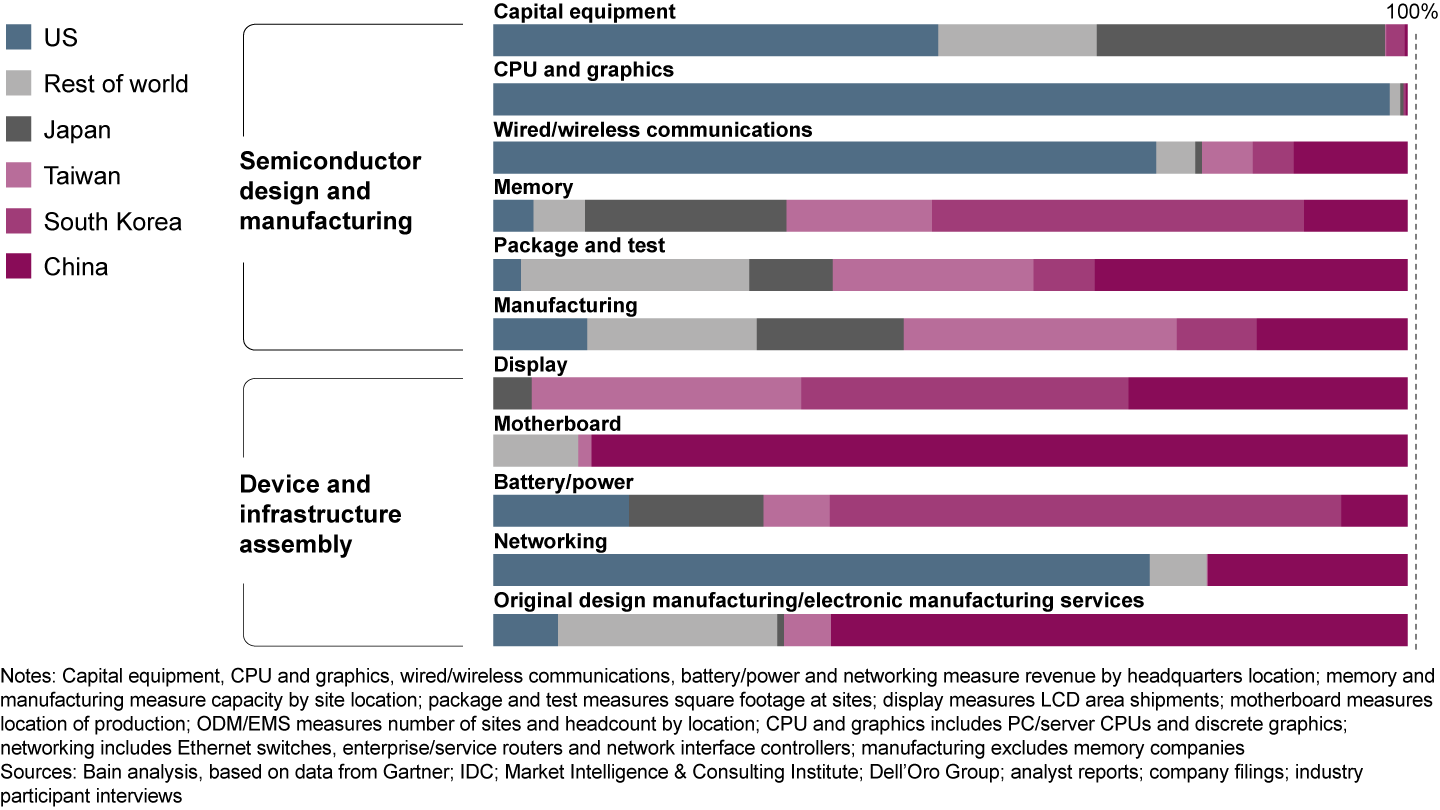
      Geographic concentration makes technology supply chains brittle
      Geographic concentration makes technology supply chains brittle
      Geographic concentration makes technology supply chains brittle

      In 2011, terrible flooding temporarily crippled supplier operations for hard-disk drives in Thailand, the largest producer behind China. That caused a global shortage of hard-disk drives that created ripple effects throughout the computer industry.

      Making supply chains more resilient is challenging because many technology components have single suppliers due in part to high capital expenditures and R&D requirements. The rapid pace of innovation further weakens supply chains because inventory quickly becomes obsolete and a “winner-takes-most” model winnows the number of suppliers. 

      The writing is on the wall now. The pandemic, combined with growing trade tensions, spell continued volatility for technology supply chains for years to come. Deutsche Bank estimates the US–China trade war could result in companies spending about $1 trillion over a five-year period to move supply chains out of China. Rising global trade tensions have affected specific companies, including Huawei Technologies, Taiwan Semiconductor Manufacturing Co. (TSMC) and Apple. The tensions have also impeded entire industries, such as Japan cutting off South Korean memory chip companies’ access to fluorinated polyimides, photoresists and hydrogen fluoride, three materials critical to production.

      What’s become obvious is the frequency and scale of these disruptions to supply chains will only continue to grow. That calls for striking a new strategic balance in technology supply chains. Low cost and efficiency are still crucial, of course, but resiliency has become vitally important. Leading technology companies are intently engaged in finding ways to build more flexibility into their sourcing and supply chains, recognizing both the downside risk and the upside competitive potential of maintaining product flows when the next disruption crops up.

      A good starting point for executives committed to revamping their supply chain is to look at it through their customers’ eyes: What do customers really want? What would make us indispensable to them? What operational capabilities differentiate us from the competition? How can we build those things into our supply chain to make it more resilient and effective? Companies that customize their supply chain, say, by quickly ramping up local production to improve turnaround time, can improve resiliency and turn the supply chain into a competitive advantage.

      Looking at successful strategies across the technology industry, Bain has identified five common attributes of resilient supply chains: an agile network structure, digital and secure operations, real-time visibility, practical analytics and an empowered organization (see Figure 3).

      Figure 3
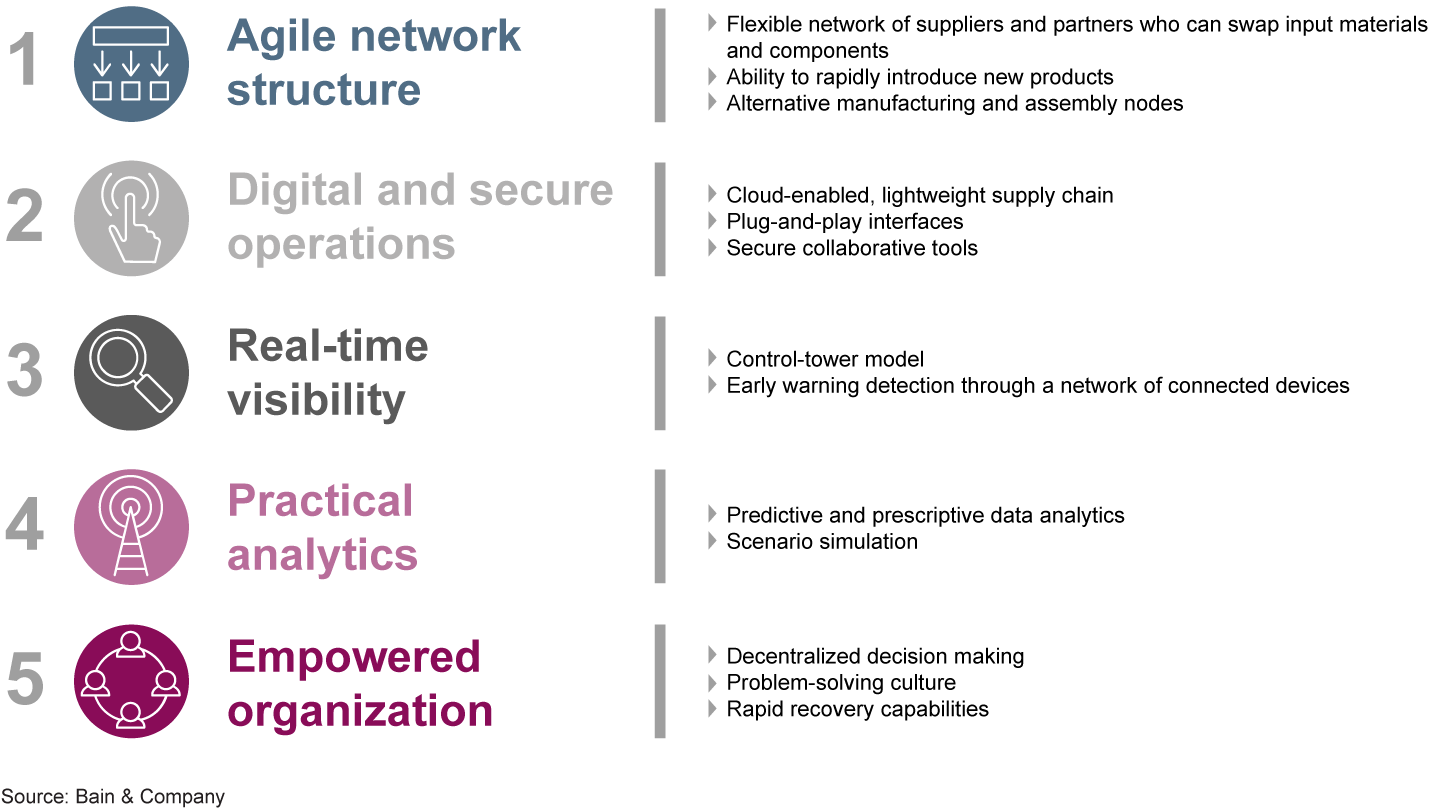
      Resilient supply chains feature five common attributes
      Resilient supply chains feature five common attributes
      Resilient supply chains feature five common attributes

      For example, an agile network of contract manufacturers can help original equipment manufacturers navigate changing tariffs. For many companies, a “China-plus-one” strategy that sources supplies from China and a second location makes sense, but where and how to manage the “plus one” is challenging.

      Trade tensions and other destabilizing events are forcing manufacturers in China to make significant adjustments to their businesses as well. Many multinational corporations have relocated some of their production out of China in recent years, in part due to rising labor costs. These companies’ share of China’s overall manufacturing revenue dropped from 29% in 2008 to 22% in 2019, according to the National Bureau of Statistics of China. Covid-19 and the escalating trade war are accelerating that exodus. Many China-based manufacturers have responded by focusing more on supporting demand from the country’s local businesses and consumers. At the same time, new trade restrictions have forced some Chinese manufacturers to find alternative sources of equipment and materials they previously imported from the US.

      Some companies have weathered crises better than others because they took steps beforehand to make their supply chains more resilient. The Bosch Group, a German-based global supplier of technology and services for automotive, consumer goods and other sectors, has used its agile network structure during the Covid-19 crisis to seamlessly reallocate production to facilities less affected by labor shortages and other repercussions of the pandemic. This structure also enabled Bosch to nimbly adjust output to match reduced demand from auto manufacturing customers that had cut their production in response to the pandemic. Similarly, Bosch used a system of sensors and software to more effectively monitor inbound supplier shipments and quickly source components as it identified shortages or shipment delays. Digital tools have also helped workers, especially equipment technicians and other service personnel, stay connected and keep facilities running as smoothly as possible.

      The final piece of a successful supply chain strategy is quantifying it. Leading companies establish clear metrics for assessing resiliency and adaptability, and they track those as rigorously as unit costs and inventory. That helps them monitor the return on investment and compare their efforts with competitors. The leaders pursue resiliency measures likely to deliver the most value, while still balancing those investments against the company’s risk profile.

      The leaders also use thorough scenario planning to stress test their strategy and make sure they’re as ready as possible for the next crisis. It might sound excessive, but imagining and preparing for a worst-case disaster that seems inconceivable today could pay off down the road. What if a single event wiped out a huge chunk of the business overnight? That’s the kind of shock TSMC faced this year, when new US export controls pushed the company to stop taking product orders from China-based Huawei, which accounted for about 15% of TSMC’s annual revenue. TSMC executives have said they expect demand from other customers to make up for it, but that’s still a massive change that requires adjustments on the fly.

      Executives embarking on a supply chain transformation should go into this journey with clear eyes: Putting resiliency above efficiency will come at a cost. It will likely be more expensive to buy some components from a second supplier outside of Asia or to move supplier operations closer to manufacturing and assembly facilities so they’re a truck drive away instead of a plane ride.

      Nevertheless, when the next disaster strikes, executives will be glad they built more resiliency and adaptability into their supply chain. That goes for their customers, too. 

      Read the Next Chapter

      A New Dawn for Automation


      Authors
      • Headshot of Peter Guarraia
        Peter Guarraia
        Alumni, Houston
      • Headshot of Peter Hanbury
        Peter Hanbury
        Partner, San Francisco
      Contact us
      Related Industries
      • Software
      • Technology
      Related Consulting Services
      • Digital
      • Enterprise Technology
      • Supply Chain
      Technology Report
      US and China: The Decoupling Accelerates

      Geopolitical tensions are pushing technology companies to revisit their global strategies.

      Read More
      Technology Report
      Quantum Computing Moves from Theoretical to Inevitable

      Quantum will likely become part of a mosaic, working with classical computing to solve big problems.

      Read More
      Technology
      Software M&A

      The good news: Most deal best practices still apply to AI acquisitions.

      Read More
      Enterprise Technology
      Artificial Intelligence Rockets to the Top of the Manufacturing Priority List

      Increased adoption of artificial intelligence significantly boosts productivity and improves performance.

      Read More
      Technology Report
      Will AI Disrupt Tech’s Most Valuable Companies?

      Hyperscalers and other market leaders have adapted well to technology shifts, but generative AI poses new challenges.

      Read More
      Published in 十月 2020
      Tags
      • Digital
      • Enterprise Technology
      • Software
      • Supply Chain
      • Technology
      • Technology Report

      How We've Helped Clients

      Helping a Midsize ERP Player Compete against the Giants

      Read case study

      Video: A Marketing Transformation Puts a Software Leader Back on Top

      Read case study

      Aggressively growing an IT service provider with a high-performance culture

      Read case study

      Ready to talk?

      We work with ambitious leaders who want to define the future, not hide from it. Together, we achieve extraordinary outcomes.

      Stay ahead in a rapidly changing world. Subscribe to Bain Insights, our monthly look at the critical issues facing global businesses.

      *I have read and understand Bain’s Privacy Notice.

      Please read and agree to the Privacy Policy.
      Bain & Company
      Contact us Sustainability Accessibility Terms of use Privacy Modern Slavery Act Statement Cookie Policy Sitemap Log In

      © 1996-2026 Bain & Company, Inc.

      Contact Bain

      How can we help you?

      • Business inquiry
      • Career information
      • Press relations
      • Partnership request
      • Speaker request
      See all offices