

Brief
In 2011, employees at semiconductor chip-maker Intel devised a new chemistry process that reduced chemical waste by 900,000 gallons, saving $45 million annually. Another team developed a plan to reuse and optimize networking systems in offices, which cut energy costs by $22 million.
The projects produced solid financial and environmental impact and good publicity for Intel, of course. Just as valuable to the company, though, is the intense engagement of employees in identifying and implementing these projects— engagement that translates into significant positive impact on recruiting, retention and employee productivity.
At Intel and other leading companies, employees now serve as frontline agents for more sustainable business operations. For companies that haven’t yet given serious consideration to sustainability, the employee connection raises the stakes.
Historically, the business case for sustainability has been built on a few planks. Being more resource efficient improves a company’s cost position and reduces the risk of disruptions to the supply chain. Acting responsibly improves relationships with regulators and addresses concerns of action groups that can quickly mount protest campaigns. Building brands that consumers associate with sustainability can open new markets or appeal to new segments.
Less obvious but equally important is how the business case extends to the ongoing challenge of acquiring, retaining and engaging talent. With top talent in short supply throughout much of the world and in most industries, employee attitudes about sustainable business practices are compelling more companies to take this issue seriously, and yielding significant benefits to those firms that take action.
For one thing, articulating a “nobler mission” for a company can energize and empower frontline employees. If you want people to wake up in the morning thrilled to sell more soap, link the product to a transformational ambition such as improving public health and reducing environmental damage, as Unilever CEO Paul Polman has done.
Polman launched Unilever’s Sustainable Living Plan in late 2010, seeking to double sales while halving the environmental impact of its soaps, tea, sauces and other consumer products by 2020. For Unilever, sustainability is the business model, an accelerator of growth. Polman takes a hard-nosed view of sustainability, but one that is holistic rather than slavish only to shareholder returns. “If we focus our company on improving the lives of the world’s citizens and come up with genuine sustainable solutions,” he says, “we are more in synch with consumers and society and ultimately this will result in good shareholder returns.” Having a deeper purpose to what employees do serves as a tremendous motivator, Polman adds. “To work for an organization where you can … be seen to be making a difference, that is rewarding.”
Unilever has been outperforming competitors through this business model, in part because employees have pursued it tenaciously in the marketplace. Like Unilever, many companies are finding that actively involving employees in sustainability programs leads to higher levels of engagement on the job. Engaged employees go the extra mile to deliver. They provide better experiences for customers, approach the job with energy—which enhances productivity—and come up with creative product, process and service improvements. They remain with their employer for longer tenures, which reduces turnover and its related costs. In turn, they create passionate customers who buy more and tell their friends, generating further growth.
As a result, companies with highly engaged workers grow revenues two and a half times as much as those with low engagement levels. And evidence from a recent Bain & Company survey shows that employees increasingly view their company’s sustainability agenda as a critical factor in engagement.
What employees are saying
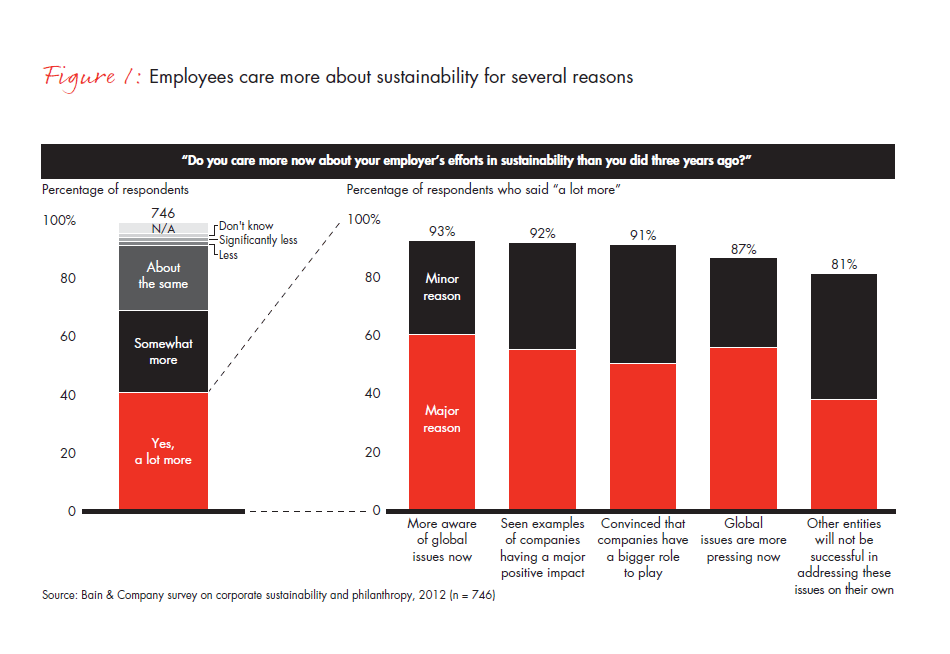
Bain recently surveyed about 750 employees across industries in Brazil, China, India, Germany, the UK and the US. The online survey shows a significant shift in attitudes and career decisions relating to sustainability. For example, roughly two-thirds of respondents said they care more about the topic now than three years ago (see Figure 1), with almost that many saying sustainable business is extremely important to them. Interest peaks among employees in their mid-30s to early 40s.
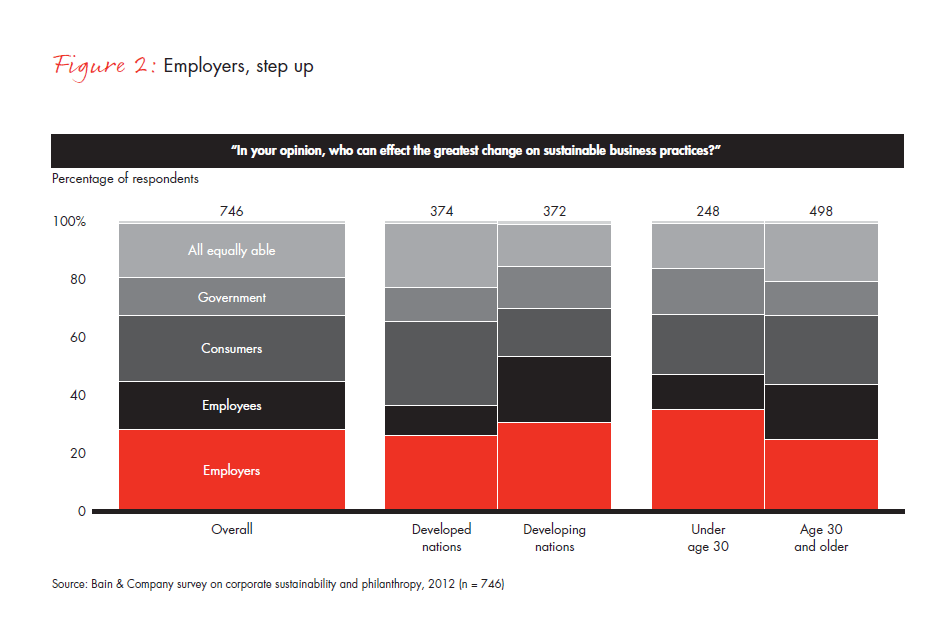
Respondents clearly have high expectations of companies. When asked which group should take the lead on sustainability, more respondents cited employers than they did consumers, employees, governments or all equally, up from three years ago (see Figure 2). In the developed world, a small but growing segment of what we call “sustainability enthusiasts” pay close attention to their firm’s behavior. Enthusiasts, who tend to be younger than the average respondent, are far more likely than other employees to view sustainability as a major factor in job choices and to accept lower compensation to work for an employer that meshes with their beliefs.
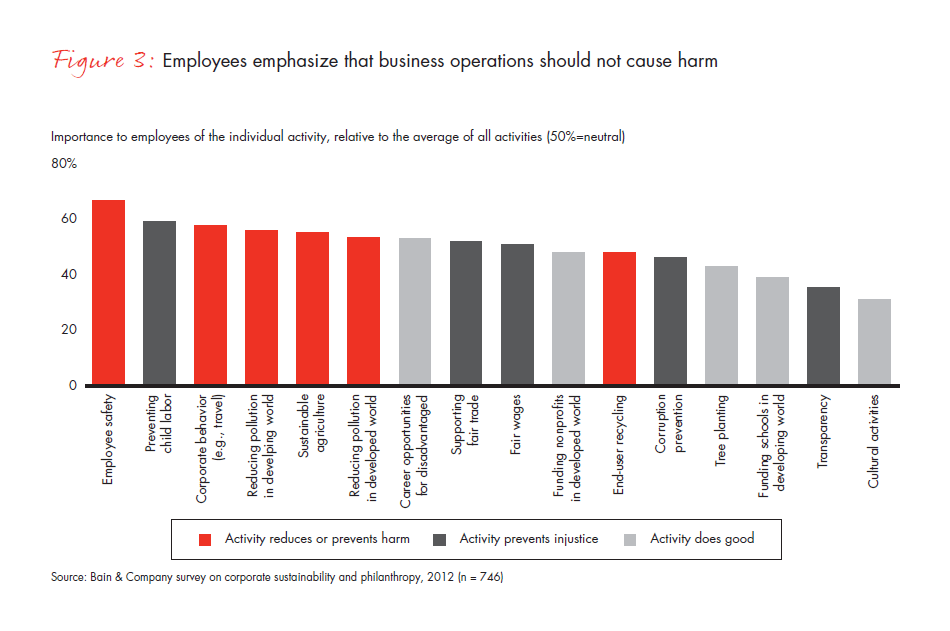
Enthusiasts point to another trend: Employees are increasingly shaping their company’s sustainability efforts. About two-thirds of employees under age 30, one-third of employees over 55 and three-quarters of enthusiasts expect to play a role in how their firm approaches the topic. In a departure from attitudes five or 10 years ago, most employees, not just enthusiasts, care more about ensuring that the business operations themselves are sustainable than they do about philanthropic activities (see Figure 3). This is consistent with the trend we’ve observed of companies shifting their focus from peripherally related “do good” programs to actions at the heart of core processes such as purchasing, manufacturing and distribution.
Several regional differences emerged from the survey. In the developing world, sustainability matters more to respondents, perhaps because evidence of issues such as pollution, lax safety and child labor may be more visible. Employees in these countries take ownership of the issue; 43% of developing-nation respondents said that employees have considerable influence on a company’s sustainability commitments, vs. 25% in developed markets.
While employees everywhere are voting with their feet, more in the developing world than in developed nations said they have accepted lower pay in the past in order to work for a sustainably minded firm. Some 59% of respondents in developing nations have excluded specific industries for employment in the past because the industries do not match their beliefs on corporate sustainability, while 33% in developed nations have done so.
For companies across industries and geographies, the Bain survey reinforces how sustainable practices have become an important means of attracting and motivating top talent. Yet many companies are missing the opportunity to engage their employees, especially their enthusiasts, to full potential. Only one-third of survey respondents characterized their own employer as a clear leader that has fully incorporated sustainable practices, with one-fifth saying their companies have made few or no efforts in this area.
What sustainability leaders are doing
Employee attitudes have changed in part because of greater awareness of corporate role models—those companies that apply employee skills and knowledge to embed sustainability throughout the organization. In recent years, forward-thinking companies have increasingly involved employees in designing and implementing their programs.
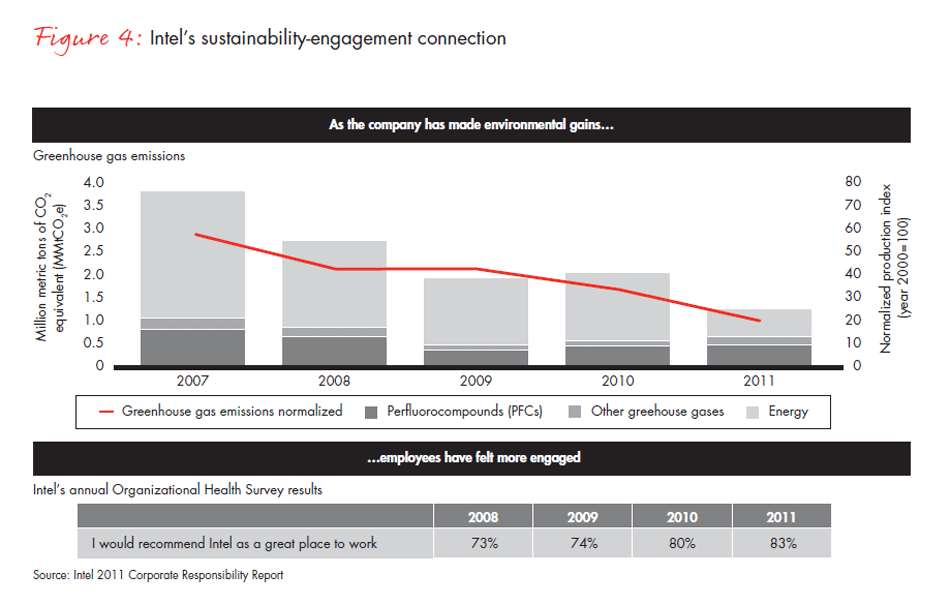
When managed well, such programs not only improve financial results, they also pay dividends in greater employee loyalty and engagement. At Intel, for instance, involvement in sustainability and corporate responsibility programs is likely one reason that the share of employees who would recommend Intel as a great place to work has risen from 61% in 2007 to 83% in 2011, the latest data available (see Figure 4).
While companies often shape a sustainability agenda to suit their individual industry and geographic footprint, the leaders do share several common characteristics in their approach to engaging employees. We would highlight three characteristics of the leaders that have broad relevance for other companies:
- They challenge employees to embed sustainability in core operations and at every stage of the business.
- They hold employees accountable for sustainable practices in their jobs, and reinforce that responsibility through compensation.
- They equip employees with tools and training in order to raise the bar for further improvements.
Let’s review how each characteristic is playing out at companies with a proven track record on sustainability.
Challenging employees to embed sustainability in core operations
Firms that are leading in sustainability initiatives stand out from the pack in the extent to which they push employees to think about how to put sustainability at the heart of the primary business, rather than doing their jobs in traditional fashion and perhaps volunteering for philanthropic activities on the side. This obviously takes executive commitment, a realistic plan and significant time and resources. However, leading companies are seeing the effort pay off.
In 2007 UK-based Marks & Spencer launched Plan A (so called because there is no Plan B for the planet). Plan A aims to make the company the most sustainable retailer in the world by 2015 and incorporate sustainability attributes, such as sustainable cotton or wood, into every product it sells by 2020 (currently one-third of its products have Plan A attributes). In the $500 million seafood line, for instance, Marks & Spencer aims to have all fish caught from sustainable sources as defined by respected authorities such as the Marine Stewardship Council, and currently meets that standard for 93% of fish sold. So Marks & Spencer buyers now work with the World Wildlife Fund and fishing industry representatives to develop programs for meeting that goal.
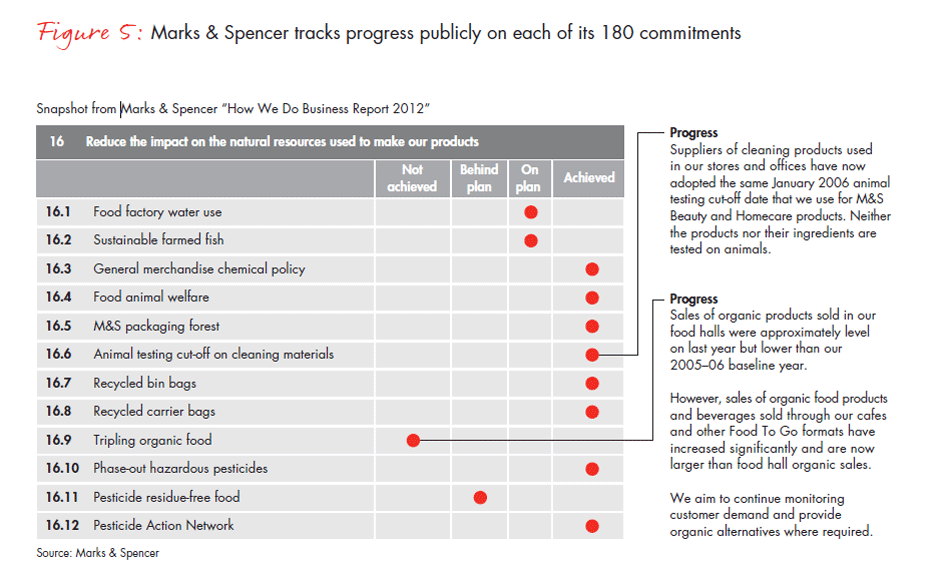
Plan A has been recognized for its high level of transparency and accountability, as the company tracks progress on 180 measurable commitments, reviews progress monthly and reports to the board and the audit committee every six months. An annual, independently ensured report details where progress is ahead of schedule and where it is lagging (see Figure 5). The 2012 report also estimates that net Plan A benefits totaled £105 million to the company itself during the year.
Plan A has been carefully designed to engage all employees from the executive office to the front lines, with varied roles depending on level and job duties. Each of the more than 1,000 Marks & Spencer stores globally has a Plan A champion, drawn from the ranks of enthusiasts, who spends about three hours a week guiding co-workers to implement sustainability initiatives and spot opportunities for improvement. To foster competition, each store is ranked regularly on metrics such as electricity consumption, waste recovery and paper usage. To foster collaboration, regional Plan A champions also meet quarterly to share best practices.
Ideas for improvements or for entirely new initiatives bubble up from all corners of the organization. Consider the origin of one of Marks & Spencer’s most successful new initiatives, called “shwopping.” In 2008 Simon Colbeck, head of technology for clothing, was concerned about the huge volume of garments that end up in landfills every year. He suggested teaming up with the nonprofit Oxfam’s 750 stores across the UK to resell used or unwanted clothing. Colbeck’s idea got approval from the board and has led to four million pieces of clothing being recycled each year, raising £2 million in the past year for Oxfam. As a direct result of shwopping, Marks & Spencer has seen a rise in customer traffic for its clothing and thus further stickiness to its brand while also helping the firm to recycle more of its products.
Other companies have found competitive monetary grants to be useful in spurring employees to translate their ideas into actionable plans. Intel has overarching corporate goals to minimize the environmental impacts of its operations and to design products that are increasingly energy efficient. Intel singles out employees who have identified ways to reduce the core business’s environmental impact, saving more than $200 million in 2010 and 2011 as a result of the projects designed by award winners. Intel also provides grant funding for innovative sustainability project ideas through its “Sustainability in Action” program. Projects funded range from using rainwater for cooling towers in India to redesigning a microprocessor product line in order to reduce packaging.
Competitive grants are just one way to embed sustainability throughout the business. At Cisco Systems, the network equipment firm, employees use “design for environment” principles covering product energy efficiency, packaging, shipping and recyclability. Once a product has reached the end of its life, for example, customers can return any Cisco equipment at Cisco’s expense, and employees direct the products into commodity waste streams for processing and recovery. Cisco’s products themselves help to cut greenhouse gas emissions by, for example, reducing electric consumption through smart utility grids. And Cisco relies on its remote collaboration technologies to reduce business travel and office space.
Holding employees accountable
Senior executives have more influence over corporate policy than do frontline employees. And certain job types—a product engineer or purchasing agent—will encounter sustainability issues more frequently than others. Yet all employees can look for opportunities to advance the company’s cause, and leading companies try to set an appropriate level of accountability for job types that have an influence on environmental or social factors. Some have even begun to selectively tie compensation to sustainability metrics.
Marks & Spencer’s management board members— anyone with profit and loss responsibility—each has Plan A targets that directly contribute to his or her performance bonuses. Store managers have an energy target that figures in their bonus. The company doesn’t feel that’s appropriate for shop employees who have limited influence over meeting targets, so sustainability metrics don’t figure in performance standards at that level. Shop employees are, however, encouraged by Plan A champions to contribute in numerous small ways, such as reminding shoppers to bring back their bags or simply turning out the lights in an empty room. Overall, this approach has helped deliver a 28% improvement in energy efficiency.
Intel, on the other hand, has since 2008 linked a portion of every employee’s variable compensation to attaining environmental sustainability metrics. Before 2008, some employees, such as, environmental engineers already had their performance evaluations linked to environmental performance based on their roles. The decision to include environmental metrics in executive and employee bonus plans extended this connection to all employees. Higher-level employees, who have a broader job scope and greater ability to affect Intel’s performance, receive a higher percentage of their overall compensation at risk through bonus programs. In 2011, the environmental metrics focused on carbon emission reductions in operations and energy efficiency for new products. While this environmental component represents a relatively small portion of the overall bonus calculation, Intel believes that it helps spur employees to collectively focus on achieving Intel’s environmental objectives.
Other companies have had similar success in tying compensation to metrics. At yogurt maker Stonyfield Farms, senior management challenged its employees to save energy at the company’s facilities. Savings were tied to employee bonuses for all workers, providing additional motivation. The company achieved its annual goal, reducing company energy use per ton of product by more than 22%.
Equipping employees with the right tools and training
Like any business initiative, realizing lasting improvements in sustainability requires that employees have the proper tools and ongoing training at hand, so that they can focus their efforts on what the company deems most important. Tools and training serve as the discipline to harness employees’ creativity.
Intel puts commodity managers and buyers through regular supply chain training to teach them methods for attaining Intel’s goals on environmental sustainability and corporate responsibility. It also provides various tools; a carbon calculator, for instance, helps manufacturing teams quantify the environmental impact of a given project.
Similarly, Marks & Spencer provides training on how to integrate Plan A into supply chain management, through sessions on how to source commodities such as soya and palm oil or fi nished products from farms and factories. Shop employees learn specific procedures for segregating waste streams. Marks & Spencer is also developing one software program to design packaging for low environmental impact.
Tools and training apply to the senior ranks as well. Statoil, a Norwegian energy company, launched a climate and energy program in 2011 that nominates 10 senior executives to take part in a year-long program. Upon completion, these participants are expected to identify and respond to future climate uncertainties within their respective areas of responsibility.
Negotiating the bumps along the road
The combination of embedded intent, accountability and groundwork preparation has allowed the sustainability leaders to improve their efforts each year. These companies have also learned that the journey inevitably involves bumps, wrong turns and dead ends. Their experiences can help other companies anticipate and perhaps avoid mistakes. Among the lessons to heed:
Encourage grassroots initiatives, but make sure they’re relevant to the strategic priorities of the business. Achieving this balance can be tough, because you don’t want to squelch the enthusiasm of frontline employees, yet that enthusiasm must be directed in ways consistent with the company’s particular profile. Mobile operator O2’s “Think Big” program in the UK, for example, aims to focus all employees toward six specific sustainability targets.
Communicate the work in progress. Sustainability rarely comes through a tidy and finished program. It’s typically a messy business, and the leaders are confident enough to share their work publicly, as Marks & Spencer does with Plan A. Retail giant Walmart has also opened its environmental efforts to scrutiny, despite ongoing criticism of the company from some quarters. That willingness to discuss efforts publicly has played a role in the sustainability results that Walmart has achieved to date.
Make it relevant to individual employees, including the enthusiasts. Overarching goals won’t resonate unless employees understand how their own behavior will contribute. Any program benefits from having a “sponsorship spine,” consisting of executives, midlevel managers and junior managers who can explain the rationale to employees at all levels and illustrate how it plays out in their organizational unit. Enthusiasts can be tapped to lead grassroots efforts among their peers.
Repeat the message dozens of times. Awareness and adoption of desired behaviors require repeated communications. Intel first linked sustainability to compensation in 2008, yet six months later a survey showed that few employees even knew about the change. That revelation led Intel to open several communications channels, including a dedicated Web portal and an interactive online employee community, called Green Intel, to facilitate discussion between teams and individuals on sustainability topics such as power management.
Don’t promise without delivering. Well-intentioned efforts that raise employee expectations but don’t deliver meaningful programs or results can easily backfire. Asking employees for ideas without a method for bringing them to life is worse than not asking in the first place. To put employees into action inexpensively, one option is to offer competitive grants. The grants allow companies to launch pilot programs and expand the best offerings while directing those that don’t work to fail fast.
If a company addresses these problems successfully, the payoff goes to the heart of the talent agenda: greater employee loyalty and engagement. New recruits to Marks & Spencer often cite Plan A as one important reason they sought work there. A number of Plan A champions have moved into the management development track.
All companies endeavor to release the discretionary energy of their talent. Engaging employees in helping a business operate sustainably is becoming essential as younger generations expand their presence in the workforce and push sustainability to the head of the corporate agenda. When their enthusiasm is directed to strategically consistent initiatives, companies can significantly improve their talent recruiting, retention and productivity—and at the same time change core business operations for the better.
Jenny Davis-Peccoud leads Bain & Company’s Global Social Impact practice and is based in London. James Allen is co-head of Bain’s Global Strategy practice and is based in London. Melissa Artabane is the practice area manager for Bain’s Global Social Impact practice and is based in Boston.
Published in 四月 2013