Article

|
|
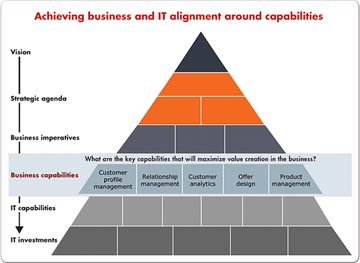
Information technology organizations and the businesses they support do not occupy parallel universes, but business leaders can be forgiven for thinking they might. A Bain & Company survey of more than 500 senior executives found that despite devoting enormous resources and energy to align IT investments with their most important business needs, fewer than one in five felt their efforts were succeeding. The consequences can be severe: The organization wastes money on the wrong IT investments. It is slow to bring new products and initiatives to market. And it defers making improvements because IT lacks the full support of the business which, in turn, fails to achieve critical objectives. There is a better way. Effective alignment can occur only when IT and business strategy are anchored in clearly articulated business capabilities. Capabilities are the specific skills needed to achieve competitive leadership. They are dynamic and give the organization an ability to adapt to changing market conditions. Supporting business capabilities permits IT to respond flexibly to essential business needs. Consider customer segmentation, a critical capability for many companies in order to grow. An IT organization built around capabilities enables the business to target attractive new customer segments in an environment of changing products, prices and consumer tastes. These goals require IT, in turn, to build capabilities for integrated data storage; common platforms for various channel, product and security needs; and dynamic end-user computing. In short, organizing around capabilities ensures that business priorities trigger key IT decisions. Leading companies typically follow a five-step process for unlocking IT's full potential to deliver business value:
Click here to read full article. The authors are all partners with Bain & Company and members of the firm's Information Technology practice. Donie Lochan is based in New Delhi; Rudy Puryear, the IT practice leader, is based in Chicago; Sachin Shah is based in London; and Arpan Sheth is based in Mumbai. Additional articles appearing in this edition of the Results Brief newsletter: Flexible work models: How to bring sustainability to a 24/7 world Making change happen: Shaping the future with women's voices Customer loyalty in retail banking |