Brief


|
|
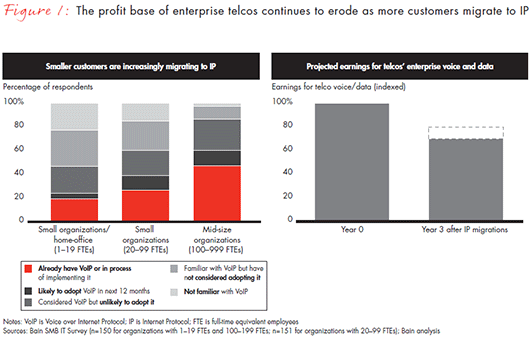
The enterprise business of telecommunications faces a crisis of eroding top and bottom lines as customers switch over from traditional, margin-rich time-division multiplexing (TDM) to financially less attractive Internet Protocol (IP) connectivity. IP connectivity allows enterprises to realize greater flexibility, cost savings and new services, but it has contributed to eroding revenues and profits for telcos—in some cases by 20% to 30% over a three-year span (see Figure 1). The entry of a wide range of competitive players delivering enterprise services over IP not only complicates the position of traditional telcos, but poses the threat of displacing them.
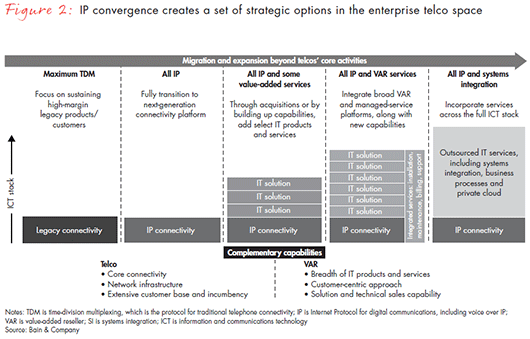
This disruption creates a dilemma for traditional telcos, which must balance short-term incentives to cling to the high margins of their traditional systems against the long-term benefits of investing in IP infrastructure and services, which are clearly the future (see Figure 2). Continuing to offer traditional TDM may yield healthy cash flows in the near term, but with the decline and obsolescence of this technology, markets would penalize the valuations of providers that have not transitioned to IP connectivity. Merely switching to IP, with few or no related services, would offer a sustainable business model, but because of lower price points, it would come at the cost of reduced revenue, leading to a lower valuation and unsatisfactory outcomes for shareholders. A more sustainable option is migrating to IP connectivity while making IT services available. The IT services market is expected to grow 6% annually over the next several years, spurred by the rise of “as a service” and other new models, which are seeing annual growth rates above 20%. Expanding services, however, has risks at both ends of the spectrum. A limited expansion may not be enough to sufficiently grow the business, while overextending services to include IT system integration could be more than most telcos are able to provide, given that it’s a fundamentally different type of business.
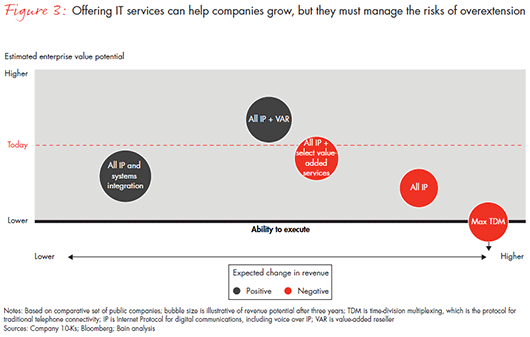
Teaming with VARs For some telcos, acquiring and leveraging the capabilities and assets of a value-added reseller (VAR) might be the most potent and optimal strategy—yet it is often undervalued and few adopt it (see Figure 3). Acquiring a suitable VAR may enable a telecom provider to materially augment its top line without overextending into a full suite of integrated IT services, since the VAR delivers proven assets and capabilities to succeed in the services market.
In our work with telcos, we have found that they can share up to 75% of their top customers with VARs, making it simpler to create a one-stop shop for information and communications for small, medium and even large enterprise customers. But success depends on getting senior executives comfortable with the notion of acquiring a VAR to bring new business capabilities in-house. Telecom industry veterans are typically more comfortable investing in real assets, such as spectrum and network infrastructure, than in talent—which can simply walk out the door. Successful integrations follow a proven playbook that creates synergistic value for the combined business while addressing the major strategic risks, including how to retain and integrate the best talent from both organizations. Herbert Blum, a partner in the Telecommunications practice, explains how value-added resellers (VARs) may help telecom companies overcome structural challenges. Since telcos and VARs are different businesses, the key to a successful partnership lies in allowing both to flourish under the same roof and in reinforcing each other’s individual strengths, which is a delicate but attainable balance to strike. We have identified a three-step playbook for success:
A short set of principles can help leaders realize success:
Herbert Blum is a partner with Bain & Company in Toronto. Jamie Cleghorn is a partner in Chicago. Christophe Van de Weyer is a partner in Brussels, and Prashanth Aluru is a partner in New Delhi. All four work with the firm’s Global Telecommunications practice. Net PromoterSM is a registered trademark of Bain & Company, Inc., Fred Reichheld and Satmetrix Systems, Inc. Net Promoter ScoreSM and Net Promoter SystemSM are trademarks of Bain & Company, Inc., Fred Reichheld and Satmetrix Systems, Inc. |