


Skip to Content
  • Offices

    Offices

    North & Latin America
    • Atlanta
    • Austin
    • Bogota
    • Boston
    • Buenos Aires
    • Chicago
    • Dallas
    • Denver
    • Houston
    • Los Angeles
    • Mexico City
    • Minneapolis
    • Monterrey
    • Montreal
    • New York
    • Rio de Janeiro
    • San Francisco
    • Santiago
    • São Paulo
    • Seattle
    • Silicon Valley
    • Toronto
    • Washington, DC
    Europe & Africa
    • Amsterdam
    • Athens
    • Berlin
    • Brussels
    • Copenhagen
    • Dusseldorf
    • Frankfurt
    • Helsinki
    • Istanbul
    • Johannesburg
    • Kyiv
    • Lisbon
    • London
    • Madrid
    • Milan
    • Munich
    • Oslo
    • Paris
    • Rome
    • Stockholm
    • Vienna
    • Warsaw
    • Zurich
    Middle East
    • Doha
    • Dubai
    • Riyadh
    Asia & Australia
    • Bangkok
    • Beijing
    • Bengaluru
    • Brisbane
    • Ho Chi Minh City
    • Hong Kong
    • Jakarta
    • Kuala Lumpur
    • Manila
    • Melbourne
    • Mumbai
    • New Delhi
    • Perth
    • Seoul
    • Shanghai
    • Singapore
    • Sydney
    • Tokyo
    See all offices
  • Alumni
  • Media Center
  • Subscribe
  • Contact
  • Global | English

    Select your region and language

    Global
    • Global (English)
    North & Latin America
    • Brazil (Português)
    • Argentina (Español)
    • Canada (Français)
    • Chile (Español)
    • Colombia (Español)
    Europe, Middle East, & Africa
    • France (Français)
    • DACH Region (Deutsch)
    • Italy (Italiano)
    • Spain (Español)
    • Greece (Elliniká)
    Asia & Australia
    • China (中文版)
    • Korea (한국어)
    • Japan (日本語)
  • Saved items (0)
    Saved items (0)

    You have no saved items.

    Bookmark content that interests you and it will be saved here for you to read or share later.

    Explore Bain Insights
  • Industries
    Main menu

    Industries

    • Aerospace & Defense
    • Agribusiness
    • Chemicals
    • Construction & Infrastructure
    • Consumer Products
    • Financial Services
    • Healthcare & Life Sciences
    • Industrial Machinery & Equipment
    • Media & Entertainment
      Industries
      Media & Entertainment
      • Media Lab
    • Metals
    • Mining
    • Oil & Gas
    • Paper & Packaging
    • Private Equity
      Industries
      Private Equity
      • Due Diligence
      • Exit Planning
      • Firm Strategy & Operations
      • Portfolio Value Creation
    • Social Impact
    • Retail
    • Technology
    • Telecommunications
      Industries
      Telecommunications
      • Capital Expenditure
      • Telco Digital Transformation
    • Transportation
    • Travel & Leisure
    • Utilities & Renewables
  • Consulting Services
    Main menu

    Consulting Services

    • Customer Experience
    • Sustainability
    • Innovation
    • M&A
    • Operations
    • People & Organization
    • Private Equity
    • Sales & Marketing
    • Strategy
    • AI, Insights, and Solutions
    • Technology
    • Transformation
  • Digital
  • Insights
    Main menu

    Insights

    • Industry Insights
    • Services Insights
    • Bain Books
    • Webinars
    • Bain Futures
    View all Insights
    Featured topics
    • Tariff Response
    • Artificial Intelligence
    • Thriving in Uncertainty
    • Executive Conversations
    • Macro Trends
    • M&A Report
    • Healthcare Private Equity Report
    • Paper & Packaging Report
    • Technology Report
    • CEO's Guide to Sustainability
    • CEO Insights
    • CFO Insights
    • COO Insights
    • CIO Insights
    • CMO Insights
    View all featured topics
  • About
    Main menu

    About

    • What We Do
    • What We Believe
    • Our People & Leadership
    • Client Results
    • Awards & Recognition
    • Global Affiliations
    Further: Our global responsibility
    • Sustainability
    • Social Impact
    • World Economic Forum
    Learn more about Further
  • Careers
    Main menu

    Careers

    • Work with Us
      Careers
      Work with Us
      • Find Your Place
      • Our Work Areas
      • Integrated Teams
      • Students
      • Internships & Programs
      • Recruiting Events
    • Life at Bain
      Careers
      Life at Bain
      • Blog: Inside Bain
      • Career Stories
      • Our People
      • Where We Work
      • Supporting Your Growth
      • Affinity Groups
      • Benefits
    • Impact Stories
    • Hiring Process
      Careers
      Hiring Process
      • What to Expect
      • Interviewing
    FIND JOBS
  • Offices
    Main menu

    Offices

    • North & Latin America
      Offices
      North & Latin America
      • Atlanta
      • Austin
      • Bogota
      • Boston
      • Buenos Aires
      • Chicago
      • Dallas
      • Denver
      • Houston
      • Los Angeles
      • Mexico City
      • Minneapolis
      • Monterrey
      • Montreal
      • New York
      • Rio de Janeiro
      • San Francisco
      • Santiago
      • São Paulo
      • Seattle
      • Silicon Valley
      • Toronto
      • Washington, DC
    • Europe & Africa
      Offices
      Europe & Africa
      • Amsterdam
      • Athens
      • Berlin
      • Brussels
      • Copenhagen
      • Dusseldorf
      • Frankfurt
      • Helsinki
      • Istanbul
      • Johannesburg
      • Kyiv
      • Lisbon
      • London
      • Madrid
      • Milan
      • Munich
      • Oslo
      • Paris
      • Rome
      • Stockholm
      • Vienna
      • Warsaw
      • Zurich
    • Middle East
      Offices
      Middle East
      • Doha
      • Dubai
      • Riyadh
    • Asia & Australia
      Offices
      Asia & Australia
      • Bangkok
      • Beijing
      • Bengaluru
      • Brisbane
      • Ho Chi Minh City
      • Hong Kong
      • Jakarta
      • Kuala Lumpur
      • Manila
      • Melbourne
      • Mumbai
      • New Delhi
      • Perth
      • Seoul
      • Shanghai
      • Singapore
      • Sydney
      • Tokyo
    See all offices
  • Alumni
  • Media Center
  • Subscribe
  • Contact
  • Global | English
    Main menu

    Select your region and language

    • Global
      Select your region and language
      Global
      • Global (English)
    • North & Latin America
      Select your region and language
      North & Latin America
      • Brazil (Português)
      • Argentina (Español)
      • Canada (Français)
      • Chile (Español)
      • Colombia (Español)
    • Europe, Middle East, & Africa
      Select your region and language
      Europe, Middle East, & Africa
      • France (Français)
      • DACH Region (Deutsch)
      • Italy (Italiano)
      • Spain (Español)
      • Greece (Elliniká)
    • Asia & Australia
      Select your region and language
      Asia & Australia
      • China (中文版)
      • Korea (한국어)
      • Japan (日本語)
  • Saved items  (0)
    Main menu
    Saved items (0)

    You have no saved items.

    Bookmark content that interests you and it will be saved here for you to read or share later.

    Explore Bain Insights
  • Industries
    • Industries

      • Aerospace & Defense
      • Agribusiness
      • Chemicals
      • Construction & Infrastructure
      • Consumer Products
      • Financial Services
      • Healthcare & Life Sciences
      • Industrial Machinery & Equipment
      • Media & Entertainment
      • Metals
      • Mining
      • Oil & Gas
      • Paper & Packaging
      • Private Equity
      • Social Impact
      • Retail
      • Technology
      • Telecommunications
      • Transportation
      • Travel & Leisure
      • Utilities & Renewables
  • Consulting Services
    • Consulting Services

      • Customer Experience
      • Sustainability
      • Innovation
      • M&A
      • Operations
      • People & Organization
      • Private Equity
      • Sales & Marketing
      • Strategy
      • AI, Insights, and Solutions
      • Technology
      • Transformation
  • Digital
  • Insights
    • Insights

      • Industry Insights
      • Services Insights
      • Bain Books
      • Webinars
      • Bain Futures
      View all Insights
      Featured topics
      • Tariff Response
      • Artificial Intelligence
      • Thriving in Uncertainty
      • Executive Conversations
      • Macro Trends
      • M&A Report
      • Healthcare Private Equity Report
      • Paper & Packaging Report
      • Technology Report
      • CEO's Guide to Sustainability
      • CEO Insights
      • CFO Insights
      • COO Insights
      • CIO Insights
      • CMO Insights
      View all featured topics
  • About
    • About

      • What We Do
      • What We Believe
      • Our People & Leadership
      • Client Results
      • Awards & Recognition
      • Global Affiliations
      Further: Our global responsibility
      • Sustainability
      • Social Impact
      • World Economic Forum
      Learn more about Further
  • Careers
    Popular Searches
    • Agile
    • Digital
    • Strategy
    Your Previous Searches
      Recently Visited Pages

      Content added to saved items

      Saved items (0)

      Removed from saved items

      Saved items (0)

      Brief

      How to Eliminate Mining Bottlenecks—for Good

      How to Eliminate Mining Bottlenecks—for Good

      Taking a holistic approach can boost throughput and reduce costs with little or no financial investment.

      By Mikael Lindgren and Marco D’Avino

      • min read
      }

      Brief

      How to Eliminate Mining Bottlenecks—for Good
      en

      As the CEO of a global mining company announced the second cost-cutting program in 18 months, the executive was sure mine productivity would finally surge. The bottleneck at a key site, it seemed, was the paste plant. But after the company invested in upgrading it, another constraint surfaced: mill throughput. A few months later, mining fronts were holding back production. Three years into a major efficiency overhaul, the program had produced only a fraction of the expected productivity gains, and the company was back to square one.

      It’s a common dilemma. Despite the industry’s long-running efforts to cut costs, improve productivity and transform mining performance, new inefficiencies pop up with alarming regularity, and programs often fail to deliver on promised gains. Even companies that manage to increase production volume and substantially lower costs frequently discover they cannot sustain the savings over time.

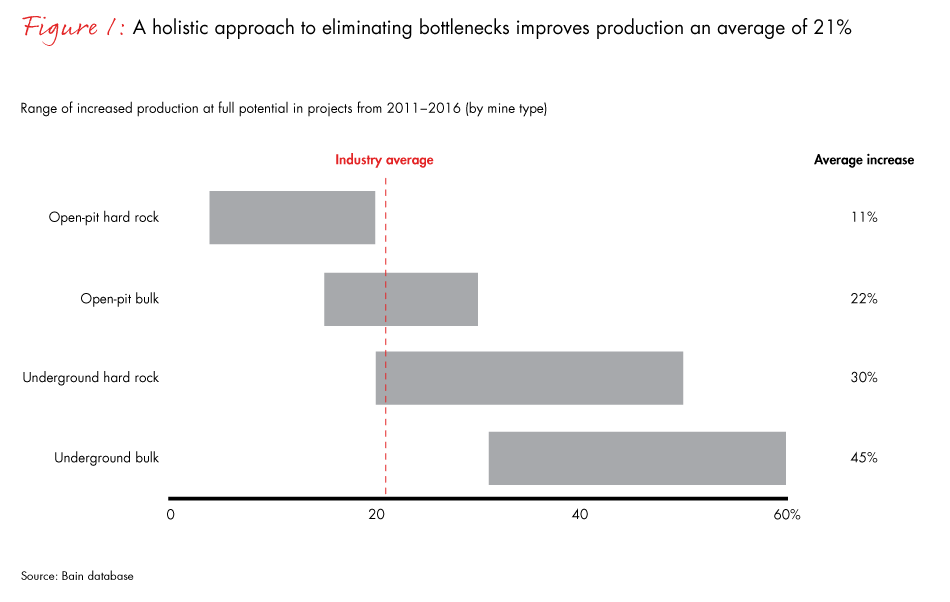
      Successful mining companies use a holistic approach to eliminate bottlenecks. Many have learned the hard way that addressing a bottleneck in isolation typically backfires, giving rise to another one. To avoid that predicament, they model scenarios for existing and potential constraints across the production system. They also manage the evolution of current and potential bottlenecks in one integrated process across functions and operational areas. This strategy can improve mining performance significantly with little or no capital investment. Bain & Company analysis shows it increases annual production volume by 21%, on average, with some companies achieving as much as 50% despite having undergone previous transformations (see Figure 1).

      An integrated approach to resolving constraints allows leadership teams to create a more stable production system, minimize the risk of future disruption to operations and ensure a safe workplace. That, in turn, promotes more effective capital allocation. By changing the way they run the business, these leaders develop a new competitive edge.

      mining-debottlenecking-fig01_embed

      Key challenges


      Debottlenecking may sound straightforward, but it’s difficult to get right. Too often, companies rely on models that focus on a single point in time, don’t model variability and are only valid within narrow operating parameters. Successful mining companies invest in models that address potential sources of variation in performance over time, including “what-if” scenarios. They also seek a deeper understanding of the factors that generate unnecessary cost. It’s not easy to obtain all that detail. As a result, most head-office teams lack the information they need to paint a full picture. Worse, the quality of such data is often poor.

      Producing quality models and information sets that are consistent over time often requires rethinking the company’s IT systems—and establishing better data discipline. Leaders maintain a view of system performance and potential in real time. That creates a single source of truth when building a business case or justifying investments to improve performance.

      Leadership teams often don’t know how much real improvement is possible when optimizing systems, making it hard to challenge planners. As a result they give in to the temptation to rapidly fix the most pressing bottleneck. However, tackling constraints one by one without a comprehensive overview is less productive and more expensive. The most effective approach starts with gathering information. What is peak performance for each step across the entire value chain? What are the interdependencies from one part of the value chain to the next? How will the system evolve as steps change? Companies that don’t understand the full picture risk making large investments that don’t deliver improvements.

      Leading companies manage multistep debottlenecking dynamically using the right data and an effective statistical model. Armed with the numbers, they can aim higher and manage variability at the same time.

      Another common misstep is to confuse short-term constraints with system bottlenecks. Any part of the production process that is shut down long enough will cause operational losses. A conveyor belt that stops functioning is a short-term constraint, not a bottleneck. Of course, removing short-term constraints is a valuable exercise, but removing bottlenecks delivers far greater returns. Bottlenecks are processes that limit the overall pace of production—and when a process can’t catch up to a full-potential pace, there is no way to recoup the loss. For example, an idle coal wash plant might well be the hidden bottleneck if it has an insufficient stockpile buffer. The downtime is precisely when the system losses occur. Successful companies distinguish between short-term constraints and bottlenecks because the investment and management differ for each risk.

      These leaders also work collaboratively across planning, mining, processing and supply chain. They are ready to challenge long-held assumptions, compare observations and improve the state of knowledge of the entire business. This requires identifying and deploying the right triad of talent—experts in information technology, technical engineering, production, maintenance, business analytics and finance. Nurturing collaboration across such groups is a challenge. But unless companies develop a single source of truth around system dynamics and commercial options—knowing when and how to seek increased output as opposed to cost efficiencies—performance improvement will remain a distant goal.

      Three steps to reducing recurring bottlenecks


      Mapping. Mapping is the vital first step to removing bottlenecks and improving performance. Successful mining companies have a clear view of the entire production chain, including key processes, throughput variability, quality performance and buffers. The leadership team at one open-cut iron ore mine realized it could unlock 20% to 30% additional processing capacity after a mapping exercise revealed the processing plant’s stockpile buffers were too small. Insufficient buffers led to low effective utilization (ore on the belt), even though plant runtime numbers looked great.

      The buffer protects the bottleneck from a varying pace of production. Before leadership teams spend money on buffers, however, they need to be sure which process is the bottleneck. In this case, lack of material in front of the plant was indeed a result of an insufficient buffer—but the bottleneck also might have been caused by poor plant design.

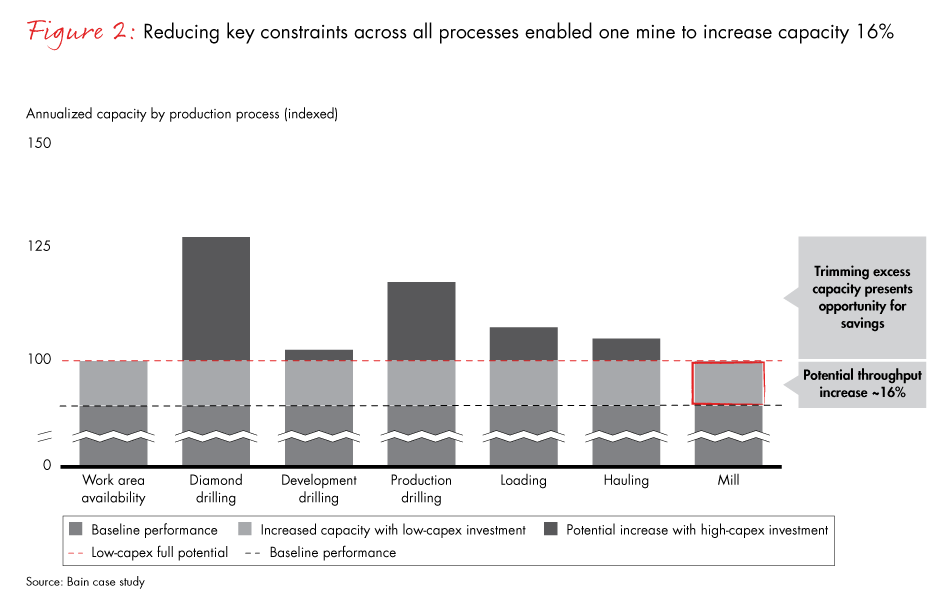
      Modeling. With a detailed map in hand, companies have the critical information to create a model that evaluates constraints, determines low and high capital expenditure for full-potential outcomes, and identifies clear pathways to improving productivity. At one deep hard-rock underground mine site, the management team firmly believed that ventilation was constraining their throughput, and that the company would need to invest 15% to 20% of annual costs to improve volume. But on closer inspection, mine statistics showed that increasing development drill productivity, optimizing their short-term planning process and, ultimately, turning around more headings, could deliver significant gains. Those steps together helped increase production 20% without any significant financial investment, and substantially reduced unit costs (see Figure 2).

      mining-debottlenecking-fig02_embed

      Implementation. The third step is building a clear implementation plan to increase production and eliminate bottlenecks—one that ensures key activities move forward in parallel where necessary. A well-designed program allows productivity improvements delivered by early phases of debottlenecking to fund the later phases and to develop the capability for continuous improvement.

      How does it work? A model identifies the bottleneck by repeatedly shifting constraints and determining total system capacity. It also addresses trade-offs across the value chain and against short-term key performance indicators. Leaders continue testing until the bottleneck moves to the process requiring the largest investment to expand further. Addressing this bottleneck often maximizes economic returns.

      That approach delivered big gains for one global diversified mining company that had been struggling with both short-term constraints (such as those caused by pebble crushers, paste plants, mobile equipment) and system bottlenecks (linked to mill, hoist and secondary cyclones) across a major site. By looking at the whole system instead of a single constraint, the leadership team developed a plan that increased production by close to 15% without any investment by making changes to technical designs such as cut-off grade, stope design and development sequence. The holistic view helped the company avoid a series of planned investments designed to mitigate the consequences of short-term constraints.

      Buffers are critical to stabile operations and productivity, and leaders manage them closely before and after removing constraints. One mining company failed to realize that the bottleneck at an underground mine site had shifted from the mine to the processing plant because it was not monitoring the data. Continuous monitoring of the buffer across each step of the value chain would have signaled the shifting bottleneck immediately, allowing the company to adjust stocks and buffers and assure better throughput.

      Many factors have forced mining companies to squeeze more out of existing assets. Commodity price declines, increased financial pressure, cost cutting and tighter capital availability have made improving operational productivity and increasing production with limited capital investment a top priority. Despite years of restructuring and some impressive unit-cost reductions, however, most mine operators still do not achieve full potential of their assets.

      A systemic and cross-functional approach to removing bottlenecks can transform mining performance, often with little or no investment. It is more complex than a quick fix, and it requires a different mindset and management skills. But it is also more effective: Debottlenecking can trigger continual waves of improvement, and gains do not disappear after 12 months. Mining companies that learn how to manage their systems from end to end and eliminate production constraints for good will reduce costs, increase profitability and improve access to investment.

      Mikael Lindgren is a partner in Bain & Company’s Sydney office. Marco D’Avino is a principal in Bain’s Sydney office.


      mining-debottlenecking-fig01_full

      mining-debottlenecking-fig02_full
      Authors
      • Headshot of Marco D'Avino
        Marco D'Avino
        Partner, Rome
      Contact us
      Related Industries
      • Energy & Natural Resources
      • Mining
      Mining
      The Global Diamond Industry 2016: The Enduring Allure of Timeless Gems

      A new generation of consumers—the millennials—represents a compelling opportunity for the diamond industry.

      Read More
      Utilities & Renewables
      For mining firms being big matters

      Four factors determine whether African mining firms can meet investor expectations.

      Read More
      Advanced Manufacturing & Services
      Operational Performance Improvement in Industrial Companies

      How companies can recognize and exploit cost reduction and improvement opportunities.

      Read More
      Mining
      Mining M&A

      The next frontier isn’t about avoiding failure; it’s about mastering repeatable success.

      Read More
      Mining
      Mining Operational Excellence: From Basics to Breakthroughs

      Mining companies can unlock lasting value by getting the fundamentals right and knowing where innovation makes the greatest impact.

      Read More
      Published in June 2017
      Tags
      • Energy & Natural Resources
      • Mining

      How We've Helped Clients

      Strategy New products propel profitability for metals manufacturer

      Read case study

      Mergers and Acquisitions An OFS captures post-merger growth synergies

      Read case study

      Mergers and Acquisitions Broader market plus tighter sales strategy equals big success for a portfolio company

      Read case study

      Ready to talk?

      We work with ambitious leaders who want to define the future, not hide from it. Together, we achieve extraordinary outcomes.

      Stay ahead in a rapidly changing world. Subscribe to Bain Insights, our monthly look at the critical issues facing global businesses.

      *I have read and understand Bain’s Privacy Notice.

      Please read and agree to the Privacy Policy.
      Bain & Company
      Contact us Sustainability Accessibility Terms of use Privacy Modern Slavery Act Statement Cookie Policy Sitemap Log In

      © 1996-2026 Bain & Company, Inc.

      Contact Bain

      How can we help you?

      • Business inquiry
      • Career information
      • Press relations
      • Partnership request
      • Speaker request
      See all offices