

|
|
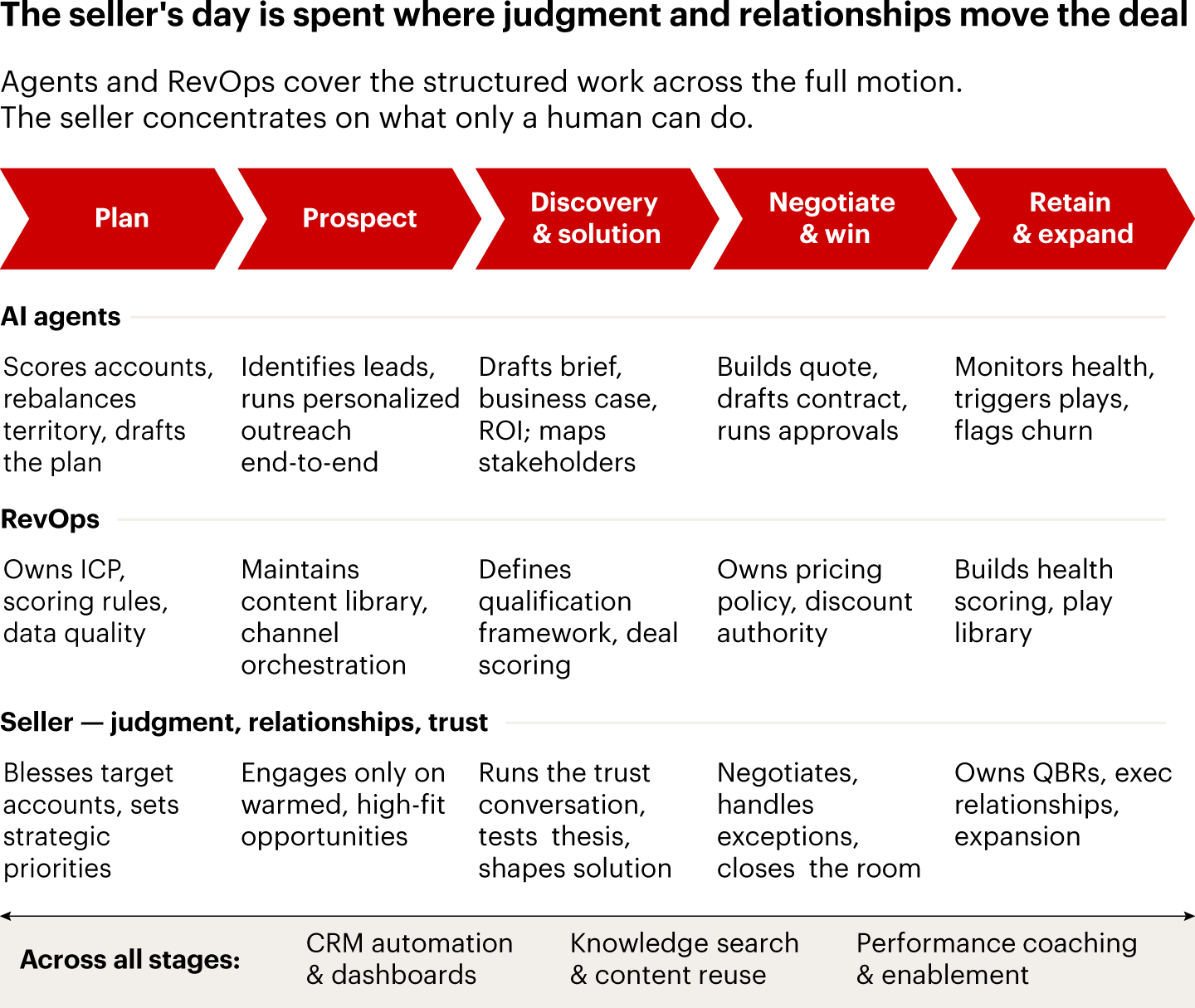
Picture an account executive on Tuesday morning. Before her first call, an AI agent has already drafted a point-of-view memo on the customer’s three biggest strategic shifts this quarter, surfaced two competitive moves she didn’t know about, flagged that the procurement contact changed last week, and proposed a revised deal structure based on analogous wins in other geographies. She spends 10 minutes tightening the recommendation, walks into the meeting with a sharper hypothesis than her customer has, and leaves with a signed term sheet. By 5 pm she has run the same play on four more accounts. Her weekly admin load (forecasting, CRM hygiene, follow-ups, internal approvals) runs in the background, generated and routed by agents whose work she reviews in 15-minute blocks. This is the super seller. She walks into every customer conversation better prepared than the customer, runs more sales cycles per week than was physically possible two years ago, and spends nearly all her working hours on the parts of selling that truly matter—judgment, relationships, and deal strategy. The best commercial operations are now creating sales teams full of super sellers: highly capable salespeople who spend all their time with customers, leading better-informed conversations with lightning-fast cycle time and a flawless customer experience. At least, that’s the vision. Few companies pull this off. Our survey of more than 1,100 sales and marketing leaders found that nearly all are experimenting with AI, but the top quartile is leaving everyone else behind, achieving roughly twice the revenue growth and twice the productivity gains of the rest. What sets them apart? Senior leadership has completely reimagined how selling gets done, with AI enabling the change. In our work with clients, we’ve found that the companies that most effectively use AI to boost the sales P&L embrace five activities. 1. Set clear commercial outcomes to drive the transformationFocusing on specific outcomes not only forces hard trade-offs but establishes a North Star for everything that follows. Is the goal growth, productivity, or both, and in what proportion? Do you prioritize share-of-wallet gain in existing accounts, new client acquisition, or access to new geographies and segments? What are the targets, and are they anchored in benchmarks or the art of the possible? The ambition should be bold and specific enough for a CFO to underwrite: Bain clients have set and achieved such ambitious goals as cutting quote cycle time by 80%. Other clients are on track to double revenue per rep and to reclaim two full selling days per week from administrative or operational tasks. 2. Redesign workflowsWinners go workflow-first, not tool-first. They map the end-to-end sales process, identifying the two or three workflows that consume the most seller time and that most directly influence the desired commercial outcome. Then, they redesign them from the ground up. They decide which tasks humans conduct, which ones AI handles, and which steps get deleted. Technology selection comes after the future-state design. From there, leaders commit fully to the prioritized workflows—quoting, account planning, content search, outbound prospecting, post-order support—and maximize sales effectiveness through the smart use of AI. When a building materials manufacturer set out to inject AI into its quote-and-design process, deep diagnostics and workflow redesign led to successful implementation of a better quoting tool. Working with Bain, the team mapped the full value stream, identified multiple candidate use cases, and narrowed those to two high-conviction minimum viable products. Once the solution was scaled across the organization, quote turnaround days fell by 90% and win rates rose 10 points. Across engagements, we redesign workflows to put agents on structured tasks and focus valuable seller time where they can inflect the deal. 3. Drive daily usageLeaders of sales organizations who are successfully delivering AI-enabled change make daily AI usage a condition of employment. They drive this home with individual measurement and a combination of carrots (recognition, leaderboard visibility) and sticks (performance improvement plans, shutting down back doors). It’s not just about daily use; volume and quality matter. Successful companies monitor which workflows each seller runs through the AI system and which ones they work around. Frontline managers inspect and coach usage in one-on-one sessions. We find that 20-plus AI-assisted workflows per seller per week is the threshold for genuine daily use. Below that, sellers are treating the tools as ornamental. In leading programs, top-quartile sellers clear the threshold within days, and the bulk of the population gets there over six months of steady push. 4. Clean up internal data tied to priority workflowsSixty percent of commercial organizations know that their data and technology aren’t ready to support AI at scale. Most are deploying tools anyway. These companies report that the outputs are embarrassing, sellers lose trust, and the program stalls, with blame levied at the model rather than the inputs. Other companies think they must do a complete organizational data overhaul before they even begin their AI transformation. Winners in this space first determine which workflows are crucial to go-to-market success, then focus senior executive attention on the work required to clean up the data sources and types that are mission-critical for those workflows. At a major technology company, sellers were spending nearly 20% of their week hunting for data and documents across fragmented systems. We helped the company archive 80% of stale contacts and collateral, curate what remained, and launch a context-aware AI assistant. Search-and-gather time fell more than 50%. That success required substantial governance and cleanup work, focused on the data that feeds priority workflows. For more, see “Why AI Stumbles Without a Solid Data Strategy” and “Governance, Trust, and the Data Foundation.” 5. Reimagine sales roles and coverageThe first four actions create value for individual sellers, but if you don’t raise seller quotas and activity expectations, combine roles, or put fewer people on a given account or opportunity, then individual productivity won’t result in greater revenue at lower cost. To bank the savings, or reinvest to drive growth, you must change the go-to-market model. A typical enterprise deal that used to involve seven to nine distinct roles (including account executive, inside support, specialist overlay, sales engineer, deal desk, customer success) can often be run well by three or four people when enabled by AI. Inside support roles disappear or shift to demand-generation activities as the transactional work is automated. Specialists can move from an account-assigned to a pursuit model. To thrive in this new model, sellers will need deeper technical fluency, sharper business acumen, and more comfort owning the full deal cycle. Companies that treat the AI rollout as a tools project and skip the role redesign simply end up with the same headcount running the same plays slightly faster. Critical success factorsWhat does success look like? In our experience, strong AI-enabled sales implementations hit the following post-launch milestones: To get there, our most successful clients resource their efforts appropriately, including:
How we can help We partner with sales and RevOps leadership on the full AI sales transformation. We help our clients set the commercial ambition, prioritize workflows where AI will move the P&L, redesign those workflows from the ground up, clean the data that the priority workflows demand, and build the adoption muscle that drives daily usage. Then we address the role, quota, and coverage redesign that converts individual productivity into growth and cost savings. When a client has its strategy in place but is stuck on execution, we go deep on one or two priority workflows: diagnosing detailed user requirements, designing the future state, configuring and testing with the front line, and scaling adoption. Three things set our approach apart:
Building super sellers isn’t about tools or pilots. The companies that will lead the next decade of B2B selling are making the five moves described above to establish a new AI-first commercial operating model. The window to build this advantage won’t stay open for long.
|