


A major retailer faced a pivotal moment. Despite years of investment in digital tools and analytics teams, its leaders couldn’t agree on a consistent view of the company's performance. Finance reported one number for sales while merchandising reported another. Critical conversations stalled, with leaders debating metrics instead of making decisions—while competitors used real-time insights to adjust pricing, reallocate inventory, and capture sales.
Across the industry, retailers face the same pressures: Margins are under strain, customer expectations are evolving, data volumes are exploding, and AI is resetting the rules of the game. At the same time, new “beyond trade” opportunities like retail media, personalized customer engagement, and intelligent supply chains are unlocking enormous value pools. Leading retailers are already seeing revenue uplift of between 5% and 15% from personalization and margins of more than 60% from retail media.
However, without unified enterprise data strategy and executive-level sponsorship, data remains trapped in silos, undermining speed, trust, and value capture. Retailers that fail to modernize risk having lower EBIT and ceding growth to competitors. Every year of delay compounds technical debt and widens the gap between them and leaders like Amazon and Walmart that are already scaling modern cloud-native data platforms and retail media ecosystems.
We can help you build the essential data and AI foundations that not only ensure you avoid this trap but also deliver measurable results. In our experience, retailers that invest in strong data foundations on average achieve:
~
%
increase in operating profit dollars within the first 12 to 18 months
~
x
return on initial value over time
Move up the data maturity curve—fast
From our work with leading retailers, we have seen that building strong data foundations doesn’t have to take years of trial and error. Rather than relying on horizontal platform builds or scattered bottom-up experiments—which too often stall or fail—we partner with retailers to tightly connect data strategy to enterprise priorities.
Our proven four-step approach accelerates impact while establishing the foundations for sustained, long-term transformation.
1. Identify current data readiness and align on strategy
Data readiness is what fuels expansion into new sources of value beyond the core, including retail media networks, data monetization, new business models, and platform scale.
Our goal is to understand your current state and your future ambition. We determine your baseline—including teaming structure, responsibilities, and processes—by running a diagnostic with a focus on operating model and governance. We benchmark your team structure and talent mix against the industry, such as the business-to-technical team ratio, to quickly identify talent gaps.
Surfacing your pain points in pricing, merchandising, supply chain, customer engagement, architecture, or technical capabilities and prioritizing them by the amount of value at stake sets the stage for a refreshed data and AI strategy. Just as critical is aligning the executive team on the overarching data strategy and vision. Together, we define the major value generators and prioritize the use cases that matter most. This ensures top-down sponsorship, clarity of direction, and a clear roadmap for value realization.
2. Leverage data domains and pilot data products
Our next step is to help you make trusted, high-quality data accessible and reusable across your organization by building fit-for-purpose data products—reusable, well-designed datasets that turn raw data into real business value. We then ensure these are clearly owned, actively maintained, and feedback-enabled for maximum value.
There are several best practices when piloting data products:
- Anchor pilots in high-value use cases. Prioritize pricing, promotion, supply chain, or loyalty where the EBIT impact is visible.
- Design for reusability. Ensure each data product can scale across multiple use cases, not just a single initiative.
- Measure impact early. Track business KPIs, not just data quality, to build credibility and momentum.
- Balance speed with governance. Keep standards in place so pilots don’t create new silos or quality issues.
Data products make it faster and easier to leverage data for new use cases, resulting in higher-quality insights that create real impact. For example, one retailer we worked with launched a real-time promotion performance dashboard. By cutting data latency from 12 hours to under 15 minutes, store managers could adjust campaigns mid-day, driving higher sell-through and immediate EBIT gains.
3. Build a strong data operating model
In our experience, many retailers start with a narrow goal, such as monetizing data, and miss the bigger picture: A strong data operating model, paired with governance, architecture, and change management, is the key to realizing sustainable value.
In fact, a lack of connection between business needs and technical delivery—not to mention a lack of accountability—can derail data modernization before it begins. We help design a data operating model with clear roles, responsibilities, and assigned owners across both business and tech to manage the data life cycle, orchestrate key activities, and enable governance processes.
Six principles anchor our approach:
- Data operating models should cover the full spectrum of data capabilities including platform, engineering, analytics, data science, governance, and stewardship.
- The level of centralization or decentralization (see Figure 1) should be determined by the maturity of the organization, with greater decentralization as capabilities evolve.
- Operating models should connect directly to enterprise priorities and deliver measurable business impact in areas such as pricing, supply chain, loyalty, and retail media.
- Every data capability should have clear ownership and governance, with a senior leader accountable for strategy, standards, and compliance across the enterprise.
- Models should be designed for scalability, starting lean to meet immediate needs and evolving toward a federated end state without creating new silos.
- Data operating models should remain agile and adaptable to integrate emerging AI applications and workforce requirements while maintaining trust and transparency.
Figure 1
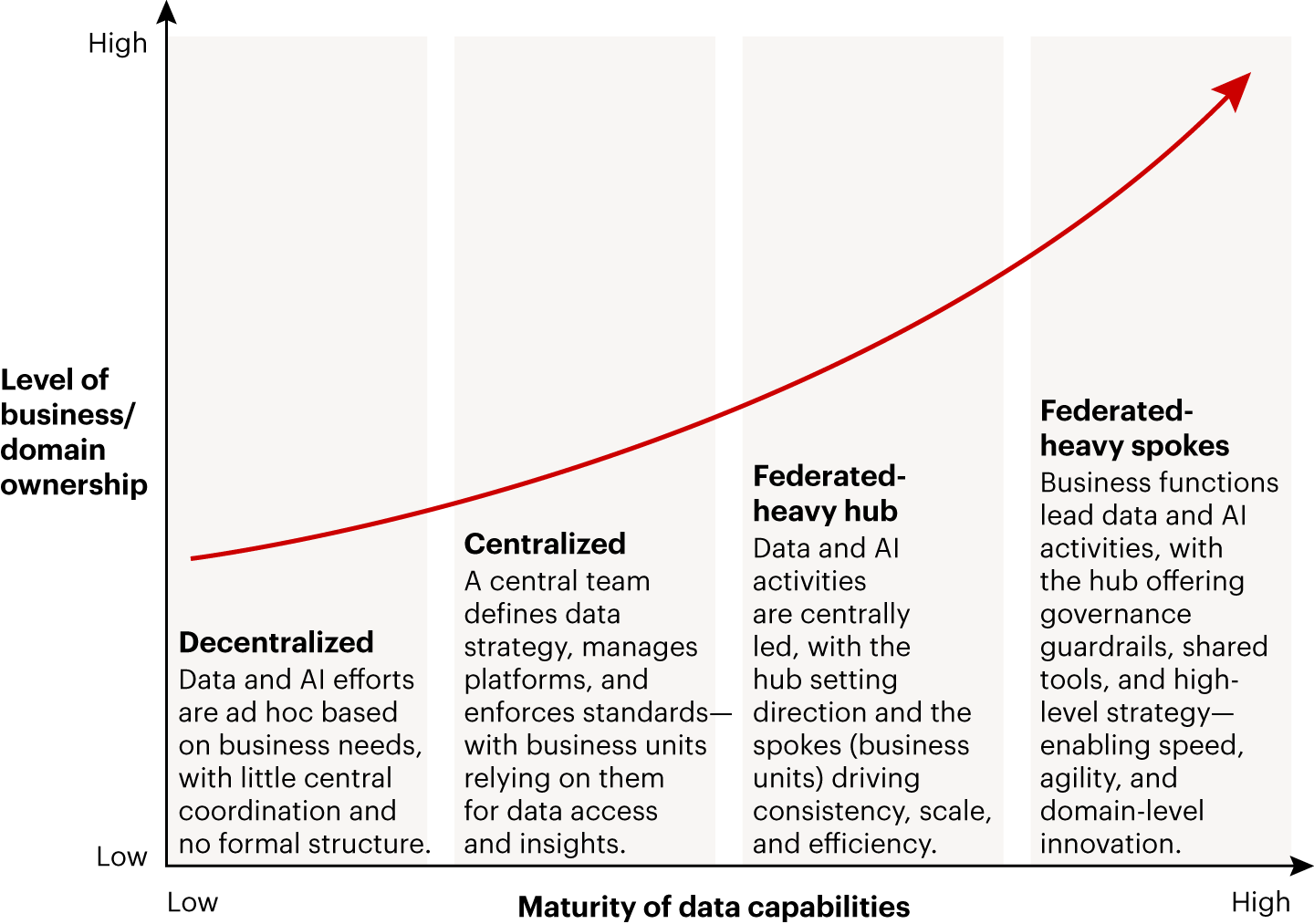

A strong operating model ensures that companies identify the right KPIs for data products. Governance bodies set enterprise-wide standards for quality, lineage, and compliance. Domain teams track metrics such as EBIT contribution, user adoption, and reusability. With clear ownership in place, leaders can monitor results quarter over quarter, adjust priorities quickly, and apply lessons from early pilots to enterprise-wide scaling.
4. Invest in data as intelligent agent
A leadership team we’re working with recently lamented that modernizing reporting only got them so far. Too many decisions still required long meetings, manual analysis, and human follow-up. They really wanted a way to make their data work for them, not just faster dashboards.
This is where AI-enabled use cases come in and where retailers can drive business value from their investment in data. Retail leaders further along the data maturity curve are leveraging their data with interactive knowledge bots—AI-powered data products that are self-learning, intelligent, and equipped with real-time feedback loops that drive autonomous refinement (see Figure 2). These use cases are the real sources of value from data, and they help clarify which data assets are most critical to fix and prioritize.
Figure 2
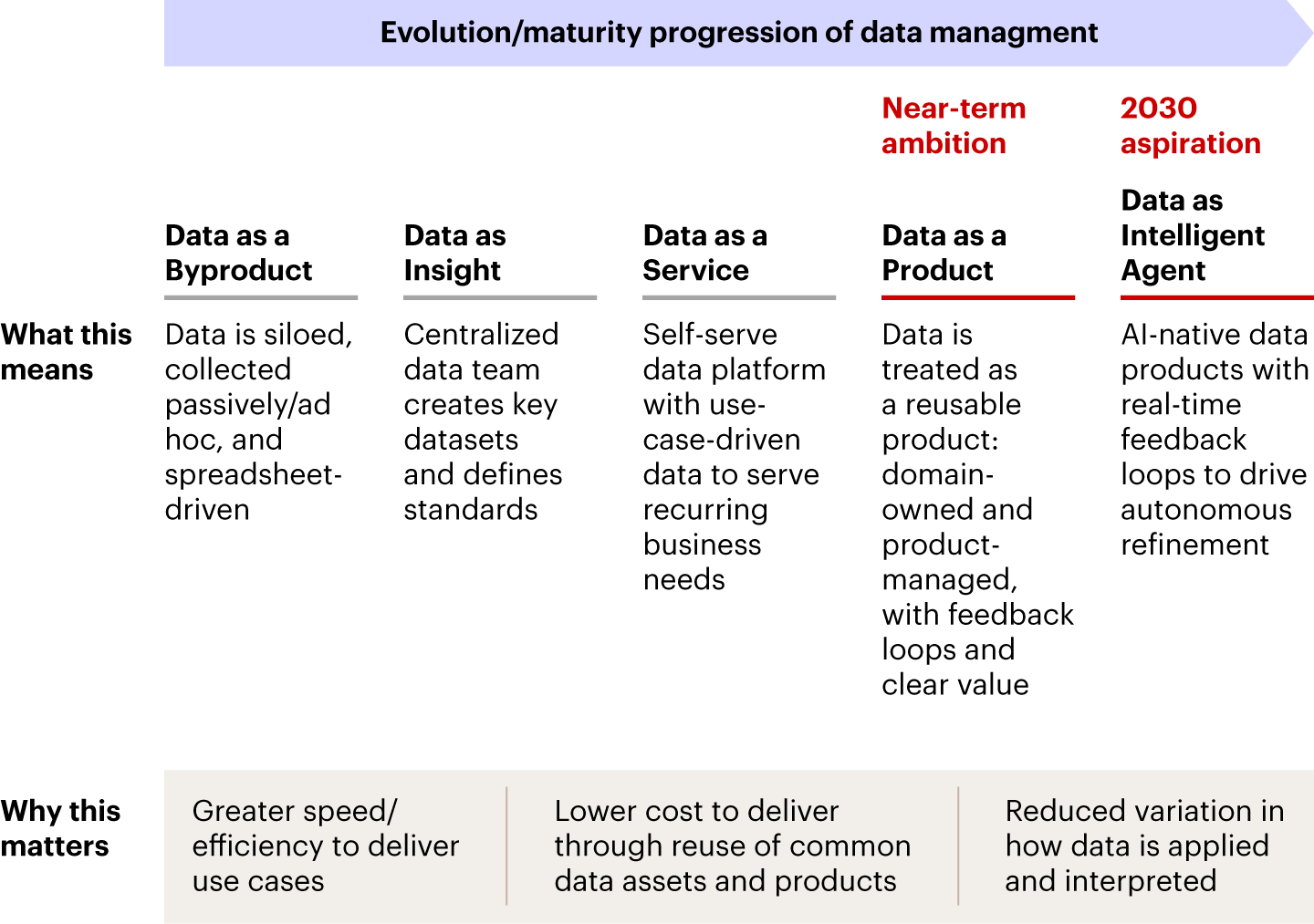

Success with intelligent agents hinges on meeting table-stakes requirements such as data accountability, ownership, stewardship, trust, and accuracy. But the potential upside is significant:
- Autonomous decision-making at scale: Intelligent agents can dynamically adjust pricing, optimize promotions, and rebalance inventory in real time. Decisions that once took weeks are made in seconds.
- Unlocking new profit pools: These agents also power the aforementioned high-margin “beyond trade” opportunities, automating retail media campaign optimization, running predictive customer engagement at scale, and even negotiating with suppliers.
- Productivity and cost efficiency: By embedding agents across store, supply chain, and support functions, retailers can automate manual tasks and boost productivity. Examples include AI co-pilots for store associates, robotics in fulfilment, and task orchestration for supply chains.
- Safer and faster decisions: Built with governance guardrails—policy-as-code, lineage tracking, and real-time observability—intelligent agents reduce human error while ensuring compliance with privacy and ethical AI standards.
Although not every retailer is ready for intelligent agents, this is the direction of travel. Those that lay the foundations now will lead tomorrow.
Why now (and why us)
Retail is a hyper-competitive, low-margin business. It’s not surprising that leaders are turning to data and AI to gain an edge. Many are seeing results, including automating up to 30% of labor time and increasing productivity by 15%, but capturing value requires bold investment and decisive action. Laggards risk being left behind.
We bring:
- Deep retail, data, and AI expertise, backed by a proven track record of helping global retailers unlock new profit pools and monetize data.
- Partnerships with leading technology players and a robust bench of practitioners who have built and scaled modern platforms.
- A structured approach that balances quick wins with the foundations for long-term success.
Crucially, we keep the big picture in mind. Although AI is becoming a powerful accelerator of value from data, it’s not the only focus. The real value comes from a robust data architecture and broader strategic enablement with business goals as the North Star. We go beyond platform builds to ensure data strategy is directly tied to business outcomes, balancing quick wins that deliver business impact with the foundations for long-term success.
For C-suite leaders, inaction isn’t an option, and the steps are clear:
- Champion the data agenda. Make it an enterprise priority, not a departmental project.
- Fund the foundation. Invest in modern architecture, governance, and talent.
- Move with urgency. Every quarter of delay compounds technical debt and cedes ground to faster competitors.
Treated as a strategic, governed, and scalable asset, data unlocks not just new profit pools but also the ability to make better decisions at the speed customers expect. The retailers that act now will define the next era of growth.
The authors would like to acknowledge Suhail Alsalehi, Marta Alves, Lauren Brom, Nate Eyster, Coulter Knapp, Stephanie Koszyk, Kelly Liu, Fiona Logue, Tahir Qureshi, and Stuart Sim.