

Brief

At a Glance
- Stalled fund-raising over the past 12 months is creating the most competitive market for new capital since the global financial crisis.
- Amid the doldrums, PE firms are learning that traditional approaches to courting investors aren’t going to support the growth to which they’ve become accustomed.
- The firms out-raising others are scaling their fund-raising capabilities to meet their ambitions, building the kind of commercial organizations large B2B sellers rely on daily.
After a decade of stunning growth in private capital fund-raising (nearly $12 trillion raised since 2012), 2023 may forever be remembered as the year the music stopped. Based on first-half activity, full-year fund-raising totals are on track to drop 28% compared with 2022, and the number of funds closed looks to decline by almost half.
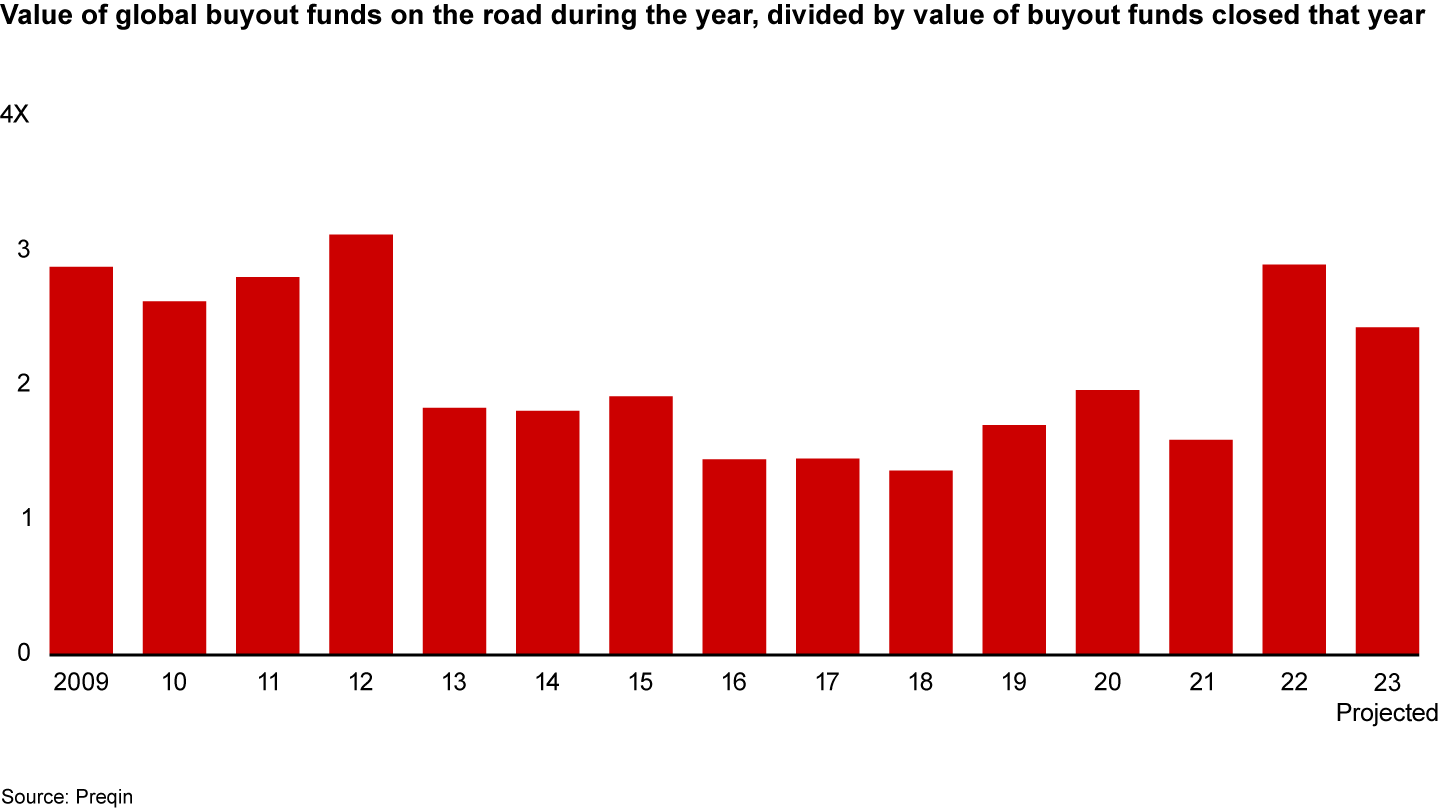
Preqin reports that around 13,900 private capital funds are currently on the road seeking $3.3 trillion across asset classes (see Figure 1). Yet 2023 full-year fund-raising totals will likely come in at around $1 trillion. That 3.2x gap between supply and demand is the widest the industry has seen since the depths of the global financial crisis. At 2.4x, the gap is a bit better for buyouts, but still not good (see Figure 2).
Figure 1
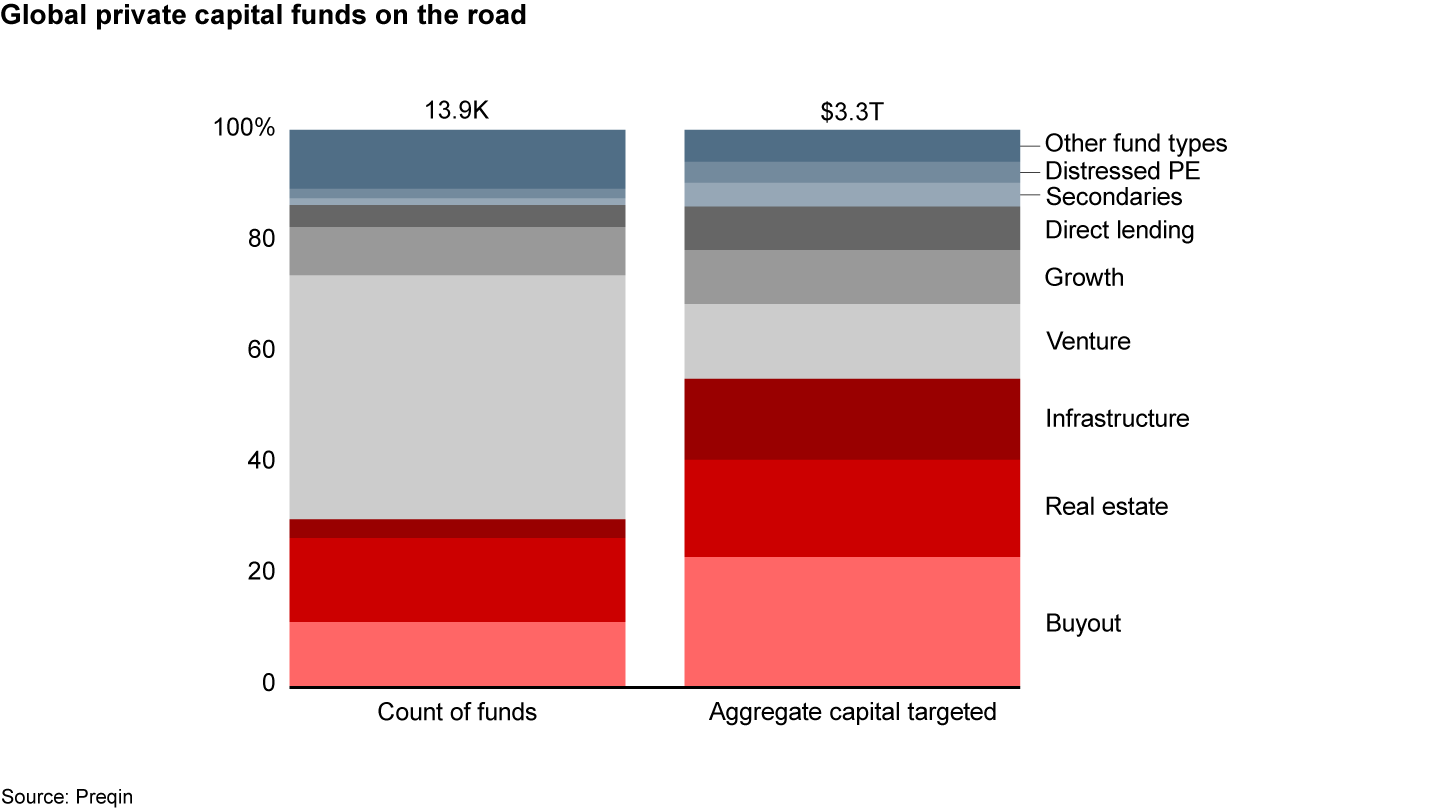

Figure 2

The abrupt deceleration has come as a shock for an industry used to raising ever-larger funds at ever-increasing velocity. And it is setting up a reckoning for firms that continue to depend on some version of the old, more genteel fund-raising model: relying on relationships, letting results speak for themselves, and assuming limited partners (LPs) won’t want to miss an allocation.
While many firms have built talent organizations and compensation structures based on a steady cadence of growth in assets under management (AUM), fewer have scaled their fund-raising function to match—largely because they haven’t had to. As the industry matures and investors get more sophisticated, however, the clear signal to general partners (GPs) is that traditional approaches to fund-raising aren’t going to cut it anymore.
The firms standing out from the pack are doing what they’ve asked so many of their portfolio companies to do over the years: professionalize their commercial organizations by adopting best-in-class sales practices. Strong performance and skill at relationship building will always be at the heart of raising new capital. But effective fund-raising strategy in the current environment looks more like the enterprise sales tactics that software companies, financial services firms, and other large B2B sellers rely on every day.
The commercial imperative
To some degree, the skidding fund-raising totals over the past year owe to transient imbalances that will eventually right themselves. LPs are sitting on massive unfunded commitments at a time when moribund exit activity has stalled new distributions. The result: One in three LPs is currently overallocated to private equity.
It’s also evident, however, that the industry’s appetite for growth is simply outstripping the long-term supply of traditional institutional capital. While most firms aspire to double-digit growth in AUM, Bain & Company projects that institutional capital allocated to alternative investments will expand by just 8% annually over the next decade. That means competition to raise private capital from traditional sources in the years ahead will only get more intense.
Feeling the pressure, many GPs are exploring new paths to growth like retail capital. But winning in the here and now will require scaling up the kind of selling capabilities that will sound familiar to any GP that has helped a portfolio company build a great commercial organization. EQT, for instance, has tripled the size of its investor relations (IR) team over the past several years in order to cover a universe of “clients” that has grown to as many as 1,000. As CEO Christian Sinding said on a recent edition of Bain’s Dry Powder podcast, the change is both organizational and cultural. “We don’t really talk about LPs anymore,” he explained, noting that “client relationship” better captures the way the firm is approaching its investors. “It’s a mindset thing,” he said.
A modern, commercial organization needs to think about how to manage this process more intentionally, create multiple touchpoints, and have the collateral to effectively engage. Strategic selling means defining the ambition; segmenting customers; honing a differentiated, data-driven value proposition; optimizing the team; and developing commercial motions that win in the market. How these processes translate in a private markets context will vary from firm to firm, but every GP should be focused on getting these five areas right.
Linking ambition to strategy
Most firms have a growth ambition, but it’s not always linked to an actionable fund-raising strategy. What’s essential is to translate ambition into a tangible goal for growth (“doubling AUM over the next five years,” for example) and support it with a clear-eyed assessment of where that capital is likely to come from.
This starts with a thorough analysis, LP by LP, of what you can reasonably count on from each of your existing relationships—not how much you hope to raise, but a fine-grained appraisal of how much is realistically bankable. Identifying your true starting point involves some key questions: How big is the gap you need to fill to realize your growth ambition? And how much can be filled by pushing existing relationships to full potential or cultivating new sources of capital?
Customer segmentation
Determining where your firm has the best chance of succeeding relies on segmenting the universe of LPs (aka customers or clients) based on potential—and potential to win. The backdrop, of course, is that private capital is a high-touch business, where relationships are built up over multiple investment cycles. Those bonds are sticky and often supported by a shared history and partnership, including coinvestment. But they aren’t unbreakable. Particularly in the current environment, LPs have little patience for GPs that aren’t performing or don’t offer products that fit their needs.
With that in mind, the firms outraising others aren’t content to sit on current relationships. Instead, they are constantly reevaluating where capital is likely to come from now, where it can come from in the midterm, and where the firm needs to start now in cultivating long-term partnerships. In that respect, prioritizing accounts and designing campaigns to fit becomes a rolling process aimed at avoiding hiccups and driving sustained growth in AUM.
As with any customer relationship, expanding share of wallet involves a full understanding of an LP’s evolving needs and how to fill them. In a world of continuation funds, secondary transactions, and adjacency strategies, there’s often a reason to have more frequent coverage conversations (as opposed to the typical three-year fund-raising cycle). The resulting flow of feedback can be critical to putting customer needs at the center of the strategy discussion.
Cultivating new investor relationships demands its own set of strategies based on deep insights into who an LP is investing with now and how it makes check-writing decisions. There aren’t massive waves of new institutional capital coming into the market that aren’t spoken for already, so, more often than not, winning with a new LP means displacing an incumbent. What’s essential is to identify where you can reasonably expect to gain traction and then to build a campaign tailored to that prospect’s unique profile.
It’s easy to fall into the trap of assuming that one size fits all—even within a particular grouping of LPs. Small pension funds, for instance, can be resource constrained and are more inclined to use investment consultants. If they have a coinvestment program, it tends to be relatively small and more passive. Larger pension funds typically have multiple “buyers” (by strategy), rarely use investment consultants, can serve as an anchor investor in a fund, and often have large active coinvestment or cosponsorship programs. Of course, in today’s overstretched environment, neither may be able to write a big check. The most accessible pools of capital may be family offices or sovereign wealth funds in the Middle East and Asia. Winning with them can require a long march of networking, intelligence gathering, and putting a firm’s most senior people in direct contact with decision makers at the fund. That process may take years to break through, but the time to start is now.
Honing a differentiated pitch
A major benefit of segmenting customers is getting smarter about them in ways that sharpen your go-to-market approach. But it’s just as important to know what LPs see when they look at you. Oftentimes, firms don’t really know.
There’s an old joke in private equity that 75% of funds are top-quartile: Most firms believe themselves to be strong performers, and they can draw on a variety of data sources to paint the most positive picture. A sophisticated LP, however, will do its own benchmarking and could see a very different picture. Investors may want to know how you stack up in terms of distributions to paid-in capital (DPI), capital loss rates, subsector performance, or any number of other metrics. The question is, what do LPs say about your firm when you’re not in the room? Who do they consider your competitors, and how do you stack up on the criteria that matter to them?
Opening your eyes to how the market views you competitively isn’t always pretty. But the unvarnished truth is essential to understanding where you are differentiated and where you may be vulnerable to competitive pressure. Crafting the kind of value proposition that will resonate with LPs depends on developing a narrative showing what is uniquely compelling about your firm’s performance and products. Why should that particular LP put its trust in you? Increasingly the story will need to be told with data.
Optimizing the team
Building a fit-for-purpose sales team for a growing B2B software company might start with benchmarking against competitors. But many alternatives managers are underresourced in this area, and the most aggressive fund-raisers have been scaling quickly—which means that looking better than your rival doesn’t necessarily mean you are optimized for what you want to achieve.
Determining the optimal set of roles and responsibilities for a commercial organization depends on a couple of practical considerations: What types of LPs are you targeting, and how complex are your offerings? Going after smaller equity checks may require a team that is focused on volume and paid accordingly. But winning over a sovereign wealth fund often requires a white-glove approach and level of talent and sophistication to match. Often, these days, the most promising pools of capital are in a different part of the world. Establishing a presence from afar raises span-of-control and hiring issues, as well as cultural challenges.
The complexity of your product offering will also determine how the team should be structured and deployed. A single-fund firm can be well served by a team of generalist IR professionals. But if your offerings include multiple strategies (think of a large fund that spans credit, infrastructure, PE, and growth), you may need a team of product specialists to work with relationship managers on the sale. There is a truism in sales that people only sell what they know (or what they’re comfortable selling). For firms with many strategies, training every single IR person to be familiar with every single product likely isn’t feasible.
Bringing data to bear on the sales process increasingly means investing in sales operations resources. A sales ops team can collate data reporting and analytics on a weekly or monthly basis to support sales meetings. It can strengthen ongoing account planning by signaling the appropriate level of resources needed, helping identify the best sales plays, and increasing accountability. Sales ops centralizes competitive intelligence and identifies opportunities to displace peers at key accounts. It also ensures the firm captures client feedback and shares it back with the IR team.
Winning in the market
Segmenting customers, honing a sales pitch, and standing up the right team are all prerequisites to strong go-to-market execution. Winning on the battlefield demands strong sales leadership and a structured approach to selling.
Fund-raising is a momentum game that depends heavily on preparation and planning. The risk is getting left behind if LPs catch a scent of trouble in your efforts to raise a fund. Realistically, firms need a clear path to a least 50% of the intended raise before hitting the road. They also need alignment on what sweeteners they’re prepared to offer—scale discounts, first-mover or so-called early bird benefits, etc.
Turning tactics into results relies on developing sales plays tailored to particular LPs. The most effective plays include a prescriptive, coordinated set of sales and marketing actions orchestrated to create and then win an opportunity with a specific prospect. There needs to be alignment, not only on what you’re willing to offer to secure a commitment, but also on what part of your value proposition will resonate most with a particular LP, and how you’ll win with each of the key decision makers during a multimonth or multiyear fund-raising process. The advantage of a structured approach is that it points the organization toward a specific objective (expand share of wallet, win a first-time investment, launch a new relationship, etc.) and then makes it easier for leadership to track execution. Careful performance tracking also tees up regular coaching opportunities to debate what works.
None of this, of course, is a replacement for personal interaction and relationships between a firm’s leadership and the decision makers who choose to allocate capital. Yet while traditional fund-raising motions remain necessary, they are no longer sufficient. Doubling down on what you’ve always done and hoping it succeeds in this difficult fund-raising market may be tempting. But the firms poised to win amid fierce competition are those investing in the capabilities and processes necessary to sell more strategically.
Here are several questions that will help define your starting point:
- Do you have a clear ambition for fund-raising and growth, and is it linked to a detailed, actionable strategy?
- Do you really know what your share of wallet is with each of your core LPs, how they build portfolios, and how you will continue to be additive?
- Beyond these core “customers,” is it clear who the next tier is, and do you have a specific set of strategies to approach them? How good are you really at scouting new LPs?
- Do you know how LPs look at you, who they consider your competitors, and how you compare? Have you used those insights to develop a clear, differentiated value proposition that will increase mindshare with clients?
- Given your ambition, do you have the right organization and structured processes in place to execute the commercial motions that will help you win with specific types of LPs in specific geographies?
First published in Ιούλιος 2023