

Brief

For a moment in history, every company shared the same simple mission statement: Protect our people, our customers, and our business. The terrible human toll of coronavirus and the mounting economic damage brought a singular clarity and urgency of purpose, forcing thousands of company experiments in new ways of working and operating.
The lessons companies learned in the months after the outbreak were profound. Virtual, digital and automation initiatives, for both customer interactions and internal operations, accelerated at astonishing speed. Supply chains ruptured across the globe, signaling that companies have for too long sacrificed resilience for efficiency. Necessity demanded simplicity as unimportant products and unnecessary processes were shunted aside. And almost every company—some intentionally, many unconsciously—thrust Agile teams at the most difficult problems.
As leadership teams dig into the complex process of recovery, one truth is abundantly clear: We cannot afford to go back to the old way of doing things. The companies that most aggressively adapt and extend new ways of operating will turn this crisis to their advantage.

Macro Surveillance Platform
For more detail on the business implications of coronavirus from Bain’s Macro Trends Group, log on to the Macro Surveillance Platform. Learn more about the platform >
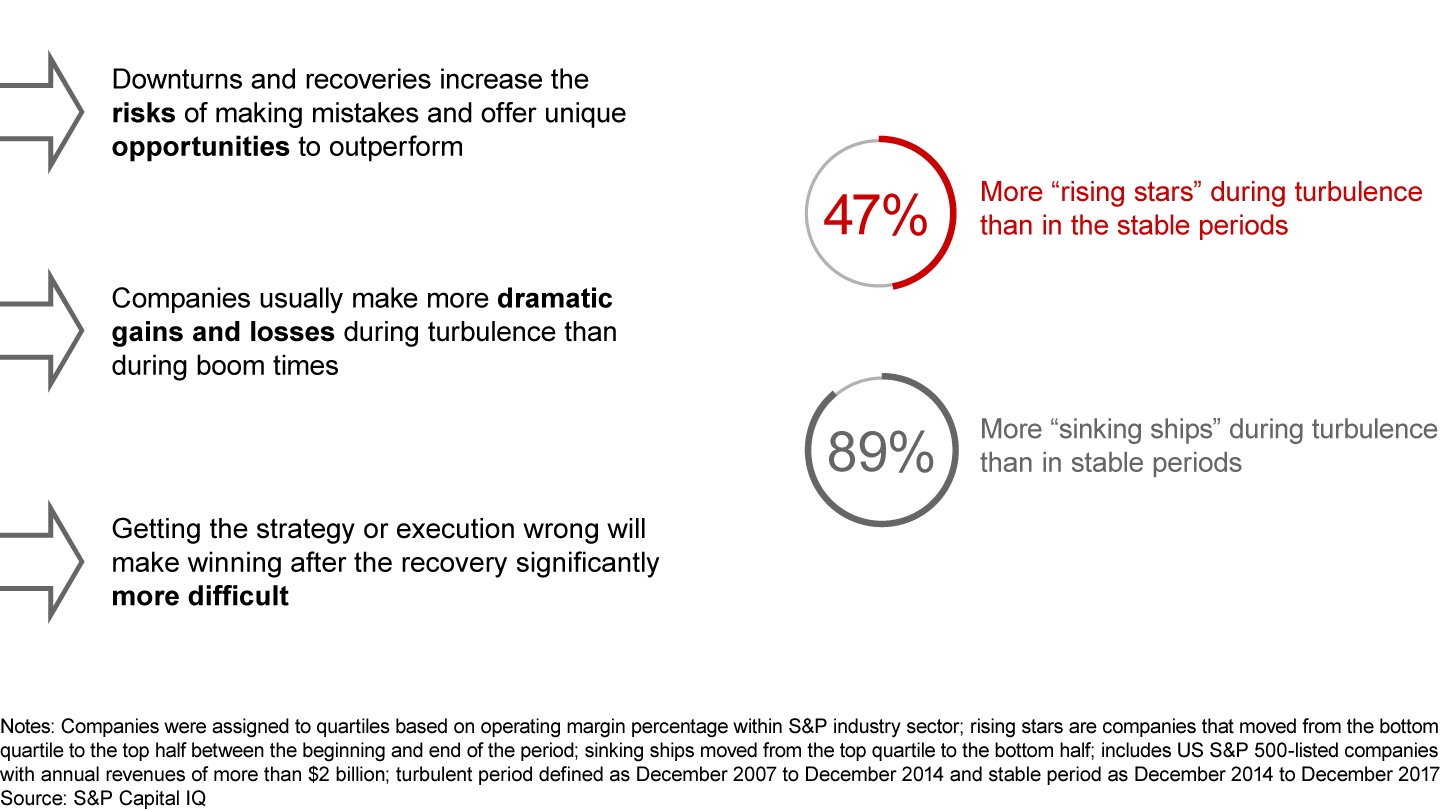
Our research shows conclusively that the biggest shifts in company fortunes, for good or for ill, happen coming out of downturns (see Figure 1). They are moments of truth when management teams can transform and reset their companies. Never before, though, has a downturn forced such immediate transformation.
This recovery will not be a straight path. Employees will head back to work and operations will restart on different timetables, following different curves across different countries, regions, industries and sectors, shaping an asymmetric recovery for all companies with global footprints and value chains. In addition, the pandemic will continue to test all of us, striking at the heart of communities and demanding that we be prepared for subsequent rounds of reinfection and containment. Companies will advance where they can, retreat when they must, often simultaneously, then adapt and start again.
Industry leaders in the next wave will use each advance to move toward a new future, not back to an old and outdated idea of “normal.” The lessons of the past few months are as valuable as they were painful. Now is the time to turn them into the business and operating models of the future.
Figure 1

A virtual, digital, automated world
Digital technologies and automation played a critical role in many companies’ initial response to the crisis. The obvious example: white collar workers emptying out of skyscrapers and urban centers and working from home on a vast scale. But it was not videoconferencing technology nor collaboration software nor bandwidth to homes that was new. What was new was the sudden willingness of every function in the company—IT, to be sure, but also legal, finance, compliance, sales and other departments—to cut through any hurdle necessary.
Versions of this happened everywhere across every part of the business in every industry. Digital roadmaps once measured in years accelerated rapidly in days and quickly proved their worth. This was true even for areas like complex business-to-business (B2B) sales, long a bastion of in-person interactions. Despite work-from-home restrictions, one global manufacturer of industrial equipment continued to operate with virtually no interruptions during the crisis by moving the majority of its transactions online through automation. Going forward, the company plans to triple the productivity of its field salesforce by further leveraging its marketing and sales technology.
In fact, Bain research shows that more than 70% of B2B buyers—and a growing number of sellers— feel that virtual sales calls are as effective as in-person calls for complex products, even those involving a high degree of customization or configuration. A leading global technology company, also experienced in inside and online sales, was prompted by Covid-19 to migrate a sizeable and growing portion of its field sellers to a new class of virtual sellers, while also formalizing a “virtual expert” as a new service offering.
Similarly, automation took on the work of some employees who were sent home and helped companies quickly respond to surges in demand. For example, faced with the sudden need to fill 100,000 job positions, Amazon turned to automated systems to screen more than a million job applicants. To ensure that its customers’ credit ratings were not damaged by late payments amid the economic stress, Banco de Guayaquil in Ecuador built and deployed bots to automatically halt late fees and refinance loans in a fraction of the time and cost of doing so manually. Similar automation efforts took place across industries (see Figure 2).
Figure 2
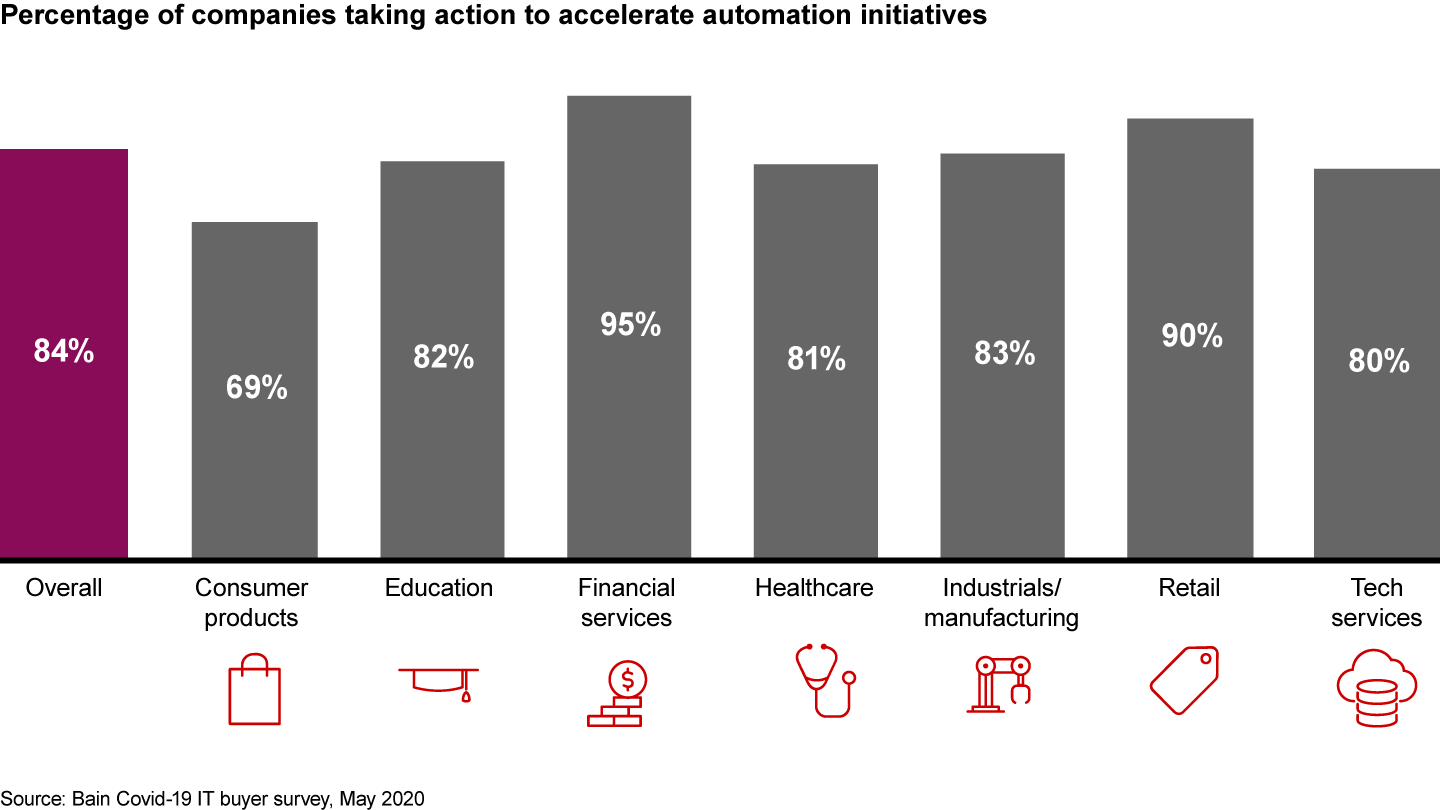
A recent Bain survey of IT buyers shows that more than 80% of companies are accelerating their automation initiatives in response to Covid-19 (see Figure 3). Yet if history is any guide, fewer than 50% of these companies will achieve their automation performance goals. As the recovery proceeds, companies need to quickly lock in and extend the success of their tactical, crisis-response experiments by grounding them in a broader vision of what the post-Covid-19 future looks like and how they must transform to succeed. Long-term success will depend not on automating a list of tasks, but on redesigning the work and processes with an eye toward automation and digitalization where they will provide the greatest value.
Figure 3

The agility, innovation and resourcefulness that IT leaders demonstrated at the start of the crisis will need to become the norm, as will the willingness of other departments to look beyond their own functional concerns.
Key questions for executive teams:
- How did you deploy incremental technology during the crisis, where did it work, and how can you scale those results?
- Do you have a sufficiently bold and transformative vision for digitalization and automation in the context of broader transformation?
- How will you prioritize your technology investments across sales, customer interactions, operations and the back office?
Resilience for a turbulent world
Although efficiency across functions and business models has been prized for decades, Covid-19 exposed the reality that it often came at the cost of resilience—the ability of companies to quickly recover from shocks. Many shared-services centers, for example, struggled to adapt when all of their employees were forced to work from home. Some companies had operating models that allowed them to quickly train and redeploy idled employees to other crucial needs, such as moving retail store floor employees to digital fulfillment roles. But many others floundered. Perhaps nowhere was the lack of resilience more obvious than supply chains.
Over the years, increasing market pressures on cost competitiveness have translated into continuous pressure on supply chains. Companies have deployed all the tools at their disposal in a highly global economy to drive efficiencies and reduce costs, optimizing every step in the chain. Well before this pandemic, supply chain leaders were beginning to see the limitations of these cost-efficient but brittle supply chains in the face of increasingly frequent disruptions, including natural disasters, escalating trade barriers, demand shocks and labor strikes. The scramble to reestablish supply chains during the pandemic further underscored the limitations of inflexible, opaque supply chains.
The data on the damage caused by supply chain disruptions is stark and compelling. One study, based on more than 800 disruptions, reported an average 7% decrease in sales and an 11% increase in costs, with long recovery periods ranging from months to more than two years. Share prices tend to follow this pattern and magnitude of deterioration and recovery time. One of the clear lessons from the shocks associated with Covid-19 is that today’s supply chains are too complex and too inflexible, and that the future will demand both more visibility and traceability.
Companies are now taking steps to construct flexible networks of suppliers and manufacturing partners. That means setting up alternative suppliers, manufacturing sites and assembly nodes and making the most of Industry 4.0 tools to optimize cost, improve visibility across the network, and accelerate reaction times. It means moving some offshore manufacturing onshore or closer to core markets to improve response time. Toyota, for example, reduces risk by having one supplier produce 60% of the needed parts, while two additional suppliers each produces 20%.
Resilience also requires piercing the opaque veil that shrouded yesterday’s supply chains. Companies are using cloud-based supply chain applications and other tools that can share information with their networks of suppliers and partners. During the Covid-19 crisis, many manufacturers demanded greater visibility into their supplier’s own supply chains—a practice worth continuing. Likewise, “control tower” solutions that integrate data across the entire supply chain, along with 5G technology and blockchain, offer leadership teams real-time visibility and allow them to calibrate supply and demand during normal times, as well as react to supply and demand shocks. The ability to compare production capacity with real-time demand signals will be a critical to choreographing advance-retreat-adapt-repeat during the recovery.
Resilience does not come without cost. The chief question facing operations leaders going forward is not whether they will invest in resiliency, but where it is needed and where the cost will pay off.
Key questions for executive teams:
- Have you been able to identify the likely failure points in your end-to-end supply chain and their root causes?
- Where and how have you already built flexibility at a reasonable cost, and where else do you have to extend that resilience?
- Do you have real-time and end-to-end visibility and traceability from origin to production line, and then forward to end user?
The need for simplicity
The Covid-19 crisis and the need for greater resilience also confirmed another lesson many executives already suspected: The supply chains of the future should not support yesterday’s complex product portfolios. The allure of increased customization and product complexity has long been hard for large organizations to resist, even as the cost and complexity to support it grow.
But faced with Covid-19, companies did whatever they had to do to keep up with spiking demand or the challenges of running plants and warehouses with fewer employees and fewer inputs. They focused on their hero SKUs—the profitable products customers needed most—and cut the rest. Simplicity took over because it had to. And the long tails of less-profitable products that companies always planned to cut were finally taken out. Many companies report surprising increases in productivity as a result. A manufacturer of personal care products reported that by reducing the number of specialty SKUs, it produced more than it ever had before or even planned to produce.
Now is the time for companies to look at the products that they do not need and discard them. And, when tempting new product opportunities arise, as they will, companies need to balance the obvious revenue opportunity against the hidden cost of complexity. Many of the best companies rely on a simple rule: Do not add a new product without subtracting an old one.
Simplification in the face of necessity goes beyond product ranges and into organizational priorities and processes. Business and product complexity begets organizational complexity, which in turn begets process complexity. Now, companies have the opportunity to focus and simplify. And the emerging data is encouraging. A Bain survey of executives and workers across the globe conducted from late April to late May found 69% of respondents reported “increased focus on initiatives that matter most for our organization.” Another 61% reported a reduction in noncritical meetings and 54% the elimination of low-value activities.
Without intentional intervention to maintain this simplicity in the future, business and product complexity—along with all the processes, initiatives, meetings and reports that prop them up—will come creeping back in and proliferate.
Key questions for executive teams:
- How have you streamlined your product offerings to improve relevance and service in response to Covid-19?
- Have you streamlined your processes and organization to reflect a less complex product offering?
- Do you have a plan for managing the invisible costs of complexity as you restart and rebuild your business model?
Agility that lasts
Simplicity was not the only unexpected effect of the pandemic. In two short months, Covid-19 rammed through behavioral changes many executives had tried to coax from their companies for years. Rapid innovation. Decisions made fast. Bureaucracy bypassed. Urgent needs tackled. Unimportant tasks shelved. Small teams on the front lines, each experiencing different phases or different effects of the pandemic in their markets, typically led the way. Quick, stand-up meetings focused on the demands of the day and the immediate goals of the week.
In other words, thousands of companies adopted Agile methods almost overnight. Amid the tragedy of Covid-19 is a marvel of collective human adaptation. According to a survey by Bain’s Organization practice, respondents who reported an increase in agility during the crisis were 2.5 times as likely to report an increase in productivity, along with better decision making, more innovation and more cross-functional teaming.
But executives cannot afford to admire this spur-of-the-moment agility for long. Without intervention, it will fade quickly when the perceived threat has passed. We know that next crisis is already on the way; setbacks are one of the few certainties of Covid-19. As companies advance, retreat, adapt and repeat, they cannot retire and restore Agile each time.
A spasmodic approach will burn out the very heroes who pulled it off in the first place. Executives need to systematically support and bolster innovation by creating more Agile teams and spreading the principles of Agile throughout the organization.
With customers’ needs shifting rapidly and employees in heightened learning mode, executives should move quickly to install closed feedback loops with both customers and employees, then use them to test, learn and adapt. Cement the new cadence as the norm—short, focused bursts of activity focused on moving forward today. That is more energizing, as we have seen, than monolithic moon shots. But couple that activity with a vision of the future, so that each problem is solved in a way that moves the organization toward that future.
Covid-19 broke plans and budgets. Executives can use that to their advantage as well. Instead of trying to right and refloat the annual and three-year plans that foundered, replace them with quarterly sprints. The newfound focus on reducing complexity and simplifying SKUs offers the perfect opportunity to start with a clean sheet and zero-base the budget. Understand who your future customers are, what they need and which highest-priority products will meet those needs, then budget for and fund the organization and processes to support them.
Key questions for executive teams:
- What have you learned from the forced experiment of Covid-19 in terms of focus, faster decisions and less bureaucracy?
- Where and how have you deployed Agile teams to deal with the crisis and beyond?
- Have you prepared your organization for the future of advance, retreat, adapt, repeat?
Back to the future
Every company must figure out how to restart operations. But the long path to recovery is beginning to separate companies into two distinct groups. The first group wants to go back to normal, following the path of least resistance. Having weathered so much risk, these companies are reverting to the tried and true, restarting in predictable ways and settling back into yesterday’s organizational charts. Understandable and reassuring, but destined to result in mediocre performance—even failure—in the new world.
The second group is committing to a harder path. These companies recognize there is no normal to go back to. Instead, they advance into the new future, resisting the gravitational pull to their former state and capitalizing on the gains from testing and learning through the crisis. They view their strategy, their customers, their operations and their cost structure through this new lens (see Figure 4).
These companies are not simply navigating the restart, but positioning their companies for a world of continued turbulence and regular shocks to the system, where adaptation and resilience will create the most value.
Which path will you follow?
Figure 4

Coronavirus
The global Covid-19 pandemic has extracted a terrible human toll and spurred sweeping changes in the world economy. Across industries, executives have begun reassessing their strategies and repositioning their companies to thrive now and in the world beyond coronavirus.
First published in Ιούνιος 2020