

Brief

Governments in emerging markets are getting serious about energy efficiency. Even though oil prices have dropped dramatically since mid-2014, policy makers in many fast-growing economies continue to recognize the imperative to reduce domestic energy consumption and the opportunities this presents. Even Gulf states rich in oil and gas—such as Qatar, Saudi Arabia and the United Arab Emirates—have established ambitious energy-efficiency programs and concrete measures to reduce energy consumption.
The reasons differ from one country to the next. For some, reducing greenhouse gas emissions is important, and for others, achieving long-term resource sustainability is key. In most cases, the greater motivation derives from a cost-benefit analysis: Leaders recognize the financial and economic benefits of curbing internal demand. Among the factors they consider:
- Domestic subsidies. Some governments would like to reduce subsidies on transportation fuel and electricity, which make energy more affordable for consumers and businesses. As the price of oil has dropped, the International Monetary Fund has encouraged countries to reduce or remove fuel subsidies. India, Indonesia, Mexico and Egypt, among others, are reforming energy subsidies, and the UAE plans to phase out transportation fuel subsidies altogether.
- Opportunity cost of exporting at market prices. For net exporters, every barrel consumed domestically— whether as fuel for transport, industry or electricity generation—is a barrel they cannot export at the market price.
- Economic surplus. Savings generated through energy efficiency can be used for other economic activities in the private and public sectors. Economic surplus also ties directly to energy security, which is a key imperative, especially for net importers.
- Efficiency is the cheapest source of energy. To meet their energy needs, emerging markets traditionally had to choose between consuming more fossil fuels or diversifying their energy supply mix to include more renewable sources. Efficiency is a more cost-efficient way to meet demand.
Raising energy efficiency requires coordination across industrial and commercial sectors throughout a country. Thus policy makers in fast-growing economies will need to collaborate closely with the private sector to achieve this. By introducing new energy regulations and encouraging greater efficiency through incentives, policy makers create new opportunities for a host of businesses, such as energy service companies (ESCOs); utilities; financial institutions; training organizations; certification bodies; automakers; and manufacturers of building materials, insulation, heating and air conditioning equipment, and other white goods. Some companies get involved early, bringing their expertise to help shape the market. Others wait until standards and directions are set and then identify the opportunities where they can best support energy transformations in these markets. All of this takes time, and among the key traits that winning players will bring to bear are patience and an active local presence.
Executives contemplating how to approach these opportunities should first understand how regulators in emerging markets develop energy-efficiency policies. This insight lays the groundwork for considering how best to develop successful products and services, within the opportunities and constraints of the regulatory landscape. Looking at how some global and regional companies have successfully embraced energy-efficiency opportunities serves as a useful guide to spark discussion about energy-efficiency ventures in emerging markets.

Energy Efficiency in Emerging Markets
Here is how governments in emerging economies can encourage energy efficiency, and how businesses can succeed in these markets.
Policies that create the energy-efficiency opportunity
In many emerging markets, government-owned organizations make up a large share of the economy. Policy makers can lead by example, taking a comprehensive approach to the design and implementation of energy-efficiency initiatives, typically across an entire sector such as transportation or buildings. To encourage efficiency and manage demand, governments create new rules, offer access to affordable financing and train new talent—all of which fuel new business opportunities.
Regulations. Governments shape energy-efficiency markets as they determine the rules by which industry operates in their countries. In India, the Bureau of Energy Efficiency created Perform, Achieve and Trade (PAT), an incentive scheme to encourage energy savings in nearly 500 plants across eight industries. The PAT scheme is similar in some respects to the emissions trading schemes seen in Europe and North America: Companies that save more energy than their targets receive energy savings certificates (ESCs) that they can sell to companies that miss their goals.
The selection of technical standards also plays an important role. Governments and industries work closely with international standards bodies, typically adopting proven standards; they rarely reinvent the wheel but modify where it makes sense, to meet local needs. Often they can move faster in emerging markets than in larger and more mature markets, because they look to international practices and experiences of early movers. The UAE, for example, quickly followed the lead of some developed markets in banning the sale of incandescent light bulbs as of January 2015. Saudi Arabia has raised efficiency requirements for new, small air conditioning units and also announced fuel efficiency requirements for cars and light trucks, following the lead of the US’s Corporate Average Fuel Economy (CAFE) standards.
Governments also set rules for procurement by public organizations and the energy services industry. As in mature markets, shaping the rules for government purchasing can be a long and complex process, requiring patience by those who would sell products and services to government agencies. Where necessary, vendors may need to gain accreditation with relevant government bodies, and the companies that invest in accrediting staff are able to move quickly into new opportunities.
Financing. Governments fund energy-efficiency measures using direct investments in the energy services industry, public-private partnerships and incentives like tax reductions. In some cases, they create incentive programs to encourage early replacement of older, inefficient products (vehicles, air conditioners) with new products that use less energy. Financing can take many forms. Governments can tie loans to performance-based contracts that allow companies to reduce their payments based on their success in energy efficiency. With some contracts, an energy services company guarantees the energy savings while the customer remains liable for the loan. With others, the energy services company assumes the financing and technical risk, sharing any savings with the customer. Performance-based contracts rely on detailed measurement to verify that the claimed energy savings are real and the result of the efficiency measures that were implemented, rather than other factors such as changes in the weather.
Despite their complexity, these financing arrangements have increased the demand for energy services in several fast-growing markets, by preserving the investment and debt capacity of a customer, such as a building owner, while generating attractive returns of typically between 20% and 40% energy savings, with a payback over four to seven years.
Human capital development. Engineering and other technical talent is typically more available in developed markets. Most emerging markets’ educational systems do not supply enough people to staff a rapidly growing, technically based ecosystem of energy efficiency. The efficiency initiatives create many new opportunities for universities and organizations providing vocational training and professional certifications, as well as financing required for each of these. Companies based in mature markets may be able to bring their vocational training programs as part of their investment in emerging markets, or in some cases, they may support the training efforts of local chapters of organizations like the Association of Energy Engineers.
Governments can fund energy-efficiency centers, provide scholarships for foreign studies in energy efficiency and push the development of energy-efficiency courses and programs in state universities. Energy-efficiency centers educate students and professionals in energy efficiency, conduct research, facilitate technology transfer, disseminate knowledge, provide training, and strengthen graduate studies and applied research.
Creating successful energy products and services
Businesses can take a three-step approach to creating energy-efficiency products and services.
Understand the rules. Companies must gain a solid understanding of the ways that regulators structure policies, regulations and incentives for energy-efficiency programs. Designing programs to encourage the formation of an energy services industry differs from making rules that would prohibit certain energy uses—though both aim at increasing energy efficiency. Even where standards align with international norms that multinational corporations may be familiar with, processes for compliance may differ.
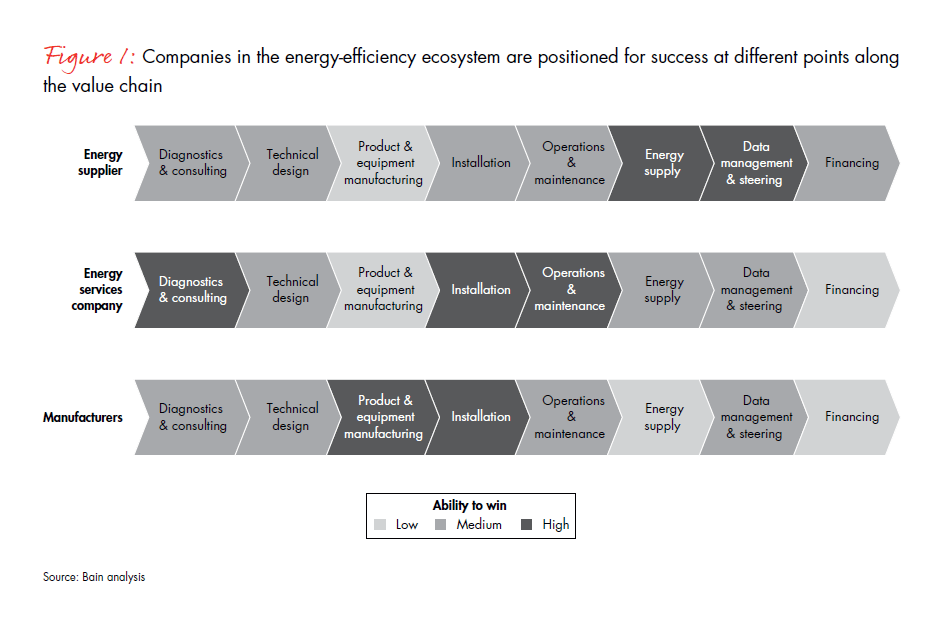
Define your role. With a clear view of the regulatory landscape, businesses can begin to identify their position in the industry, relevant market opportunities and prospective customers. Most will enter the market with the goal of delivering a limited set of products and or services. Those that want to influence the market may come in early and aim for a broader role in the landscape— as a platform developer or a provider of breakthrough technologies or business models that create opportunities for others. Depending on their role, energy companies will find different opportunities for success along the energy-efficiency value chain (see Figure 1).
Develop the value proposition. Companies must develop a competitive value proposition and business model, as well as the capabilities that will help them deliver on their goals. For businesses entering emerging markets, a key aspect of this process is determining whether their products or services are suitable, or require substantial reinvention. They should also assess what skills are needed and what partnerships might be beneficial. Finally, they must evaluate their geographic capabilities: In one region, they may have the necessary people and assets for success, but find they are unable to replicate it in another.
Key capabilities for success in emerging markets
Several examples of winning ventures in energy efficiency illustrate four critical capabilities required for success in emerging markets: product innovation, embracing local preferences, partnering with other organizations and geographic repeatability.
Product innovation in financial services. India’s Bureau of Energy Efficiency develops policies and initiatives to help reduce the country’s energy intensity, including innovative financing of energy-efficiency projects. ICICI, a private bank in India, was one of several to embrace this program. It introduced a loan scheme to help commercial and industrial companies, small and midsize enterprises and public sector organizations finance energy-efficiency services and purchase equipment and lighting for energy-efficiency projects. A $350 million loan from the World Bank supports these efforts, with most loans delivered over three to five years at 7% to 9% annual rates. The energy savings from these projects range from 15% to 30%.
For example, ICICI financed new street lighting in the city of Nashik in Maharashtra. During the first phase of this project, officials replaced half of the city’s 25,000 streetlights with energy-efficient lights, resulting in energy savings of 30% during the first year.
Embracing local requirements in automotive. Most developing markets are too small to set proprietary fuel-efficiency standards for automakers, so many adopt European or US standards. US, Japanese and European standards may converge in 2025, although local markets may continue to tailor them to their needs; for example, policy makers in a warmer region may take into account greater energy demands from car air-conditioning systems. Advancements in internal combustion-engine technology—such as turbo engines, gasoline direct injection and start-stop transmissions—will drive energy efficiency in traditional automobiles.
In some markets, regulators look for breakthroughs in electric vehicle technology and other new-energy vehicle technologies. Chinese automaker BYD is betting on reduced battery costs to boost adoption of electric vehicles, and other global automakers are watching closely to see how they may have to adapt their plans. China’s regulators could pivot quickly to electric vehicle-friendly rules if they see a national player ahead of the curve.
Partnering in district utility infrastructure. In Qatar, where air conditioning represents a large share of energy use, Qatari holding company United Development Company partnered with Tabreed, a UAE-based cooling solutions company, to establish Qatar Cool in 2003. Qatar Cool provides district cooling services, chilling water at a central location then distributing it to nearby buildings, where it helps to produce air conditioning— an efficient alternative to conventional cooling. While Tabreed brought to the partnership its experience in designing energy-efficient cooling plants, the new company’s success also depended on United Development Company’s involvement in Qatar’s real estate developments. Qatar Cool supplies district cooling to the residents of West Bay and Pearl-Qatar in Doha.
Geographic repeatability in energy services. Johnson Controls, a US-based company that manages heating, cooling and energy systems in commercial buildings, is expanding into emerging markets. Its energy service company in Singapore retrofitted Corporation Place, a large commercial building that leases space to manufacturing, electronics and IT companies, resulting in a 58% improvement in energy efficiency and about $540,000 in energy savings annually.
Across emerging markets, the push to become more energy efficient will continue to create opportunities for many players in the energy sector and beyond, including energy providers, energy service companies, product manufacturers, finance companies, automakers, data analysts, training companies and education providers. Success requires a clear understanding of the goals and methods of policy makers’ efficiency programs and your organization’s competitive advantages and challenges, as well as a focused effort to build and refine the necessary capabilities to capture these opportunities.
Kim Petrick is a partner with Bain & Company in Dubai. Amit Sinha is a Bain partner in New Delhi. Both work with Bain’s Global Utilities & Alternative Energy practice.
For their contributions to this work, the authors would like to thank their colleagues in the Dubai office: Eric Beranger-Fenouillet, a partner; Joseph Rahi, a principal; and Eric Guraieb, a manager.
First published in agosto 2015