
Skip to Content
  • Offices

    Offices

    North & Latin America
    • Atlanta
    • Austin
    • Bogota
    • Boston
    • Buenos Aires
    • Chicago
    • Dallas
    • Denver
    • Houston
    • Los Angeles
    • Mexico City
    • Minneapolis
    • Monterrey
    • Montreal
    • New York
    • Rio de Janeiro
    • San Francisco
    • Santiago
    • São Paulo
    • Seattle
    • Silicon Valley
    • Toronto
    • Washington, DC
    Europe & Africa
    • Amsterdam
    • Athens
    • Berlin
    • Brussels
    • Copenhagen
    • Dusseldorf
    • Frankfurt
    • Helsinki
    • Istanbul
    • Johannesburg
    • Kyiv
    • Lisbon
    • London
    • Madrid
    • Milan
    • Munich
    • Oslo
    • Paris
    • Rome
    • Stockholm
    • Vienna
    • Warsaw
    • Zurich
    Middle East
    • Doha
    • Dubai
    • Riyadh
    Asia & Australia
    • Bangkok
    • Beijing
    • Bengaluru
    • Brisbane
    • Ho Chi Minh City
    • Hong Kong
    • Jakarta
    • Kuala Lumpur
    • Manila
    • Melbourne
    • Mumbai
    • New Delhi
    • Perth
    • Seoul
    • Shanghai
    • Singapore
    • Sydney
    • Tokyo
    See all offices
  • Alumni
  • Media Center
  • Subscribe
  • Contact
  • Argentina | Español

    Select your region and language

    Global
    • Global (English)
    North & Latin America
    • Brazil (Português)
    • Argentina (Español)
    • Canada (Français)
    • Chile (Español)
    • Colombia (Español)
    Europe, Middle East, & Africa
    • France (Français)
    • DACH Region (Deutsch)
    • Italy (Italiano)
    • Spain (Español)
    • Greece (Elliniká)
    Asia & Australia
    • China (中文版)
    • Korea (한국어)
    • Japan (日本語)
  • Saved items (0)
    Saved items (0)

    You have no saved items.

    Bookmark content that interests you and it will be saved here for you to read or share later.

    Explore Bain Insights
  • Industries
    Main menu

    Industries

    • Aeroespacial y Defensa
    • Agroindustria
    • Químicos
    • Construcción e Infraestructura
    • Productos de Consumo
    • Servicios Financieros
    • Salud y Ciencias de la Vida
    • Maquinaria y Equipo Industrial
    • Medios y Entretenimiento
      Industries
      Medios y Entretenimiento
      • Media Lab
    • Metales
    • Minería
    • Petróleo y Gas
    • Papel y Empaque
    • Private Equity
      Industries
      Private Equity
      • Due Diligence
      • Exit Planning
      • Firm Strategy & Operations
      • Portfolio Value Creation
    • Sector Público y Social
    • Retail
    • Tecnología
    • Telecomunicaciones
      Industries
      Telecomunicaciones
      • Capital Expenditure
      • Telco Digital Transformation
    • Transporte
    • Viajes y Turismo
    • Servicios Públicos y Energías Renovables
  • Consulting Services
    Main menu

    Consulting Services

    • Customer Experience
    • Sustainability
    • Innovation
    • M&A
    • Operations
    • People & Organization
    • Private Equity
    • Sales & Marketing
    • Strategy
    • AI, Insights, and Solutions
    • Technology
    • Transformation
  • Digital
  • Insights
    Main menu

    Insights

    • Industry Insights
    • Services Insights
    • Bain Books
    • Webinars
    • Bain Futures
    View all Insights
    Featured topics
    • Tariff Response
    • Artificial Intelligence
    • Thriving in Uncertainty
    • Executive Conversations
    • Macro Trends
    • M&A Report
    • Healthcare Private Equity Report
    • Paper & Packaging Report
    • Technology Report
    • CEO's Guide to Sustainability
    • CEO Insights
    • CFO Insights
    • COO Insights
    • CIO Insights
    • CMO Insights
    View all featured topics
  • About
    Main menu

    About

    • What We Do
    • What We Believe
    • Our People & Leadership
    • Client Results
    • Awards & Recognition
    • Global Affiliations
    Further: Our global responsibility
    • Sustainability
    • Social Impact
    • World Economic Forum
    Learn more about Further
  • Carreras
    Main menu

    Carreras

    • Trabaja con Nosotros
      Carreras
      Trabaja con Nosotros
      • Find Your Place
      • Nuestras Áreas de Trabajo
      • Equipos Integrados
      • Estudiantes
      • Internships & Programs
      • Eventos de Reclutamiento
    • La Vida en Bain
      Carreras
      La Vida en Bain
      • Historias Profesionales
      • Nuestra Gente
      • Dónde Trabajamos
      • Apoyando tu Crecimiento
      • Grupos de Afinidad
      • Beneficios
    • Impact Stories
    • Nuestro Proceso
      Carreras
      Nuestro Proceso
      • Qué Esperar
      • Entrevistas
    FIND JOBS
  • Offices
    Main menu

    Offices

    • North & Latin America
      Offices
      North & Latin America
      • Atlanta
      • Austin
      • Bogota
      • Boston
      • Buenos Aires
      • Chicago
      • Dallas
      • Denver
      • Houston
      • Los Angeles
      • Mexico City
      • Minneapolis
      • Monterrey
      • Montreal
      • New York
      • Rio de Janeiro
      • San Francisco
      • Santiago
      • São Paulo
      • Seattle
      • Silicon Valley
      • Toronto
      • Washington, DC
    • Europe & Africa
      Offices
      Europe & Africa
      • Amsterdam
      • Athens
      • Berlin
      • Brussels
      • Copenhagen
      • Dusseldorf
      • Frankfurt
      • Helsinki
      • Istanbul
      • Johannesburg
      • Kyiv
      • Lisbon
      • London
      • Madrid
      • Milan
      • Munich
      • Oslo
      • Paris
      • Rome
      • Stockholm
      • Vienna
      • Warsaw
      • Zurich
    • Middle East
      Offices
      Middle East
      • Doha
      • Dubai
      • Riyadh
    • Asia & Australia
      Offices
      Asia & Australia
      • Bangkok
      • Beijing
      • Bengaluru
      • Brisbane
      • Ho Chi Minh City
      • Hong Kong
      • Jakarta
      • Kuala Lumpur
      • Manila
      • Melbourne
      • Mumbai
      • New Delhi
      • Perth
      • Seoul
      • Shanghai
      • Singapore
      • Sydney
      • Tokyo
    See all offices
  • Alumni
  • Media Center
  • Subscribe
  • Contact
  • Argentina | Español
    Main menu

    Select your region and language

    • Global
      Select your region and language
      Global
      • Global (English)
    • North & Latin America
      Select your region and language
      North & Latin America
      • Brazil (Português)
      • Argentina (Español)
      • Canada (Français)
      • Chile (Español)
      • Colombia (Español)
    • Europe, Middle East, & Africa
      Select your region and language
      Europe, Middle East, & Africa
      • France (Français)
      • DACH Region (Deutsch)
      • Italy (Italiano)
      • Spain (Español)
      • Greece (Elliniká)
    • Asia & Australia
      Select your region and language
      Asia & Australia
      • China (中文版)
      • Korea (한국어)
      • Japan (日本語)
  • Saved items  (0)
    Main menu
    Saved items (0)

    You have no saved items.

    Bookmark content that interests you and it will be saved here for you to read or share later.

    Explore Bain Insights
  • Industries
    • Industries

      • Aeroespacial y Defensa
      • Agroindustria
      • Químicos
      • Construcción e Infraestructura
      • Productos de Consumo
      • Servicios Financieros
      • Salud y Ciencias de la Vida
      • Maquinaria y Equipo Industrial
      • Medios y Entretenimiento
      • Metales
      • Minería
      • Petróleo y Gas
      • Papel y Empaque
      • Private Equity
      • Sector Público y Social
      • Retail
      • Tecnología
      • Telecomunicaciones
      • Transporte
      • Viajes y Turismo
      • Servicios Públicos y Energías Renovables
  • Consulting Services
    • Consulting Services

      • Customer Experience
      • Sustainability
      • Innovation
      • M&A
      • Operations
      • People & Organization
      • Private Equity
      • Sales & Marketing
      • Strategy
      • AI, Insights, and Solutions
      • Technology
      • Transformation
  • Digital
  • Insights
    • Insights

      • Industry Insights
      • Services Insights
      • Bain Books
      • Webinars
      • Bain Futures
      View all Insights
      Featured topics
      • Tariff Response
      • Artificial Intelligence
      • Thriving in Uncertainty
      • Executive Conversations
      • Macro Trends
      • M&A Report
      • Healthcare Private Equity Report
      • Paper & Packaging Report
      • Technology Report
      • CEO's Guide to Sustainability
      • CEO Insights
      • CFO Insights
      • COO Insights
      • CIO Insights
      • CMO Insights
      View all featured topics
  • About
    • About

      • What We Do
      • What We Believe
      • Our People & Leadership
      • Client Results
      • Awards & Recognition
      • Global Affiliations
      Further: Our global responsibility
      • Sustainability
      • Social Impact
      • World Economic Forum
      Learn more about Further
  • Carreras
    Popular Searches
    • Agile
    • Digital
    • Strategy
    Your Previous Searches
      Recently Visited Pages

      Content added to saved items

      Saved items (0)

      Removed from saved items

      Saved items (0)

      Brief

      Looking Up to Space

      Looking Up to Space

      Space has the potential to be a trillion-dollar industry.

      By Alex Bhak, Matthieu Vigneron, and Danielle Burgs Escobar

      • min read
      }

      Brief

      Looking Up to Space
      en

      Elon Musk became the wealthiest person on earth for the first time on 7 January 2021, overtaking Jeff Bezos for a few weeks. While the two tech titans took different paths to the top, they both anticipated the structural transition of the global economy towards e-commerce, cloud, and green. They also both bet on space to be the next big thing. In the past, space exploration was the domain of government agencies and nation states. But these days, private companies and business billionaires enter the sector looking to make strides of their own. What was once restricted is now widespread and mainstream—and the new space race includes private investors alongside global superpowers.

      Space has progressively become essential to our everyday life, enabling weather forecasts, live event broadcasts, financial transactions, and car navigation. It also is key to a high number of critical economic sectors, like agriculture, transport, utilities, and financial services, and increasingly to national security.

      But this is just the start. New satellite constellations promise ubiquitous low-latency connectivity. New space programs raise hopes to serve earth’s needs from space. For example, earth-observation could advance smart farming by lowering water consumption, fertilisers, and pesticides by more than 19% while increasing crop production by 10%. Also, satellite observation data could generate rapid mapping to help forecast up to 80% of natural disasters, such as floods, fires, and droughts.

      Looking further out, plans are taking form to populate space. These new space districts would push the outer limits of human achievement by harnessing new technologies to explore the next great frontier. Pushing against these boundaries, and beyond them, could make space the No. 1 end market for any large company in the world.

      But this does not come without risks: Space is becoming increasingly congested and contested. The proliferation of satellites—7,510 according to the European Space Agency (ESA)—and the fast-accelerating launch pace of cheaper small satellites create collision risks, threatening access to space, while geopolitical threats are progressively transforming space into the next area of warfare.

      Six potential areas of disruption for the space sector

      When developing a comprehensive view of the key disruptions affecting an industry and a perspective of future industry direction, we find it useful to start with a set of six lenses to see the potentially significant areas of cross-industry disruption by 2050 (see Figure 1).

      Figure 1
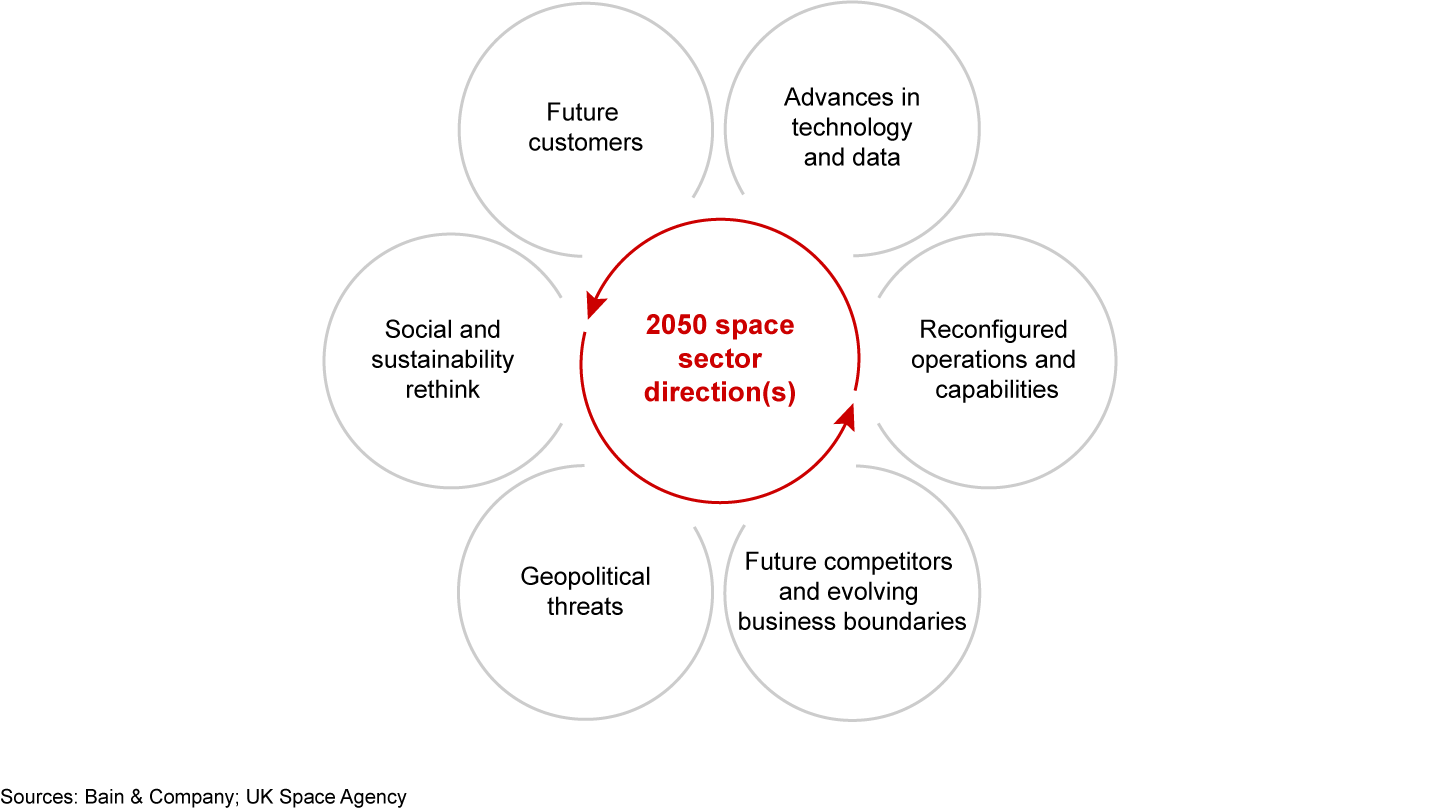
      There are six lenses to view the potential but significant areas of cross-industry disruption by 2050

      Future customers: Will the market remain focused on addressing earth’s needs or shift to also serving new territories in space where hundreds of thousands of people would live?

      “Building 100 Starships a year gets to 1,000 in 10 years or 100 megatons a year or maybe around 100k people per Earth-Mars orbital sync.”
      — Elon Musk tweet

      Social and sustainability rethink: Are we heading towards the Kessler syndrome, with chain-collisions of debris in low-earth orbit leading to lockdown of space?

      “128 million objects from greater than 1 mm to 1 cm [estimated to be in orbit]”
      — ESA

      Geopolitical threats: Will space become the exclusive domain of superpowers? And if so, how confrontational will those superpowers be?

      “We don’t own space anymore.”
      — US Senator Angus King following China landing a rover on Mars (May 2021)

      Future competitors and evolving business boundaries: Will space become the No. 1 market for large companies across all sectors?

      "[16] Psyche could be unique in that it might be an asteroid that is totally made of iron and nickel.”
      — Dr. Tracy M Becker et al, Southwest Research Institute. It is estimated the iron alone on today’s market would be worth $10,000 quadrillion (75,000x the global economy)

      Reconfigured operations and capabilities: Will space become earth’s factory?

      “Eventually it will be much cheaper and simpler to make really complicated things, like microprocessors and everything, in space and then send those … back down to earth, so that we don’t have the big factories and pollution generating industries that make those things now on earth. And earth can be zoned residential.”
      — Jeff Bezos (2020)

      Advances in technology and data: Are we moving to a decentralised artificial intelligence-driven spacecraft operation model, enabled to onboard edge-computing and analytics?

      “[Earth observation] satellites provide us with vast quantities of data, over 150 terabytes per day, which is not always processed efficiently.”
      — ESA

      Five space scenarios for 2050

      There is no way to build scenarios around each uncertainty. The most effective leadership teams focus on the few vital uncertainties that matter, understand the possible scenarios that could develop, and identify the critical trigger points that signal a swing to one scenario or another—we call these signposts.

      Taking together the six lenses of potential disruption, we see two critical macrodimensions—space governance and space relevance—that should shape five potential scenarios for the space sector in the coming 30 years (see Figure 2). We define space governance as the ability of space powers to establish common space norms to ensure security while managing space resources and debris. This would also include cooperation on international programs and avoiding investment duplications. Space relevance is the scope of earth activities and their commercial potential, from only serving earth’s needs to also addressing space needs.

      Figure 2
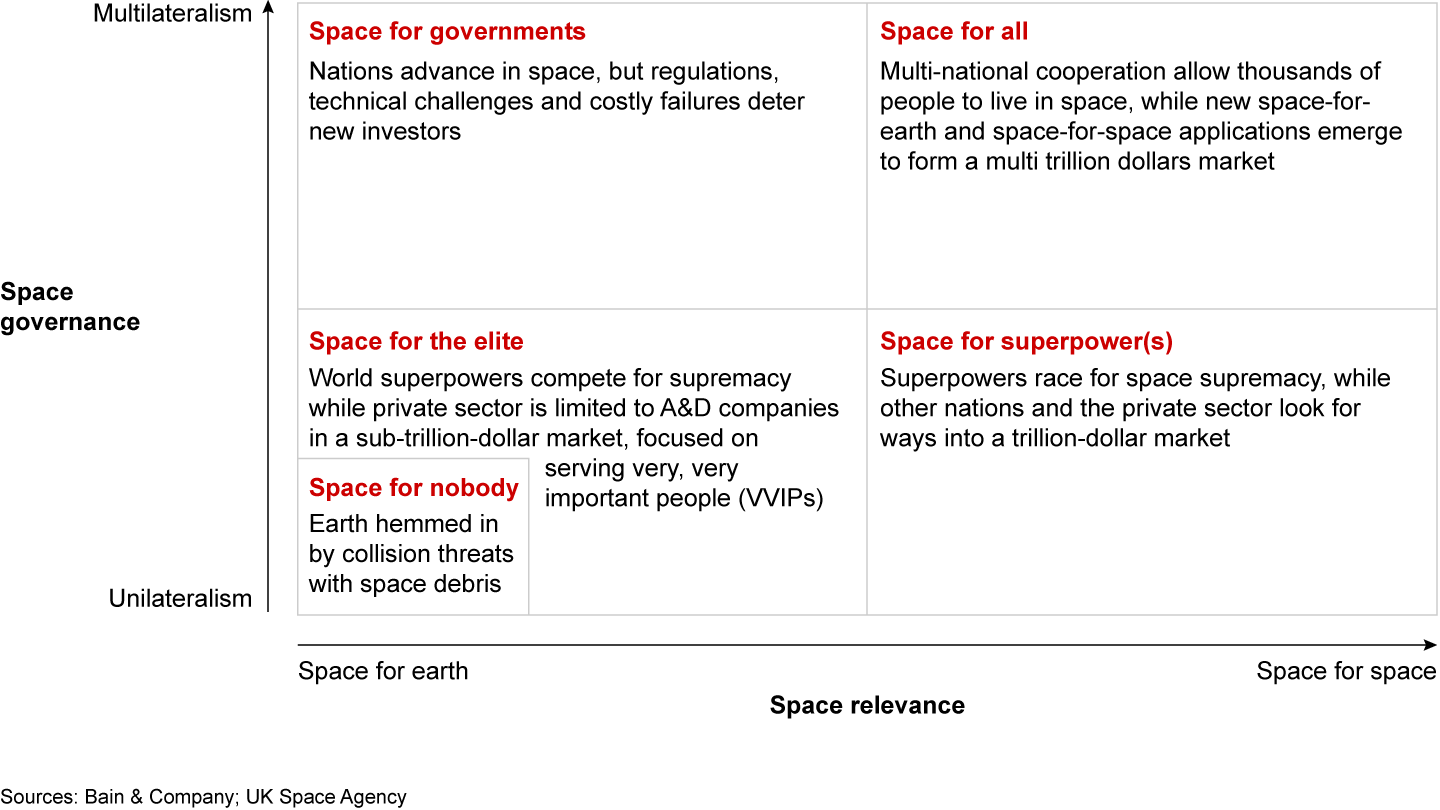
      Two critical macro-dimensions—space governance and space relevance—could shape five potential scenarios for the space sector in the coming 30 years

      Building the plan to be ready for space

      Robust 2050 strategies balance commitment to a bold vision with an explicit set of investments that will prepare an organisation to seize the future as it unfolds, rather than scramble reactively.

      To thrive amid these profound disruptions, you need a strategy that meets today’s challenges and seizes tomorrow’s opportunities. Your strategic planning should be built around three parts that can anticipate risks and uncertainty in a new, evolving sector like the space industry:

      • A future-back vision of potential sector disruptions
      • Industry scenarios around uncertainties that matter most
      • Strategic options, blending no-regret moves, options and hedges, and big bets. For example:
        • No-regret moves. Actions like ongoing cost management or increasing operational effectiveness that will benefit the company under any scenario.
        • Options and hedges. Strategic tactics aimed at specific scenarios. They might include small pilots that can be ramped up or scaled down quickly.
        • Big bets. These are large-scale commitments that are mostly valuable in the prevailing scenario.

      How to prepare for the space disruption

      The space industry is changing at a rapid pace, with new prospectors eager to stake a claim now. Just as the recent digital boom changed the business landscape, the space industry holds the same potential. This next frontier will demand a constant stream of innovative technologies, infrastructure, providers, and services. The whole ecosystem will be affected by this new space race.

      Aerospace companies might investigate opportunities to improve efficiency as a no-regret move, by learning from and collaborating with agile, new space companies. They could reassess their portfolio to make sure they focus investments and efforts on a mix of short- and mid-term options and future high potential bets. More companies are entering the field as 2020 saw $5.2 billion raised for start-up space investment.

      Companies in each industry vertical could massively use space data to disrupt their industry, shifting to new data-enabled service business models. This could start with transport, mining, financial services, and agriculture—as seen when the John Deere company started using space data to accelerate precision agriculture. Companies could start building proofs of concept with aerospace and defence players and start-ups, and then invest to scale the most promising ones.

      Financial investors might investigate opportunities to take advantage of new space applications for assets in their portfolio (e.g., low-latency ubiquitous connectivity, geospatial analytics enabled by new space sensors) as a no-regret move. They might also reassess their investment options and bets in space with a clear view of their appetite for risk and capital-intensive businesses in a sector that is more dynamic and volatile than it used to be.

      Governments also have entered the space race with public space budgets increasing 6% per annum during 2015–2020. They might review their space ambition as a no-regret move in a fast-moving sector, based on their geopolitical context, along with their economic and scientific objectives. They could define the right mix of actions to trigger demand (direct purchases, economic diplomacy, usage stimulation) and support supply (access to capital and talent, regulation) with a combination of bilateral and multilateral international collaboration. Beyond “horizontal” measures to improve country attractiveness, they might choose to invest in a few short- and mid-term options and long-term bets around their specific needs or areas of strength.

      For any organisation, the first step is to answer three practical questions:

      • Do you have a clear view of what the five potential long-term space scenarios could mean for your business?
      • Have you identified signposts, the critical trigger points that signal a swing towards one specific scenario?
      • Have you defined your mix of no-regret, options and hedges, and bets?

      This will help organisations chart a path to win in the future potential trillion-dollar space industry. The biggest winners might even get a seat at Elon Musk’s table for his 80th birthday party in his new Martian mansion in 2051.

      The authors would like to thank Gabriel Tresmontant, manager in London, for supporting the creation of this brief.

      Related Brief

      A Strategy for Embracing Uncertainty

      There are no crystal balls, but companies can get a lot smarter about envisioning future scenarios and knowing when to act on them.

      Authors
      • Headshot of Alex Bhak
        Alex Bhak
        Partner, London
      • Headshot of Matthieu Vigneron
        Matthieu Vigneron
        Partner, Montreal
      • Headshot of Danielle Burgs Escobar
        Danielle Burgs Escobar
        Partner, London
      Related Industries
      • Aerospace & Defense
      Aerospace & Defense
      Defense M&A

      Bold moves will determine the winners as a continent rearms.

      Read more
      Aerospace & Defense
      Improving Program Performance in Aerospace and Defense

      At MRO Europe, Bain Parners Katherine Kajzer-Hughes and Massimo Sabella discuss how outcome-driven reform is essential to success.

      Read more
      Aerospace & Defense
      Defense Investment at a Turning Point

      Private investment in new entrants is up sharply, but large shifts in market share will take years, given long investment and development cycles.

      Read more
      Aerospace & Defense
      Air Travel Forecast to 2040: Geopolitics and the Carbon Challenge

      Three charts illustrate how the aviation demand outlook remains stable, with uncertainties around tariffs and trade counterbalanced by evolving sustainability assumptions.

      Read more
      Aerospace & Defense
      Beyond Program Management: A Bold Fix for Aerospace and Defense Programs

      Program performance continues to fall short. A smarter approach can achieve step-change improvements in cost and speed.

      Read more
      First published in octubre 2021
      Tags
      • Aerospace & Defense

      How We've Helped Clients

      A Reimagined Learning and Development System Cultivates Talent and Drives Innovation

      See more related case studies

      A Defense Company Surmounts Industry Challenges with Cost Management

      See more related case studies

      An Ambitious Supply Chain Strategy Takes AircraftCo to New Heights

      See more related case studies

      Want to continue the conversation

      We help global leaders with their organization's most critical issues and opportunities. Together, we create enduring change and results

      Bain Insights. Our perspectives on critical issues global businesses face in today's challenging environment, delivered monthly.

      *I have read and understand Bain’s Privacy Notice.

      Please read and agree to the Privacy Policy.
      Bain & Company
      Contact us Sustainability Accessibility Terms of use Privacy Modern Slavery Act Statement Cookie Policy Sitemap Log In

      © 1996-2026 Bain & Company, Inc.

      Contact Bain

      How can we help you?

      • Business inquiry
      • Career information
      • Press relations
      • Partnership request
      • Speaker request
      See all offices