
Skip to Content
  • Offices

    Offices

    North & Latin America
    • Atlanta
    • Austin
    • Bogota
    • Boston
    • Buenos Aires
    • Chicago
    • Dallas
    • Denver
    • Houston
    • Los Angeles
    • Mexico City
    • Minneapolis
    • Monterrey
    • Montreal
    • New York
    • Rio de Janeiro
    • San Francisco
    • Santiago
    • São Paulo
    • Seattle
    • Silicon Valley
    • Toronto
    • Washington, DC
    Europe & Africa
    • Amsterdam
    • Athens
    • Berlin
    • Brussels
    • Copenhagen
    • Dusseldorf
    • Frankfurt
    • Helsinki
    • Istanbul
    • Johannesburg
    • Kyiv
    • Lisbon
    • London
    • Madrid
    • Milan
    • Munich
    • Oslo
    • Paris
    • Rome
    • Stockholm
    • Vienna
    • Warsaw
    • Zurich
    Middle East
    • Doha
    • Dubai
    • Riyadh
    Asia & Australia
    • Bangkok
    • Beijing
    • Bengaluru
    • Brisbane
    • Ho Chi Minh City
    • Hong Kong
    • Jakarta
    • Kuala Lumpur
    • Manila
    • Melbourne
    • Mumbai
    • New Delhi
    • Perth
    • Seoul
    • Shanghai
    • Singapore
    • Sydney
    • Tokyo
    See all offices
  • Alumni
  • Media Center
  • Subscribe
  • Contact
  • Argentina | Español

    Select your region and language

    Global
    • Global (English)
    North & Latin America
    • Brazil (Português)
    • Argentina (Español)
    • Canada (Français)
    • Chile (Español)
    • Colombia (Español)
    Europe, Middle East, & Africa
    • France (Français)
    • DACH Region (Deutsch)
    • Italy (Italiano)
    • Spain (Español)
    • Greece (Elliniká)
    Asia & Australia
    • China (中文版)
    • Korea (한국어)
    • Japan (日本語)
  • Saved items (0)
    Saved items (0)

    You have no saved items.

    Bookmark content that interests you and it will be saved here for you to read or share later.

    Explore Bain Insights
  • Industries
    Main menu

    Industries

    • Aeroespacial y Defensa
    • Agroindustria
    • Químicos
    • Construcción e Infraestructura
    • Productos de Consumo
    • Servicios Financieros
    • Salud y Ciencias de la Vida
    • Maquinaria y Equipo Industrial
    • Medios y Entretenimiento
      Industries
      Medios y Entretenimiento
      • Media Lab
    • Metales
    • Minería
    • Petróleo y Gas
    • Papel y Empaque
    • Private Equity
      Industries
      Private Equity
      • Due Diligence
      • Exit Planning
      • Firm Strategy & Operations
      • Portfolio Value Creation
    • Sector Público y Social
    • Retail
    • Tecnología
    • Telecomunicaciones
      Industries
      Telecomunicaciones
      • Capital Expenditure
      • Telco Digital Transformation
    • Transporte
    • Viajes y Turismo
    • Servicios Públicos y Energías Renovables
  • Consulting Services
    Main menu

    Consulting Services

    • Customer Experience
    • Sustainability
    • Innovation
    • M&A
    • Operations
    • People & Organization
    • Private Equity
    • Sales & Marketing
    • Strategy
    • AI, Insights, and Solutions
    • Technology
    • Transformation
  • Digital
  • Insights
    Main menu

    Insights

    • Industry Insights
    • Services Insights
    • Bain Books
    • Webinars
    • Bain Futures
    View all Insights
    Featured topics
    • Tariff Response
    • Artificial Intelligence
    • Thriving in Uncertainty
    • Executive Conversations
    • Macro Trends
    • M&A Report
    • Healthcare Private Equity Report
    • Paper & Packaging Report
    • Technology Report
    • CEO's Guide to Sustainability
    • CEO Insights
    • CFO Insights
    • COO Insights
    • CIO Insights
    • CMO Insights
    View all featured topics
  • About
    Main menu

    About

    • What We Do
    • What We Believe
    • Our People & Leadership
    • Client Results
    • Awards & Recognition
    • Global Affiliations
    Further: Our global responsibility
    • Sustainability
    • Social Impact
    • World Economic Forum
    Learn more about Further
  • Carreras
    Main menu

    Carreras

    • Trabaja con Nosotros
      Carreras
      Trabaja con Nosotros
      • Find Your Place
      • Nuestras Áreas de Trabajo
      • Equipos Integrados
      • Estudiantes
      • Internships & Programs
      • Eventos de Reclutamiento
    • La Vida en Bain
      Carreras
      La Vida en Bain
      • Historias Profesionales
      • Nuestra Gente
      • Dónde Trabajamos
      • Apoyando tu Crecimiento
      • Grupos de Afinidad
      • Beneficios
    • Impact Stories
    • Nuestro Proceso
      Carreras
      Nuestro Proceso
      • Qué Esperar
      • Entrevistas
    FIND JOBS
  • Offices
    Main menu

    Offices

    • North & Latin America
      Offices
      North & Latin America
      • Atlanta
      • Austin
      • Bogota
      • Boston
      • Buenos Aires
      • Chicago
      • Dallas
      • Denver
      • Houston
      • Los Angeles
      • Mexico City
      • Minneapolis
      • Monterrey
      • Montreal
      • New York
      • Rio de Janeiro
      • San Francisco
      • Santiago
      • São Paulo
      • Seattle
      • Silicon Valley
      • Toronto
      • Washington, DC
    • Europe & Africa
      Offices
      Europe & Africa
      • Amsterdam
      • Athens
      • Berlin
      • Brussels
      • Copenhagen
      • Dusseldorf
      • Frankfurt
      • Helsinki
      • Istanbul
      • Johannesburg
      • Kyiv
      • Lisbon
      • London
      • Madrid
      • Milan
      • Munich
      • Oslo
      • Paris
      • Rome
      • Stockholm
      • Vienna
      • Warsaw
      • Zurich
    • Middle East
      Offices
      Middle East
      • Doha
      • Dubai
      • Riyadh
    • Asia & Australia
      Offices
      Asia & Australia
      • Bangkok
      • Beijing
      • Bengaluru
      • Brisbane
      • Ho Chi Minh City
      • Hong Kong
      • Jakarta
      • Kuala Lumpur
      • Manila
      • Melbourne
      • Mumbai
      • New Delhi
      • Perth
      • Seoul
      • Shanghai
      • Singapore
      • Sydney
      • Tokyo
    See all offices
  • Alumni
  • Media Center
  • Subscribe
  • Contact
  • Argentina | Español
    Main menu

    Select your region and language

    • Global
      Select your region and language
      Global
      • Global (English)
    • North & Latin America
      Select your region and language
      North & Latin America
      • Brazil (Português)
      • Argentina (Español)
      • Canada (Français)
      • Chile (Español)
      • Colombia (Español)
    • Europe, Middle East, & Africa
      Select your region and language
      Europe, Middle East, & Africa
      • France (Français)
      • DACH Region (Deutsch)
      • Italy (Italiano)
      • Spain (Español)
      • Greece (Elliniká)
    • Asia & Australia
      Select your region and language
      Asia & Australia
      • China (中文版)
      • Korea (한국어)
      • Japan (日本語)
  • Saved items  (0)
    Main menu
    Saved items (0)

    You have no saved items.

    Bookmark content that interests you and it will be saved here for you to read or share later.

    Explore Bain Insights
  • Industries
    • Industries

      • Aeroespacial y Defensa
      • Agroindustria
      • Químicos
      • Construcción e Infraestructura
      • Productos de Consumo
      • Servicios Financieros
      • Salud y Ciencias de la Vida
      • Maquinaria y Equipo Industrial
      • Medios y Entretenimiento
      • Metales
      • Minería
      • Petróleo y Gas
      • Papel y Empaque
      • Private Equity
      • Sector Público y Social
      • Retail
      • Tecnología
      • Telecomunicaciones
      • Transporte
      • Viajes y Turismo
      • Servicios Públicos y Energías Renovables
  • Consulting Services
    • Consulting Services

      • Customer Experience
      • Sustainability
      • Innovation
      • M&A
      • Operations
      • People & Organization
      • Private Equity
      • Sales & Marketing
      • Strategy
      • AI, Insights, and Solutions
      • Technology
      • Transformation
  • Digital
  • Insights
    • Insights

      • Industry Insights
      • Services Insights
      • Bain Books
      • Webinars
      • Bain Futures
      View all Insights
      Featured topics
      • Tariff Response
      • Artificial Intelligence
      • Thriving in Uncertainty
      • Executive Conversations
      • Macro Trends
      • M&A Report
      • Healthcare Private Equity Report
      • Paper & Packaging Report
      • Technology Report
      • CEO's Guide to Sustainability
      • CEO Insights
      • CFO Insights
      • COO Insights
      • CIO Insights
      • CMO Insights
      View all featured topics
  • About
    • About

      • What We Do
      • What We Believe
      • Our People & Leadership
      • Client Results
      • Awards & Recognition
      • Global Affiliations
      Further: Our global responsibility
      • Sustainability
      • Social Impact
      • World Economic Forum
      Learn more about Further
  • Carreras
    Popular Searches
    • Agile
    • Digital
    • Strategy
    Your Previous Searches
      Recently Visited Pages

      Content added to saved items

      Saved items (0)

      Removed from saved items

      Saved items (0)

      Brief

      Loyalty Insights: Assessing Your Net Promoter System®

      Loyalty Insights: Assessing Your Net Promoter System®

      Is your company achieving the full benefits of its customer advocacy effort?

      By Rob Markey and Aaron Cheris

      • min read
      }

      Brief

      Loyalty Insights: Assessing Your Net Promoter System®
      en

      VimpelCom—one of the world’s largest telecommunications companies, with 215 million customers—adopted the Net Promoter System® to improve the customer experience. In 2013, with Bain’s help, the company launched an assessment to determine how well the system was working.

      The findings were not encouraging. “Our employees were really not focused on the customer, even in general,” Anton Telegin, the company’s group director for commercial transformation, recalled during a recent Net Promoter System podcast. Added Natalia Macpherson, group director of customer experience: “We didn’t have a unified customer strategy that everyone knew and agreed to.”

      VimpelCom’s NPS advocates—Telegin, Macpherson and their colleagues—realized that they had to roll up their sleeves. They had to help employees understand the system better. They had to encourage leaders to get more involved. And they needed a better understanding of loyalty economics, so that they could build persuasive business cases for customer-centric investments.


      This year, 2016, marks 10 years since Fred Reichheld laid out the principles behind the Net Promoter System in his best-seller, The Ultimate Question. Over the past decade, thousands of companies around the world have adopted the system.

      But how well is it really working at all these organizations? Building a customer-centric company through Net Promoter, after all, is a complex and arduous journey. It wouldn’t be surprising if some companies found themselves stumbling or stalling out along the way.

      To assess the successes and the stumbles, we have now studied close to 130 Net Promoter System companies, VimpelCom among them. Overall, we learned, only a small fraction of these companies are implementing all of the best practices that Bain’s experts recommend. So nearly everyone is still on the journey. Many, of course, are just starting out.

      As we probed deeper, however, we found big differences among companies. At the top were a sizable group that gave the Net Promoter System a 9 or a 10 in answer to the question, “How successful has NPS been at helping you improve your business or organization?” It may sound a little meta, but we think of these organizations as promoters of their Net Promoter System. They would almost certainly recommend the system to other companies—probably excepting their competitors.

      At the bottom, it’s a different story. Some companies scored their Net Promoter Systems between zero and 6 on the “helping you improve your business” question. We have to think of these companies as detractors—they’re certainly dissatisfied with their results, at least so far. One big difference between the two groups: A majority of promoters have adopted more than four-fifths of the 35 or so best practices identified by the experts. A majority of detractors have adopted less than one-fifth. In fact, the more best practices a company has adopted, the more likely it is to be a promoter.

      What are the other key differences between the promoters and the detractors? Combing through the data, we found three big points of distinction—points that may help you focus your investments and make your own Net Promoter System more effective than it is today.

      1. Reliable data

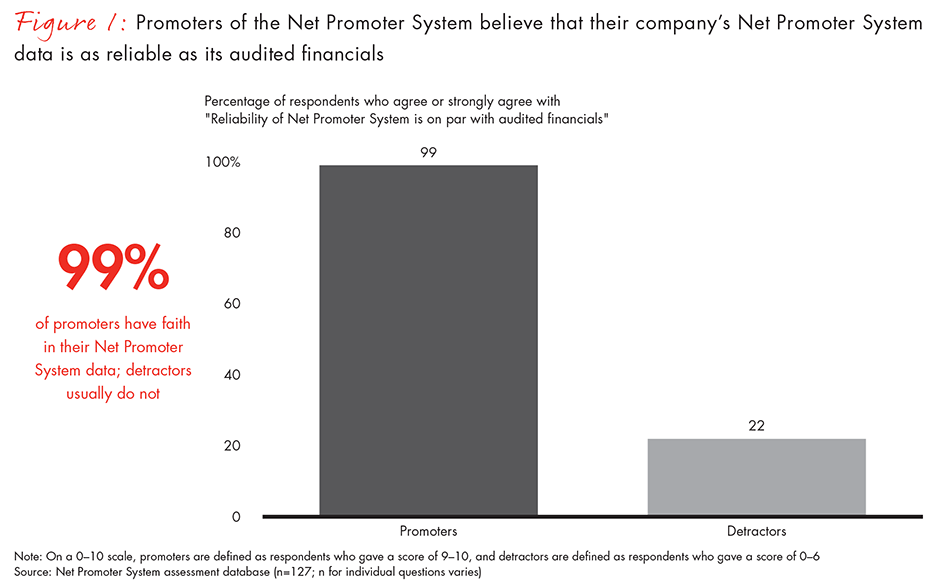
      One difference was stunning, both in its magnitude and its implications. A whopping 99% of NPS promoters “agree” or “strongly agree” that their Net Promoter data is on a par with their audited financials (see Figure 1). In short, they gather data that they believe is reliable. They trust it. The detractors don’t. Only 22% of detractors, or fewer than one in four, believe that their NPS data is as trustworthy as their financial numbers.

      assessing-your-net-promoter-system-fig01_embed

      Here’s a powerful symbol of this difference: 75% of promoters say their NPS results and improvement plans are directly addressed in their company’s annual report and communications with the board. The comparable number for detractors is only 17%.

      One factor behind the gap may be a difference in response rates. Nearly half of the detractors report response rates of less than 20%. Promoters get higher rates, on average. And more than twice as many promoters as detractors say that survey respondents represent more than 80% of their revenue.

      Reliable data is the foundation of the Net Promoter System. If a company’s leaders don’t believe the data, why should employees? And why should anyone take action, let alone invest money, based on what the data seems to show? Without good data you can’t understand loyalty economics. You can’t tell how much it might be worth to invest in increasing the ratio of promoters to detractors, because you don’t have an accurate gauge of your success. Low response rates are a giveaway: they almost always indicate unreliable data, and are thus a sign of a struggling Net Promoter System. If you can’t get most of your customers to respond to your requests for feedback, it’s little wonder you can’t trust the feedback you do get.

      2. Closing the loop with employees and customers

      Customer feedback, of course, is just a starting point—it’s what you do with the data that counts. In a well-functioning Net Promoter System, the feedback flows directly to frontline employees and others responsible for the customer experience. The feedback then triggers actions of all sorts. Customer-service reps discuss how to improve the quality of their services. Cross-functional teams address procedural or policy issues that are getting in the way of a great customer experience. Frontline managers call customers who are unhappy—or who have offered particularly helpful feedback—to learn more. They close the loop.

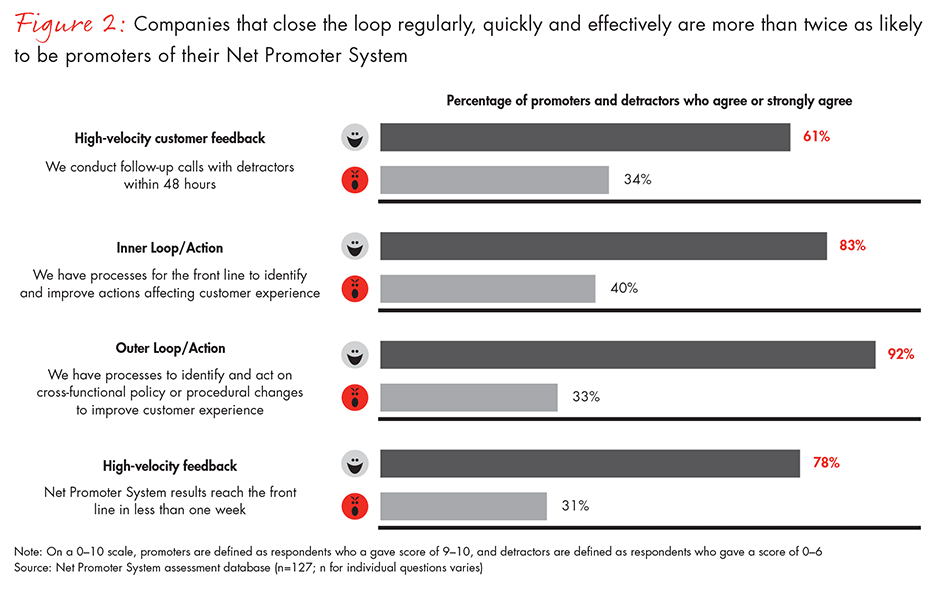
      Here, too, there are vast disparities between promoters and detractors (see Figure 2):

      assessing-your-net-promoter-system-fig02_embed
      • 78% of promoters say that they share customer feedback with frontline employees within a week or less. Only 31% of detractors do so.
      • 61% of promoters say that they conduct follow-up calls with detractors within 48 hours. Only 34% of detractors do so.
      • 83% of promoters say that have processes by which frontline employees can identify and improve actions affecting the customer experience. Only 40% of detractors have such processes.
      • 92% of promoters report that they have established processes to identify and act on cross-functional policy or procedural changes to improve the customer experience. Only 33% of detractors have such processes.

      The giveaway here is whether frontline employees understand and can explain the Net Promoter System and what they can accomplish by using it. More than twice as many promoters as detractors say that the majority of employees could explain what NPS is, why it is important and what it takes to delight customers. The essence of the system is that it offers people throughout the organization the ability to learn and to grow in their jobs by delivering a better and better experience to customers. But if people don’t understand how Net Promoter works or why it’s important, how can they ever do so? 

      3. Understanding loyalty economics

      The ultimate goal of the Net Promoter System is to improve the lives of customers and thus to fuel profitable growth. The connection between these two objectives is critical. A company has to measure the value of loyalty among each customer segment. It has to establish the differential value of promoters as compared with detractors and thereby determine what it should invest in creating more promoters. This “loyalty economics” is the business reality that underlies a successful Net Promoter System. Unless a company has a deep understanding of the connections between loyalty and financial results, its system will always be in jeopardy when the next round of cost-cutting comes along.

      Yet most companies, we found, do not yet have a solid grasp of loyalty economics—in other words, they haven’t calculated the value of creating promoters among their customers. Overall, nearly three-quarters of respondents disagreed with the statement, “We have been able to calculate word of mouth and referral economics,” indicating that they had not yet connected the scores they were collecting with loyalty economics. But here, too, there were big differences. Nearly four times as many promoters as detractors say they do calculate loyalty economics. About four times as many incorporate these calculations into their assessments of the lifetime value of a customer. More than twice as many report that their CFO has certified their NPS-derived customer lifetime value calculations.

      Lurking under all these numbers is one key organizational difference. Virtually all—99%—of the promoters reported that their CEO and other senior leaders were committed to the fundamental goal of creating more customer promoters and fewer customer detractors. The same percentage reported that their senior leaders were aligned on the company’s NPS goals in their communications and actions. The comparable figures for detractors weren’t terrible, but they were considerably lower. To be sure, we don’t know which way the causal arrow points: leaders at detractor companies may not be aligned because they don’t yet trust their data, or their lack of alignment may have led the company to underinvest in gathering reliable data. Whatever the relationship, it’s clear that leadership commitment and alignment is a very big factor in determining how well a company’s Net Promoter System is likely to work.

      Assessments like these are a powerful tool. Measuring your own company’s successes and failures shows you where you need to improve. Comparing your results with Bain’s database points out your standing on each dimension of the system relative to the practices of other companies, including the highly successful ones that we have been calling promoters. The database itself lets us highlight the key factors that seem to make the most difference to results. Reliable data, effective closed-loop feedback and loyalty economics are three big ones.

      VimpelCom has used the assessment twice now, once in 2013 and again in 2015. The company’s group directors Telegin and Macpherson could scarcely be happier with what they’ve learned. At first, for example, the system was slow to catch on because leaders weren’t sufficiently involved. “Yes, you can implement the operational NPS,” said Macpherson. “But without the leadership knowledge, engagement and driving the program, it’s not going to be that effective.” Another key: getting finance involved in building business cases for customer-related investments. For instance, a team calculated the relative impact of customer promoters and detractors on churn rates. When VimpelCom took measures to increase the number of promoters, churn rates dropped by 10% in one year, generating $350 million in extra revenue.

      Not a bad return on the company’s investment in assessments.

      Rob Markey is a partner and director in Bain & Company’s New York office and leads the firm’s Global Customer Strategy & Marketing practice. He is coauthor of the best-seller The Ultimate Question 2.0: How Net Promoter Companies Thrive in a Customer-Driven World. Aaron Cheris is a partner in Bain’s San Francisco office and leads Bain’s Retail practice in the Americas.


      assessing-your-net-promoter-system-fig01_full

      assessing-your-net-promoter-system-fig02_full
      Authors
      • Headshot of Rob Markey
        Rob Markey
        Advisory Partner, Boston
      • Headshot of Aaron Cheris
        Aaron Cheris
        Partner, San Francisco
      Related Consulting Services
      • Net Promoter System®
      • Sales and Marketing
      How We Can Help
      • Net Promoter®
      Sales and Marketing
      Applying the Net Promoter System to Internal Customers

      A robust internal Net Promoter System can help service teams, such as IT and HR, support those who serve customers.

      Read more
      Sales and Marketing
      Who Should Run Your Net Promoter System®?

      Gritty, passionate executives are key to implementing a Net Promoter System effectively.

      Read more
      Sales and Marketing
      Is That Customer Worth Your Time?

      Allocate time with customers based on analytics, not gut instinct.

      Read more
      Loyalty
      Net Promoter for People: Give Employees a Voice, Get Their Best

      Net Promoter® for People is about empowering employees to bring energy, enthusiasm and creativity to delight customers.

      Read more
      Loyalty
      After Years of Customer Loyalty Programs in Insurance, What Works, and What’s Next?

      Based on Bain’s 10 years of research, five themes describe the progress and challenges of earning customers’ advocacy in an increasingly digital experience.

      Read more
      First published in marzo 2016
      Tags
      • Loyalty
      • Net Promoter System®
      • Net Promoter®
      • Sales and Marketing

      How We've Helped Clients

      Resetting Shared Services to Save $75 Million

      See more related case studies

      Transformation sparks financial leader's turnaround

      See more related case studies

      Turning around a pioneering service for working parents with sick children

      See more related case studies

      Want to continue the conversation

      We help global leaders with their organization's most critical issues and opportunities. Together, we create enduring change and results

      Bain Insights. Our perspectives on critical issues global businesses face in today's challenging environment, delivered monthly.

      *I have read and understand Bain’s Privacy Notice.

      Please read and agree to the Privacy Policy.
      Bain & Company
      Contact us Sustainability Accessibility Terms of use Privacy Modern Slavery Act Statement Cookie Policy Sitemap Log In

      © 1996-2026 Bain & Company, Inc.

      Contact Bain

      How can we help you?

      • Business inquiry
      • Career information
      • Press relations
      • Partnership request
      • Speaker request
      See all offices