
Skip to Content
  • Offices

    Offices

    North & Latin America
    • Atlanta
    • Austin
    • Bogota
    • Boston
    • Buenos Aires
    • Chicago
    • Dallas
    • Denver
    • Houston
    • Los Angeles
    • Mexico City
    • Minneapolis
    • Monterrey
    • Montreal
    • New York
    • Rio de Janeiro
    • San Francisco
    • Santiago
    • São Paulo
    • Seattle
    • Silicon Valley
    • Toronto
    • Washington, DC
    Europe & Africa
    • Amsterdam
    • Athens
    • Berlin
    • Brussels
    • Copenhagen
    • Dusseldorf
    • Frankfurt
    • Helsinki
    • Istanbul
    • Johannesburg
    • Kyiv
    • Lisbon
    • London
    • Madrid
    • Milan
    • Munich
    • Oslo
    • Paris
    • Rome
    • Stockholm
    • Vienna
    • Warsaw
    • Zurich
    Middle East
    • Doha
    • Dubai
    • Riyadh
    Asia & Australia
    • Bangkok
    • Beijing
    • Bengaluru
    • Brisbane
    • Ho Chi Minh City
    • Hong Kong
    • Jakarta
    • Kuala Lumpur
    • Manila
    • Melbourne
    • Mumbai
    • New Delhi
    • Perth
    • Seoul
    • Shanghai
    • Singapore
    • Sydney
    • Tokyo
    See all offices
  • Alumni
  • Media Center
  • Subscribe
  • Contact
  • Argentina | Español

    Select your region and language

    Global
    • Global (English)
    North & Latin America
    • Brazil (Português)
    • Argentina (Español)
    • Canada (Français)
    • Chile (Español)
    • Colombia (Español)
    Europe, Middle East, & Africa
    • France (Français)
    • DACH Region (Deutsch)
    • Italy (Italiano)
    • Spain (Español)
    • Greece (Elliniká)
    Asia & Australia
    • China (中文版)
    • Korea (한국어)
    • Japan (日本語)
  • Saved items (0)
    Saved items (0)

    You have no saved items.

    Bookmark content that interests you and it will be saved here for you to read or share later.

    Explore Bain Insights
  • Industries
    Main menu

    Industries

    • Aeroespacial y Defensa
    • Agroindustria
    • Químicos
    • Construcción e Infraestructura
    • Productos de Consumo
    • Servicios Financieros
    • Salud y Ciencias de la Vida
    • Maquinaria y Equipo Industrial
    • Medios y Entretenimiento
      Industries
      Medios y Entretenimiento
      • Media Lab
    • Metales
    • Minería
    • Petróleo y Gas
    • Papel y Empaque
    • Private Equity
      Industries
      Private Equity
      • Due Diligence
      • Exit Planning
      • Firm Strategy & Operations
      • Portfolio Value Creation
    • Sector Público y Social
    • Retail
    • Tecnología
    • Telecomunicaciones
      Industries
      Telecomunicaciones
      • Capital Expenditure
      • Telco Digital Transformation
    • Transporte
    • Viajes y Turismo
    • Servicios Públicos y Energías Renovables
  • Consulting Services
    Main menu

    Consulting Services

    • Customer Experience
    • Sustainability
    • Innovation
    • M&A
    • Operations
    • People & Organization
    • Private Equity
    • Sales & Marketing
    • Strategy
    • AI, Insights, and Solutions
    • Technology
    • Transformation
  • Digital
  • Insights
    Main menu

    Insights

    • Industry Insights
    • Services Insights
    • Bain Books
    • Webinars
    • Bain Futures
    View all Insights
    Featured topics
    • Tariff Response
    • Artificial Intelligence
    • Thriving in Uncertainty
    • Executive Conversations
    • Macro Trends
    • M&A Report
    • Healthcare Private Equity Report
    • Paper & Packaging Report
    • Technology Report
    • CEO's Guide to Sustainability
    • CEO Insights
    • CFO Insights
    • COO Insights
    • CIO Insights
    • CMO Insights
    View all featured topics
  • About
    Main menu

    About

    • What We Do
    • What We Believe
    • Our People & Leadership
    • Client Results
    • Awards & Recognition
    • Global Affiliations
    Further: Our global responsibility
    • Sustainability
    • Social Impact
    • World Economic Forum
    Learn more about Further
  • Carreras
    Main menu

    Carreras

    • Trabaja con Nosotros
      Carreras
      Trabaja con Nosotros
      • Find Your Place
      • Nuestras Áreas de Trabajo
      • Equipos Integrados
      • Estudiantes
      • Internships & Programs
      • Eventos de Reclutamiento
    • La Vida en Bain
      Carreras
      La Vida en Bain
      • Historias Profesionales
      • Nuestra Gente
      • Dónde Trabajamos
      • Apoyando tu Crecimiento
      • Grupos de Afinidad
      • Beneficios
    • Impact Stories
    • Nuestro Proceso
      Carreras
      Nuestro Proceso
      • Qué Esperar
      • Entrevistas
    FIND JOBS
  • Offices
    Main menu

    Offices

    • North & Latin America
      Offices
      North & Latin America
      • Atlanta
      • Austin
      • Bogota
      • Boston
      • Buenos Aires
      • Chicago
      • Dallas
      • Denver
      • Houston
      • Los Angeles
      • Mexico City
      • Minneapolis
      • Monterrey
      • Montreal
      • New York
      • Rio de Janeiro
      • San Francisco
      • Santiago
      • São Paulo
      • Seattle
      • Silicon Valley
      • Toronto
      • Washington, DC
    • Europe & Africa
      Offices
      Europe & Africa
      • Amsterdam
      • Athens
      • Berlin
      • Brussels
      • Copenhagen
      • Dusseldorf
      • Frankfurt
      • Helsinki
      • Istanbul
      • Johannesburg
      • Kyiv
      • Lisbon
      • London
      • Madrid
      • Milan
      • Munich
      • Oslo
      • Paris
      • Rome
      • Stockholm
      • Vienna
      • Warsaw
      • Zurich
    • Middle East
      Offices
      Middle East
      • Doha
      • Dubai
      • Riyadh
    • Asia & Australia
      Offices
      Asia & Australia
      • Bangkok
      • Beijing
      • Bengaluru
      • Brisbane
      • Ho Chi Minh City
      • Hong Kong
      • Jakarta
      • Kuala Lumpur
      • Manila
      • Melbourne
      • Mumbai
      • New Delhi
      • Perth
      • Seoul
      • Shanghai
      • Singapore
      • Sydney
      • Tokyo
    See all offices
  • Alumni
  • Media Center
  • Subscribe
  • Contact
  • Argentina | Español
    Main menu

    Select your region and language

    • Global
      Select your region and language
      Global
      • Global (English)
    • North & Latin America
      Select your region and language
      North & Latin America
      • Brazil (Português)
      • Argentina (Español)
      • Canada (Français)
      • Chile (Español)
      • Colombia (Español)
    • Europe, Middle East, & Africa
      Select your region and language
      Europe, Middle East, & Africa
      • France (Français)
      • DACH Region (Deutsch)
      • Italy (Italiano)
      • Spain (Español)
      • Greece (Elliniká)
    • Asia & Australia
      Select your region and language
      Asia & Australia
      • China (中文版)
      • Korea (한국어)
      • Japan (日本語)
  • Saved items  (0)
    Main menu
    Saved items (0)

    You have no saved items.

    Bookmark content that interests you and it will be saved here for you to read or share later.

    Explore Bain Insights
  • Industries
    • Industries

      • Aeroespacial y Defensa
      • Agroindustria
      • Químicos
      • Construcción e Infraestructura
      • Productos de Consumo
      • Servicios Financieros
      • Salud y Ciencias de la Vida
      • Maquinaria y Equipo Industrial
      • Medios y Entretenimiento
      • Metales
      • Minería
      • Petróleo y Gas
      • Papel y Empaque
      • Private Equity
      • Sector Público y Social
      • Retail
      • Tecnología
      • Telecomunicaciones
      • Transporte
      • Viajes y Turismo
      • Servicios Públicos y Energías Renovables
  • Consulting Services
    • Consulting Services

      • Customer Experience
      • Sustainability
      • Innovation
      • M&A
      • Operations
      • People & Organization
      • Private Equity
      • Sales & Marketing
      • Strategy
      • AI, Insights, and Solutions
      • Technology
      • Transformation
  • Digital
  • Insights
    • Insights

      • Industry Insights
      • Services Insights
      • Bain Books
      • Webinars
      • Bain Futures
      View all Insights
      Featured topics
      • Tariff Response
      • Artificial Intelligence
      • Thriving in Uncertainty
      • Executive Conversations
      • Macro Trends
      • M&A Report
      • Healthcare Private Equity Report
      • Paper & Packaging Report
      • Technology Report
      • CEO's Guide to Sustainability
      • CEO Insights
      • CFO Insights
      • COO Insights
      • CIO Insights
      • CMO Insights
      View all featured topics
  • About
    • About

      • What We Do
      • What We Believe
      • Our People & Leadership
      • Client Results
      • Awards & Recognition
      • Global Affiliations
      Further: Our global responsibility
      • Sustainability
      • Social Impact
      • World Economic Forum
      Learn more about Further
  • Carreras
    Popular Searches
    • Agile
    • Digital
    • Strategy
    Your Previous Searches
      Recently Visited Pages

      Content added to saved items

      Saved items (0)

      Removed from saved items

      Saved items (0)

      Brief

      Per-Seat Software Pricing Isn’t Dead, but New Models Are Gaining Steam

      Per-Seat Software Pricing Isn’t Dead, but New Models Are Gaining Steam

      AI features force vendors to rethink pricing models, raising several tough challenges.

      By Eric Maltiel and Josh Sandberg

      • min read
      }

      Brief

      Per-Seat Software Pricing Isn’t Dead, but New Models Are Gaining Steam
      en
      Executive Summary
      • AI is reshaping value and cost structures in the software industry, making traditional per-seat pricing less relevant in some cases.
      • But the shift away from seats to new pricing models is complex, requiring new telemetry, internal capabilities, and sales enablement—and a new mindset among customers.
      • Hybrid pricing models have emerged as the dominant interim strategy, blending per-seat and AI-based usage or outcome metrics.
      • Success for vendors hinges on aligning pricing with perceived customer value, equipping sales teams, and guiding customers through the transition.

      The rise of generative artificial intelligence is starting to complicate the tried-and-true per-seat model of pricing software. Whether a company licenses Microsoft 365 or Salesforce, the simplicity of per-user, per-month pricing has paired naturally with adoption of software as a service (SaaS). Per-seat pricing historically worked well because most business software provided value to customers by making employees more productive. It was easy to understand, forecast, and budget around. The model worked for software vendors as well, with a natural path for growth as customers add employees.

      Now a growing chorus of voices argues that “seats are dead.” That’s an overstatement, but the sentiment is not completely off base. AI introduces fundamental shifts in how value is created and consumed in software, and in some cases, renders the traditional seat-based model misaligned and even obsolete. Yet, while moving away from per-seat pricing may seem to be a smart move for many companies, the transition will be complex and difficult to execute—a minefield for the unprepared.

      At this early stage of the shift, it’s worth exploring what sales and marketing executives should consider as they position their organizations for an AI-infused future.

      How AI disrupts SaaS pricing

      AI changes the game along two major dimensions: the value it delivers and the cost structure it imposes.

      Consider value. Many generative AI features and agents operate in the background, completing tasks with much less or no human engagement. For example, AI tools that automate customer service interactions may replace entry-level support roles altogether, which means the traditional price-per-human meter loses relevance. If a business customer needs fewer humans to operate the software, the economics of pricing based on headcount disintegrates. Even if the number of seats doesn’t decline, AI can deliver much more value per seat, or value uncorrelated with seats, and vendors should aspire to capture their share of that value.

      Second, AI introduces new costs. Model inference, fine-tuning, and AI-specific R&D all carry expenses. So even as some companies look to AI as a way to improve profit margins, the cost of building and running AI-infused product features will be substantial for software companies and may continue to rise. Software companies will be pressed to monetize those features in a way that more than covers usage costs.

      Saying goodbye is always hard

      Given these disruptions, software firms should consider when it makes sense to continue pricing by the seat and when they should shift their pricing model. In certain situations—where there is significant risk to the core business, where AI features are meaningfully differentiated, and where customers can measure return on investment—many vendors have turned to new pricing models based on usage, output, or outcomes (see Figure 1). However, several challenges inherent to a new model are not always fully appreciated.

      Figure 1
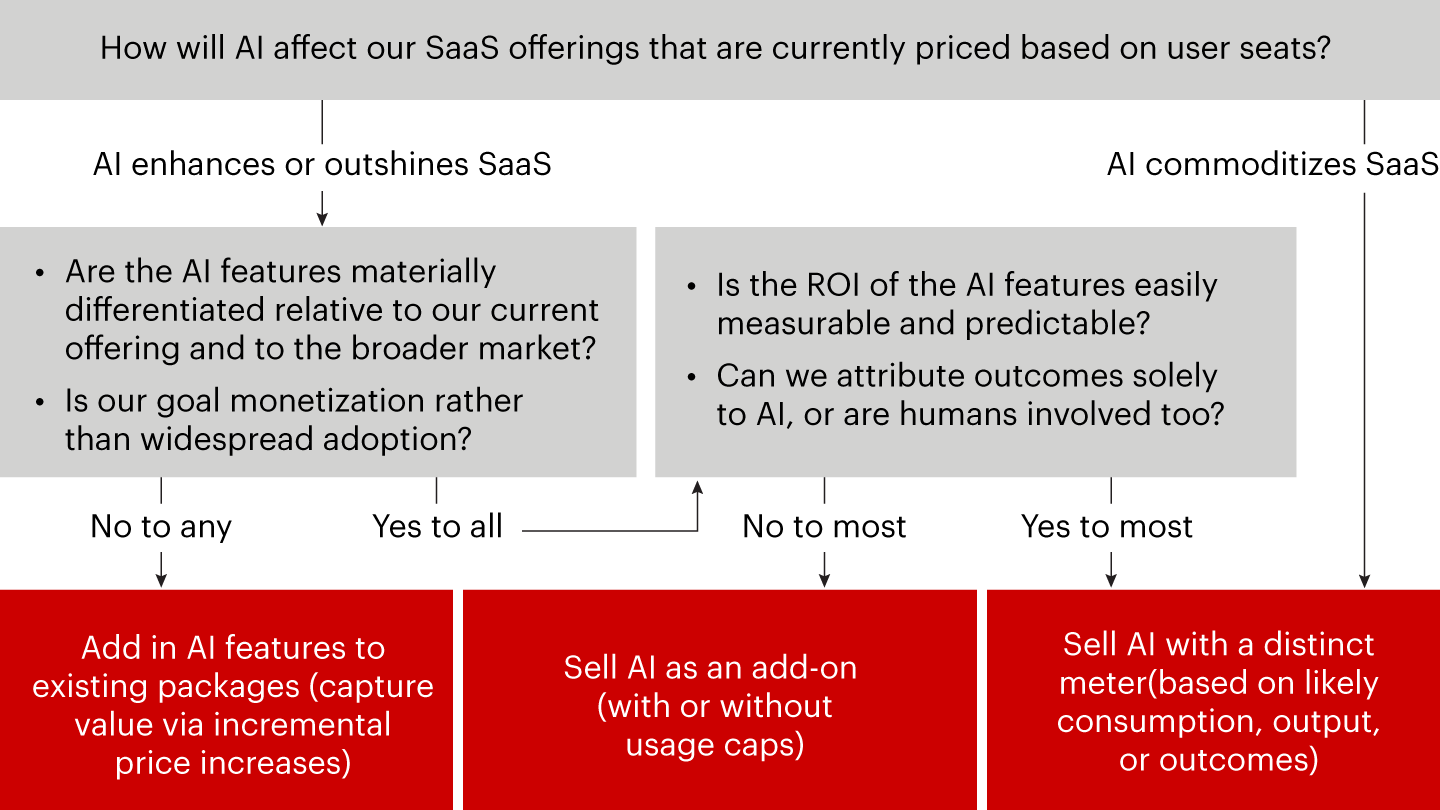
      An initial decision tree for how to package and meter AI features in software
      Source: Bain & Company

      Consider the internal hurdles. Moving to AI usage- or outcome-based pricing models involves adapting or acquiring capabilities inside the organization. Most software companies lack the product telemetry or IT, billing, and finance infrastructure to support these models at scale. Sales, finance, and product teams often operate in silos and lack a shared language or metrics around pricing and value.

      The go-to-market team faces other challenges. Sales reps typically have been trained to sell seats. Asking them to change conversations with customers to focus on AI usage or outcomes will require new capabilities, new playbooks, new tools such as sizing calculators, and new compensation models. The entire commercial engine may need to be retooled.

      Externally, there are also several hurdles to overcome. Customers’ procurement teams typically are accustomed to buying software based on headcount, not value. Selling an AI usage- or outcome-based model will involve changing long-held norms and shifting budget lines from labor to software. Vendors’ sales staff may need to negotiate with different executives to free up funds for software.

      The toughest challenge could be asking customers to spend more before they see savings. Take the case of a SaaS vendor pitching a $40,000 AI agent that could eventually replace an $80,000 sales development rep. In the short term, the customer still needs both the employee and the AI agent while it evaluates outcomes. The customer must raise its cost by 50% for an undefined period. Unless the vendor helps its customer bridge that gap—perhaps with incentives such as delayed payments, flexible contracts, or performance guarantees linked directly to profit and loss outcomes—the sale may stall.

      Going hybrid for now

      As software companies have started to explore how to monetize the value they deliver and reduce the risks of AI disruption, most have taken a middle path, adopting a hybrid pricing model. We recently analyzed more than 30 SaaS vendors that are introducing generative AI capabilities (excluding AI-native vendors) and found: 

      • Roughly 35% have simply increased per-seat pricing, bundling AI features into existing tiers. Zoom, for instance, has taken this path. 
      • About 65% have introduced a hybrid approach, layering an AI meter (say, by usage or feature access) on top of seat-based pricing. Adobe and Salesforce have taken this step.
      • None of these 30-plus vendors now exclusively monetize AI as a separate add-on, although several did when we performed this analysis a year ago.
      • And none of these vendors have fully shifted to AI usage- or outcome-based pricing, in contrast with many new AI companies.

      A hybrid approach allows companies to begin capturing AI-driven value without completely overhauling their pricing infrastructure or commercial motions. It limits the disruption to their current recurring revenue, and it also gives customers the flexibility to adopt AI at their own pace. Importantly, this approach acknowledges that not all customers will transition to AI at the same time.

      Guidelines for next steps

      Not every vendor will need to change its current model. But for executives weighing how to shift pricing in response to AI, a few high-gain areas of focus will help set the most effective course.

      1. Choose the pricing meter thoughtfully. What accounts for value in an AI offering, as perceived by customers, will differ for every product, use case, and industry. It might be the number of queries handled, tasks automated, support tickets resolved, sales insights generated, or other outcomes. The vendor’s meter must correlate with perceived value, be easy to understand, and avoid incentives that discourage adoption.

      Not all AI features will be valued equally. Certain AI-enhanced workflow features might be technically impressive, but customers might place low value on them. A pricing meter should reflect what customers value, not just what the product can do in theory. Of course, vendors can educate customers to make them aware of hidden value created by a particular AI feature, and then monetize that value.

      2. Develop robust product telemetry. Vendors cannot price on AI usage or outcomes if they don’t know what customers are using or achieving. Companies that are early in telemetry development should invest in instrumentation now, even before moving away from seats, because telemetry is essential for future flexibility.

      3. Equip the commercial team and other groups. Sales teams will need new messaging, new tools such as ROI calculators, and often new incentives. Reps will benefit from training to convey future value, not just current features. And companies should evaluate how the buying roles and process at their customers may need to change to succeed with an outcome-based sale.

      4. Design for flexibility and predictability. Customers may be less confident initially about which use case will yield the most value, so vendors should allow customers’ spending to be flexible across the range of AI agents, use cases, and outcomes. Flexibility also applies between seat-based and AI usage- or outcome-based spending, which helps the customer manage the transition at its own pace. And simple, clear definitions of outcomes will help ensure predictability for customers, reducing the potential for billing disputes.

      5. Treat customers as partners on the journey. AI will often drive savings in the form of slower headcount growth or higher productivity, but those benefits take time to materialize. Bring customers along with clear business cases, active deployment support, and flexible terms. Customers who get help in projecting future costs and savings will be more willing to take the leap.

      *   *   *

      Seats may not be dead, but they are no longer the only game in town. As AI changes the software value chain, pricing capabilities become increasingly important to increase growth and maintain or improve competitive positioning.

      Successful transitions require more than just a pricing project; they require a companywide transformation. Hybrid models offer a practical path forward if they’re grounded in clear value metrics, supported by telemetry, and sold through a retooled commercial engine. Firms that wait may lose out to more agile competitors or fail to capture the full value of their innovation, especially as per-seat models become less relevant.

      Authors
      • Headshot of Eric Maltiel
        Eric Maltiel
        Partner, San Francisco
      • Headshot of Josh Sandberg
        Josh Sandberg
        Partner, San Francisco
      Related Industries
      • Software
      • Technology
      Related Consulting Services
      • Pricing
      • Sales and Marketing
      How We Can Help
      • B2B Pricing
      B2B Pricing
      Expanding Profit Margin Through Intelligent Pricing

      How leading firms use technology to strategically set prices and master the value story.

      Read more
      Technology
      Software M&A

      The good news: Most deal best practices still apply to AI acquisitions.

      Read more
      B2B Pricing
      Tariffs: Three Keys to Developing a Winning Pricing Strategy

      Pricing is one of the quickest-acting tools available to executives, making it critical to any tariff response plan.

      Read more
      Technology
      Where Have All the Sales Reps Gone?

      The math has changed: Future growth won’t reflect the size of the sales staff, but how much value you add.

      Read more
      B2B Pricing
      AI's Powerful Pricing Potential

      Generative AI-enhanced pricing can boost revenue growth, widening the gap between leaders and laggards.

      Read more
      First published in octubre 2025
      Tags
      • B2B Pricing
      • Pricing
      • Sales and Marketing
      • Software
      • Technology

      How We've Helped Clients

      Helping a Midsize ERP Player Compete against the Giants

      See more related case studies

      Consistent pricing and direct selling boost TechCo’s gross margins

      See more related case studies

      Pricing games: A technology company develops a winning approach

      See more related case studies

      Want to continue the conversation

      We help global leaders with their organization's most critical issues and opportunities. Together, we create enduring change and results

      Bain Insights. Our perspectives on critical issues global businesses face in today's challenging environment, delivered monthly.

      *I have read and understand Bain’s Privacy Notice.

      Please read and agree to the Privacy Policy.
      Bain & Company
      Contact us Sustainability Accessibility Terms of use Privacy Modern Slavery Act Statement Cookie Policy Sitemap Log In

      © 1996-2026 Bain & Company, Inc.

      Contact Bain

      How can we help you?

      • Business inquiry
      • Career information
      • Press relations
      • Partnership request
      • Speaker request
      See all offices