

Brief

If you live in a Western country, you’ve almost certainly heard about or even tried ride-sharing companies like Uber or Lyft. You may not, however, have heard of Didi Chuxing. Yet, with more than 400 million users in more than 400 Chinese cities, and handling 20 million rides each day, DiDi is many times bigger than Uber—whose China operations DiDi acquired and absorbed in 2016. And the terabytes of data generated by all those transactions gives DiDi a huge information advantage. Matching the data it collects on every aspect of millions of rides with end-of-ride ratings from customers allows the company to create predictive models: What sorts of experiences typically produce promoters? Which ones produce detractors?
As a result, DiDi doesn’t need to ask all its riders for Net Promoter® feedback; instead, its computer models generate a rating score for almost every ride. Those predictive scores match up very reliably—more than 80% and improving—with what customers say in traditional Net Promoter feedback. This gives DiDi two advantages: First, it provides almost instantaneous modeled feedback to its drivers (without the often-burdensome request for its riders to do the work of providing feedback). And second, it instantly identifies situations where there’s some need for relationship or service recovery, triggering an intervention—potentially even before the customer has completed the ride. If DiDi’s algorithms identify a pickup that went awry or a ride that took longer than it should have to reach the destination, the company can issue an apology or a credit. If things went especially well, then DiDi’s app can prompt the customer with ways to tell friends about the ride-sharing service’s benefits.
DiDi’s approach offers a glimpse into the future of feedback: using predictive analytics to figure out whether customers are promoters or detractors, and using prescriptive analytics to help close the loop and enable direct action.
DiDi provides just one example of the many ways in which advanced analytics can enhance a company’s Net Promoter System® and improve its customer experience. The Net Promoter System has always helped companies maintain customer intimacy at scale—allowing organizations with hundreds or thousands of employees to behave like mom-and-pop shops in the eyes of their customers. Advanced analytics applied in the right ways can foster even deeper customer intimacy in an increasingly digital world, using exploding volumes of digital interaction data to remember, interpret and enhance each customer’s experience at every point of contact, digital or personal.
So what is the full range of ways in which advanced analytics can improve the Net Promoter System? We group advanced analytics use cases in three broad categories: descriptive, predictive and prescriptive.
Descriptive analytics: The foundation for learning
As the name suggests, descriptive analytics describes what happened during a customer interaction. The company can then use this information as the basis for future learning and experimentation: What would happen if we responded differently?
Descriptive analytics helped one cable TV company recognize that certain types of calls to tech support—for pixelation on the screen, for example—were rarely resolved over the phone. Trained to avoid unnecessary truck rolls, call center reps would try anyway. A relatively simple analysis of the first-call resolution rate by call type showed that these efforts were almost entirely in vain. Only 1 or 2 calls in 10 were resolved over the phone. The analysis motivated the company to create a simple business rule encouraging reps to dispatch a truck for those types of calls, rather than engage in a futile attempt to resolve the issue over the phone, saving the company money and reducing customer frustration.
In a slightly more sophisticated example of descriptive analytics, Sunrise, the Swiss telecom company, built a statistical model aimed at identifying the key causes of customer attrition. The company populated the model with characteristics and behaviors of customers who canceled their service, hoping to learn as much as possible from each case. Sunrise assembled data on who they were, what their calling patterns were like, how long they had been customers, how much they were worth as customers and what happened during their most recent interactions before they left. The model narrowed the field of potential reasons to a few that really mattered. With clarity about the characteristics and experiences of customers who had closed accounts, Sunrise was able to prioritize and make structural changes and investments to improve the customer experience, as well as launch targeted customer interventions to reduce attrition.
Tom Springer, a partner with Bain's Advanced Analytics practice, shares how companies can use descriptive, predictive and prescriptive analytics to understand implicit and explicit customer feedback, and act on it in real time.
Predictive analytics: Forecasting customer behavior
Sunrise’s experience also illustrates the evolution from descriptive to predictive analytics. A predictive model attempts to forecast what a customer will do in the future, building on insights developed by descriptive analytics. These models are based on meaningful customer and contextual data, and predictions change as the underlying data changes, helping companies to intervene and influence the outcomes of a customer’s experience.
In Sunrise’s case, the work that went into populating the descriptive model unearthed an interesting insight: When one customer defects, other customers in his or her calling circle also tend to cancel their accounts. In fact, the more customers in your calling circle who leave for the competition, the more likely you are to leave, too. That insight provided Sunrise with an important indicator of attrition risk that hadn’t surfaced in other data or analyses. This created an opportunity to get out ahead of potential attrition among customers whose friends had left. By employing this indicator and others as input to a predictive model, Sunrise could identify customers at risk of attrition much earlier in the process, and could intervene to enhance their experience, their products and other elements of their service to earn the customers’ continued business. Reducing churn in the telecom business pays off heavily.
Call center reps at Progressive Insurance get a Net Promoter Score® (NPS®) on almost all of their calls, but most of the feedback they receive is actually synthetic. A small fraction comes from customers themselves, along with valuable verbatim feedback. Most of the feedback, however, is produced by software from Mattersight that automatically generates an estimated likelihood-to-recommend score for each call.
Using call recordings, the language-based Mattersight system analyzes every second of every conversation in order to create thousands of statistically significant data attributes about the call. Examples of the algorithmic production include the amount of productive interaction time, engagement of the caller, empathy level of the agent, and granular measurements such as pauses, interruptions and conversational turns. The analytics are enhanced with additional data about the customer, such as service history, product ownership and information derived from other sources.
Some of the factors feeding the predictive model seem obvious. Swear words and the word “cancel” are rarely good. References to competitors, attrition threats and supervisor escalations usually spell trouble. Some aspects, however, are more sophisticated and capture the variability of communication styles and preferences. For example, the system classifies a customer’s personality style based on his or her spoken language, tone, tempo and syntax. This offers insight into the core psychological needs of the caller and allows algorithms to pinpoint when a customer is in distress and for how long.
The model also leverages complex pattern-and time-based logic, which allows for a deeper contextual understanding, such as why there would be distress at the end of the call vs. the beginning. Emotion can play a large role: Positive comments are typically a good sign, while people talking over each other is often a sign of an argument or frustration, lowering the likelihood-to-recommend score. But even if the call lacks emotional cues, certain signals offer indicators about the likely outcome. For example, long periods of silence can indicate a potentially frustrating wait by the customer while the rep completes a task. The reason for a call often sets a good baseline.
Through large-scale analytics that can identify personality patterns and trends in customer interactions, predictive models like Progressive’s enable both accelerated learning for reps and accelerated organizational learning.
Prescriptive analytics: Creating strategic advantage
Prescriptive analytics takes predictive analytics a step further, triggering outbound customer treatments to enhance the relationship. These treatments, which can include targeted offers, messages or recommendations, are based not only on predicted customer behavior but also on inferences about the most effective and economic content, timing and channel. Prescriptive algorithms marry preconfigured treatments and interventions with analytic inferences in operational “engines” that guide and tailor customer interactions in real time.
For example, prescriptive algorithms can provide reps like the ones at Progressive with instant suggestions during customer calls: “Here is the next best offer to make to this customer”—that is, the action that has the best chance of enhancing the customer’s relationship with the company. Or they can provide the engine for tailoring web or mobile experiences to customers, including content or product recommendations. They help tune the company’s interactions with customers within and across any channel.
DiDi’s engine illustrates the power and potential of prescriptive analytics. Netflix, too, provides a well-known example of prescriptive analytics in action, recommending content to viewers based on their own past behavior, behavior of viewers “like them” and real-time browsing behavior. Netflix customers, of course, are free to navigate the content in other ways (by genre, for example), but the recommendations ensure that appealing content is always on the screen, which improves the viewer’s experience and helps distinguish Netflix from other viewing interfaces—live TV or other streaming services—that are just a click away.
For large companies, prescriptive analytics may offer one of the most important defenses against threats from digital natives. Despite the popular view of incumbent companies as lumbering behemoths unable to counter disruption from Internet start-ups, incumbents have a huge hidden asset: the data and history they amass about large numbers of customers. They also have the scale and resources to support and fund advanced analytics, to launch experiments with their customer base in ways that smaller companies cannot.
In fact, in the age of disruption and Internet start-ups, data is the new currency, and companies that are bigger typically have more of it and more ways to use it. Scale has long benefited industrial companies, who gained cost and revenue advantages through accumulated experience in manufacturing and selling their products. In the age of advanced analytics, scale in the accumulation of data and analytic resources now offers similar advantages. Using advanced analytics is not just the cool new thing—it is the essence of maintaining a competitive edge. While many big companies remain slow-moving giants, the ones that figure out how to use this new form of scale advantage often are able to outmaneuver their smaller competitors.
Crawl, walk, run
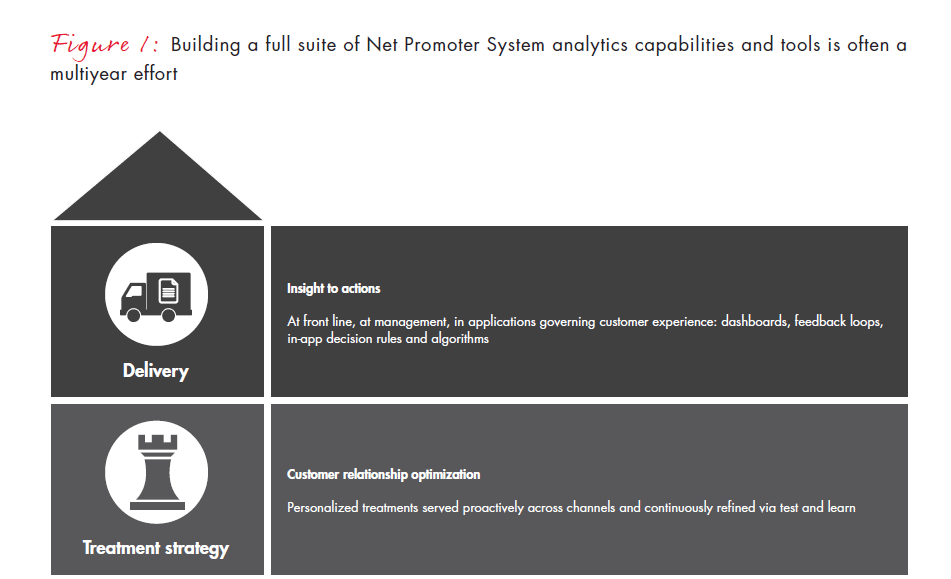
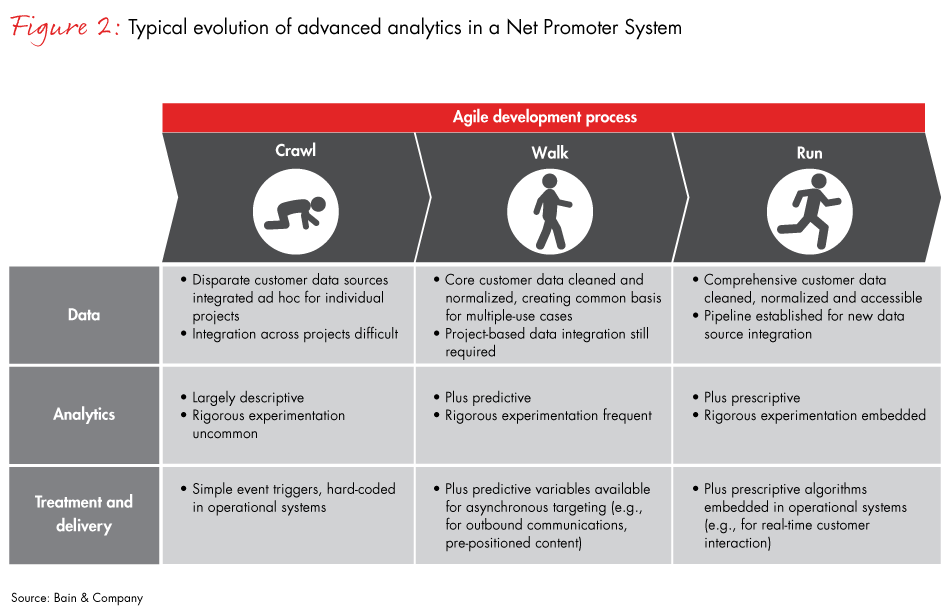
It takes time to build the sort of advanced analytics capability that provides a strategic advantage to a Net Promoter company (see Figure 1). The companies that take an evolutionary “crawl, walk, run” approach have made the most rapid progress. They iterate quickly around specific use cases so that they learn and reap the benefits as they grow. Individual use cases evolve and improve as the business experiments with and refines them, while a broader portfolio of use cases ensures that advanced analytics is yielding positive results. This not only helps demonstrate the value of advanced analytics, but defines successful new ways of working and highlights additional capabilities the company needs to develop. With each new step, new opportunities appear on the horizon, attracting further investment to reach them. Evolution is an iterative process.
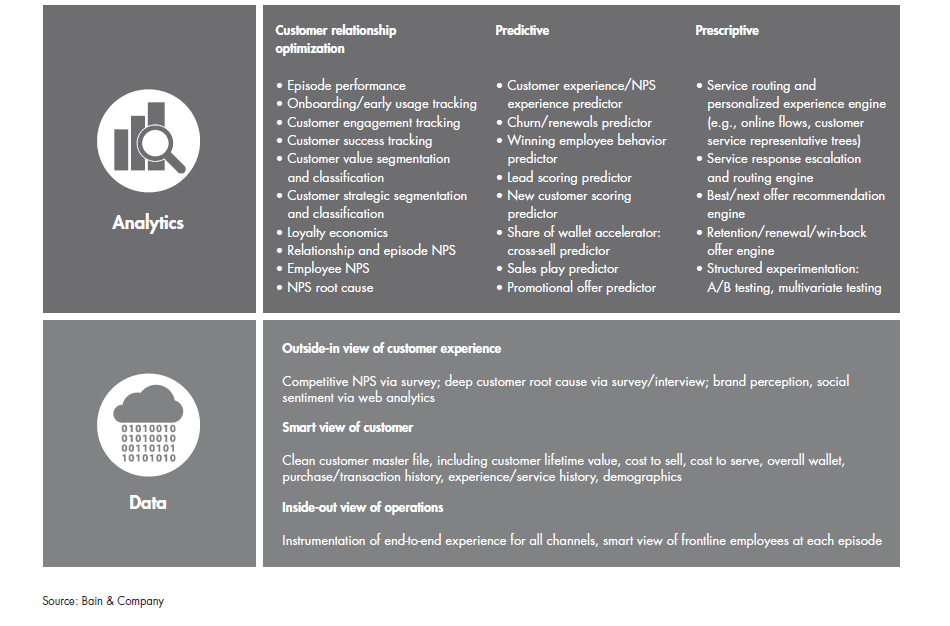
Customer-focused executives should ask themselves the following questions: Where are we on the evolutionary scale (see Figure 2)? How strong is our data foundation? What analytic use cases have we developed already? How are they manifested in our operations?
What resources and talent are working on all of this? Are they guided by a coherent strategy and roadmap?
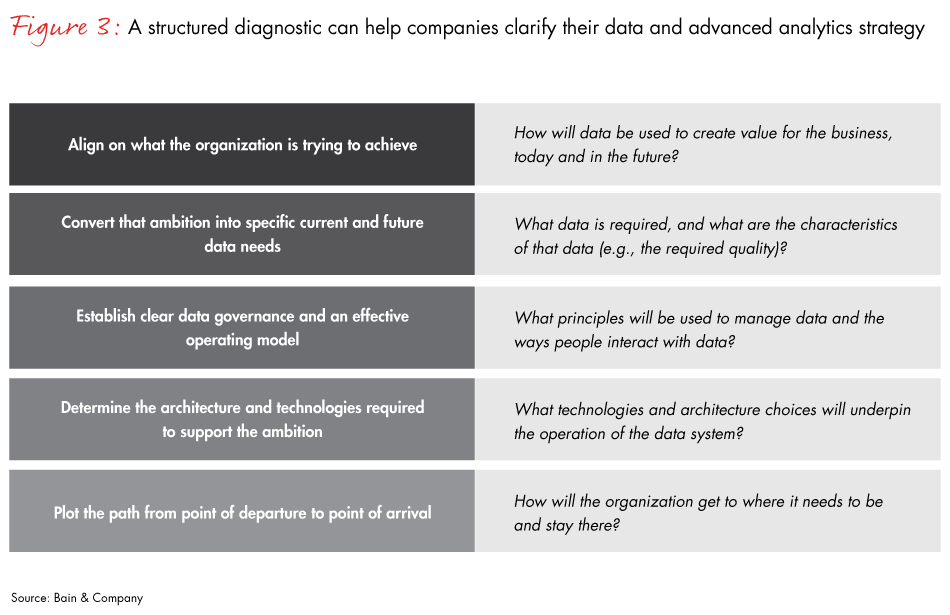
If the answers to these questions aren’t immediately apparent, then the right next step may be to establish more clarity, ideally via a structured analytics strategy diagnostic. The diagnostic should be informed by benchmarks and best practices, and should address the five key priorities for establishing a clear data and advanced analytics strategy (see Figure 3). This will expose key strengths and gaps in the company’s approach, and can help build the case to address the most important opportunities and obstacles to progress.
Achieving and sustaining loyalty leadership—be-coming a successful Net Promoter company—requires a multiyear journey to analytics leadership, so you’ll need to start sooner rather than later. It takes time to develop a strong foundation of data, analytics skills and capabilities to move from descriptive to predictive to prescriptive, and to reach scale learning and intimacy.
Rob Markey is a partner and director in Bain & Company’s New York office and leads the firm’s Global Customer Strategy & Marketing practice. He is coauthor of the best seller The Ultimate Question 2.0: How Net Promoter Companies Thrive in a Customer-Driven World. Tom Springer is coleader of Bain’s Advanced Analytics practice. He is based in Boston.
Net Promoter®, Net Promoter System®, Net Promoter Score® and NPS® are registered trademarks of Bain & Company, Inc., Fred Reichheld and Satmetrix Systems, Inc.
First published in julio 2017