

Brief

Executive Summary
- North America’s midstream industry faces fast-moving changes, as private equity aggressively targets the sector, as bottlenecks move from the wellhead to the water’s edge and as capital markets demand that companies fund their own growth while improving capital efficiency.
- Market leaders can take advantage of the moment to capture a greater share of growth, strengthening their hand through M&A and building relationships that will help them develop their export business.
- Small and midsize companies have more difficult decisions to make. Some will expand their footprint in important basins through organic investments or M&A. Others may see their best play in preparing to be acquired.
- Private equity firms will need to deliver against the premium prices many are paying for assets by improving their due diligence capabilities and developing strong deal theses that explain how they will create value.
North America’s midstream industry has prospered through a series of disruptions over the past decade. In the mid-2000s, midstream entered an “infrastructure supercycle” as shale production took off. The need for infrastructure across a broad set of basins led to a proliferation of midstream companies in a rising tide that lifted all boats. In 2016, oil and gas prices collapsed, but midstream was protected—at first—thanks to long-term contracts. Those contracts have begun to expire, however, leaving many companies struggling to deliver on growth promises.
Today, midstream faces its most critical moment yet. Key valuation metrics, such as adjusted enterprise value to EBITDA, are at 10-year lows as investors have left the sector. Three major trends are upending the industry, creating a complex set of strategic and financial questions for midstream executives.
- Private equity is changing the playing field. PE firms are participating in a number of different ways, including as project developers in direct competition with traditional midstream companies, as partners on large projects and as investors. PE transactions are happening with premiums as high as 20% above public valuations, leaving firms with a clear imperative to develop and execute strategic and operational plans that create more value—or face the consequences of middling returns.
- Export markets are opening. Production of oil, natural gas and natural gas liquids in North America has overwhelmed domestic demand. Midstream has a critical role to play in connecting this surplus supply to international markets, in China and across Asia, Europe and elsewhere. The industry has invested more than $350 billion in the last 10 years building pipelines and other critical infrastructure. As a result, the bottlenecks have shifted from the wellhead to the water’s edge. As North America’s abundant supply goes global, it brings midstream operators into contact with a new customer base, new competition and different business models.
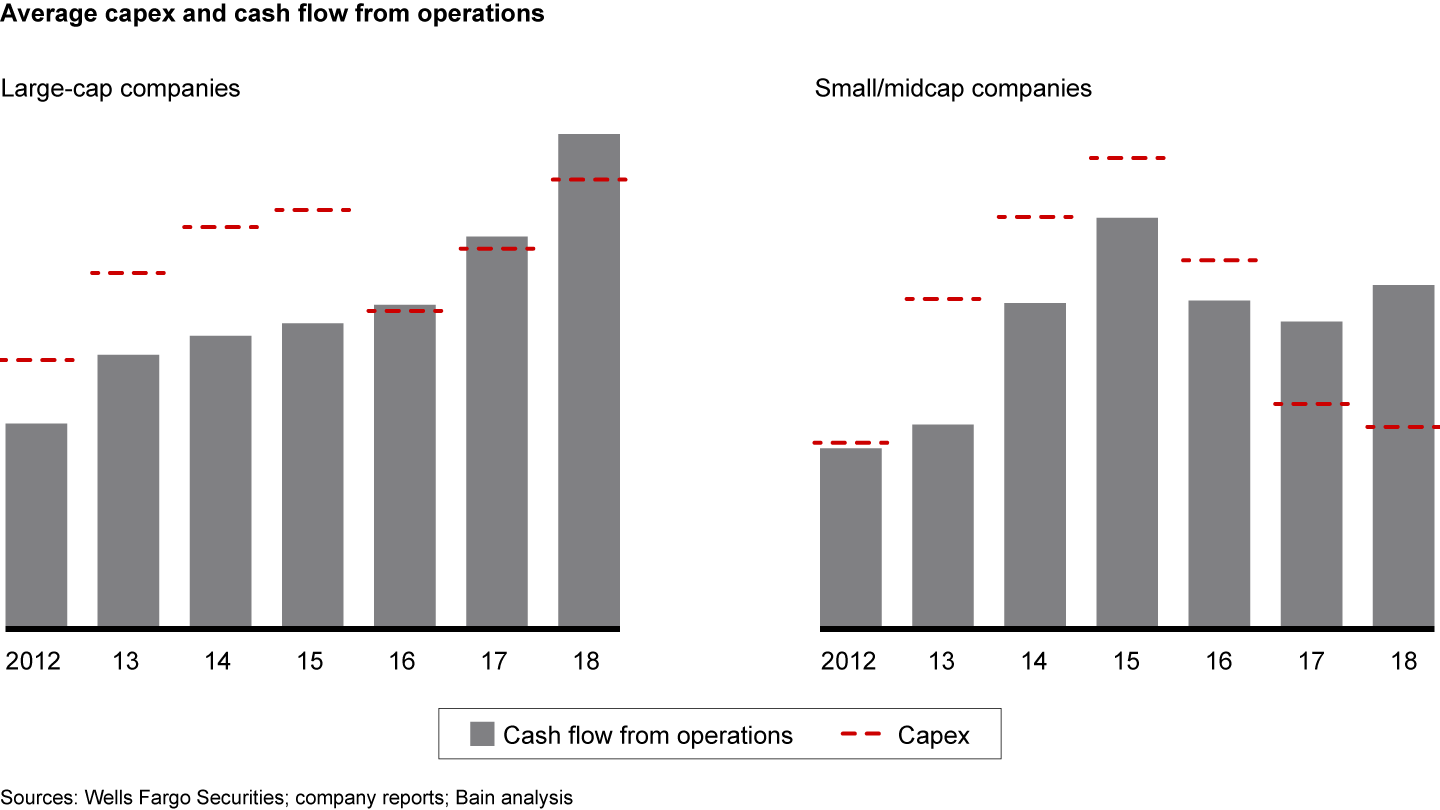
- Capital markets have dried up, requiring companies to fund their own growth. Midstream’s funding model has changed rapidly and significantly in recent years. Investors want companies to pivot away from a growth-at-all-costs mindset to one focused on capital efficiency and return on capital employed. North American midstream companies raised an average of $67 billion in debt and equity capital annually between 2012 and 2018, but we expect them to raise an average of only about $25 billion annually from those sources from 2019 through 2023 (see Figure 1). Because of this, midstream will need to fund much of its growth through operating cash flow. Most of the larger midstream companies have cash flows healthy enough to support their growth projects (see Figure 2). In fact, growth capex for this group hit an all-time high in 2018. That’s not the case for small and midsize companies, whose cash flows declined after 2015. Some have attractive growth potential but will struggle to fund projects with their own cash flows, which presents opportunities for larger companies and private equity to step in.
Figure 1
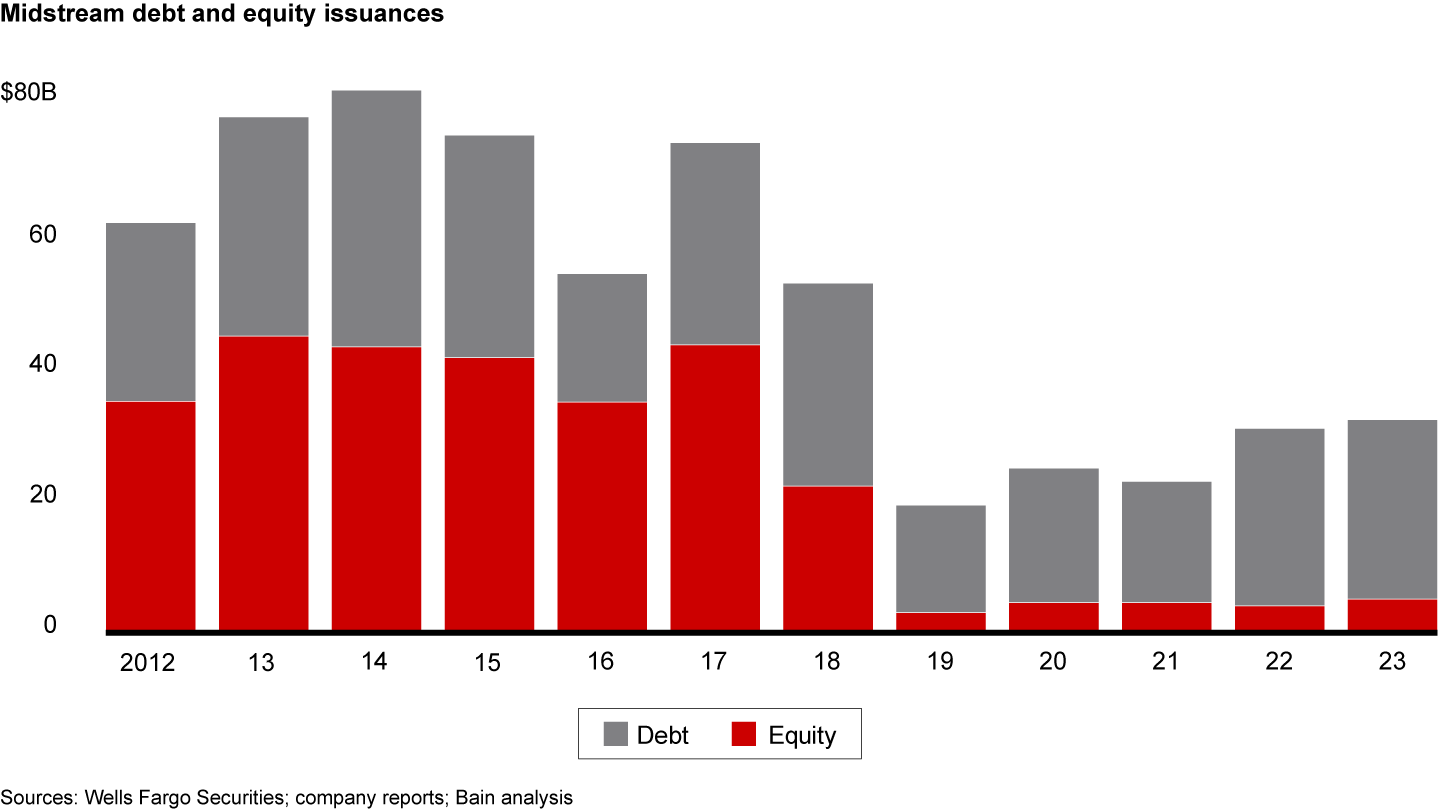

Figure 2

All three of these trends—the enlarged role of private equity, the export opportunity and the shift in funding models—indicate an inflection point for North America’s midstream companies. We believe the opportunities and risks are great enough that they are likely to reshuffle the leaderboard for North American midstream over the next three to five years.
Strategic implications for three groups of companies
To take advantage of the current dynamics, companies should begin with a realistic assessment of their strategic and financial starting positions. Bain & Company’s analysis of about 50 midstream companies suggests that firms are loosely grouped into three distinct categories, each with specific opportunities and implications for success (see Figure 3).
Figure 3
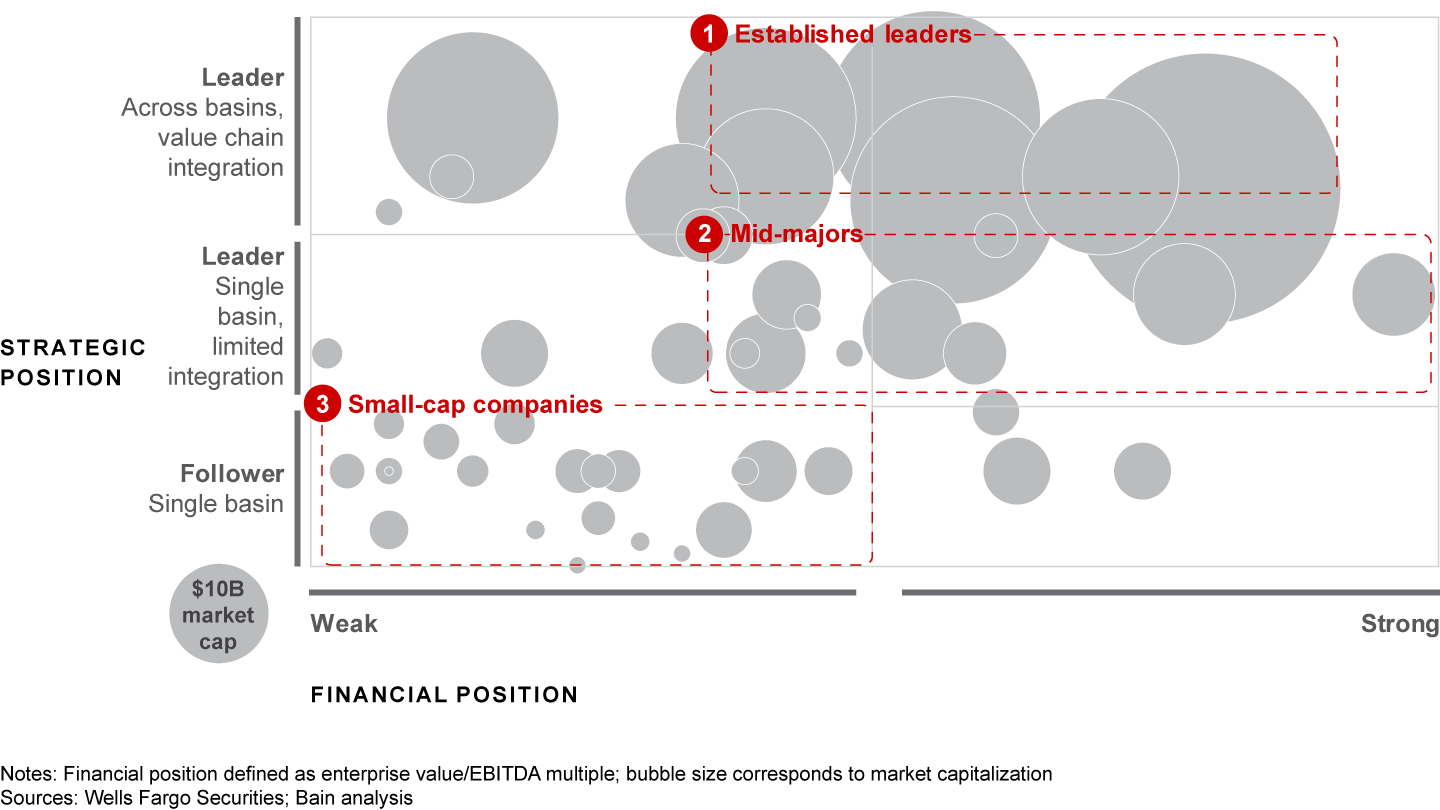

Established leaders should be playing offense. These companies have strong financial and strategic positions. They are leaders in multiple basins and are vertically integrated across much of the midstream value chain. As such, they are well positioned to take advantage of a range of opportunities. For instance, they might:
- Leverage their existing footprint to win a disproportionate share of growth opportunities
- Proactively pursue M&A, either scale deals (for example, extending basin leadership) or scope deals (adding new business lines, diversifying basins)
- Define a participation model to capitalize on the growth of exports, through directly participating at scale, participating as an equity partner, providing “last mile” infrastructure or other models
- Use their integrated value chains and access to multiple markets to capture pricing arbitrage opportunities between trading hubs (either domestic hubs, or US vs. international hubs)
Mid-majors should take the opportunity to redefine themselves. Many of these companies have most of their assets in a single basin and face the risk of producers moving out of that basin—for example, to the Permian. Most don’t have fully integrated positions. Growth will become more challenging even in their core basins, as established leaders will be better able to deliver a vertically integrated solution to customers with access to multiple markets. We believe there are several strategic imperatives for this group:
- Redefine the business around a defensible core, shedding noncore assets with limited growth potential.
- Be disciplined but bold with M&A, as the right set of moves will allow this group to move up the leaderboard. Companies should consider a combination of tuck-ins that expand the scope of their position (that is, acquiring oil-gathering assets to complement natural gas–gathering assets) and select transformational moves that reposition the organization. Both types of M&A allow companies to extend their leadership positions in high-growth basins, develop a more integrated value chain or diversify into other basins.
- Pursue a sustained cost transformation to fund the growth strategy.
Small-cap companies should consider merging or selling. More than 20 publicly traded midstream companies seem unlikely to continue as independent entities. These companies are not large enough to have a role in institutional investors’ portfolios, and they will be challenged to win new business at attractive returns on capital, even more so than the mid-majors. These companies face the risk of a decline in underlying volumes, which would lead to smaller margins, distribution cuts and lower shareholder returns. Some of these companies will prepare to be acquired by firms that may be a more natural parent. Others may pursue mergers of equals, seeking to develop greater scale and a stronger financial position, and perhaps using private equity funding to finance the transactions. In some cases, they may also acquire assets from private equity firms.
Strengthening your hand
No matter the business model chosen, midstream companies need to build several capabilities to ensure success.
- Develop market intelligence that gets you to the bottleneck first. Midstream companies need to dial up their ability to see around corners, spotting opportunities before they are well formed and then having the conviction to make investments. Forecasting is both art and science, and while outright prediction is usually a fool’s errand, there are ways to improve your odds of success. Some midstream companies are creating market intelligence teams with diverse capabilities, including geologists and reservoir engineers who model upstream conditions, experts from petrochem and utilities who understand downstream markets, and economists. These cross-functional teams combine their market intelligence with feedback that business development teams receive from upstream and downstream customers, in the US and abroad. Being the first to a bottleneck means stepping into the unknown, but with good market intelligence, companies can do so confidently.
- Invest in next-generation capabilities. Many companies are starting to use zero-based budgeting to reach the next level of efficiency and productivity. Some invest a portion of those savings to build next-generation capabilities, creating the midstream “firm of the future.” One midstream company not only reduced costs by more than 30% across multiple functions, but also identified certain capabilities where it needed to redeploy some of those savings and invest to become best in class. Those areas included market intelligence, a centralized major project development team, a marketing function that capitalized on price differences between hubs and a central digital team.
- Create a true strategy that charts a path for growth beyond the next two years. Many midstream companies’ strategies today are the outcome of decisions on individual projects. This project-by-project approach worked well when there was an abundance of growth opportunities, but a different tack is needed today. Defining the desired portfolio in three years provides clarity on where to invest now. Executives can then evaluate projects based on integrated system economics, rather than considering only asset-level returns.
Finally, investments in digital technologies and advanced analytics can support all of these capabilities. Digital technologies—from inspection drones to handheld apps—combined with advanced analytic techniques can reduce costs and deliver richer insights. (For more on digital transformations, read the Bain Brief “How Digital Improves Management Systems in Oil and Gas.”)
How private equity firms can create value in midstream
Private equity firms are investing heavily in midstream, with $34 billion of transactions in the first five months of 2019. Given the premiums that private equity firms are paying, they will need to develop compelling deal theses and post-acquisition strategic and operational plans in order to continue delivering outsize returns. To thrive in this increasingly difficult environment, PE teams need to get three things right.
Decide how to participate in midstream. We see several fund strategies being deployed today:
- Project developer. Companies that deploy this model are adept at identifying bottlenecks before others do, and they act quickly on those opportunities. They also have capable management and creative commercial teams that put together unique business models. In recent years, PE firms pursued gathering and processing deals in the Permian and other basins. Going forward, we see opportunities in exports (particularly ethane), storage and consolidation in slower-growth basins.
- Project investor/JV partner. Dozens of small and midsize midstream companies are struggling to repair their balance sheets and fund projects that generate value. Private equity has a role to play in providing capital to the most attractive firms and projects.
- Public investor (partial or whole ownership). Several PE firms are investing in minority positions of publicly traded companies. Others pursue leveraged buyouts of undervalued public companies—as with IFM Investors’ $10 billion deal to take Buckeye Partners private. Bain’s analysis identifies more than a dozen publicly traded midstream companies that may be good candidates for this type of transaction, based on their robust growth, noncore assets and value dislocation—the discrepancy between price and value.
- Enabler of industry consolidation. Since the public equity and debt markets have pulled away from the midstream sector, private equity could play a significant role in financing the consolidation that we expect to see.
Raise your due diligence game. Bain’s research finds that the root cause of difficulty in most deals is the failure of strategic, operational and financial due diligence to highlight critical issues. Many PE firms do sufficient financial diligence but underinvest in the other two areas. Rigorous strategic diligence examines the underlying volume outlook in a company’s footprint as well as the target’s positioning to capture that growth—and how this compares with its peers’ positioning. Acquirers also need to understand the duration of current contracts, and whether they are likely to be revised if prices rise or fall. Another key element is defining the future portfolio, assessing which assets are core vs. noncore and weighing opportunities to expand the company’s participation in the value chain. Finally, operational diligence determines the condition of assets as well as opportunities to improve on current performance, such as in procurement, optimizing maintenance planning, improving plant utilization, and executing better on time and budget.
Develop a plan to generate value above the premium paid. Private equity firms that realize the highest returns develop a value-creation playbook, based on the findings of the due diligence, before the deal closes, so that they can put it into action on day one. PE firms see an opportunity today because of low valuations, but many are not investing enough in the value-creation blueprint that will ensure their targets deliver on the investments.
North America’s midstream sector is likely to look very different five years from now, with fewer small players competing in single basins and with more volume selling to markets across Asia, Europe and elsewhere. The moves that executives make today, in midstream companies and in the private equity firms with interests in them, will determine who will continue to prosper and who may need to exit the game.
Whit Keuer, Ethan Phillips and Luis Uriza are partners with Bain & Company’s Global Oil & Gas practice, which Luis leads in the Americas. They are based in Dallas, Houston and Bogotá, respectively.

How Digital Improves Management Systems in Oil and Gas
Mobile apps and data analytics are transforming management systems into real-time tools for sharing best practices and ensuring compliance.
First published in agosto 2019