

Brief
Singapore’s nonprofit sector is growing up as nonprofit organizations (NPOs) gradually evolve away from their reliance on public funds and fill a critical gap, providing education, social services and healthcare to an increasing number of citizens.
As they mature and become more independent, NPOs also gain a better understanding of the roadblocks that keep them from having a greater impact. A fundamental issue: The practices of making charitable donations and volunteering are still relatively novel to many in Singapore. Nonprofits have found that it requires nothing less than a major cultural shift for corporations and individuals to view themselves as part of a nation of givers willing to share their time and resources with those who are less fortunate.
The prize is within reach. If NPOs establish more partnerships with Singapore’s highly trained corporate community, the nation will have a unique opportunity to cultivate a world-class nonprofit sector. But success depends on NPOs recruiting and accepting help from the private sector—and on professionals stepping up.
In 2014, Bain & Company, in collaboration with the Centre for Non-Profit Leadership (CNPL), conducted its second survey of Singapore’s NPOs: where they stand, how they view themselves and what they see as their challenges. In addition to surveying NPO leaders, we conducted dozens of interviews with them. Our report provides valuable insights into the state of NPOs and the best strategies to unlock their full power.
Four years after our initial 2010 survey, we found that NPOs have made strides in key areas. But three major challenges jeopardize the sector’s expansion: attracting the talent required to sustain expansion goals, tackling a leadership crunch resulting from uneven management and board succession processes, and addressing the insufficient disclosure and transparency about an organization and its impact that undermine private-sector confidence and contributions.
A giving nation taking root
In recent years, Singapore has seen a steady increase in its number of NPOs along with the donations and volunteers needed to support them (see below):
- Singapore now has nearly 600 Institutions of a Public Character (IPC), which are NPO-approved to receive tax-deductible donations.
- Volunteer rates have increased. While only 9% of Singaporeans volunteered in 2000, the rate has increased to 20%–30% in the past few years.
- They also are giving more. SG Gives, Singapore’s largest donation portal, saw a 30% surge in total donations to S$11 million in 2013, with the number of donors increasing by 33%, from 8,087 to 10,714.
Still, our analysis of Singapore’s nonprofit sector identified crucial areas that limit the role and effectiveness of organizations:
Private-sector participation is relatively untapped. Even though the rate of volunteerism and donations has increased over the past decade, individual and corporate support significantly lags international benchmarks. Singapore ranks 64th on the World Giving Index. High-net-worth individuals are a potentially large source of giving, and the private sector is relatively untapped for both donations and pro bono work.
A few large charities dominate fundraising. These few accounted for 85% of total receipts in 2013, according to the Commissioner of Charities.
Nonprofits need leaders. The growth in volunteerism and donations hasn’t been matched by an equal rise in the number of talented individuals available to serve as NPO executive directors or board members. Two benchmarks illustrate the gap between Singapore and countries with well-established nonprofit sectors. Nonprofits’ paid workers make up only about 2% of the nation’s total workforce, compared with 7.7% in the US and 8.5% in Australia.¹ And the number of hours donated still trails volunteer hours in Australia and the US. These benchmarks illustrate that there’s not enough exposure or activity by enough people, a situation that negatively affects Singapore’s success in producing well-qualified leaders.
Unless NPOs address these issues proactively, they will fail to reach their full potential, limiting their capacity to provide a safety net for those in need.
How NPO leaders rate themselves
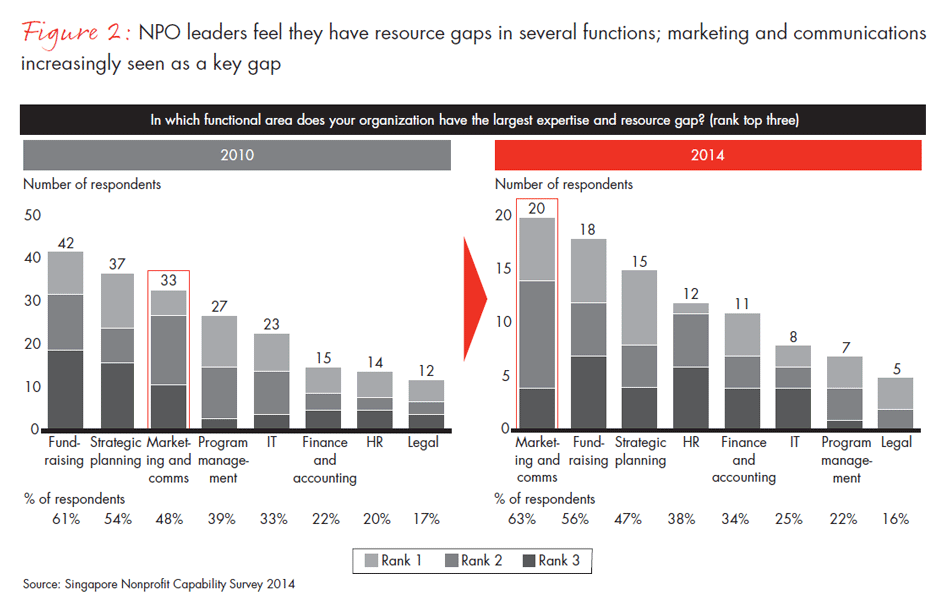
Our survey and interviews with NPO leaders helped us determine how they view their own performance, the strength of their capabilities, the challenges before them, and how their organizations are evolving (see figures). Compared with 2010 survey results, our most recent survey shows that Singapore’s NPO leaders have gained confidence. They give themselves higher marks on a range of performance indicators..
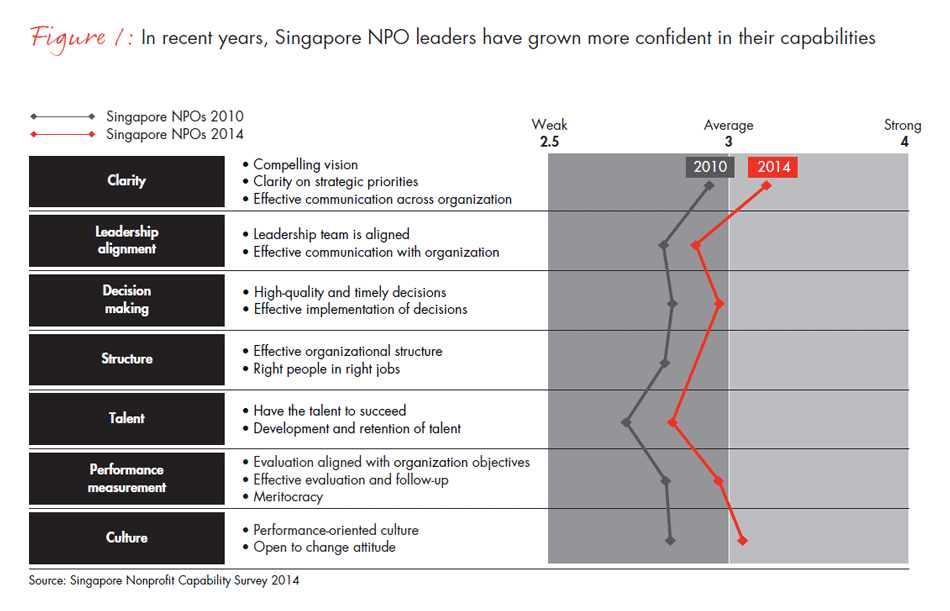
Most of the nation’s NPO executives feel that they are developing a clear, compelling vision and making quality, timely decisions, with strong implementation. For example, when asked if they translated their strategic priorities into specific initiatives with clear milestones and clear accountabilities, 91% of the respondents agreed they do. And they rated themselves above average—3.2 on a scale of 3.5—in their decision-making capabilities.
They also are creating a more effective organizational structure and are putting the right people in the right jobs. In increasing numbers, they are more adept at measuring their performance and continually improving. Among the methods they use: aligning evaluations with the organization’s objectives and providing more effective follow-up.
One major sign that the nonprofit sector is coming into its own is that NPO leaders are increasingly aware of where they fall short and are devising ways to improve. Based on our survey, three key areas dominate their concerns: attracting talent, enabling leadership succession and improving disclosure and transparency. Tackling these issues means moving away from practices that are artifacts of the traditional model, in which nonprofits largely served as government contractors relying heavily on public support. Developing a more independent nonprofit sector comes with many challenges. But evidence shows that as long as organizations are seen as having strong links to the government, they’ll continue to face hurdles in such areas as attracting top talent.
Just as they recognize these challenges, the best of Singapore’s nonprofits have developed ways to overcome them. Let’s look at each challenge, one by one, and the strategies for success some leading NPOs have implemented.
Challenge: Attract quality talent below the executive-director level. More than one-third (34%) say they still struggle to recruit new blood in a vibrant job market. Among the biggest reasons: They must compete with rising salaries in both the private and nonprofit sectors and, despite the need to maintain lean organizations, must offer the appropriate careerdevelopment opportunities to show recruits how they could advance in nonprofits.
Best practice: Implement an integrated strategy to both attract and retain talent. The most effective NPOs offer strong training and career development, build a collaborative and cohesive culture and take full advantage of the organization’s mission to instill passion in job candidates.
For example, Boys’ Town invests heavily in staff training and skill development. The organization offers candidates several incentives to join the staff: On-the-job training helps new hires become certified social workers, and a company-wide training plan enables staff to reach their career goals. As a result, Boys’ Town has achieved robust growth in donations, allowing it to help more youths in need.
Challenge: Develop a leadership succession plan at the senior-management and board levels. When asked if their organization has an effective succession process for leadership positions, half of respondents readily admit it doesn’t. Most boards are dominated by individuals recommended for the job by other members. Board members also have long tenures, staying for an average of five and a half years, according to a survey by Credit Suisse, CNPL and the National University of Singapore Business School. Both factors contribute to an absence of fresh points of view and a lack of critical board-level skills in such areas as fundraising, branding and social work.
Best practice: Adopt a structured approach to board and leadership succession and revitalization. NPOs can address the leadership crunch by proactively planning board renewal and utilizing broader networks to recruit new board members. They also can enhance the board assessment process with a professional, independent assessment of board performance.
The Persatuan Pemudi Islam Singapura, also known as the Singapore Muslim Women’s Association, excels at boosting public confidence. It used grants from the Voluntary Welfare Organisations-Charities Capability Fund to conduct an online board-assessment survey and found that greater transparency in the evaluation process has made it easier to recruit and retain board members.
Challenge: Make financial information and donor impact transparent. Only 48% of nonprofits surveyed by Credit Suisse, CNPL and the NUS Business School make their financial statements or annual reports publicly available.
A lack of confidence in the effective use of contributions and the unavailability of financial reports undermines NPOs’ abilities to raise private funding. Accountability and transparency are essential to enhancing the relationships among NPOs, donors and volunteers.
Best practice: Commit to providing credible, readily available information. To strengthen donor confidence, NPOs need to institute widely accepted corporate governance policies. That means regularly updating donors with well-documented information about their contributions, the impact of those contributions and the organization’s progress. It’s also critical to shore up support for an NPO’s leadership team by disclosing the team’s backgrounds and qualifications. The same survey found that fewer than 40% of NPOs make such information available.
Both the Children’s Cancer Foundation (CCF) and Food from the Heart routinely communicate with their donors and disclose financial information. For example, at CCF, fundraising partners are regularly informed about fundraising policies, and the nonprofit is fully accountable to all its donors with its strong level of corporate governance and financial management. These have helped boost donor confidence.
Similarly, it’s longstanding commitment to transparency has enabled Food from the Heart to boost its fundraising as well as recruit more volunteers, advances that have resulted in increased food distribution for Singapore’s less fortunate. An annual summary of activities and independent audit, detailed in its annual reports, ensure both reliable financial accounting and documentation for tax deductions, all of which build trust with it’s large, diverse and growing group of donors and partners.
Conclusion: Creating a community for NPOs
Singapore’s NPOs are bracing for a boom in demand for their services. Economists caution that the rapidly aging labor force threatens to dramatically slow the country’s economic growth over the next two decades, leaving Singapore’s NPOs with an even more urgent role to play.
Building strong leaders capable of advancing organizations to the next level of professionalism, so that they can meet this coming boom, is a critical priority for Singapore’s nonprofits. That means nonprofits must develop leaders who can deliver a reliable succession plan, attract highly skilled talent, inspire donor confidence through improved accountability and transparency and ensure that their organizations are prepared to meet the many other challenges that stem from the growing demand for NPO services.
With one of the world’s most highly trained workforces, Singapore’s private sector offers a ready pool of talent that’s more than capable of helping NPO boards grow the leadership skills required to evolve and scale up.
To close the leadership gap, NPOs will need to recruit a thriving community of advisers from the private sector. They also will need to induce the best and brightest from Singapore’s corporate community to work for nonprofits—and develop a systematic approach to helping them make the transition. Whether they serve as advisers or as members of the leadership team, their contributions will prove invaluable in making NPOs more professional. They can inspire fresh ideas, create an environment that helps attract top talent and develop new approaches to everything from decision making to funding to the use of social media.
When Singapore’s nonprofit community mirrors the expertise and sophistication of its world-class private sector, it will be prepared to meet any challenge—and unleash nonprofits’ full power.
Why the nonprofit sector is growing
Three trends are fueling demand for nonprofit help. People in Singapore are growing older, and the needs of this aging population outstrip services. The socioeconomic divide also is deepening— more low-income households require support to bridge a looming income gap. In fact, among the world’s advanced economies, Singapore faces one of the highest levels of income inequality. Its Gini coefficient (a measure of the degree of inequality within a country, where zero is complete equality and one is maximum inequality) rose to 0.463 in 2013. Finally, people’s attitude toward giving is changing—a civil society is emerging. The spike in volunteering and increased donations reflects a growing awareness of community needs. The government has helped promote giving by making IPC contributions tax-deductible.
1 The source of Singapore data is Bain & Company analysis. The source of US and Australia data is “The State of Global Civil Society and Volunteering,” Lester M. Salamon, S. Wojciech Sokolowski, Megan A. Haddock, Helen S. Tice, Johns Hopkins University, March 2013.
Sebastien Lamy is a partner in Bain & Company’s Singapore office and a member of the board of the Centre for Non-Profit Leadership. Usman Akhtar, a partner in Bain & Company’s Jakarta office, leads the company’s Social Impact practice in Southeast Asia.
First published in enero 2015