

Brief

Executive Summary
- Most companies understand the importance of nurturing investor relationships. Yet relatively few have a process in place for systematically soliciting investor feedback and linking it to strategy.
- When Nikon put in place such a system as part of its investor relationship management, it became a secret weapon for turning the company around.
- At one point Nikon’s stock had fallen below liquidation value; investor relationship management helped shape a highly successful transformation that delivered a 35% boost in the company’s stock price in its first year.
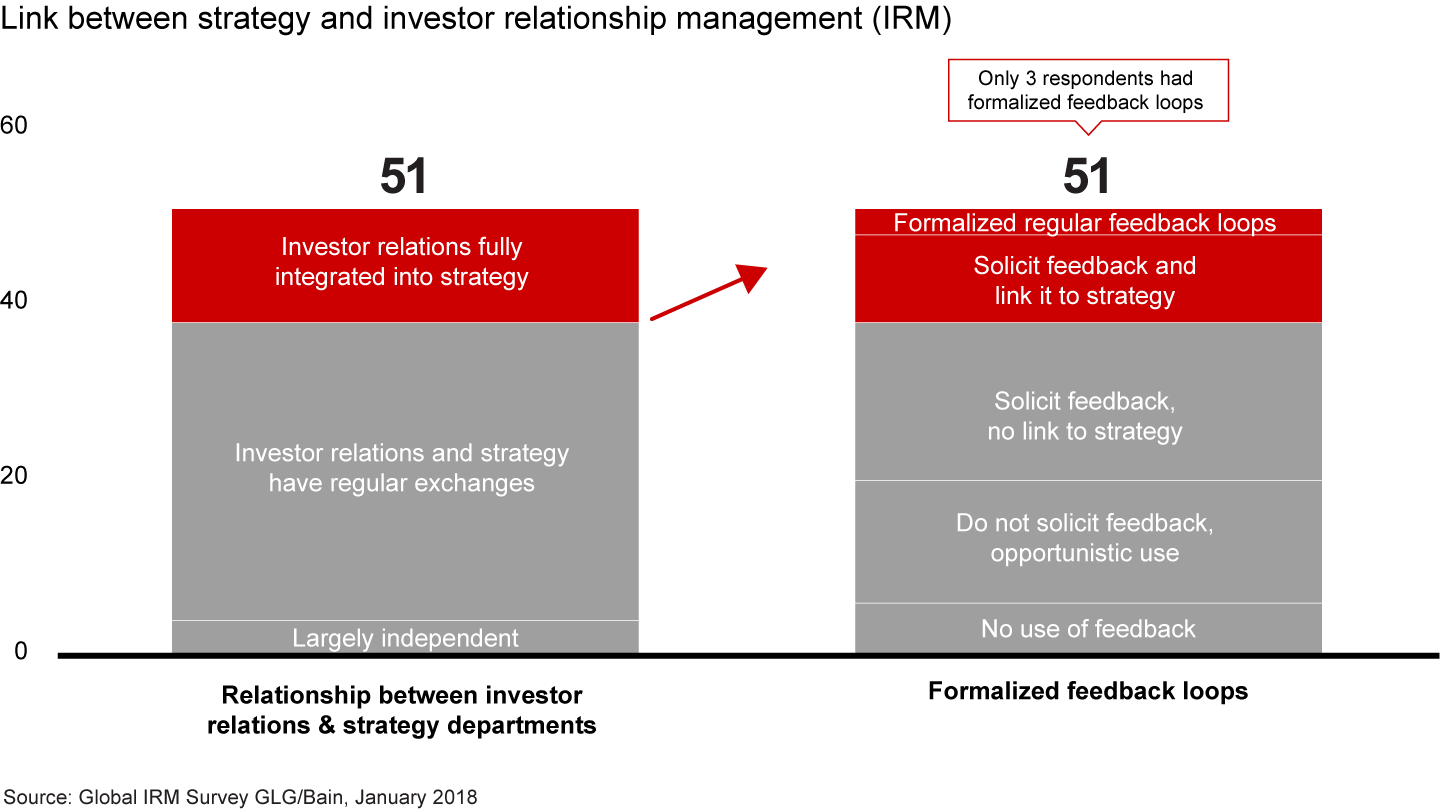
It seems like a natural course of action for companies proactively to seek advice from their most important investors. A company’s key investors are smart, industry-savvy and capable of providing invaluable feedback on the corporate agenda—something that’s sorely needed in the era of digital disruption. Yet, surprisingly few companies have put in place a system of inviting input from targeted investors as part of a two-way dialogue aimed at improving decision making, strategy and performance. When Bain & Company recently surveyed 51 top executives in America, Europe and Asia about their investor relationship management practices, we learned that while most of them communicate at least monthly with investors, participate in one-on-one meetings with key investors and are segmenting their investor base for differentiated emphasis in communications, only 6% of the companies have a formal structure in place to link investor relations with strategy and best utilize investor feedback (see Figures 1 and 2 ). This at a time when 30% say they are affected by investor activism and more than half see investor relationship management as a means of increasing their stock price.
Figure 1
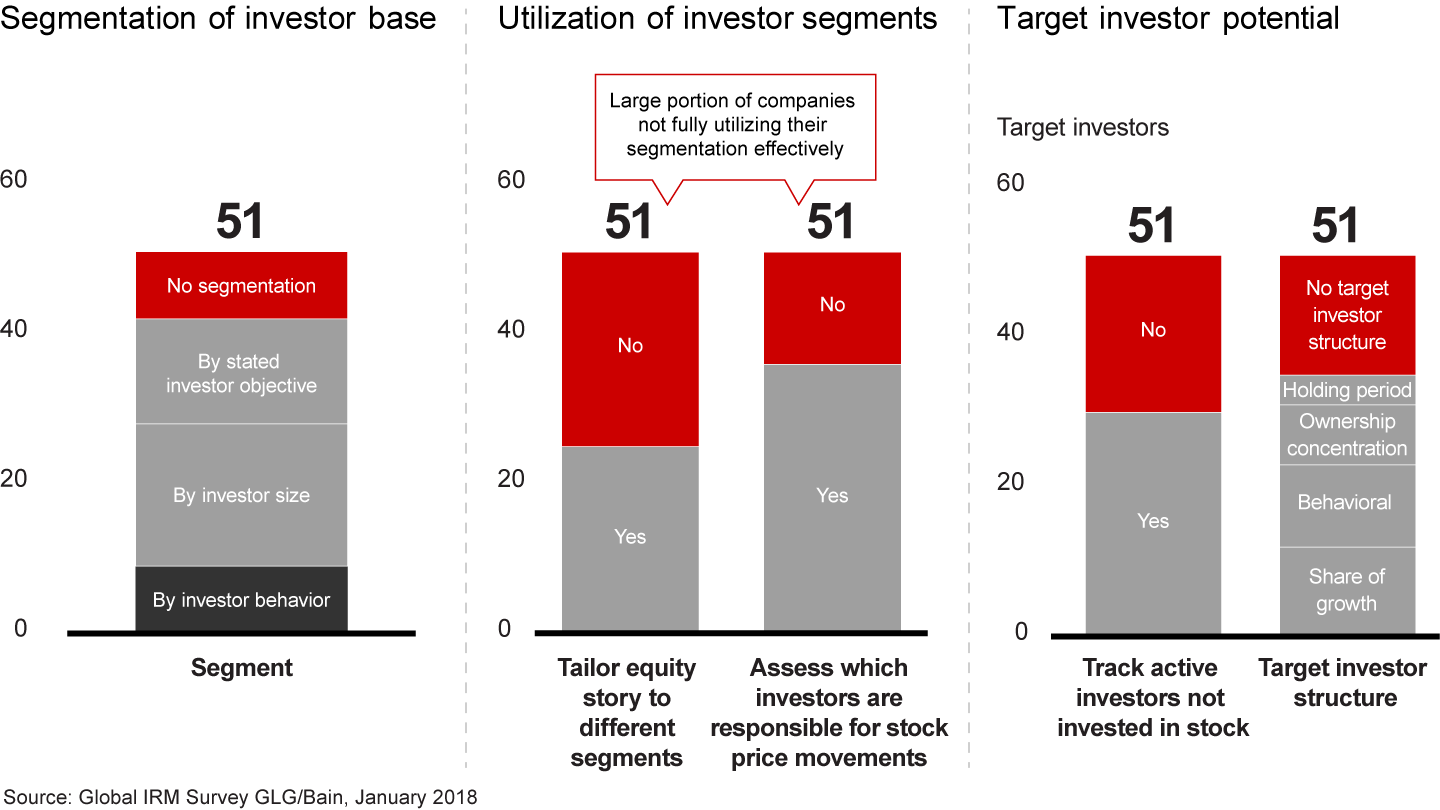

Figure 2

However, one struggling company turned to investor relationship management to regain solid footing for the digital era. Its experience provides a lesson to any company plotting a future amid uncertainty.
Nikon may be one of the world’s most enduring brands, but in 2016 it faced a crisis that threatened its existence. The century-old company whose name is synonymous with high-quality photography watched its core business steadily lose ground in the digital era. The rise of smartphones seemed to have made the company less relevant: Its revenues were at almost the same level they had been a full decade earlier. They had surged with the rise of digital cameras only to peak in 2012, coming back down as smartphones became widely used. Nikon watched its profits sink, and its stock price at one point fell below liquidation value. Then a new CFO joined the company: Masashi Oka, a financial industry veteran who played a key role in transforming Mitsubishi UFJ Financial Group–owned Union Bank in the US. Oka had found feedback from US regulators very helpful in his efforts to revive Union Bank and saw an opportunity to do something similar at Nikon.
Instead of working closely with regulators, this time Oka suggested that the company make the bold move of pursuing help from its investors. The rationale: Investors would be a resource that could provide invaluable insights into what Nikon was doing wrong and how it could shape a transformation. Large institutional investors have brainpower, proprietary analysis, access to competitors and a sharp focus on money. In personal meetings and interviews, Nikon’s largest current and former investors gave their reasons for buying, holding or selling the company’s stock and answered fundamental questions about their view of management. The response was like a cold shower. For example, the company had issued this brief statement to accompany disappointing quarterly performance, which sounded eerily like the predictions made by Kodak a generation earlier: “We believe that the market contraction will bottom out soon and our profits will improve.” Then a major former investor was asked to provide feedback. What did the investor really think? “Management is delusional about their long-term prospects,” said the investor, adding, “Every time we meet it truly shocks me how far behind Nikon’s business is and how slow they have been to grasp the trends of the industry.”
It was the first big step in a dramatic turnaround.
Most companies see investor relations as a one-way street, usually focusing on communicating their view of intrinsic value and limiting their efforts to the perfunctory sharing of quarterly or annual corporate performance. They approach investor relations like a marketing pitch; in fact, it is the PR department that often performs the function. Nikon saw the opportunity to turn investor relations on its head by using regular meetings with top-class investors as something akin to due diligence. The company created a well-planned process for soliciting feedback from targeted investors and ensuring that the feedback made its way back to the executive suite for analysis and action. Investor relations needed to move from the PR department to the CEO agenda.
In an age of increasing investor activism, this sounds like a simple arrangement that could benefit any company by bridging the gap between management and investors. It also could help mitigate the different types of bias that hurt management decisions, everything from confirmation bias that blinds them to opposing information, or emotional bias and overconfidence that impede logical decision making. Investors can more objectively provide opposing views to strategy and key assumptions.
At Nikon, investor feedback helped convince CEO Kazuo Ushida, a 40-year veteran of Nikon’s technology businesses, that the company needed to revisit its dialogue with investors. It also helped identify the critical issues to address.
The first move was to segment Nikon’s investors based on their overall attractiveness to its investor portfolio. Companies often only consider how attractive their company is to investors but fail to weigh how beneficial an investor is to their shareholder portfolio. The right investor base can improve stock price, reduce volatility and provide valuable feedback.
Nikon was able to analyze investors’ trading behavior to segment actual and potential investors according to investment period, industry focus (and understanding) and the degree of investment diversification. In this way, Nikon could identify which investors it should target and cultivate. Segmenting also set the stage for targeting communications. While companies are required to share the same materials with all investors, they can emphasize the elements that will be most relevant to particular investor segments—highlighting stable cash flow for pension funds or exposure to mega trends spurring market growth, for example. For its part, Nikon focused on cost optimization opportunities and balance sheet management when communicating to value-oriented investors and on long-term structural changes when communicating to growth-oriented investors.
The most important benefit of segmenting, however, was that it allowed the company systematically to identify those investors that would be most important for providing valuable feedback. Thanks to the analysis, Nikon could identify and then interview past investors to understand the reasons they had purchased and then sold their Nikon shares. Nikon could then follow up by asking what would persuade the investor to repurchase.
Nikon interviewed targeted past investors to identify the sources of distrust, the reasons for purchasing shares and the reason for selling. Nikon asked about the conditions that would convince a former major institutional investor to repurchase, and was told: “Nikon needs to be bold and give investors hope that changes are coming. It is a steep mountain to climb with how much their products have trailed the market.” To make such sentiments actionable, the company established a feedback loop for routinely funneling investor input to management and then sharing relevant information back to investors and, perhaps more important, to those potentially critical former investors.
The uninhibited and unbiased views from its first round of investor interviews created a burning platform for change. Nikon’s three-year plan took an optimistic view of the market and assumed that the company could grow each of its businesses, despite the fact that some of its core businesses were in decline. Nikon’s semiconductor lithography business had been unable to break even for years, for example, and the imaging products market was contracting faster than anticipated. Investor feedback convinced the company of the need for a bold restructuring plan that would both improve its capability to generate profits and rewire its management DNA.
Directly influenced by investor input, the restructuring plan would carry a onetime cost of ¥48 billion ($430 million) but generate ¥20 billion ($180 million) in annual savings. The plan involved reforming Nikon’s struggling semiconductor lithography and imaging products units, both potentially high-value-added businesses, by cutting fixed costs, reducing SKUs and focusing on high-value-added product lines. It also called for streamlining headquarters and cutting executive management’s compensation. Nikon would reduce the number of directors and officers.
Simultaneously, Nikon would shift to portfolio-based management, redefining the role of each business in its portfolio—beyond semiconductor lithography and imaging products—to optimize resource allocation. It would implement targets linked to shareholder value, relying on such metrics as return on equity and return on invested capital. It would enhance its governance structure, improving transparency in leadership appointment, adding more diversity to the board and installing a more effective system for evaluating executive management performance.
After announcing this program, the company reached out to 30 current and past investors to elicit feedback on the plan. Some investors signaled that although the plan was a step in the right direction it did not go far enough. Commented one: “I’ve seen many transformations, but if the market is shrinking at 10% you really need to cut costs at a faster rate to maintain your margin. I assumed you had some further cost reduction up your sleeve.” Nikon took note and committed to reducing costs at a rate exceeding market contraction.
Six months later, the prospects looked brighter. In a strategy that essentially was co-created with investors, the company was reducing costs at a rate exceeding the market contraction. Again, it was time to check in with investors. The responses, like Nikon’s fortunes, had reversed course. The very same former major investor who had previously described Nikon’s management as “delusional” had now changed its tune. “I am very impressed with the bold actions you have taken thus far, and I look forward to monitoring your progress from here. It sounds like Nikon will be a very different company five years from now—at a minimum a much more profitable one.”
Wilhelm Schmundt, a partner in Bain's Corporate Finance practice, outlines four ways that companies can unlock the full potential of investors.
Nikon’s approach to targeting and appealing to the right investors and relying on them to unlock hidden value paid off well. The restructuring enabled the company’s semiconductor lithography business to break even, strengthened the profit structure of its imaging products business and convinced investors that it was solidly enhancing its management DNA. In fact, one full year into its transformation Nikon’s stock price had risen by 35%. Perhaps more important for the long term, it helped the company elevate the importance of investor relations. What the company once viewed as a routine function now was acknowledged as a gold mine in its midst. With its restructuring successfully completed, strategy making at Nikon now has become a process of cocreation with investors. It is a core part of the CFO’s work: Last year Oka personally met with 145 investors and his investor relations team collectively met with more than 500. Those investors are helping chart the company’s journey into its second century.
Four steps to unlocking the value of investors
-
Understand what is causing the gap between current valuation and intrinsic value. Invest to determine the causes. Is there a lack of intrinsic value creation or differences in perceived industry comps? Are you focusing on the wrong investors for your equity story or using the wrong investor metrics and messages?
- Build the right investor mix. Conduct detailed “behavior-based” analysis of your investor base (and the industry’s investors) to understand who moves the stock price and why they buy. Compare your findings with the equity story to understand their willingness to buy in the future. Create a list of target investors that are likely to buy.
- Create a two-way dialogue. Capture and aggregate feedback from your investors to redefine your equity story and strategy. Regularly collect feedback from investors, comparing their input with the company’s internal messaging.
- Institutionalize metrics and tracking for a feedback loop. Measure conversion to stock purchases to understand success, as well as leading indicators on buy-side meetings with analysts and portfolio managements.
This brief is based on an article that appeared in Harvard Business Review.

How Companies Can Use Investors to Their Advantage
Investors can be a powerful strategic resource, providing not only capital but also less-biased insight into the threats and opportunities that a company encounters.
Shigeki Ichii is a Bain & Company partner in Tokyo. Wilhelm Schmundt and Numan Waheed are Bain partners based in Munich and Atlanta, respectively.
First published in septiembre 2018