

Brief

Executive Summary
- Growth has slowed, and margins have shrunk in tech services; business as usual could cost firms 45% to 50% of their value.
- AI is the biggest disruption, but economic nationalism, aging populations, and the energy transition are also forcing change.
- Disruption also brings new growth opportunities, such as core modernization, process transformation, ASIC chip development, and more.
- Rewiring strategy, modernizing delivery, and reimagining talent could help leaders grow twice as fast; others risk being left behind.
After years of sustained growth, the technology services sector is under pressure. Average industry growth has slowed to about 2% to 3% (compared with 4% to 5% growth before Covid-19), margins have fallen by more than 200 basis points, and valuations have reverted to pre–Covid-19 levels.
AI and its productivity benefits may be the most visible disrupters, but other forces are also reshaping the industry:
- Technology is becoming a core function of every business, as evidenced by the greater investments that many multinationals are making in their own global capability centers.
- Economic nationalism and the rise of a post-global trade system create uncertainties (particularly regarding tariffs) that increase pressure on spending and dampen demand for tech services. The trend also brings fresh challenges for hiring foreign labor in the IT industry, disrupting supply dynamics.
- Demographic shifts are reshaping the talent pool as populations age in major economies such as Europe and Japan. Rising job protection may make it harder to shift work to tech service firms, while mounting healthcare and insurance payouts will add cost pressures and squeeze discretionary spending.
- The global energy transition will increase cost pressures on sectors such as oil and gas and manufacturing as they invest capex into new forms of energy. In these and other industries, the need to redesign processes will put pressure on spending.
The competitive landscape is also shifting: In addition to other tech service competitors, AI platforms such as OpenAI and Palantir are eroding traditional services, and hyperscalers are developing platform- and application-level services that compete directly with tech services.
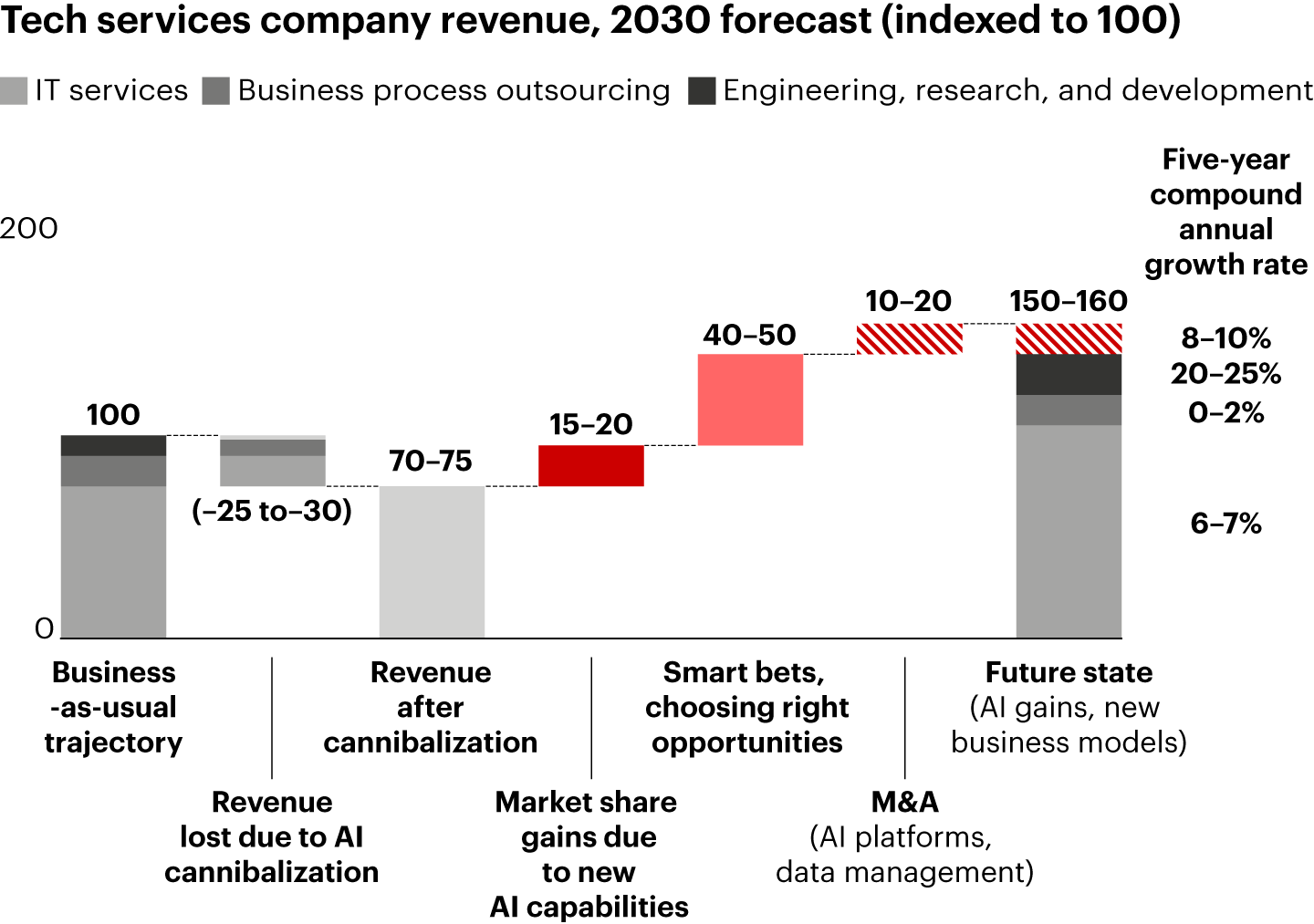
These trends pose real risks to the tech services industry. Bain’s research suggests that continuing to operate with a business-as-usual approach could erode revenue by 30% or more as work gets automated or replaced by AI. Firms stand to lose 5 to 7 points of EBIT margin from deal discounting to win more work, which could contribute to an enterprise value loss of 45% to 50% over the next five years.
But these trends also create new opportunities—more than enough to offset the risks:
- AI is at the heart of many of these changes, and the process of integrating AI into existing workflows will create a surge in demand for AI services.
- At the same time, the rising importance of tech across every aspect of the enterprise extends the range of activities that will require tech services.
- All of these trends create an immediate and midterm demand for tech services to help organizations adapt to changing conditions.
The next generation of IT service leaders will pull away fast (see Figure 1). Bain’s research estimates that leaders are poised to grow by 8% to 10%, sustain or expand margins, and increase revenue multiples by 3 to 3.5 times. These spoils will go to service providers that can decisively transform their organizations by reshaping their offerings, delivery models, P&L structures, and operating systems.
Figure 1


Forces shaping tech services
The trends reshaping the IT services industry are leading to a rethink of how these firms operate and where growth will come from.
Trillion-dollar AI economy:
- AI is no longer an add-on; it’s becoming a core capability across enterprise and software-as-a-service platforms. As industrial strength multimodal models (e.g., large language models and small language models) gain traction, demand is rising for high-quality annotation, validation, and data ops capabilities.
- Another enormous opportunity is that the modernization of apps still running Cobol—all 200 billion to 800 billion lines of active code—is less time consuming and more feasible with help from AI, which can identify the business logic in old code and translate it into more modern languages. This creates new opportunities for core modernization in industries such as banking.
- AI is also moving to the edge, enabling low-latency inferencing and smarter controllers. All of this is fueling unrelenting data center growth, including critical investments in underlying technologies such as communications infrastructure, power, and cooling.
- A surge in demand for application-specific chips to power AI applications will create new opportunities for tech services in chip design, verification and validation, and packaging.
Tech at the core of every business:
- Business process transformation is becoming faster, thanks to AI-first models that go beyond automation and redesign processes (e.g., mortgages and claims) from the ground up. Transforming processes and avoiding pilot overkill is critical for enterprises to see returns from AI.
- End-to-end transformation is also being reshaped with AI-enabled platform services that allow for more standardized and repeatable outputs. Agentic systems are coming online, which will allow these to run more autonomously.
- Across industries and product categories, customers are seeking out greater convenience and features. For example, in the automotive industry, as vehicles advance from partially to fully autonomous (advanced driver assistance systems level 3 to 5), tech services firms will play a role in enabling those features.
- Underpinning all of these and other opportunities is data—modernized, productized, and made AI-ready—the management of which is likely to become a large area of spending in tech services.
Post-globalization and expanding role of governments:
- A massive reconfiguration of spending patterns and innovation hubs is underway. Supply chains are becoming more intelligent, agile, and transparent, supported by embedded decision making that allows systems to make choices without waiting on human intervention. This creates the opportunity for more spending across the various steps of the supply chain (planning, sourcing, manufacturing, fulfillment) that tech services companies could tap into.
- Across the globe, governments are developing policies that create more secure and predictable environments for digital assets such as cryptocurrency and stablecoins, encouraging the adoption of blockchain. New centers of investment are opening up, including Japan and the Middle East.
- Countering the trend for moving operations back onshore, an increase in offshoring and nearshoring is also possible due to the rising costs of H-1B visas.
Demographic shifts upend traditional talent pools:
- There is a rising need for drastic efficiency gains to address the emerging global workforce imbalance in aging economies such as Japan and Europe.
- There is an increase of robots and agents in physical and digital environments.
Energy transition and surge in green infrastructure:
- Powering the AI transformation requires extensive changes to the energy infrastructure.
- Interest in nuclear energy is picking up again, particularly to meet the needs of hyperscale data centers.
- At the same time, green energy continues to gain momentum, with massive investments flowing into grid modernization and next-generation storage technologies.
Eight imperatives for success in IT services
While the opportunities ahead are enormous, tech service providers won’t capture them with a business-as-usual mindset. The sector is likely to keep shifting toward winners-take-most dynamics, fueled by the heavy investments required to master AI and reimagine business models. For firms that commit to the right bets and move decisively, the payoff can be far greater (see Figure 2).
Figure 2

Strategy shift: Gone are the days of defining strategy at a vertical and geographic level based on attractiveness and ability to win. Strategy today needs to take a more focused approach, identifying opportunities at the intersection of specific industries, geographies, and spending themes. This approach, which we call “micro-battles,” unlocks AI-led transformations with hyper-specialized expertise accompanied by broad-based horizontal technology capabilities. Transforming the mortgage origination process in US banking offers one good example. Tech service companies should identify 15 to 20 micro-battles in which they aspire to be a top player in that niche.
Multiservice solutions: To succeed in the market, companies need to bring together offerings that span multiple areas of the business, not just one team or capability. These solutions should be tailored to tackle specific high-priority challenges—for instance, the micro-battles referenced above. That means combining expertise in areas such as service design, technology, industry knowledge, data, and operations. To really make it work, companies have to be strategic about where they invest money and how they deploy talent. For example, delivering on claims process transformation in property and casualty insurance in the US means bringing together service design to redesign the claims process with the best of AI and automation, platform partnerships with core systems (e.g., insurance tech providers Guidewire or Duck Creek), custom app development, and next-generation operations embedded with AI to be able to stitch together an outcome for the client.
Revamped go-to-market model: The limiting factor in change will be how the front line adapts. AI-led services call for fundamentally different customer conversations and delivery motions that will require not just investments in offerings and partnerships but also new skills for the front line. Resetting the go-to-market model entails new roles for the front line as customer advisers and experts, new capabilities for risk management and developing more complex solutions, and deep integration with technology ecosystem partners. As in all transformations that introduce new processes, a continuous loop of frontline learning and feedback is essential.
Platform-based delivery and value-based pricing: Agents with a human in the loop are rapidly becoming part of the delivery model, helping teams shift from custom, one-off solutions to more scalable, composable, and interoperable platforms. For example, custom app development has relied heavily on individual skills and lacked a consistent way to efficiently measure progress. Now, providers are moving toward a more unified view of the software development life cycle, using platforms to improve speed, efficiency, and clarity around outcomes. Similarly, modernization efforts are becoming more automated. Instead of relying on manual effort and institutional memory to understand legacy systems, AI can generate knowledge graphs and automate much of the work. These platform-based delivery models will help shift pricing away from hourly metrics to value-based models in which customers reward providers for achieving target outcomes.
Talent strategy: As automation absorbs tasks, as companies localize talent (e.g., to keep pace with changing visa requirements), and as employee expectations change, talent strategy needs to evolve. Without a reimagined talent model, the traditional delivery pyramid could morph into a costlier diamond structure. To stay ahead, companies must rethink their talent strategy—building competency-based career architectures, extending these frameworks to clients, and investing in developing capabilities that go beyond technology, such as creative problem-solving, domain expertise, and forward-deployed engineering. Equally critical is redefining the employee value proposition to create a more geographically and culturally diverse workforce and to appeal to Gen Z workers. Incremental tweaks to HR models won’t suffice; firms must irreverently challenge outdated policies, rigid career paths, and traditional approaches to coaching, replacing them with more flexible, purpose-driven, and individualized talent experiences.
Culture reset: Responding to this moment and capturing the opportunities calls for a major cultural shift. As both customer demand and talent supply fluctuate, tech services need to respond by moving from homogenous teams to diverse talent across skills, backgrounds, and cultures. From rigid hierarchies to flatter, faster teams. From layers of oversight to more hands-on doers. From siloed functions to agile, cross-functional collaboration. From command-and-control to empowered frontline decision making. And from a people-first mindset to a tech-first stance—not just for customers but within the organization.
Partnership: Successful providers will offer a differentiated proposition to partners, working together to align offerings, create joint account plans, and invest together in IP. Partners are willing to invest if service providers bring in a repeatable approach to process transformation.
M&A: Leading tech service firms will take advantage of M&A opportunities to differentiate themselves and their offerings, particularly in areas that allow them to leapfrog competitors in the race to realize value from AI, such as data management and other AI platforms. Accordingly, developing acquisition and integration excellence is a nonnegotiable.
To fund all eight of these imperatives, tech service companies will need to become leaner, focusing investments on the muscle of the organization. Better delivery comes through improving margins of fixed-price projects, and better operations result from taking a zero-based approach to deploying AI across all internal functions, including talent, HR, finance, procurement, and so on, to free up 200 to 300 basis points of margin.
Resetting tech services
The tech services industry is at a turning point. Growth has slowed, margins are under pressure, and new players—especially AI-native ones—are shaking up the competitive landscape. And it's not just about AI. Global structural shifts such as economic nationalism, aging workforce populations, and energy transition are reshaping demand and talent dynamics and changing how and where value gets created.
The risks are real: Bain’s research shows that firms that continue with business as usual risk major value erosion—as much as 50%—but those that act boldly can capture outsized gains. The next wave of winners could grow twice as fast as the market by redefining strategy, modernizing delivery, and reinventing talent strategy. For tech service firms, the moment of transformation is now.
First published in noviembre 2025