

Brief

As companies turn to M&A to help them deal with the mounting pressures of digital disruption, they’re discovering the many daunting ways that digital M&A is a different beast than traditional M&A.
Among the causes for concern: the forward-looking approach to due diligence and the financing methods and valuation multiples required for digital assets, not to mention the questions regarding how to integrate them without destroying what the acquirers just bought.
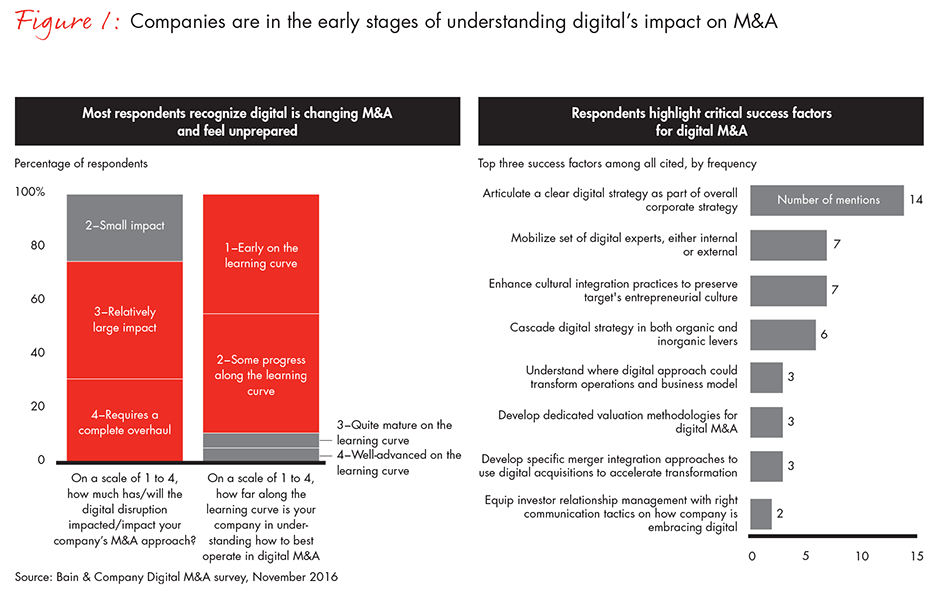
When we recently interviewed top M&A executives in Europe about their experience, fully three-quarters of them said that digital disruption has had a relatively large impact or even requires a complete overhaul of their M&A strategy (see Figure 1). These executives readily admitted that they have a lot to learn. “Simply put, we don’t know what we don’t know,” said one executive. In fact, only 11% described themselves as being either “mature” or “advanced” on the learning curve.
What will it take to adapt their M&A approach to digital? The interviewed executives overwhelmingly agreed on the importance of articulating a clear digital strategy as part of overall corporate strategy. Half of the executives cited the need to nurture and mobilize a set of specific digital experts, either internal or external and well-integrated into the industry digital ecosystem, when performing due diligence on a target. Half of them also agreed on the need to enhance cultural integration practices to preserve and develop a digital target’s entrepreneurial culture, including anticipating cultural challenges as early as the due diligence phase.
These executives echo what we counsel companies. Indeed, companies that do the best job of adapting to the unique characteristics of digital acquisitions will more successfully build these and other capabilities if they hope to outpace competitors in the digital transformation of their industry.
Some executives instinctively believe that a single acquisition of a digital player will transform their business to deliver the digital part of their corporate strategy. But from our experience, that’s simply not the case. In fact, the best companies acknowledge that their first digital acquisition may actually be less accretive, if not dilutive. Instead, they prepare themselves for a series of organic and inorganic moves. They guide their inorganic efforts with a well-devised approach that is both consistent and repeatable across all four steps of the M&A value chain: M&A strategy, corporate financing, due diligence and merger integration.
Frequent and material acquisitions are proven ingredients for success, based on Bain & Company’s long-term research on M&A performance as measured by total shareholder return. However, for digital M&A, a consistent and repeatable approach becomes even more important. Why? Not only are the rules somewhat different for digital M&A, but you’re also likely to be paying an even higher premium for your acquisition, betting on a fast—although uncertain—development.
Let’s look at the four critical steps one by one.
M&A strategy. We find that the best companies are extremely clear about how digital M&A will enable their strategy. Publicis Groupe acquired Sapient for $3.7 billion in 2014 to spur a digital transformation of its core business. This was a material acquisition for Publicis, intended to accelerate its transformation to a digital advertising agency and gain scale against growing competition from Google and Facebook. Publicis now achieves 50% of its revenue from digital—that’s ahead of its 2018 target—and offers a best-in-class digital platform for client interactions, among other significant benefits.
Sapient was not the first digital acquisition for Publicis, and it will likely not be the last. Again, consistency and repeatability are key success factors. M&A strategy is not a one-time solution, but rather something that should be an integral part of your global growth strategy. Companies pursuing such gains need to start by evaluating how digital has distorted the value chain of the industry, then determine the specific ways that M&A would help deliver on that unique strategy—for instance, enabling customer digital engagement, reshaping operations, or protecting against digital disrupters’ business models. Because deals are time-consuming and often difficult, most companies should consider only M&A that will bring them to scale for digital capabilities or help them accelerate their digital transformation. Yet in rare cases, it makes sense to make smaller acquisitions in order to experiment or to generate marketing insights on the future evolution of the business.
Companies can ask themselves a series of basic questions when performing their M&A strategy in the digital world:
- Are we considering both defensive and offensive digital M&A moves?
- Are we adopting a forward-looking and value-based approach to screening attractive digital targets for our business?
- Do we clearly understand how digital fits into our strategy, and do we strive to be a thoughtful parent for the acquired digital company and its legacy business?
- Are we modifying our approach with incremental investments that mitigate risks?

A Guide to Successful Digital M&A
Companies looking to M&A in the face of digital disruption must change their approach.
Corporate financing. Many companies think that digital assets are too expensive. Determining the right valuation starts by understanding how the acquisition will impact the growth-value profile of their stock and equity profile. The ultimate goal is to signal to the market that the digital acquisition is not just a one-off acquisition, but rather part of a series of organic and inorganic moves that feed into the firm’s corporate strategy and help it adapt and win in the digitalization of its industry. This will help influence the evolution of the company’s market perception and its price-to-earnings (PE) ratio.
Higher or different valuations usually can be associated with three types of deals: acquisitions for critical shape-shifting capabilities required to bring the acquirer up to digital grade; acquisitions in areas that evolve the acquirer in strategically valuable technology such as cybersecurity, artificial intelligence, the Internet of Things or analytics; and acquisitions that significantly scale up the size of a customer base that can almost immediately create a winner-takes-all situation, displacing the competition. These acquisitions support future equity value, and companies should consider allocating the affordable price premium to such deals.
Another thorny issue: how to finance the deal. Because targets tend to be expensive, acquirers are limited in their ability to use stock, as the dilutive effect for existing shareholders would be too high. But acquiring a risky digital target in a 100% cash deal may expose the company to overvalued goodwill and future write-offs. To mitigate the risk linked to the target’s high multiples, acquirers need to evaluate all potential financing solutions, considering adapted payment terms such as earn-outs or other deferred payment mechanisms.
There are exceptions. In rare cases—and for defensive reasons—it makes sense to consider major dilutions and to break the piggy bank to take control of a major digital disrupter. Facebook adopted a “users first, profits later” mindset in its $19 billion acquisition of WhatsApp, a defensive move that positioned Facebook as the world leader in messaging. The price tag for WhatsApp seemed high, given its lack of financials. But Facebook based the valuation on WhatsApp’s rapidly expanding base of users rather than on financials. The company paid $42 per WhatsApp user, compared with its own valuation of $144 per Facebook user at the time of the deal close, and executives viewed the acquisition as mission critical for the company’s strategy.
Again, consistency and repeatability matter. When a company transforms its equity profile to become a more legitimate digital player, it can gain more flexibility in how it finances future deals.
Thales purchased growing cybersecurity firm Vormetric for $400 million, which was 5.7 times Vormetric’s sales. The acquisition communicated to the market that Thales was shifting its financial profile to the high-growth business. Vormetric’s advanced technology commands gross margins of 80% to 90%. At around 25% year-over-year gains, cybersecurity sales growth is expected to significantly outpace Thales’ core business, resulting in an increasingly positive impact on the overall financials. Our research suggests that, over time, Thales’ organic development strategy, supported by multiple acquisitions in the cybersecurity space, will increasingly be captured in Thales’ PE ratio and overall valuation, helping to attract growth investors. In fact, by the end of December 2016, Thales traded at a 21.8 PE multiple, a 15% premium over the aerospace and defense industry, which averaged 18.9.
Arnaud Leroi, who leads Bain's M&A practice in Europe, the Middle East and Africa, outlines four critical steps that successful companies take to execute digital M&As.
Due diligence. Digital M&A turns traditional due diligence on its head. For instance, to get a good valuation, companies need to screen a target before value has actually been monetized. Also, how should an acquirer compensate for the lack of financials?
In traditional due diligence, much of the effort involves evaluating a target’s past business performance and current competitive position. In digital M&A, acquirers need to become more forward-looking, possibly through approaches that evaluate the potential success of the business model under different scenarios. The best companies build and manage a community of external experts to become connected to the digital ecosystem of which they are a part—or of which they want to be a part—and heavily rely on those experts to support diligence in areas that are hard to assess objectively.
Due diligence in digital M&A calls for paying extra attention to certain considerations. Is the acquirer capable of becoming a strong corporate parent, suited to accelerate the development of the digital acquisition? This is something to determine independently of the value of the digital acquisition in transforming the acquirer’s own core business. Another important question: How scalable are the acquired assets in terms of people, technology and business models?
Leading acquirers rely on digital tools to complement their traditional sources of information. For example, some use tools that can assess the perception and market recognition of the target. For sector and company screening, data provider CB Insights helps develop information-rich company profiles, visualize competitive dynamics and uncover nonfinancial performance metrics. For diligence into a particular company, web scraping provides indicators of market share and growth momentum such as web-traffic analysis, social media engagement metrics, and geographic coverage vs. competitors over time by extracting location websites.
Acquirers may also turn to Glassdoor or LinkedIn to assess the culture, or rely on tools that provide insights into the operating model of the acquired company—moves that help them mitigate potential integration issues. Cultural risks are particularly vexing, and many companies have demonstrated how easy it can be to destroy digital assets in just a few months. By making a thorough integration assessment part of due diligence, companies can avoid unpleasant surprises.
Merger integration. When Microsoft acquired LinkedIn for $26 billion in 2016, one of the goals was to integrate product offerings while preserving each company’s unique identity. After the deal announcement, Microsoft’s CEO announced that LinkedIn would be kept autonomous, but Microsoft engineers would be tasked to see how they could innovate with this new asset.
In our experience, the best companies pursue a “scope” deal mindset rather than a “scale” deal mindset with digital acquisitions. (Scope deals expand a company’s scope by adding new customers, products, markets or channels. Scale deals grow a company’s scale by adding similar products or customers.) That means investigating where each company can benefit from the other to accelerate transformation from technologies, customer proximity, go-to-market access and other capabilities.
We also advise our clients to consider tactics to enable a smooth integration, including cultural exchange programs between the companies and incorporating digital acquisition leaders in their key governance forums. Digital day-one integration teams are also critical to ensure that the combined company is prepared with an integrated digital strategy.
While almost 90% of digital M&A can be considered scope deals that will require only selective integration, in our experience some situations call for a more comprehensive integration of the two companies. For instance, it likely makes sense to fully integrate the two companies when your company faces a major business model disruption linked to digital, and you have already done several acquisitions in the specific digital area. One strategy: Consider a reverse takeover approach in which you give leadership of the digital acquisition business functional responsibility for the entire company to spur your transformation. When Publicis acquired Sapient in a transformational deal, it gave Sapient’s executives the keys to the car. It also created Sapient Inside, a network of Sapient digital specialists who will help its traditional advertising agencies benefit from best-practice methods and tools.
Digital disruption will only intensify. As it does, companies in all industries will increasingly consider M&A as a way to adapt. But success requires a clear understanding of the changing rules for digital in M&A strategy, corporate financing, due diligence and merger integration to help companies stay a step or two ahead of the competition. As is often the case in this digital world, most successful companies will learn by doing and implement a feedback loop on their early digital M&A deals. They will lead a significant evolution of their M&A skills and processes, making them consistent and repeatable capabilities for the future.
Arnaud Leroi is a Bain & Company partner based in Paris and a leader of Bain’s M&A practice in Europe, the Middle East and Africa. Laura Miles is a partner in Atlanta who leads Bain’s Global M&A practice. Elizabeth Spaulding, a Bain partner in San Francisco, leads the firm’s Global Digital practice, and Laurent-Pierre Baculard is a Bain partner in Paris who leads the firm’s Digital practice in Europe, the Middle East and Africa.
First published in febrero 2017