

World Economic Forum

Executive Summary
- Ninety-five percent of executives say circularity will be critical within three years, but only about 20% have supply chains built to scale it.
- More than 60% of companies lack clear customer prioritization for circularity.
- Circular supply chains are emerging as the next basis of competitive advantage.
Leadership teams are betting on circularity. In a recent global survey of nearly 500 executives across manufacturing-centric industries, 95% said circularity will be important to their company within the next three years, and 71% called it “very important” (see Figure 1). Yet only around 20% of companies have built circular supply chains that work at scale—and the gap is widening.
Figure 1
That gap is becoming a competitive fault line. Companies that can recover products, extend asset life, capture value across multiple cycles, and scale service models are reshaping their economics and pulling ahead. Those still optimized for linear flows are not. As secondary markets deepen, access to critical materials tightens, and regulation increases, circular supply chains will become a durable advantage.
The challenge lies in the architecture of circular supply chains. Circularity breaks the assumptions on which traditional supply chains were built—namely, predictable volumes, standardized inputs, and unit-based economics. Scaling it requires CEOs and chief operating officers to make clear choices about where to compete, how to redesign value chains for multiple life cycles and service flows, and which capabilities sit at the core of the operating model.
Circularity leaders confront the structural barriers that cause circular initiatives to stall long before they reach scale. This Bain Brief distills the core insight from our recent work with the World Economic Forum and industry leaders: Scaling circularity is not about doing more pilots; it’s about redesigning the supply chain to absorb variability, recover value, and perform reliably across multiple product lives.
Barriers to scale
Circular initiatives rarely fail for lack of ambition. They fail because today’s systems were built for linear flows. Companies hit operational, economic, and regulatory friction the moment they try to scale beyond pilots (see Figure 2). Unless addressed, these constraints prevent circular systems from operating at industrial speed or reliability.
Figure 2
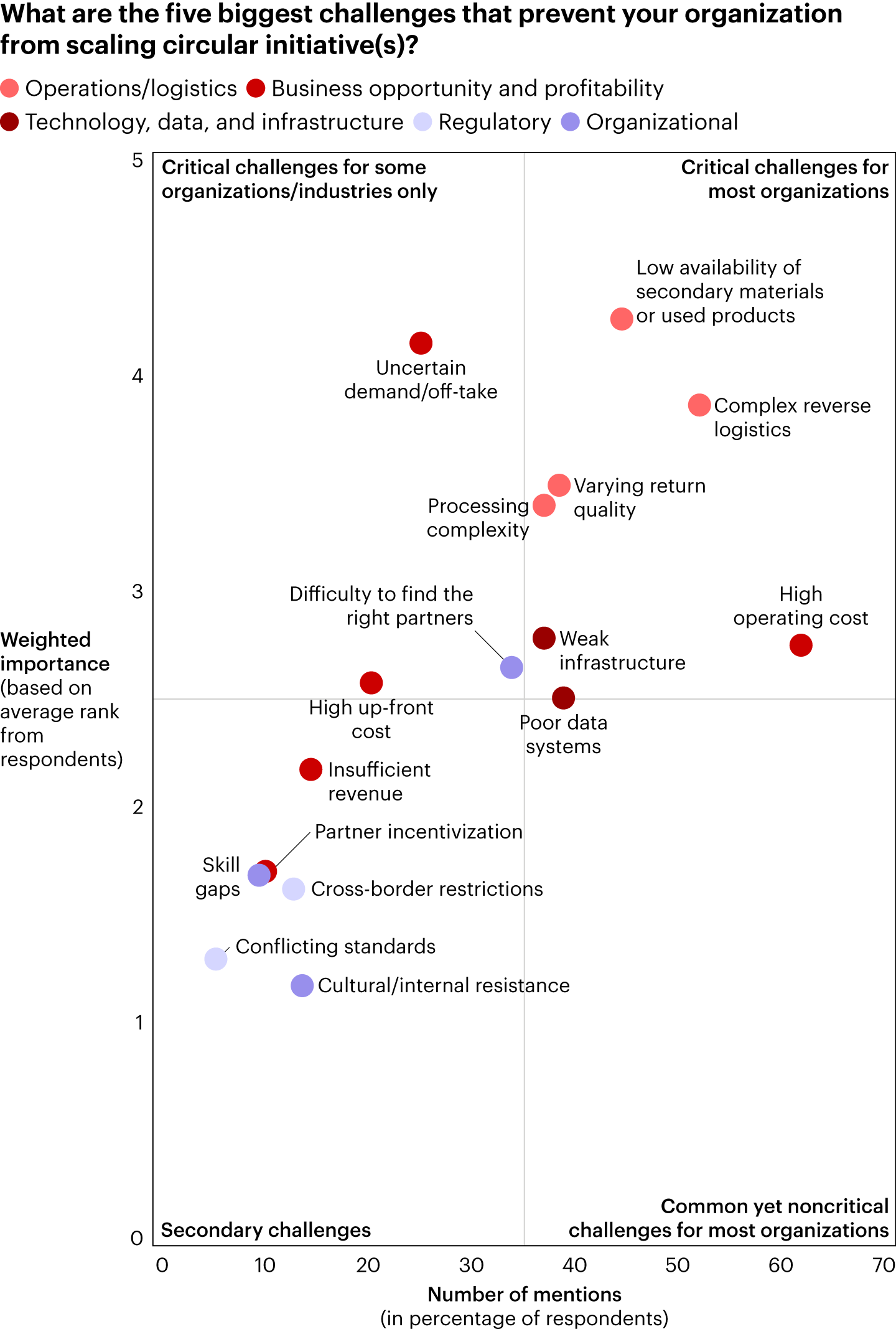

Notes: Respondents ranked the five most critical challenges, with the first being the most important; totals do not sum to 100% of respondents as multiple answers were allowed
Source: Bain & Company and the CTI initiative global executive survey, July 2025 (n=491)Most supply chains are designed for predictability, with stable demand signals, consistent product quality, and forward-only flows. Circularity introduces variability. Returns arrive unevenly. Product condition varies widely. Reverse logistics add costs, delays, and operational friction. When companies try to scale circular volumes without addressing these realities, performance deteriorates.
Across industries, operational friction is the single most common and most difficult barrier to scaling AI. Companies struggle to secure sufficient volumes of returned products, manage quality dispersion, and coordinate reverse flows that were never designed into their networks. Even when demand exists for refurbished or remanufactured goods, supply volatility undermines service levels and economics.
Leading original equipment manufacturers are redesigning ecosystems to secure feedstock. Renault, for example, partnered with Suez to build an end-of-life vehicle recovery platform that combines automotive remanufacturing expertise with industrial-scale dismantling and collection. The objective was not sustainability branding; it was stabilizing material flows and capturing residual value at scale.
The economics compound the challenge. Many companies lack visibility into lifetime margins, making it difficult to price refurbished products, allocate costs across multiple lives, or justify up-front investment. Reverse logistics, inspection, and reprocessing costs often sit outside traditional P&L structures, obscuring value and slowing decision making. Finally, reward systems built around selling more units hinder service-based models that extend product lifetimes.
Regulation and infrastructure further complicate scaling efforts. Inconsistent definitions of “waste” vs. “product,” cross-border shipment restrictions, and uneven incentives force companies into fragmented, local solutions that limit learning and efficiency. Limited traceability and shortages of repair or diagnostic capabilities stall scaling long before economics can improve.
The core issue is systemic: Circularity cannot scale on top of linear foundations. Without deliberate redesign, pilots remain pilots.
To win, prioritize
Circular leaders scale faster not by doing more but by focusing their efforts. The biggest mistake companies make is applying circularity everywhere at once—that is, across too many products, customers, and markets. Complexity explodes, resources dilute, and early wins fail to materialize. By contrast, companies that scale successfully make difficult choices up front about where circularity creates clear value and where it does not—yet. Prioritization reduces complexity, concentrates resources, and creates proof points needed to gain consensus for broader change.
In our experience, leaders follow three guidelines to scale successfully: They choose winnable products, target consistent demand, and aim for the appropriate value proposition.
Choose winnable products. Products with high residual value, predictable return flows, and technical feasibility for repair, refurbishment, or remanufacturing create early economic momentum. Durable equipment, electronics, vehicles, and assets containing scarce or strategic materials are common starting points. These categories support value recovery even before full scale is reached.
Target consistent demand. Circularity scales faster in areas in which customers face cost pressure, regulatory requirements, or strong incentives to extend product life. Business-to-business segments, regulated markets, and regions with established return behaviors often provide the strongest initial pull. But most companies fail to prioritize customer segments in which demand is strongest (see Figure 3). Bain research shows 60% of companies lack clear customer prioritization for circularity, rising to 74% in machinery and 67% in medtech.
Figure 3
Aim for the appropriate value proposition. Invest where circularity delivers superior economic value, including resilience, lower total cost of ownership, or differentiated performance. Leaders pilot in markets with supportive regulation, existing infrastructure, and manageable complexity. Concentrating volume accelerates learning, stabilizes flows, and builds proof points before expansion.
This set of priorities does more than reduce risk; it creates the credibility needed to unlock investment, mobilize partners, and overcome internal skepticism. Early operational results are critical to scaling successfully.
The right design
Once priorities are clear, design, not intent, determines whether circularity scales. Most companies underestimate the differences between circular and linear operations. Forecasting returns, assessing product condition, triaging outcomes, and managing dual flows require distinct capabilities. Stretching existing models rarely works.
Leaders make explicit choices about their operational model, choosing the appropriate operating architecture, deciding what to control, and designing networks for variability.
Choose the appropriate operating architecture. Circular and linear flows can be integrated, separated, or combined in hybrid models. Fully independent circular networks offer focus but are hard to scale. Fully integrated models offer efficiency but risk overwhelming linear systems. In practice, most leaders adopt hybrids, sharing logistics and infrastructure where it makes sense while keeping quality-critical steps such as diagnostics and remanufacturing distinct.
Decide what to control. High-value, knowledge-intensive activities, such as sorting, testing, and remanufacturing, tend to remain in-house to protect quality and economics. Scale-intensive activities, such as collection, basic logistics, and dismantling, are often outsourced. The goal is not vertical integration but control where it matters.
Leading companies are explicit about where control creates value. Schneider Electric converted two production sites in France into dedicated refurbishment hubs and embedded a circular distribution center within its existing network. The company kept sorting, testing, and refurbishment in-house to protect quality and technical expertise while outsourcing reverse logistics to specialized partners. Within two years, circular product coverage expanded from 6% to 38% of its ranges, and more than 160 tons of equipment were recovered. Scale followed architecture, not ambition.
Design networks for variability. Circular flows benefit from a balance of centralized hubs and localized nodes. Central hubs deliver scale and expertise for complex reprocessing. Local nodes improve collection rates, reduce lead times, and increase customer participation. Successful networks are modular, allowing capacity to flex as volumes grow.
Across all three dimensions, partnerships are essential. No company scales circularity alone. Access to materials, data, capabilities, and customers increasingly depends on ecosystem design rather than ownership.
Critical foundations
Even well-designed operations stall without the appropriate foundations. Companies break out of pilot mode only when they put in place the underlying systems (technology, people, finance, and policy) that allow circularity to operate as a reliable, profitable business model.
Leaders make sure three key foundational elements are in place before scaling: technology and data, governance and talent, and finance and regulation.
Technology and data. Data transforms circular operations from reactive to repeatable. Traceability systems, diagnostics, and advanced forecasting help manage variability in returns and quality. While many companies plan to deploy AI and advanced analytics, only those with clear use cases and operational readiness capture value. Technology is an enabler, not the starting point.
Governance and talent. Internal engagement is the strongest predictor of circular success (see Figure 4). Circularity leaders rewire incentives, key performance indicators, and accountability around life cycles value rather than unit sales. They invest in new skills, including remanufacturing, diagnostics, and reverse planning, and signal clearly that circularity is core to strategy, not a side initiative.
Figure 4
Circularity becomes profitable only when an organization shifts its mindset. In India, Siemens shifted from a replacement mindset to a retrofit-first philosophy for medium-voltage switchgear. By retaining up to 70% of original equipment mass and extending asset life by between 10 years and 15 years, customers achieved 40% to 50% total cost savings while reducing material use by up to 70%. The shift required new governance, dedicated service capabilities, and cross-functional ownership, but it transformed circularity from a sustainability initiative into a profit engine.
Finance and regulation. Circular supply chains require up-front investment, but returns are realized over multiple years. Leaders treat these investments as strategic, not incremental. Returns are grounded in lifetime margins, material security, and resilience benefits rather than short-term payback alone.
Regulation is not a compliance afterthought; it shapes the operating model. HP’s Renew program adapts its refurbishment flows by region, processing domestically in India because of trade restrictions while consolidating volumes in European hubs to meet certification standards. Scale is determined as much by regulatory design as by operational capability.
Getting the sequencing correct matters. Companies that lead with governance and economics, then add technology and partnerships, scale faster than those that start with tools.
System redesign
Scaling circularity is not about adding new initiatives; it’s about redesigning operations so that products live more than once.
The companies pulling ahead confront the real barriers, focus on markets where circularity has an edge, rebuild supply chains and economic models for multiple life flows, and put in place the elements required to scale. In doing so, they turn circularity into a source of growth, resilience, and competitive advantage.
Just as digital supply chains defined winners in the 2000s, circular supply chains will define winners in the decade ahead. Those that move now will secure access to materials, customers, and profit pools that others will struggle to reach.
First published in marzo 2026