

Article
The swift emergence of China's consumer class has brought with it a challenge: Even as the ranks of shoppers grow in record-setting numbers, both multinationals and local companies alike find these shoppers to be something of a mystery. What consumer goods do they prefer? How do they decide among brands? How do their shopping behaviors and preferences differ in Tier-1 cities like Shanghai and in Tier-5 cities such as Tonglu County or Xiangshan County? As they grow in income and sophistication, how do their shopping habits change?
Until now, consumer goods companies had precious little data on shopper behavior to generate the insights that could help them know the most effective ways to market to China's shoppers. In Bain & Company's recently published series of reports, "What Chinese shoppers really do but will never tell you," we helped fill that void by introducing real-time data that provides a groundbreaking look at Chinese shoppers. It brings their purchasing behaviors into sharper focus, helping global and local consumer products makers navigate the variables required to compete in such a complex, fast-changing landscape.
For those reports, Bain partnered with Kantar Worldpanel to study the real-time shopping habits of 40,000 Chinese households from 373 cities in 20 provinces and four major municipalities. The data reflects what they actually purchase—as opposed to what they say they'll purchase in consumer surveys. The results produced rare insights into how much shoppers spend by region and by city in 26 important consumer categories. In our reports, we explored the findings in-depth across critical dimensions. For example, we looked at loyalist vs. repertoire behavior. Bain research shows that consumer behavior ranges between two extreme types: loyalist and repertoire. Consumers demonstrate loyalist behavior when they repeatedly buy one brand for a specific need or occasion. In contrast, consumers exhibit repertoire behavior when they tend to choose different brands for the same occasion or need. Most people display both loyalist and repertoire behaviors, depending on what category they are buying. Also, the same category may elicit different buying behaviors from one country to another. (For a complete look at how repertoire analysis can help a company grow its brand, see the Bain Brief, "Introducing The Bain Brand Accelerator.") We also examined shopper behavior by city tiers, product category stage of development, life stage and retail channel.
For marketers, the findings provide insights that will help shape key strategic decisions. Here is a synopsis of those insights and the implications for consumer products companies selling in China.
Chinese shoppers exhibit solid repertoire behavior in a majority of product categories
Like elsewhere in the world, repertoire categories outnumber loyalist categories by a wide margin. Of the 26 categories we studied, shoppers demonstrated loyalist behavior in only six of them. Shoppers' willingness to buy a variety of brands is just as true for heavy shoppers in a category—those representing the top 20% of purchasers—as it is for average shoppers (see Figure 1). For example, average shoppers bought facial tissue 6.7 times last year, alternating between three or four brands. But heavy shoppers, who purchased facial tissue 14 times last year, chose five or six brands. The six loyalist categories we identified include infant formula, baby diapers, beer, milk, carbonated soft drinks and chewing gum. In these categories, an increase in buying frequency does not translate into purchasing more brands. On the contrary, shoppers tend to buy the same few brands. A heavy shopper buys infant formula 13.4 times a year, and an average shopper makes the purchase 7.1 times. But in either case, there's little variation in the number of brands they choose—1.8 brands compared with 1.5 brands.
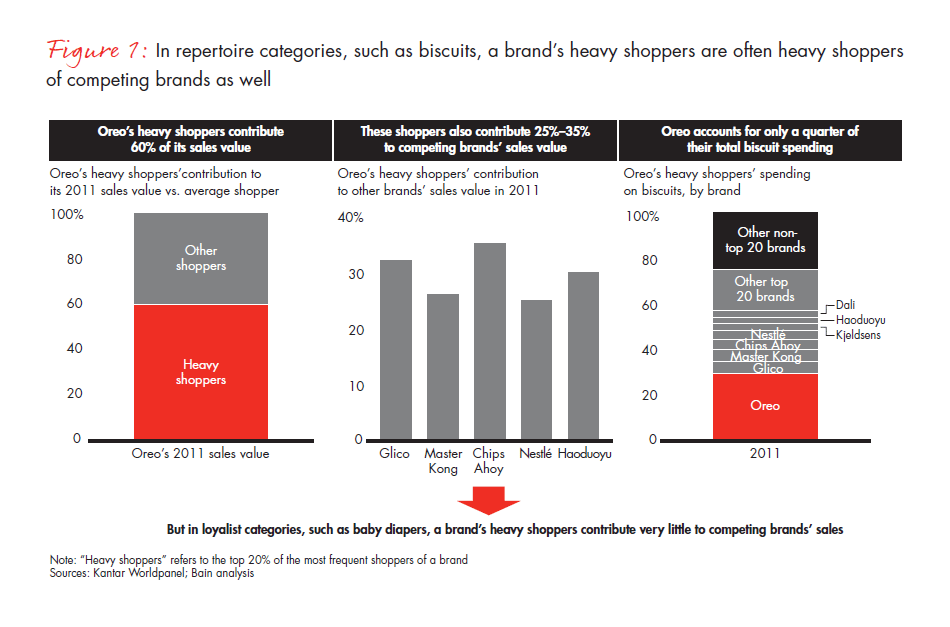
When we looked at category nature, we found that repertoire behavior is consistent across all four types of categories we studied: beverages, packaged food, personal care and home care. And repertoire behavior didn't vary based on a shopper's stage of life. A common belief is that curious young shoppers buy more brands while older, set-in-their-way shoppers are more loyal. But our research data debunks that belief. Except for biscuits, yogurt and candy, life stage doesn't have a significant impact on shoppers' repertoire behavior in most categories we studied.
Repertoire behavior also didn't change as a result of category development stage—the extent to which the category is purchased by all potential consumers. Some consumer goods makers have operated on the assumption that the more developed the category, the more prevalent the repertoire behavior. However, we found that repertoire behavior exists even in underdeveloped categories. Take color cosmetics, a category that includes everything from mascara to lipstick. This is an emerging category in China; fewer than half of all Chinese purchasers of color cosmetics buy the product once a year or more. Compare that to skin care, which 96% of Chinese women buy once a year or more. Our study found that shoppers of color cosmetics exhibit the same repertoire behavior as shoppers of highly penetrated categories like skin care.
Winning companies will avoid overinvesting to make their shoppers loyal to a brand—it's just not how consumers shop in China.
Where shoppers live influences repertoire behavior
While all of those factors don't influence repertoire behavior, we found one that does: where a shopper lives. In repertoire categories, shoppers in Tier-1 and Tier-2 cities buy more brands than their counterparts in Tier-3 to Tier-5 cities, because they make more frequent purchases in the category. For example, average households in Beijing, Shanghai and Guangzhou made 21 purchases of biscuits compared with 11 purchases by the average Tier-5 city households. Those average households in major cities bought 8.5 brands of biscuits in 2011, compared with 4.8 brands for shoppers in Tier-5 cities. In contrast, in loyalist categories such as milk and beer, shoppers in Tier-1 and Tier-2 cities don't buy significantly more brands than those in Tier-5 cities.
We found that modern trade plays a role in the prevalence of repertoire behavior in Tier-1 and Tier-2 cities. Hypermarkets, the fast-growing modern trade segment, represent over half of all modern trade sales nationally. The format has made deep inroads into China's largest cities, offering shoppers a wider availability of brands than in the traditional trade that flourishes in smaller cities.
In repertoire categories, we don't expect Chinese shoppers to develop stronger brand loyalist behavior any time soon. Instead, as purchasing frequency and modern trade penetration increase in Tier-3 to Tier-5 cities, along with rising incomes per household, repertoire behavior is likely to increase in these areas—and successful companies will be those that prepare for the increase in repertoire behavior.
The battle between foreign and local brands is intensifying—and it's too soon to declare a winner
We found there is no relationship between repertoire or loyalist behavior and whether a category is dominated by foreign or local brands. Also, we found that both local and foreign brands are well positioned to succeed in China. Chinese shoppers love brands, which they consider safe and trustworthy. In addition, except for well-recognized leading brands or imported products, they often can't identify whether a brand is foreign or local at the point of sale. When a foreign brand succeeds in China, it has little to do with its foreign status. More likely, it is the result of a multinational player using proven branding and activation techniques—the same techniques that can help a local company gain equal success.
Multinationals lead in categories they introduced, such as chocolate and chewing gum. Domestic players dominate in more traditional categories, like instant noodles, where they have more knowledge about local tastes and behaviors. They also benefit from well-established brands and have strong supply and distribution networks that ensure product availability.
But now, it's becoming anybody's game, as foreign and local brands break new ground by competing in each other's strongholds. In candy, Italy's Alpenliebe now leads local brands with a 9.2% market share—it created local flavors, innovated easy-to-carry tube packages and captured special-occasion consumers. At the same time, local brands like YNBY toothpaste and Bluemoon laundry detergent have entered the premium segment in the modern trade channels in Tier-1 and Tier-2 cities, which has traditionally been controlled by multinationals.
Undeniably, the battle between foreign and local brands is more brutal than ever, and it will only intensify as successful local brands adopt global players' strategies and global brands continue their move into lower-tier cities and the mass-market segment. Winners will gain market share by noting—and adapting—what's worked for the competition.
Penetration is the path to leadership
When we analyzed the leading brands in each of the repertoire categories, we found that winners have one critical thing in common: high rates of penetration— the percentage of households in a market buying a particular brand—compared with the average of the top 20 brands in their category. Across categories, increasing penetration is the primary way to build big brands. This is a key insight from the research of the Ehrenberg-Bass Institute for Marketing Science, summarized by Professor Byron Sharp, director of the Institute, in his book How Brands Grow, based on decades of observations of buying behavior. Logical as it is, this fact of life often is overlooked by consumer products companies: The most important factor in gaining a competitive edge is achieving a much higher market penetration rate. In short, that means getting more households to buy your brand. For example, in toothpaste, Crest is the brand with the highest penetration rate—57% compared with the average of 15% for the category's top 20 brands. Not surprisingly, it's also the category leader, with 15% market share. Oreo maintains the highest penetration rate among any biscuit player. Its penetration rate of 46% is more than three times the national average for the top 20 brands, and its market share of 10% is higher than that of its competitors. In these categories, success for leading companies has more to do with penetration than other factors, such as the rate at which shoppers make repeat purchases of the brand or the brand's share of wallet.
Rules for winning in a repertoire dominated world
Based on the study's findings, we've established some rules for the road ahead. The path to market leadership begins by knowing the category characteristics that will guide your growth strategy. The most important factor: Clearly define the category in which you compete (for example, is the category "juice" or is it "soft drinks"?), then assess whether it's a repertoire or loyalist category.
In repertoire categories:
- Brands are important to Chinese shoppers—even if they don't think about one brand frequently. Winning in such an environment means that marketers need to focus on important activities that support two crucial decision moments. The first: Make sure your brand is part of the shoppers' repertoire. The second: Ensure that there's enough in-store marketing to recruit shoppers each time they're selecting a brand and making a purchase. The best approach to win repertoire shoppers is to recruit them consistently at the point of sale, day in and day out, and to deploy perfect sales execution.
- Build scale in priority regions first. If scale is required for year-round visibility, the most cost-effective approach is to target a locality or region and then move on to the next one with a winning repeatable model.
- Understand that repertoire behavior flourishes even in underdeveloped categories. Being a first mover does not guarantee long-term success because shoppers will consider other brands as the category develops. And don't focus too much on segmenting shoppers by life stage or expect to win loyalty for your brand as shoppers move to later life stages.
In loyalist categories:
- Because shoppers tend to stick to their preferred brand for a specific need or occasion, it's critical to recruit shoppers in well-defined shopper segments and encourage them to try your brand first. The first trial is the foundation for building brand preference.
- One important way to build brand preference is through highly targeted marketing initiatives and public relations events, emphasizing specific switching points and investing to reduce churn.
- Make it easy for shoppers to find your brand in the store. That means investing to ensure the products are in stock, on the right shelf and attractively displayed—but it's not necessary to motivate shoppers continually with in-store activations.
- Our study's real-time shopper data has helped us clearly see the wide gap between consumer goods companies' assumptions about how China's shoppers behave and what they actually do in the stores. Perhaps the most important thing we've learned is that asking shoppers what they want won't help you really understand their behavior and win them over. They often don't know what they want or will purchase until they're presented with a repertoire of products at the point of sale. It's far more important to focus your efforts on understanding their actual shopping behavior as it relates to your particular product—while also keeping careful track of what your competitors are doing to win them over.
First published in noviembre 2012