
Skip to Content
  • Bureaux

    Bureaux

    Amérique du Nord et Amérique du Sud
    • Atlanta
    • Austin
    • Bogota
    • Boston
    • Buenos Aires
    • Chicago
    • Dallas
    • Denver
    • Houston
    • Los Angeles
    • Mexico City
    • Minneapolis
    • Monterrey
    • Montreal
    • New York
    • Rio de Janeiro
    • San Francisco
    • Santiago
    • São Paulo
    • Seattle
    • Silicon Valley
    • Toronto
    • Washington, DC
    Europe, Moyen-Orient et Afrique
    • Amsterdam
    • Athens
    • Berlin
    • Brussels
    • Copenhagen
    • Doha
    • Dubai
    • Dusseldorf
    • Frankfurt
    • Helsinki
    • Istanbul
    • Johannesburg
    • Kyiv
    • Lisbon
    • London
    • Madrid
    • Milan
    • Munich
    • Oslo
    • Paris
    • Riyadh
    • Rome
    • Stockholm
    • Vienna
    • Warsaw
    • Zurich
    Asie et Australie
    • Bangkok
    • Beijing
    • Bengaluru
    • Brisbane
    • Ho Chi Minh City
    • Hong Kong
    • Jakarta
    • Kuala Lumpur
    • Manila
    • Melbourne
    • Mumbai
    • New Delhi
    • Perth
    • Shanghai
    • Singapore
    • Sydney
    • Tokyo
    Voir tous les bureaux
  • Alumni
  • Presse
  • S’abonner
  • Contacter
  • Canada | Français

    Sélectionnez votre région et votre langue

    Global
    • Global (English)
    Amérique du Nord et Amérique du Sud
    • Brazil (Português)
    • Argentina (Español)
    • Canada (Français)
    • Chile (Español)
    • Colombia (Español)
    Europe, Moyen-Orient et Afrique
    • France (Français)
    • DACH Region (Deutsch)
    • Italy (Italiano)
    • Spain (Español)
    • Greece (Elliniká)
    Asie et Australie
    • China (中文版)
    • Korea (한국어)
    • Japan (日本語)
  • Saved items (0)
    Saved items (0)

    You have no saved items.

    Bookmark content that interests you and it will be saved here for you to read or share later.

    Explore Bain Insights
  • Expertises Sectorielles
    Menu principal

    Expertises Sectorielles

    • Aerospace et Défense
    • Agroalimentaire
    • Chimie
    • Infrastructures, BTP et Matériaux de Construction
    • Grande Consommation
    • Services Financiers
    • Santé
    • Engins & Equipements Industriels
    • Media et Divertissement
    • Metals
    • Mining
    • Pétrole & Gaz
    • Papier et Emballage
    • Private Equity
    • Secteur Public
    • Distribution
    • Technologie
    • Télécommunications
    • Transportation
    • Travel & Leisure
    • Utilities & Energies Renouvelables
  • Expertises Fonctionnelles
    Menu principal

    Expertises Fonctionnelles

    • Expérience Client
    • ESG
    • Innovation
    • Fusions et Acquisitions
    • Opérations
    • People & Organization
    • Private Equity
    • Sales & Marketing
    • Stratégie
    • IA, Perspectives et Solutions
    • Technology
    • Transformation
  • Digital
  • Points de Vue
  • About
    Menu principal

    About

    • Notre Activité
    • Nos Valeurs
    • Nos Collaborateurs et Notre Équipe Dirigeante
    • Notre Impact
    • Prix & Récompenses
    • Partenariats Internationaux
    Further: Our global responsibility
    • Sustainability
    • Impact Social
    • World Economic Forum
    Learn more about Further
  • Carrières
    Menu principal

    Carrières

    • Rejoignez-nous
      Carrières
      Rejoignez-nous
      • Find Your Place
      • Nos domaines d’expertise
      • Equipes multidisciplinaires
      • Étudiants
      • Stages et programmes
      • Événements de recrutement
    • La vie chez Bain
      Carrières
      La vie chez Bain
      • Blog: Inside Bain
      • Récits de carrière
      • Nos collaborateurs
      • Nos bureaux
      • Soutenir votre évolution professionnelle
      • Groupes d’affinités
      • Avantages chez Bain
    • Histoires d’impact
    • Notre processus de recrutement
      Carrières
      Notre processus de recrutement
      • Ce que vous pouvez attendre
      • Entretiens
    Trouver un poste
  • Bureaux
    Menu principal

    Bureaux

    • Amérique du Nord et Amérique du Sud
      Bureaux
      Amérique du Nord et Amérique du Sud
      • Atlanta
      • Austin
      • Bogota
      • Boston
      • Buenos Aires
      • Chicago
      • Dallas
      • Denver
      • Houston
      • Los Angeles
      • Mexico City
      • Minneapolis
      • Monterrey
      • Montreal
      • New York
      • Rio de Janeiro
      • San Francisco
      • Santiago
      • São Paulo
      • Seattle
      • Silicon Valley
      • Toronto
      • Washington, DC
    • Europe, Moyen-Orient et Afrique
      Bureaux
      Europe, Moyen-Orient et Afrique
      • Amsterdam
      • Athens
      • Berlin
      • Brussels
      • Copenhagen
      • Doha
      • Dubai
      • Dusseldorf
      • Frankfurt
      • Helsinki
      • Istanbul
      • Johannesburg
      • Kyiv
      • Lisbon
      • London
      • Madrid
      • Milan
      • Munich
      • Oslo
      • Paris
      • Riyadh
      • Rome
      • Stockholm
      • Vienna
      • Warsaw
      • Zurich
    • Asie et Australie
      Bureaux
      Asie et Australie
      • Bangkok
      • Beijing
      • Bengaluru
      • Brisbane
      • Ho Chi Minh City
      • Hong Kong
      • Jakarta
      • Kuala Lumpur
      • Manila
      • Melbourne
      • Mumbai
      • New Delhi
      • Perth
      • Shanghai
      • Singapore
      • Sydney
      • Tokyo
    Voir tous les bureaux
  • Alumni
  • Presse
  • S’abonner
  • Contacter
  • Canada | Français
    Menu principal

    Sélectionnez votre région et votre langue

    • Global
      Sélectionnez votre région et votre langue
      Global
      • Global (English)
    • Amérique du Nord et Amérique du Sud
      Sélectionnez votre région et votre langue
      Amérique du Nord et Amérique du Sud
      • Brazil (Português)
      • Argentina (Español)
      • Canada (Français)
      • Chile (Español)
      • Colombia (Español)
    • Europe, Moyen-Orient et Afrique
      Sélectionnez votre région et votre langue
      Europe, Moyen-Orient et Afrique
      • France (Français)
      • DACH Region (Deutsch)
      • Italy (Italiano)
      • Spain (Español)
      • Greece (Elliniká)
    • Asie et Australie
      Sélectionnez votre région et votre langue
      Asie et Australie
      • China (中文版)
      • Korea (한국어)
      • Japan (日本語)
  • Saved items  (0)
    Menu principal
    Saved items (0)

    You have no saved items.

    Bookmark content that interests you and it will be saved here for you to read or share later.

    Explore Bain Insights
  • Expertises Sectorielles
    • Expertises Sectorielles

      • Aerospace et Défense
      • Agroalimentaire
      • Chimie
      • Infrastructures, BTP et Matériaux de Construction
      • Grande Consommation
      • Services Financiers
      • Santé
      • Engins & Equipements Industriels
      • Media et Divertissement
      • Metals
      • Mining
      • Pétrole & Gaz
      • Papier et Emballage
      • Private Equity
      • Secteur Public
      • Distribution
      • Technologie
      • Télécommunications
      • Transportation
      • Travel & Leisure
      • Utilities & Energies Renouvelables
  • Expertises Fonctionnelles
    • Expertises Fonctionnelles

      • Expérience Client
      • ESG
      • Innovation
      • Fusions et Acquisitions
      • Opérations
      • People & Organization
      • Private Equity
      • Sales & Marketing
      • Stratégie
      • IA, Perspectives et Solutions
      • Technology
      • Transformation
  • Digital
  • Points de Vue
  • Carrières
    Recherches les plus fréquentes
    • Agile
    • Digital
    • Stratégie
    Vos recherches précédentes
      Pages récemment visitées

      Content added to saved items

      Saved items (0)

      Removed from saved items

      Saved items (0)

      Etude

      Coping with Coronavirus: How Private Equity Firms Can Focus on What Matters Most

      Coping with Coronavirus: How Private Equity Firms Can Focus on What Matters Most

      PE leaders are scrambling to keep up with the Covid-19 crisis. What they need is a practical way to assess risk company by company and prioritize the most effective response.

      Par Marc Lino, Hubert Shen, Andrei Vorobyov, et Hao Zhou

      • min
      }

      Etude

      Coping with Coronavirus: How Private Equity Firms Can Focus on What Matters Most
      en

      As fast as the Covid-19 crisis is unfolding, leaders of private equity firms have to move faster.

      While it is impossible to gauge the outbreak’s ultimate impact, efforts to contain the virus have already ground broad swaths of economic activity to a halt, generating widespread ripple effects across global financial and consumer markets.

      By now, most firms have set up an emergency response team, have implemented measures to take care of their people and are communicating with investors. They are paying more and more attention to determining the outbreak’s potential impact on portfolio companies and developing a clear, decisive action plan to mitigate the damage.

      For Our Clients

      Macro Surveillance Platform

      For more detail on the business implications of coronavirus from Bain’s Macro Trends Group, log on to the Macro Surveillance Platform. Learn more about the platform >

      By definition, there is no universal playbook. The outbreak affects every portfolio company uniquely, requiring a tailored plan for each. Tactics like drawing down credit lines or aggressively managing working capital might work across the portfolio. But those are table stakes, not strategies.

      The real question is what to do next. Given limited time and resources, it is essential to triage portfolio companies by identifying the most pressing threats and drawing clear priorities. Fund managers need a rapid and logical way to:

      • Assess specific risks to individual portfolio companies;
      • Prioritize companies with the greatest potential to affect fund performance; and
      • Develop a customized action plan for each priority company.

      Assessing portfolio company risk

      To navigate the swirling uncertainty presented by the coronavirus outbreak, PE firms should start by modeling the most likely impact scenarios and determining the signposts that will signal new developments. Firms then can make a rapid risk assessment of each portfolio company in light of those evolving scenarios. Conditions will differ based on everything from geography to government response. What’s critical is to identify the most pressing challenges first, allowing the firm to direct its limited time and resources toward the companies with the most immediate and consequential issues.

      We’ve developed an interactive survey tool that serves as a useful triage mechanism. It helps fund managers quickly gauge each portfolio company’s vulnerability based on four areas of potential exposure: reduced demand, supply chain or operational interruptions, workforce issues and financial stability. Is revenue set to fall off a cliff, or is the company’s position more resilient? Is your supply chain secure, or has the global run on toilet paper suddenly disrupted your deliveries of pulp-based packaging? Do you need to raise new debt in the short term, or has the turmoil in the bond markets foreclosed that? Can you operate in a way that ensures the safety of staff and customers? If not, do you have the flexibility to adjust?

      A uniform assessment process makes developing a response as straightforward as possible. Using the findings, firms can plot portfolio companies on a matrix based on how much risk each faces, whether that risk is addressable and how much value is at stake for the fund. By aligning companies this way, firms can build an action plan that shifts more effort and resources to portfolio companies with the highest vulnerability and the highest controllable value (see Figure 1).

      Figure 1
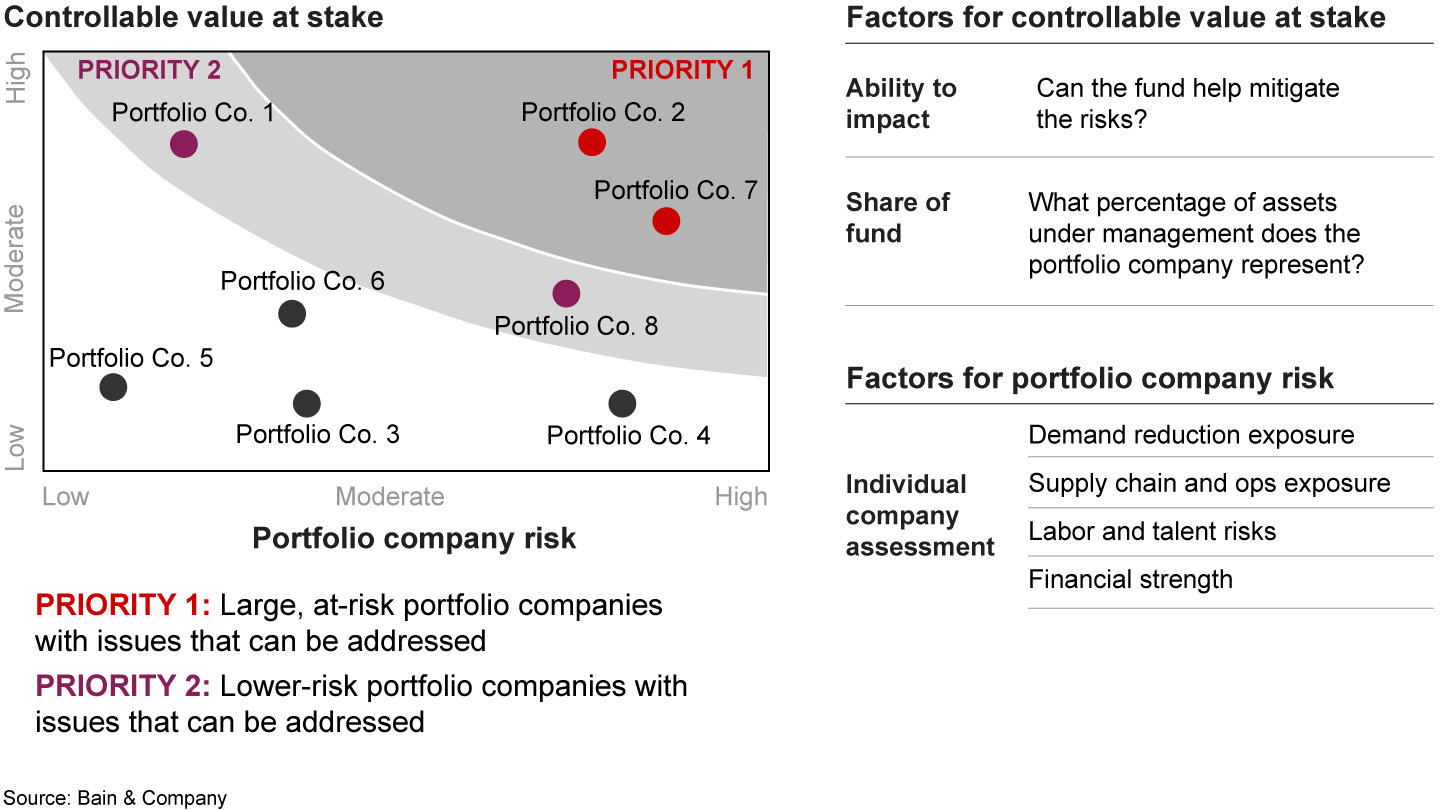
      Firms can triage their response based on individual portfolio company risk and “controllable value at stake” for the fund

      Building a customized agenda

      A strong, customized plan identifies a tactical set of initiatives the company can launch immediately. For each prioritized portfolio company, it lays out a phased execution roadmap that mobilizes the resources―opex/capex injections, project staff and outside expertise―these critical initiatives require. The most effective firms also establish a structure for learning, continuously following up on initiatives and sharing best practices across the portfolio.

      While different companies may share similar risks, no two plans will look alike. Consider a hypothetical chain of retail health clinics focused on primary care. Having spent the previous two years implementing a strategy to roll up smaller provider groups, it currently has 50 clinics in three European countries and is still integrating several of those acquisitions. Its balance sheet is leveraged but in relatively good shape. From a commercial standpoint, it has developed a strong franchise and growing “same-store” sales.

      A full government lockdown in its core markets, however, has put heavy strain on the company’s short-term outlook. Although health clinics are allowed to remain open, this company faces issues across all areas assessed: demand, supply chain, workforce and financial. On the demand side, fear of contracting the virus could drive down retail traffic for a period of time, raising the real risk of a cash crunch. Staying open at all will depend on maintaining staff safety and coping with a dwindling inventory of clinical supplies across the company and its geographies.

      These risk factors pose immediate danger and require a rapid response. The first priority is to identify the clinical supplies critical to staying open safely and searching for alternative sources. Second, the company must implement specific protocols to protect clinical workers from Covid-19 infection, while drawing up a dynamic plan to reallocate workers as necessary to cope with gaps in coverage. If demand drops far enough, the company might also need to generate cash by trimming part-time or nonessential workers and adjusting salaries.

      Supporting revenue calls for an immediate campaign to tell customers when clinics are open and communicate the steps the company has taken to ensure their safety. It will also involve implementing a plan to switch over to telehealth, using videoconferencing tools to screen patients and give nonemergency medical advice from a safe distance. The company will want to explore what Covid-19-specific offerings it might be able to develop, including testing support. And while all of that is in motion, the finance team will have to develop clear plans for improving cash generation while maintaining a close eye on debt obligations.

      Now contrast that scenario with the situation faced by a hypothetical US-based software company. This firm builds solutions for retail customers and is well on its way to transitioning to a SaaS subscription model. While a total clampdown in many states is no less alarming for the leadership of this company, it has more time to form a response. That’s because its products are mission-critical for customers and generate a recurring stream of predictable revenue. It is also lucky that not all of its retail clients are in markets that have been shut down. Like any company in this environment, this one has to scramble to make sure its employees are safe. But even that is made easier by the fact that many of them work remotely already.

      The software company’s big issue is what happens as the virus-related economic disruption spreads and deepens. While a SaaS model creates revenue resilience, retailers struggling to stay open will eventually ask for relief or simply stop paying. The top priority, then, is to devise a plan to help these customers weather the storm while deepening the company’s relationship with them.

      That effort should start with an assessment of the company’s own financial situation. How much financial leeway does it have to offer customers relief? The next step is to assess the impact of the Covid-19 crisis on key customers, from those that are severely distressed and unlikely to recover to those that are actually experiencing a bump in demand (or better). By layering on an analysis of the company’s engagement with those customers (deal in the pipeline, just sold something, renewal upcoming, no current activity), sales leadership can map out a customer-by-customer path forward and offer tailored win-win solutions. One example: Offer a holiday from subscription payments in return for an early renewal or longer-term contract.

      As our dedicated coronavirus page demonstrates, the outbreak poses myriad different issues for each industry, company and CEO across the global economy. What makes the private equity challenge uniquely difficult is the range of risks presented by a complex portfolio of companies spanning a number of industries and geographies. Generalized playbooks don’t add much value at a time when a global crisis affects each portfolio company differently. What’s critical is developing a practical plan to assess risk, prioritize action and execute quickly.

      Related Insights

      Coronavirus

      The global Covid-19 pandemic has extracted a terrible human toll and spurred sweeping changes in the world economy. Across industries, executives have begun reassessing their strategies and repositioning their companies to thrive now and in the world beyond coronavirus.

      Marc Lino, Hubert Shen, Andrei Vorobyov and Hao Zhou are partners with Bain & Company’s Global Private Equity practice. They are based in Amsterdam, Los Angeles, Copenhagen and Hong Kong, respectively.

      Auteurs
      • Headshot of Marc Lino
        Marc Lino
        Partner, Dubai
      • Headshot of Hubert Shen
        Hubert Shen
        Partner, Los Angeles
      • Andrei Vorobyov
        Alumni, Copenhagen
      • Headshot of Hao Zhou
        Hao Zhou
        Partner, Hong Kong
      Contactez-nous
      Synergies sectorielles
      • Private Equity
      Coronavirus
      Will Covid-19 Hurt or Help Healthcare Companies? It Depends

      Prospects have improved for alternative sites of care, telemedicine, modernization of clinical trials, and healthcare provider consolidation.

      Voir plus
      Coronavirus
      Cash Management Practices to Weather a Downturn

      Take an honest look at the business, and decide where to improve.

      Voir plus
      Private Equity
      Spotting the Downturn Early and Coming Out Ahead with Gryphon’s David Andrews

      We ask the co-CEO of Gryphon Investors how he spotted one of the harshest cycles in the industry’s history and when he thinks it may finally break.

      Voir plus
      Coronavirus
      Ramping Up Online Grocery without Breaking the Bank

      Bain’s Marc-André Kamel discusses the challenges that online grocery presents for retailers and CPGs and how they can pair up to find a winning solution.

      Voir plus
      Private Equity
      What Kind of AI Cycle Are We Actually In?

      The question for investors is not whether AI will boom or bust, but who may be unwittingly subsidizing the buildout.

      Voir plus
      First published in mars 2020
      Mots clés
      • Coronavirus
      • Private Equity

      Comment nous avons aidé nos clients

      A Strategic Vision Inspires a Strategic Acquisition

      Lire l’étude de cas

      Rapid Tech Due Diligence Helped a Private Equity Firm Invest with Confidence

      Lire l’étude de cas

      Broader market plus tighter sales strategy equals big success for a portfolio company

      Lire l’étude de cas

      Vous souhaitez continuer cette conversation ?

      Nous aidons des dirigeants du monde entier à matérialiser des impacts et des résultats pérennes et créateurs de valeur dans leurs organisations.

      Les points de vue de Bain : notre perspective sur des problématiques auxquelles sont confrontées les entreprises à travers le monde, envoyés chaque mois dans votre boîte de réception. 

      *J’ai lu la politique de confidentialité et j’accepte les conditions.

      Merci de lire notre politique de confidentialité.
      Bain & Company
      Contactez-nous Sustainability Accessibility Conditions d’utilisation Politique de Confidentialité Cookie Policy Mentions Légales Sitemap Log In

      © 1996-2026 Bain & Company, Inc.

      Contacter Bain

      Comment pouvons-nous vous aider ?

      • Business inquiry
      • Career information
      • Press relations
      • Partnership request
      • Speaker request
      Voir tous les bureaux