


Rapport


|
|
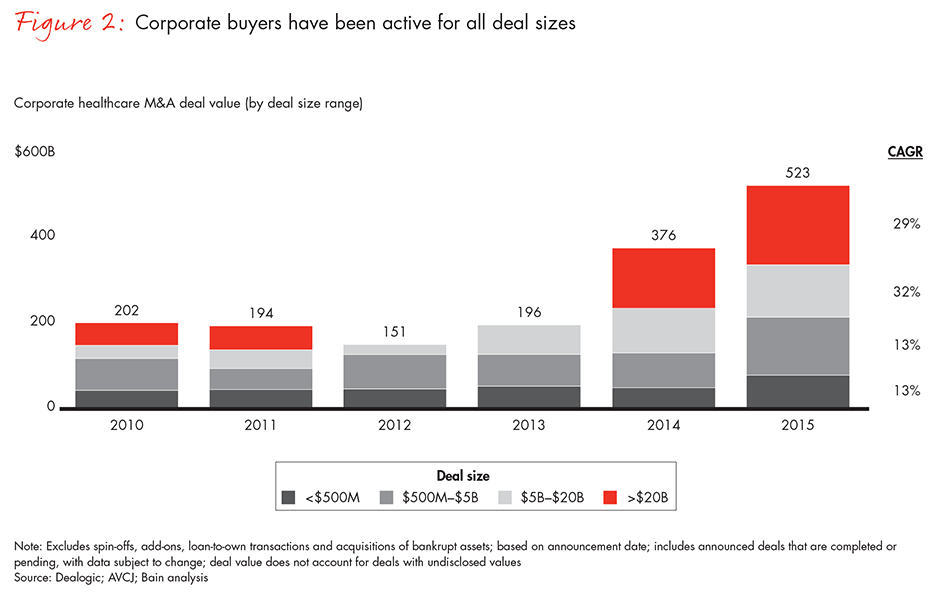
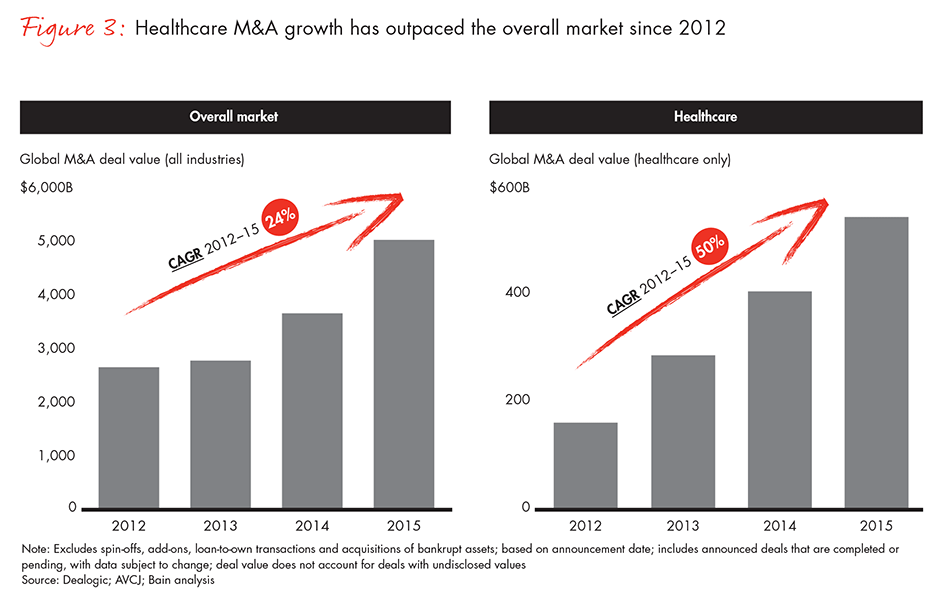
Healthcare M&A reached $546 billion in announced deal value in 2015—a 2.5 times increase over the previous decade’s average annual value (see Figure 1). Corporate buyers, which make up the largest share of healthcare M&A by far, likewise set a new record: $523 billion. Megamergers fueled much of the increase in value. Five deals over $20 billion were announced during the year (excluding the Pfizer-Allergan deal, which was called off in April 2016 and is excluded from this report’s analysis), which represented a third of healthcare M&A deal value. But even without these megamergers, corporate M&A in healthcare would have been well in excess of the average annual deal value of the previous decade, as corporate buyers pursued deals of all sizes (see Figure 2). Other industries joined healthcare in setting records, and global M&A deal value reached a new high of approximately $5 trillion in 2015.1 Yet healthcare activity stood out, with growth in healthcare deals significantly outpacing growth in overall M&A deals over the past three years (see Figure 3). From 2012 to 2015, overall M&A grew at a compound annual growth rate (CAGR) of 24% while healthcare M&A grew more than twice as fast, at a 50% CAGR. What is driving all of this M&A activity? The macro environment has favored M&A for several years. Tepid economic growth has made organic growth more challenging, spurring many firms to turn to inorganic methods to fuel meaningful topline improvements. The wide availability of inexpensive debt and strong equity values (albeit with more volatility beginning in the second half of 2015, as discussed later in this report) made M&A an attractive option. And in some cases, financial benefits like tax inversions also drove M&A activity. 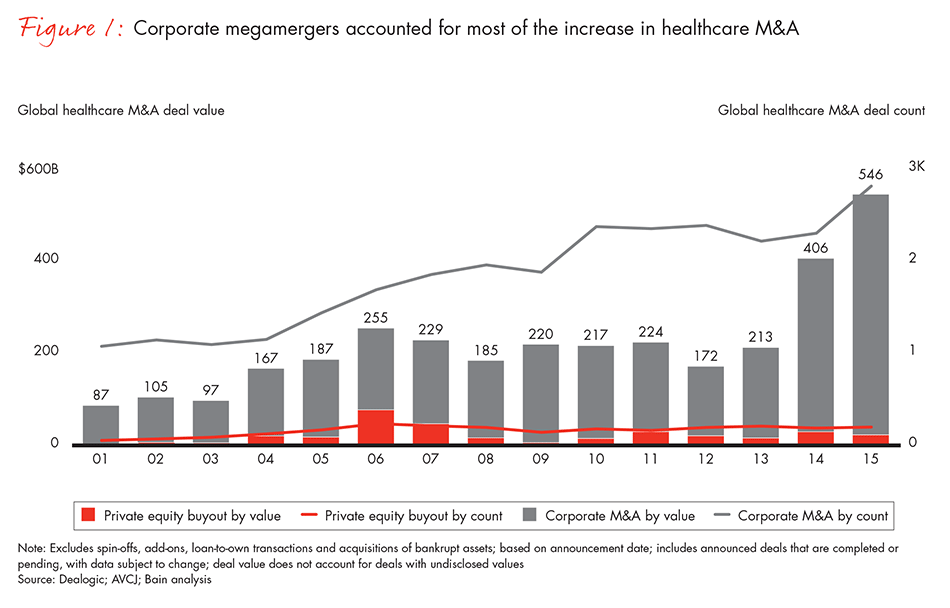
Beyond these macro conditions, several industry-specific trends further fueled the healthcare M&A boom. First, demand for healthcare is surging given the rise of chronic and lifestyle diseases, aging populations in many developed markets and a growing middle class in many developing regions. As a result, there will be continued pressure globally to contain healthcare costs, which have consistently outrun GDP growth. Innovation is bringing new drugs, devices, technology and analytics to market. And new government regulations aim to improve quality and increase access to healthcare. Taken together, these trends are shifting the way that healthcare is delivered across the globe, triggering consolidation along the value chain as firms position themselves to emerge as winners. Corporate buyers pursued many of the recent healthcare deals to advance their category leadership strategies, aiming to build or bolster leadership positions across their portfolios. This approach follows a clear downstream customer trend, in which desire for vendor consolidation and more sophisticated procurement practices clearly favor the category leaders. Consider drugmaker Shire, which recently made three acquisitions to build its leadership position in rare diseases. Shire acquired NPS Pharmaceuticals for $5.2 billion (announced and closed in 2015), Dyax for $5.9 billion (announced in 2015 and closed in 2016) and Baxalta for $32 billion (announced in 2016). In the global dental market, Dentsply, a leader in dental consumables, announced in 2015 that it would acquire high-tech dental equipment manufacturer Sirona for $5.5 billion. The value of these mergers will come from building scale in specific customer-defined categories rather than building scale broadly across the biopharma and medtech markets. Category leaders have deeper relationships with their customers, key opinion leaders and even regulators, which gives them better insight into the dynamics and evolution of the category. As a result, category leaders can better direct their R&D efforts and product portfolios to meet market needs, and they often attract the best talent and assets available. Shire’s acquisitions, for example, do not simply broaden its portfolio of drugs; they also deepen the company’s expertise in the rare disease market, including important capabilities like navigating the orphan drug approval process and managing targeted population clinical trials. And the combined Dentsply Sirona will have a more comprehensive product offering for its dental customers, as well as the right expertise to lead the charge as the equipment and consumables markets become more connected. In the US payer sector, megamergers that were announced in 2015—for example, Anthem’s $54 billion acquisition of Cigna and Aetna’s $37 billion acquisition of Humana—were partly influenced by category leadership and the desire to move into new customer segments. Generally, in the payer and provider sectors, the category is relevant at the local level given patients’ desire to have care delivered close to their homes. Providers’ continued consolidation and expansion across the value chain—adding physician practices, insurance capabilities and new sites of care through M&A and partnerships—has catalyzed consolidation among payers. These payer deals also enable acquirers to better access higher-growth segments within the broader sector. Another factor spurring healthcare M&A activity in recent years has been the financial benefit of tax inversions. Biopharma and medtech tend to be high-margin, global businesses, so a lower corporate tax rate can significantly benefit earnings. However, regulations are changing to curb the financial benefits of tax inversions, and some of these deals have been unwound because the strategic benefits alone are insufficient to offset the complexity that would come with the deal. Implications for corporate buyers Looking ahead, it is not clear how long the M&A bonanza will last, especially in light of the capital market volatility and strong possibility of a recession in the next few years. But M&A will continue to be an important avenue for growth in healthcare, regardless of the economic cycle, and a downturn typically turns up attractive buying opportunities. All companies, then, can benefit by focusing on five fundamentals:
Companies that excel in these activities raise the odds of over-delivering results from their M&A endeavors. Acknowledgments The authors of this report are Bain & Company partners Nirad Jain, Vikram Kapur, Franz-Robert Klingan, Kara Murphy, Tim van Biesen and Joshua Weisbrod. The report was prepared by Bain’s Healthcare Private Equity practice and a team led by Lauren Christman, a senior consultant in Bain’s Healthcare practice. The authors would like to thank Rebecca Levinsky, Tina Strasse, Andrew Criste and Justin Doshi for their contributions, John Peverley for his research assistance and John Campbell for his editorial support. We are grateful to Dealogic and AVCJ for the valuable data they provided for this report. This work is based on secondary market research, analysis of financial information available or provided to Bain & Company and interviews with industry participants. Bain & Company has not independently verified any such information provided or available to Bain and makes no representation or warranty, express or implied, that such information is accurate or complete. Projected market and financial information, analyses and conclusions contained herein are based on the information described above and on Bain & Company’s judgment, and should not be construed as definitive forecasts or guarantees of future performance or results. The information and analysis herein does not constitute advice of any kind, is not intended to be used for investment purposes, and neither Bain & Company nor any of its subsidiaries or their respective officers, directors, shareholders, employees or agents accept any responsibility or liability with respect to the use of or reliance on any information or analysis contained in this document. This work is copyright Bain & Company and may not be published, transmitted, broadcast, copied, reproduced or reprinted in whole or in part without the explicit written permission of Bain & Company. 1 See the Bain Brief “Maximizing Your Merger’s Potential” for more about overall M&A activity, including a discussion of three approaches to achieving a merger’s full potential. 2 See the Bain Brief “Simplify to Grow in Healthcare” for more on this topic. Note: Dealogic is the primary source for the M&A data in this report, supplemented with data from AVCJ and other public and private data sources. The dataset is based on deal announcement date and includes deals that are completed or pending, with data subject to change. Deal values do not account for deals with undisclosed values. Data excludes spin-offs, add-ons, loan-to-own transactions, acquisitions of bankrupt assets and private investments in public equity (PIPEs). The healthcare dataset includes healthcare-related deals that may be classified in other sectors by Dealogic. This methodology differs from that used in Bain’s Global Private Equity Report 2016, Asia-Pacific Private Equity Report 2016 and certain other Bain publications. |