
Skip to Content
  • Bureaux

    Bureaux

    Amérique du Nord et Amérique du Sud
    • Atlanta
    • Austin
    • Bogota
    • Boston
    • Buenos Aires
    • Chicago
    • Dallas
    • Denver
    • Houston
    • Los Angeles
    • Mexico City
    • Minneapolis
    • Monterrey
    • Montreal
    • New York
    • Rio de Janeiro
    • San Francisco
    • Santiago
    • São Paulo
    • Seattle
    • Silicon Valley
    • Toronto
    • Washington, DC
    Europe, Moyen-Orient et Afrique
    • Amsterdam
    • Athens
    • Berlin
    • Brussels
    • Copenhagen
    • Doha
    • Dubai
    • Dusseldorf
    • Frankfurt
    • Helsinki
    • Istanbul
    • Johannesburg
    • Kyiv
    • Lisbon
    • London
    • Madrid
    • Milan
    • Munich
    • Oslo
    • Paris
    • Riyadh
    • Rome
    • Stockholm
    • Vienna
    • Warsaw
    • Zurich
    Asie et Australie
    • Bangkok
    • Beijing
    • Bengaluru
    • Brisbane
    • Ho Chi Minh City
    • Hong Kong
    • Jakarta
    • Kuala Lumpur
    • Manila
    • Melbourne
    • Mumbai
    • New Delhi
    • Perth
    • Shanghai
    • Singapore
    • Sydney
    • Tokyo
    Voir tous les bureaux
  • Alumni
  • Presse
  • S’abonner
  • Contacter
  • Canada | Français

    Sélectionnez votre région et votre langue

    Global
    • Global (English)
    Amérique du Nord et Amérique du Sud
    • Brazil (Português)
    • Argentina (Español)
    • Canada (Français)
    • Chile (Español)
    • Colombia (Español)
    Europe, Moyen-Orient et Afrique
    • France (Français)
    • DACH Region (Deutsch)
    • Italy (Italiano)
    • Spain (Español)
    • Greece (Elliniká)
    Asie et Australie
    • China (中文版)
    • Korea (한국어)
    • Japan (日本語)
  • Saved items (0)
    Saved items (0)

    You have no saved items.

    Bookmark content that interests you and it will be saved here for you to read or share later.

    Explore Bain Insights
  • Expertises Sectorielles
    Menu principal

    Expertises Sectorielles

    • Aerospace et Défense
    • Agroalimentaire
    • Chimie
    • Infrastructures, BTP et Matériaux de Construction
    • Grande Consommation
    • Services Financiers
    • Santé
    • Engins & Equipements Industriels
    • Media et Divertissement
    • Metals
    • Mining
    • Pétrole & Gaz
    • Papier et Emballage
    • Private Equity
    • Secteur Public
    • Distribution
    • Technologie
    • Télécommunications
    • Transportation
    • Travel & Leisure
    • Utilities & Energies Renouvelables
  • Expertises Fonctionnelles
    Menu principal

    Expertises Fonctionnelles

    • Expérience Client
    • ESG
    • Innovation
    • Fusions et Acquisitions
    • Opérations
    • People & Organization
    • Private Equity
    • Sales & Marketing
    • Stratégie
    • IA, Perspectives et Solutions
    • Technology
    • Transformation
  • Digital
  • Points de Vue
  • About
    Menu principal

    About

    • Notre Activité
    • Nos Valeurs
    • Nos Collaborateurs et Notre Équipe Dirigeante
    • Notre Impact
    • Prix & Récompenses
    • Partenariats Internationaux
    Further: Our global responsibility
    • Sustainability
    • Impact Social
    • World Economic Forum
    Learn more about Further
  • Carrières
    Menu principal

    Carrières

    • Rejoignez-nous
      Carrières
      Rejoignez-nous
      • Find Your Place
      • Nos domaines d’expertise
      • Equipes multidisciplinaires
      • Étudiants
      • Stages et programmes
      • Événements de recrutement
    • La vie chez Bain
      Carrières
      La vie chez Bain
      • Blog: Inside Bain
      • Récits de carrière
      • Nos collaborateurs
      • Nos bureaux
      • Soutenir votre évolution professionnelle
      • Groupes d’affinités
      • Avantages chez Bain
    • Histoires d’impact
    • Notre processus de recrutement
      Carrières
      Notre processus de recrutement
      • Ce que vous pouvez attendre
      • Entretiens
    Trouver un poste
  • Bureaux
    Menu principal

    Bureaux

    • Amérique du Nord et Amérique du Sud
      Bureaux
      Amérique du Nord et Amérique du Sud
      • Atlanta
      • Austin
      • Bogota
      • Boston
      • Buenos Aires
      • Chicago
      • Dallas
      • Denver
      • Houston
      • Los Angeles
      • Mexico City
      • Minneapolis
      • Monterrey
      • Montreal
      • New York
      • Rio de Janeiro
      • San Francisco
      • Santiago
      • São Paulo
      • Seattle
      • Silicon Valley
      • Toronto
      • Washington, DC
    • Europe, Moyen-Orient et Afrique
      Bureaux
      Europe, Moyen-Orient et Afrique
      • Amsterdam
      • Athens
      • Berlin
      • Brussels
      • Copenhagen
      • Doha
      • Dubai
      • Dusseldorf
      • Frankfurt
      • Helsinki
      • Istanbul
      • Johannesburg
      • Kyiv
      • Lisbon
      • London
      • Madrid
      • Milan
      • Munich
      • Oslo
      • Paris
      • Riyadh
      • Rome
      • Stockholm
      • Vienna
      • Warsaw
      • Zurich
    • Asie et Australie
      Bureaux
      Asie et Australie
      • Bangkok
      • Beijing
      • Bengaluru
      • Brisbane
      • Ho Chi Minh City
      • Hong Kong
      • Jakarta
      • Kuala Lumpur
      • Manila
      • Melbourne
      • Mumbai
      • New Delhi
      • Perth
      • Shanghai
      • Singapore
      • Sydney
      • Tokyo
    Voir tous les bureaux
  • Alumni
  • Presse
  • S’abonner
  • Contacter
  • Canada | Français
    Menu principal

    Sélectionnez votre région et votre langue

    • Global
      Sélectionnez votre région et votre langue
      Global
      • Global (English)
    • Amérique du Nord et Amérique du Sud
      Sélectionnez votre région et votre langue
      Amérique du Nord et Amérique du Sud
      • Brazil (Português)
      • Argentina (Español)
      • Canada (Français)
      • Chile (Español)
      • Colombia (Español)
    • Europe, Moyen-Orient et Afrique
      Sélectionnez votre région et votre langue
      Europe, Moyen-Orient et Afrique
      • France (Français)
      • DACH Region (Deutsch)
      • Italy (Italiano)
      • Spain (Español)
      • Greece (Elliniká)
    • Asie et Australie
      Sélectionnez votre région et votre langue
      Asie et Australie
      • China (中文版)
      • Korea (한국어)
      • Japan (日本語)
  • Saved items  (0)
    Menu principal
    Saved items (0)

    You have no saved items.

    Bookmark content that interests you and it will be saved here for you to read or share later.

    Explore Bain Insights
  • Expertises Sectorielles
    • Expertises Sectorielles

      • Aerospace et Défense
      • Agroalimentaire
      • Chimie
      • Infrastructures, BTP et Matériaux de Construction
      • Grande Consommation
      • Services Financiers
      • Santé
      • Engins & Equipements Industriels
      • Media et Divertissement
      • Metals
      • Mining
      • Pétrole & Gaz
      • Papier et Emballage
      • Private Equity
      • Secteur Public
      • Distribution
      • Technologie
      • Télécommunications
      • Transportation
      • Travel & Leisure
      • Utilities & Energies Renouvelables
  • Expertises Fonctionnelles
    • Expertises Fonctionnelles

      • Expérience Client
      • ESG
      • Innovation
      • Fusions et Acquisitions
      • Opérations
      • People & Organization
      • Private Equity
      • Sales & Marketing
      • Stratégie
      • IA, Perspectives et Solutions
      • Technology
      • Transformation
  • Digital
  • Points de Vue
  • Carrières
    Recherches les plus fréquentes
    • Agile
    • Digital
    • Stratégie
    Vos recherches précédentes
      Pages récemment visitées

      Content added to saved items

      Saved items (0)

      Removed from saved items

      Saved items (0)

      Etude

      Killing Complexity Before Complexity Kills Growth

      Killing Complexity Before Complexity Kills Growth

      How to restore a Founder's Mentality, including intolerance for bureaucracy.

      Par Ron Kermisch and Jed Fallis

      • min
      }

      Etude

      Killing Complexity Before Complexity Kills Growth
      en

      Why do so many companies lose their way? When companies are just starting out, they have no problem identifying the path before them. The founders know where they’re headed, who their customers are and how they hope to succeed. Often, they see themselves as insurgents—on a mission to fill customer needs that incumbents have overlooked or ignored. Founders obsess over the details. They abhor bureaucracy and personally keep tabs on what is happening on the front line to make sure they’re still on top of their markets. Employees take their cues from the founders and keep finding new ways to please customers, do their jobs better and increase sales.

      The problem is that most companies lose the Founder’s Mentality® as they grow. But size itself is not really the problem—some corporations (a lucky few) manage to maintain the founder’s mentality, even as they grow into major multinationals. What really hurts the founder’s mentality and hamstrings large organizations is complexity. Complexity is the “silent killer” of growth, creeping in unnoticed as companies expand into new geographies and lines of business. Layers, ranks and titles build up, and the connection to the front line is severed. Instead of keeping up with customers, management spends most of its time on process.

      Inside the Founder's Mentality

      Explore how companies that nurture and maintain three key traits are more likely to sustain growth.

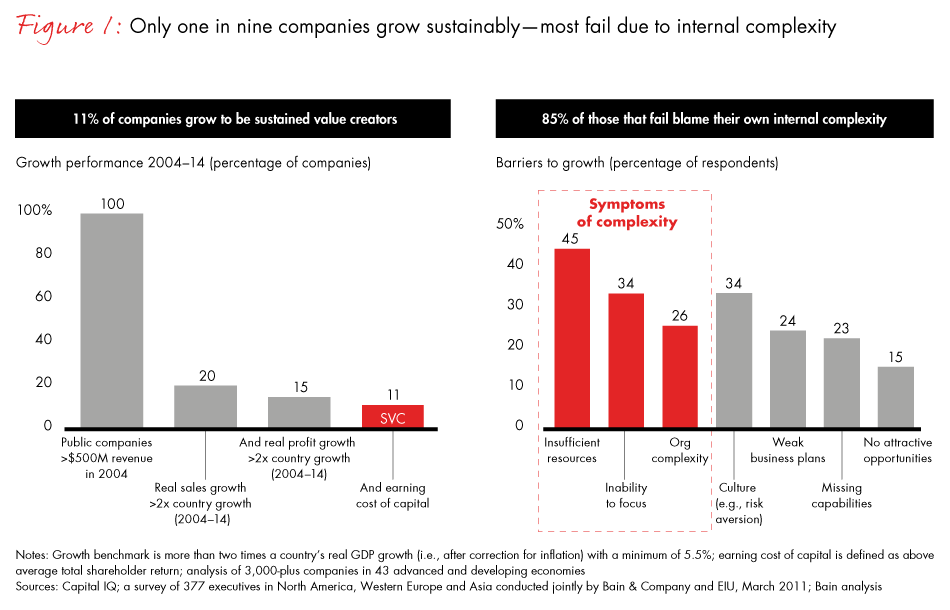
      In many cases, what comes next is stall-out: a precipitous drop in sales, from which it is very difficult to recover. The company that has lost the founder’s mentality has morphed into the sluggish incumbent that the upstarts can beat. Indeed, only 11% of large companies (public companies with more than $500 million in sales) become sustained value creators. Two-thirds stall out, fail or are acquired. In a Bain & Company survey, 85% of CEOs in companies that have ceased to be value creators blame internal factors such as complexity, not external factors, for their woes (see Figure 1). Complexity kills, but companies don’t need to succumb. Leaders who recognize the threat can intervene and simplify their organizations before it’s too late. Done correctly, organizational simplification enables a company to build a new operating model that restores the speed and focus of the founder’s mentality and reenergizes its people. And, unlike reorganizations aimed primarily at cost—which, by the way, rarely stick because they deal mostly with symptoms—an organizational simplification can deliver sustained performance improvement because it addresses unneeded complexity that drives cost and limits responsiveness.

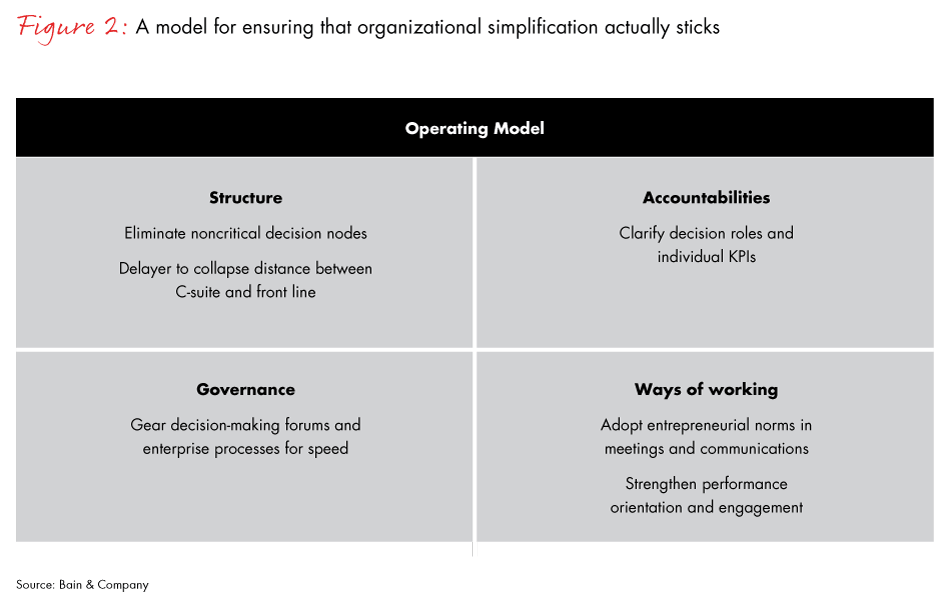
      Organizational simplification does not mean just redrawing the org chart. It also requires streamlining processes through changes in accountabilities, governance and ways of working. Without all these elements, organizational simplification won’t deliver lasting results; before long, complexity will creep back in (see Figure 2). In practice, organizational simplification is often performed in tandem with business simplification, which might include shedding less productive geographies and lines of business to regain strategic focus.
      killing-complexity-fig01_embed

      killing-complexity-fig02_embed

      The restructuring itself involves dramatically delayering the organization and eliminating unnecessary nodes. Nodes are intersections in the corporate matrix where an executive or manager sits, where decisions are made or where financial reporting takes place. Critical interactions needed to keep the company going take place at nodes, but companies tend to build up unnecessary nodes, which slow down decision making, reduce responsiveness and can inhibit change and innovation. Nodes can be viewed as a proxy for complexity; having too many is a danger sign.

      To understand what effective organizational simplification looks like in practice, consider the turnaround at a major insurance company. The company had gone through a major reorganization after the global financial crisis, but seven years later it was still suffering from the effects of complexity. For example, its core insurance business had extensive country and product organizations, as well as functional units (finance, etc.). This created redundancies and thousands of unnecessary nodes since the matrix extended six or seven levels deep in the organization.

      But what hurt the business—and created the urgency to change—was the loss of customer-centric focus that this complexity caused. A sharp focus on customers and markets had been an enduring legacy of the founder and had helped to keep the company an industry leader. In recent years, however, the focus had turned inward. Functions were managed to avoid risk, and managers strove to deliver on internal performance metrics, rather than to provide the best products and services to drive growth. Service began to lag and the company was having trouble keeping up with changes in the market. It took three times longer to issue a policy than other insurers. Customers received multiple bills from different parts of the company, whereas competitors offered a “unified” experience.

      Ron Kermisch, a partner in the Organization practice, discusses how incumbent companies can simplify their organizations to get back their mojo and return to the path of sustainable growth.

      Competitors seized the advantage. When one rival launched a successful online channel in an important country’s market, local leaders knew they were in trouble. But the company was slow to respond because authorization and funding decisions required multiple approvals. Similar scenarios played out across the company, as hundreds of decisions—big and small—were bogged down because they had to pass through too many nodes. Adding to the urgency for change, the company was having little success in its attempts to reduce its cost base and shareholders were clamoring for better results.

      Leadership realized that it would take a sweeping organizational simplification effort to address these problems. In 2015, it organized a team to lead the effort to restore a customer-centric focus, speed up decision making, redirect talent and energy to driving growth, and reduce personnel costs by 10%. The group began with a diagnostic, which included input from customers as well as benchmarking against industry peers. Then, through a series of workshops, they sketched out the “future state” for how the company would function. Working backward from there, they began to draw the organizational structure and reporting relationships to make that future a reality. The team also identified the most critical activities for the future state and those that were nonessential.

      To restore customer focus, the team pushed decision making closer to the customer for key decisions (i.e., into the countries) but also made the country organizations subservient to the product houses and eliminated the regional infrastructure. This resulted in clear ownership for decisions, gave the product houses “end-to-end” responsibility for the customer experience and reduced the three-dimensional matrix to a two-dimensional matrix. The net effect: a more direct connection between the front line and leadership. The reorganization eliminated nodes below the level of relatively senior executives so that the vast majority of people would have only one boss. This dramatically reduced the number of matrix reporting relationships.

      Implementation began in 2016 and included a significant change-management program to build commitment to the new way of doing things. Employees would assume new roles and responsibilities and have to adopt new ways of working to reclaim lost responsiveness and speed. The company clarified decision roles and assigned accountability for hundreds of decisions. To reinforce the behaviors needed in the redesigned organization, the company rolled out new performance metrics that focused on critical factors needed for growth and better customer outcomes. The company also reworked governance models to focus more sharply on critical areas such as limiting cost growth, and eliminated oversight that stood in the way of speedy execution.

      Most important, everyone from the front line to the C-suite had to embrace a new way of working. Where there had been bureaucratic wheel-spinning and risk avoidance, the company wanted to see collaboration and entrepreneurism. The company would no longer tolerate “energy vampires” who cranked out templates, scheduled meetings, avoided ownership of decisions or stopped action with requests for one more round of analysis.

      Learn More

      Founder's Mentality

      Fast-growing companies can become global leaders without losing the values that helped them succeed. Bain’s research explores how large incumbents can also reignite their growth by recapturing their Founder’s Mentality®.

      In the first year, the organizational simplification removed hundreds of millions of dollars from the cost base and enabled the company to start moving faster. For example, in the old organization, country managers, regional leads and multiple levels of product management provided input into product decisions. But because of uncertainty about decision rights, too many issues were elevated to a very senior level, slowing responsiveness. The new model balances the need for frontline decision making with global guidelines. Responsiveness to customer needs has improved dramatically.

      Restoring the energy and sense of purpose that most companies are born with can be transformative. Companies can indeed get their mojo back. But they also have to work to keep it. For example, once a company has removed unnecessary nodes, it can create a nodes-management system to ensure that complexity does not creep back in. Leaders can help sustain performance improvements by making a conscious effort to model the founder’s mentality. They should inspire with bold goals, commit to continued simplification to make life easier for workers and celebrate wins along the way.

      Ron Kermisch is a partner and director in Bain & Company’s Boston office. Jed Fallis is a partner in Bain & Company’s Toronto office.

      Founder’s Mentality® is a registered trademark of Bain & Company, Inc.


      killing-complexity-fig01_full

      killing-complexity-fig02_full
      Auteurs
      • Headshot of Ron Kermisch
        Ron Kermisch
        Advisory Partner, Boston
      • Headshot of Jed Fallis
        Jed Fallis
        Partner, Toronto
      Contactez-nous
      Expertises fonctionnelles transverses
      • Accelerated Performance Transformation
      • Operating Model & Org Design
      Comment pouvons-nous vous aider ?
      • Complexity Management
      • Zero-based Redesign
      Stratégie
      Barriers and Pathways to Sustainable Growth: Harnessing the Power of the Founder's Mentality

      Some companies have been able to anticipate and address the internal obstacles to growth.

      Voir plus
      Zero-based Redesign
      Radical Change through Zero-Based Redesign

      A clean-slate approach helps companies make structural changes that dramatically reduce costs and improve performance.

      Voir plus
      Founder's Mentality
      The Magic of Founder-led Companies

      Companies with their founder present performed twice as well as their peers in the S&P 500 over the past decade.

      Voir plus
      Accelerated Performance Transformation
      Retooling for the New Cost Imperative

      To accelerate growth in the crisis, companies need to act on five big themes.

      Voir plus
      Founder's Mentality
      Joyful Routines

      How “joyful routines” rooted in purpose, simplicity, and frontline empowerment can transform execution into a source of energy and growth.

      Voir plus
      First published in avril 2017
      Mots clés
      • Accelerated Performance Transformation
      • Complexity Management
      • Founder's Mentality
      • Operating Model & Org Design
      • Zero-based Redesign

      Comment nous avons aidé nos clients

      A Go-to-Market Redesign Helps a Tech Company Thrive

      Lire l’étude de cas

      A Global Retailer Transforms Technology and Data to Conquer the Digital Future

      Lire l’étude de cas

      Zero-based Redesign Puts a MedTech Leader on a Path to Sustainable Growth

      Lire l’étude de cas

      Vous souhaitez continuer cette conversation ?

      Nous aidons des dirigeants du monde entier à matérialiser des impacts et des résultats pérennes et créateurs de valeur dans leurs organisations.

      Les points de vue de Bain : notre perspective sur des problématiques auxquelles sont confrontées les entreprises à travers le monde, envoyés chaque mois dans votre boîte de réception. 

      *J’ai lu la politique de confidentialité et j’accepte les conditions.

      Merci de lire notre politique de confidentialité.
      Bain & Company
      Contactez-nous Sustainability Accessibility Conditions d’utilisation Politique de Confidentialité Cookie Policy Mentions Légales Sitemap Log In

      © 1996-2026 Bain & Company, Inc.

      Contacter Bain

      Comment pouvons-nous vous aider ?

      • Business inquiry
      • Career information
      • Press relations
      • Partnership request
      • Speaker request
      Voir tous les bureaux