
Skip to Content
  • Bureaux

    Bureaux

    Amérique du Nord et Amérique du Sud
    • Atlanta
    • Austin
    • Bogota
    • Boston
    • Buenos Aires
    • Chicago
    • Dallas
    • Denver
    • Houston
    • Los Angeles
    • Mexico City
    • Minneapolis
    • Monterrey
    • Montreal
    • New York
    • Rio de Janeiro
    • San Francisco
    • Santiago
    • São Paulo
    • Seattle
    • Silicon Valley
    • Toronto
    • Washington, DC
    Europe, Moyen-Orient et Afrique
    • Amsterdam
    • Athens
    • Berlin
    • Brussels
    • Copenhagen
    • Doha
    • Dubai
    • Dusseldorf
    • Frankfurt
    • Helsinki
    • Istanbul
    • Johannesburg
    • Kyiv
    • Lisbon
    • London
    • Madrid
    • Milan
    • Munich
    • Oslo
    • Paris
    • Riyadh
    • Rome
    • Stockholm
    • Vienna
    • Warsaw
    • Zurich
    Asie et Australie
    • Bangkok
    • Beijing
    • Bengaluru
    • Brisbane
    • Ho Chi Minh City
    • Hong Kong
    • Jakarta
    • Kuala Lumpur
    • Manila
    • Melbourne
    • Mumbai
    • New Delhi
    • Perth
    • Shanghai
    • Singapore
    • Sydney
    • Tokyo
    Voir tous les bureaux
  • Alumni
  • Presse
  • S’abonner
  • Contacter
  • Canada | Français

    Sélectionnez votre région et votre langue

    Global
    • Global (English)
    Amérique du Nord et Amérique du Sud
    • Brazil (Português)
    • Argentina (Español)
    • Canada (Français)
    • Chile (Español)
    • Colombia (Español)
    Europe, Moyen-Orient et Afrique
    • France (Français)
    • DACH Region (Deutsch)
    • Italy (Italiano)
    • Spain (Español)
    • Greece (Elliniká)
    Asie et Australie
    • China (中文版)
    • Korea (한국어)
    • Japan (日本語)
  • Saved items (0)
    Saved items (0)

    You have no saved items.

    Bookmark content that interests you and it will be saved here for you to read or share later.

    Explore Bain Insights
  • Expertises Sectorielles
    Menu principal

    Expertises Sectorielles

    • Aerospace et Défense
    • Agroalimentaire
    • Chimie
    • Infrastructures, BTP et Matériaux de Construction
    • Grande Consommation
    • Services Financiers
    • Santé
    • Engins & Equipements Industriels
    • Media et Divertissement
    • Metals
    • Mining
    • Pétrole & Gaz
    • Papier et Emballage
    • Private Equity
    • Secteur Public
    • Distribution
    • Technologie
    • Télécommunications
    • Transportation
    • Travel & Leisure
    • Utilities & Energies Renouvelables
  • Expertises Fonctionnelles
    Menu principal

    Expertises Fonctionnelles

    • Expérience Client
    • ESG
    • Innovation
    • Fusions et Acquisitions
    • Opérations
    • People & Organization
    • Private Equity
    • Sales & Marketing
    • Stratégie
    • IA, Perspectives et Solutions
    • Technology
    • Transformation
  • Digital
  • Points de Vue
  • About
    Menu principal

    About

    • Notre Activité
    • Nos Valeurs
    • Nos Collaborateurs et Notre Équipe Dirigeante
    • Notre Impact
    • Prix & Récompenses
    • Partenariats Internationaux
    Further: Our global responsibility
    • Sustainability
    • Impact Social
    • World Economic Forum
    Learn more about Further
  • Carrières
    Menu principal

    Carrières

    • Rejoignez-nous
      Carrières
      Rejoignez-nous
      • Find Your Place
      • Nos domaines d’expertise
      • Equipes multidisciplinaires
      • Étudiants
      • Stages et programmes
      • Événements de recrutement
    • La vie chez Bain
      Carrières
      La vie chez Bain
      • Blog: Inside Bain
      • Récits de carrière
      • Nos collaborateurs
      • Nos bureaux
      • Soutenir votre évolution professionnelle
      • Groupes d’affinités
      • Avantages chez Bain
    • Histoires d’impact
    • Notre processus de recrutement
      Carrières
      Notre processus de recrutement
      • Ce que vous pouvez attendre
      • Entretiens
    Trouver un poste
  • Bureaux
    Menu principal

    Bureaux

    • Amérique du Nord et Amérique du Sud
      Bureaux
      Amérique du Nord et Amérique du Sud
      • Atlanta
      • Austin
      • Bogota
      • Boston
      • Buenos Aires
      • Chicago
      • Dallas
      • Denver
      • Houston
      • Los Angeles
      • Mexico City
      • Minneapolis
      • Monterrey
      • Montreal
      • New York
      • Rio de Janeiro
      • San Francisco
      • Santiago
      • São Paulo
      • Seattle
      • Silicon Valley
      • Toronto
      • Washington, DC
    • Europe, Moyen-Orient et Afrique
      Bureaux
      Europe, Moyen-Orient et Afrique
      • Amsterdam
      • Athens
      • Berlin
      • Brussels
      • Copenhagen
      • Doha
      • Dubai
      • Dusseldorf
      • Frankfurt
      • Helsinki
      • Istanbul
      • Johannesburg
      • Kyiv
      • Lisbon
      • London
      • Madrid
      • Milan
      • Munich
      • Oslo
      • Paris
      • Riyadh
      • Rome
      • Stockholm
      • Vienna
      • Warsaw
      • Zurich
    • Asie et Australie
      Bureaux
      Asie et Australie
      • Bangkok
      • Beijing
      • Bengaluru
      • Brisbane
      • Ho Chi Minh City
      • Hong Kong
      • Jakarta
      • Kuala Lumpur
      • Manila
      • Melbourne
      • Mumbai
      • New Delhi
      • Perth
      • Shanghai
      • Singapore
      • Sydney
      • Tokyo
    Voir tous les bureaux
  • Alumni
  • Presse
  • S’abonner
  • Contacter
  • Canada | Français
    Menu principal

    Sélectionnez votre région et votre langue

    • Global
      Sélectionnez votre région et votre langue
      Global
      • Global (English)
    • Amérique du Nord et Amérique du Sud
      Sélectionnez votre région et votre langue
      Amérique du Nord et Amérique du Sud
      • Brazil (Português)
      • Argentina (Español)
      • Canada (Français)
      • Chile (Español)
      • Colombia (Español)
    • Europe, Moyen-Orient et Afrique
      Sélectionnez votre région et votre langue
      Europe, Moyen-Orient et Afrique
      • France (Français)
      • DACH Region (Deutsch)
      • Italy (Italiano)
      • Spain (Español)
      • Greece (Elliniká)
    • Asie et Australie
      Sélectionnez votre région et votre langue
      Asie et Australie
      • China (中文版)
      • Korea (한국어)
      • Japan (日本語)
  • Saved items  (0)
    Menu principal
    Saved items (0)

    You have no saved items.

    Bookmark content that interests you and it will be saved here for you to read or share later.

    Explore Bain Insights
  • Expertises Sectorielles
    • Expertises Sectorielles

      • Aerospace et Défense
      • Agroalimentaire
      • Chimie
      • Infrastructures, BTP et Matériaux de Construction
      • Grande Consommation
      • Services Financiers
      • Santé
      • Engins & Equipements Industriels
      • Media et Divertissement
      • Metals
      • Mining
      • Pétrole & Gaz
      • Papier et Emballage
      • Private Equity
      • Secteur Public
      • Distribution
      • Technologie
      • Télécommunications
      • Transportation
      • Travel & Leisure
      • Utilities & Energies Renouvelables
  • Expertises Fonctionnelles
    • Expertises Fonctionnelles

      • Expérience Client
      • ESG
      • Innovation
      • Fusions et Acquisitions
      • Opérations
      • People & Organization
      • Private Equity
      • Sales & Marketing
      • Stratégie
      • IA, Perspectives et Solutions
      • Technology
      • Transformation
  • Digital
  • Points de Vue
  • Carrières
    Recherches les plus fréquentes
    • Agile
    • Digital
    • Stratégie
    Vos recherches précédentes
      Pages récemment visitées

      Content added to saved items

      Saved items (0)

      Removed from saved items

      Saved items (0)

      Etude

      Tariffs: The Costs of Inaction

      Tariffs: The Costs of Inaction

      Trade levies are more than a headline. As tariffs tighten their grip on global commerce, companies must act decisively to mitigate risks and seize opportunities.

      Par Karen Harris, François Faelli, Hugo Parkinson, et Dunigan O'Keeffe

      • min
      }

      Etude

      Tariffs: The Costs of Inaction
      en

      Tariffs are no longer a distant policy issue; they are an immediate and complex challenge affecting most businesses. Leadership teams need to act decisively to navigate this disruptive landscape and plan for the broader implications in a fragmented global economy. Both short-term decisions and long-term strategies are essential to mitigate risks and capitalize on shifting opportunities.

      It helps to put tariffs in context, as symptoms of a larger geopolitical trend: the move from a globalized world to a post-global one. After decades of integrating markets, electorates are pushing back against policies of economic integration, with many nations implementing or considering more protectionist policies, to the detriment of nations that rely on exports. Fragmented markets are more costly for businesses and punish mistakes of prediction or forecasting more severely.

      Beware the lure of simplistic answers

      Predicting the precise impact of tariffs is a fraught exercise. Currency adjustments, retaliatory tariffs, and shifting trade flows create ripple effects that defy linear calculation. Efforts to quantify these impacts can sometimes yield false precision, leaving businesses ill prepared for the complexities ahead. Strategic responses require a balanced grasp of uncertainty, not blind reliance on models or assumptions.

      In general, a tariff is just a specific instance of a government tax that raises government savings (government revenue minus government spending), at the expense of different sectors of the economy: Households may incur higher prices, businesses may generate lower profits, and foreign trading partners may take a hit to their balance of trade. Which sectors ultimately bear the cost of a government’s change in policy is determined by a complex mix of supply and demand balances that vary across products and within those products’ value chains. 

      In the event of a broad increase in tariffs, it is virtually impossible to fully anticipate the net effect of the policy. We can, however, say it’s unlikely that the cost of the tariffs will be fully borne by either consumers or foreign entities. While the global economy is in a very different place than it was in 2017, back then tariffs had a negligible impact on US consumer price inflation; at the product level, though, the impact was varied, and it changed over time as well. 

      Beyond that, any changes in US tariff policy will produce many effects and countereffects, both within the US economy (e.g., the creation of domestic substitutes) and outside the US economy (e.g., the diversion of trade flows from tariffed to non-tariffed countries). While these effects would undoubtedly disrupt business plans and operations, they will also tend to mitigate the macroeconomic effects.

      More broadly, inflationary pressures from tariffs may be lower than many leadership teams assume (see Figure 1). To use an example of a highly disruptive scenario—the immediate imposition of 100% import tariffs on China—the net inflationary shock is likely to be substantially less acute than the post-pandemic inflationary shock when supply was globally constrained while demand was stimulated.

      Figure 1
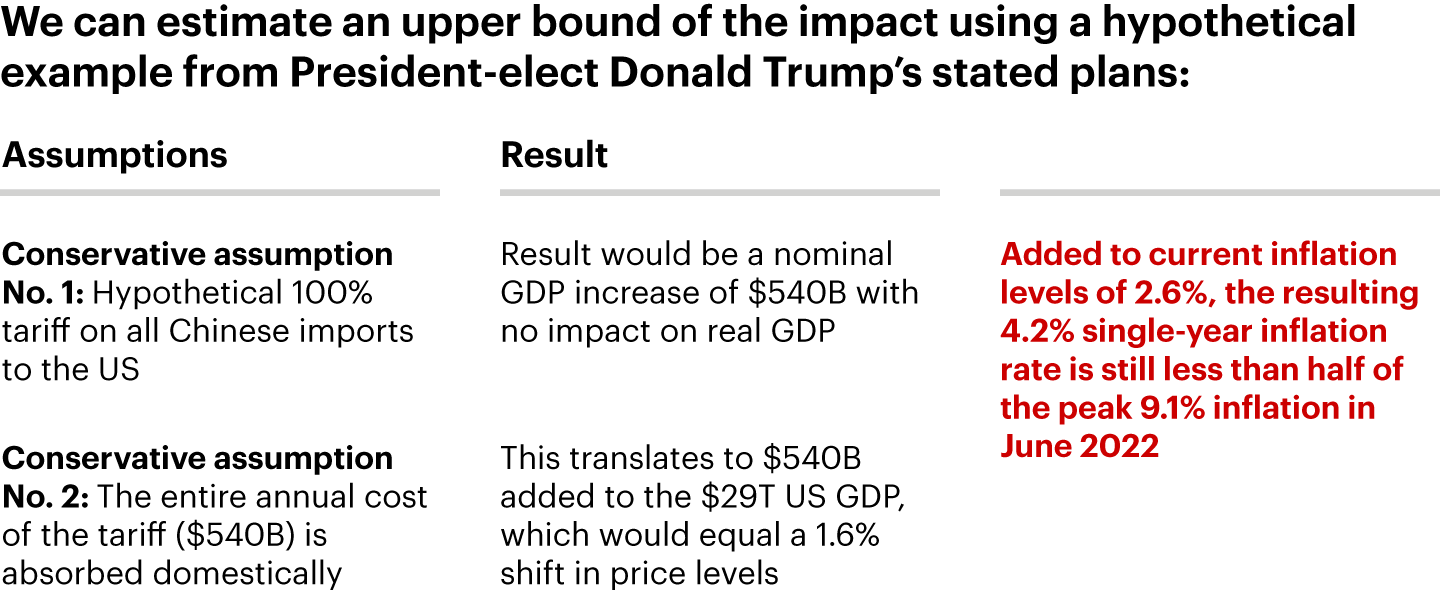
      The overall price impact could be more muted than post-pandemic inflation
      Source: Bain & Company

      Act now, plan now: A double-edged imperative

      Winning in this new world order requires action on two fronts: the immediate and the long-term.

      Act now

      Businesses can mobilize around three key imperatives:

      • Understand your value chain—upstream and downstream—and where it crosses borders. Develop a view of your competitors' exposures and where you are more or less exposed.
      • Determine the breakpoints that will force a business shift—what tariff levels, for what duration, would change decisions?
      • Identify where you have negotiating and pricing leverage and where you need to develop it.

      It’s vital to assess tariff exposure at a company level, as the implications will vary significantly between companies even within one industry. Automakers, for example, have divergent pathways depending on the setup of their supply chains. They can act to optimize their existing footprint, by reshuffling volumes to make US production for the local market and assemble to their maximum capacity at US sites. They can also invest in increasing the flexibility of their existing manufacturing footprint, to ramp volumes up and down as conditions require. And they can reevaluate future large-scale investments in their existing footprint.

      Plan now

      In a world of fractured trade, long-term success hinges on strategies that emphasize prediction, adaptability, and resilience. A key element involves developing hedges and optionality to buy yourself room to maneuver.

      Having mapped their value chains as part of “Act now,” companies can take a more disciplined approach to understanding their exposures more broadly. The process of understanding supply chain exposures, for example, may reveal challenges of monitoring and analyzing potential disruptions and the need to build that capability quickly to deal with volatility.

      The first step is to align around your company’s worldview. Given the global realignment, analyze your company the way an activist investor would. What is the two-page deal thesis that describes what drives the value for this market? What critical markets, products, and suppliers are required and fundamental to the valuation of the company? Scanning that deal thesis, what are your company’s critical exposures?

      Prediction. This capability involves generating beliefs about the future of your industry with enough conviction to trigger actions that can create competitive advantage. Realistically, precision will remain elusive amid the countervailing forces unleashed by tariffs, and the greater risk is overconfidence. Instead, focus on which impact matters to your business. How large is the potential impact to your revenue and margins in an extreme but plausible outcome?

      • Will we face a new tariff/cost barrier, and if so, what is the magnitude and how long will this last?

      Adaptability. Being adaptable means changing the business faster than competitors are changing. The most successful companies will also match their adaptation to the rate of change of the policy environment, which is evolving fast in this case.

      • Will our overseas competitors react by lowering price and outhustling us in our current markets? If so, can we find other markets? Will those be sufficient?

      Resilience. Companies with superior resilience survive shocks better than their competitors do. If companies can’t adapt quickly enough, their ability to build resilience becomes paramount. The extent of pain they can endure—and their strategies to mitigate it—needs to shape the response. This will depend on time horizon as well: The capacity to absorb pain does eventually time out.

      • Do we buy a business whose main source of value is “if things go wrong”?

      Navigating complexity, securing opportunity

      Tariffs are manifestations of a broader economic realignment, one that will reshape how businesses operate. Companies that respond with urgency and sophistication will not only weather the disruption but position themselves as leaders in a post-global era. For those that hesitate, the costs could be steep—and irreversible.

      Auteurs
      • Headshot of Karen Harris
        Karen Harris
        Managing Director, Macro Trends Group, New York
      • Headshot of François Faelli
        François Faelli
        Partner, Brussels
      • Headshot of Hugo Parkinson
        Hugo Parkinson
        Partner, London
      • Headshot of Dunigan O'Keeffe
        Dunigan O'Keeffe
        Partner, San Francisco
      Contactez-nous
      Expertises fonctionnelles transverses
      • Macro Strategy
      • Opérations
      • Procurement
      • Supply Chain
      Macro Tendances
      Tariff Response: What You Need to Know

      Bain's Karen Harris and Hernan Saenz discuss the lasting impact of tariffs, what leading companies are doing to adapt, and the strategic moves to make for success.

      Voir plus
      Macro Tendances
      Tariffs: The Next Chapter

      Companies need to rebuild their strategies for a world in which the free movement of goods, capital, IP, and people cannot be taken for granted.

      Voir plus
      Macro Tendances
      The New Case for Zero-Based Cost Management

      A clean-sheet approach helps leaders produce savings that stick—even in turbulent times.

      Voir plus
      Macro Tendances
      Beyond Tariffs: The Supply Chain Reinvention Imperative

      Tariffs are accelerating businesses’ operations overhaul. Winning in today’s disrupted world demands bold trade-offs and strategic transformation.

      Voir plus
      Macro Tendances
      In an Era of Tariffs and Turbulence, Four Moves That Matter

      Understand your exposure. Understand your competitors’ exposure. Adjust your pricing and supply chains accordingly. Repeat as necessary.

      Voir plus
      First published in décembre 2024
      Mots clés
      • Macro Strategy
      • Macro Tendances
      • Opérations
      • Procurement
      • Supply Chain
      • Tariff Response

      Comment nous avons aidé nos clients

      New sourcing plan lowers costs

      Lire l’étude de cas

      Don't give customers options they don't want

      Lire l’étude de cas

      Carmaker shifts its production model

      Lire l’étude de cas

      Vous souhaitez continuer cette conversation ?

      Nous aidons des dirigeants du monde entier à matérialiser des impacts et des résultats pérennes et créateurs de valeur dans leurs organisations.

      Les points de vue de Bain : notre perspective sur des problématiques auxquelles sont confrontées les entreprises à travers le monde, envoyés chaque mois dans votre boîte de réception. 

      *J’ai lu la politique de confidentialité et j’accepte les conditions.

      Merci de lire notre politique de confidentialité.
      Bain & Company
      Contactez-nous Sustainability Accessibility Conditions d’utilisation Politique de Confidentialité Cookie Policy Mentions Légales Sitemap Log In

      © 1996-2026 Bain & Company, Inc.

      Contacter Bain

      Comment pouvons-nous vous aider ?

      • Business inquiry
      • Career information
      • Press relations
      • Partnership request
      • Speaker request
      Voir tous les bureaux