Bain Classic | Etude


|
|
Most senior executives at consumer products companies can say with complete conviction that their business strategy is entirely focused on the consumer. Through surveys and focus groups, they constantly put consumers under a microscope. They probe for ideas for new products, packaging, and pricing, and rigorously test them in the market. There's just one problem: The lenses that companies traditionally use to understand consumer behavior and brand health-satisfaction ratings and market share-give a picture that is distorted and frequently misleading. Let's look first at satisfaction ratings. One cosmetics company, for instance, recently scored 8 out of a possible 10 in its consumer satisfaction ratings. That would seem to bode well for growth. Yet the company was losing market share at an alarming rate. How could that be? Market share provides a more realistic take on consumer behavior, but often is propped up by heavy promotional spending and advertising campaigns. And, like satisfaction surveys, market share looks backward, not forward. These metrics reveal little or nothing about future consumer behavior—which is what really should be guiding growth strategy. Consumer products firms aren't the only companies grappling with misperceptions. When we recently surveyed 362 companies, we found that 80% believed they were delivering a "superior experience" to their customers. But when we asked customers, they gave only 8% of companies high marks. Executives need a more advanced tool for examining consumers-one that provides a sharper, more precise view. They need to focus not on satisfaction and market share but on consumer loyalty and advocacy, on creating enthusiastic consumers who come back to buy their product again and again-and are happy about doing it. Our research shows that the most accurate way to measure consumers' loyalty is to ask them just one question—"How likely are you to recommend this product to a friend or colleague?" When given on a scale of zero to 10, the responses will fall into three categories: promoters (those rating you a 9 or 10), who are loyal fans of your product; passives (the 7s and 8s); and detractors (those giving scores of 0-6). By taking the percentage of promoters and deducting the percentage of detractors, executives can determine a metric known as Net Promoter® Score (NPS). 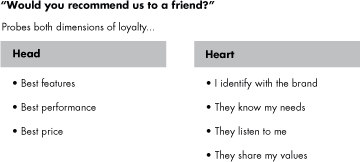
According to our research, which includes a recent study involving 2,500 consumers and 55 brands in 16 product categories, NPS correlates strongly with consumer loyalty, referrals and repurchases. Nearly 70% of promoters, for instance, recommended a brand to their friends or colleagues, and almost half of the time to four or more people. That kind of advertising you just can't buy. Promoters will also give a brand a greater share of wallet than detractors or passives will; typically, promoters devote more than two-thirds of their spending in a category to a favored brand. 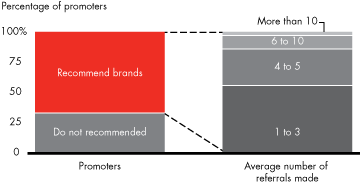
Because the scores help uncover determinants of future behavior, they provide a much better basis for spotting weaknesses, evaluating a brand's health and helping gauge whether new products will succeed. Consider the case of one new soft drink. After it test-marketed well with consumers, the manufacturer threw considerable marketing muscle into the drink's national launch, with an integrated campaign of print, outdoor, radio and TV ads tied to two of the country's most popular pro sports events, as well as college campus promotions. But a study Bain & Company did in consumer products a few months later indicated that, despite the robust marketing support for the drink's rollout, it still had a tough hill to climb: It had an NPS of minus 11%, while the market-leading soda in the segment it was attempting to crack into had an NPS that was a good 30 points higher. Indeed, over the next two quarters, the new drink appeared to lose traction; its US sales dropped, and its tiny market share actually shrank. The market leader, meanwhile, continued to grow sales and gain market share for the third year in a row, standing out as one of the few growth stories in its category. Increasing your ranks of promoters
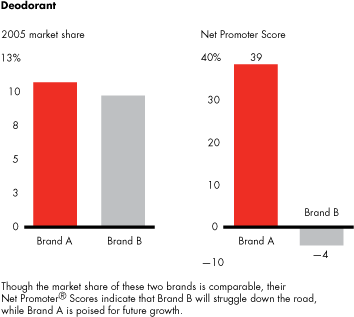
Let's look at them in order of priority. First, you have to deal with the passives and detractors. They're the critical vulnerability for your brands. If you don't figure out what is bothering them and what you can do to delight them, you're likely to lose them to competitors. Detractors are especially likely to switch—and especially destructive. They wreak havoc by tarnishing a company's reputation, undermining sales and growth by complaining to their friends. A low Net Promoter Score means a brand has high numbers of passives and detractors—and that can be a powerful indicator that an established brand's in trouble, long before the problems turn into a market share slide. Consider the tale of two deodorants. According to market share figures, Brand A and Brand B antiperspirants appeared to be in a virtual tie: Brand A, 11%; vs. Brand B, 10%. But their NPS forecast a deep potential split down the road: Brand A, 39%; vs. Brand B, -4%. Follow-up with the promoters, passives and detractors about the reasons behind their ratings pointed to critical differences between the two products: Brand A's promoters valued it for product qualities like fragrance and efficacy; whereas Brand B's promoters were motivated by price. Again, this portended that Brand A was poised for continued growth, and that Brand B was likely to struggle to maintain share through price concessions. Companies need to get an accurate read on how many passives and detractors they have, and then probe them to identify what would convert them into promoters. This is the approach financial software powerhouse Intuit took when it used NPS research to help reverse a market share slide in its TurboTax product. After new online rivals began aggressively stealing share from TurboTax in 2003, Intuit's Consumer Tax Group, which had seen the biggest decline, created a 6,000 member "Inner Circle" of consumers who agreed to serve as a web-based focus group. Separating the promoters from the neutrals and detractors with the question "How likely are you to recommend TurboTax to friends or colleagues?" Intuit then asked members to explain their number-one priority for enhancing any aspect of the customer experience, including shopping, buying, installing, using and tech support. A follow-up question let them prioritize a list of 10 suggestions made by others. The company found that each group had different priorities and issues. Detractors, for instance, wanted improved tech support. To address that issue, the company returned phone-tech support operations to North America and boosted tech-support staffing. Promoters ranked simplifying rebate programs as their top priority for improvement. Soon the proof-of-purchase requirements were simplified, the process was streamlined and the turnaround time was reduced by several weeks. Thanks to these moves, Intuit was able to gather information that helped it redesign its core TurboTax product, improve its offering to promoters and address the issues bothering detractors. Consumer advocacy rose dramatically, and the company regained market share in online channels. Diamond producer De Beers is one company that developed insights about specific sets of consumers, customized offerings to meet their needs and won big. A few years ago, for example, the company spotted an opportunity regarding three-stone jewelry. De Beers's consumer research revealed that in Japan, most jewelry was purchased by women for themselves. Exploring how it could create excitement around self-purchase occasions, De Beers developed an insight about Japanese women's underlying need for self-fulfillment and their desire to celebrate their independence. That led the company to offer a three-stone ring called Trilogy-which women would buy themselves in honor of their personal past, present and future-in that market. Trilogy quickly became a big success; four years later it accounted for the largest diamond-jewelry segment in Japan. Beauty products maker Olay-a market share leader, with a 39% share-is winning high NPS scores, proving that you don't have to be a niche brand to create legions of loyal promoters. Olay illustrates well how a mass brand can create a following among a variety of consumers. Its NPS for facial moisturizers is 55%, more than double that of the closest competitor. Olay, which once focused on middle-aged women, has achieved this success by carefully tailoring its products to different consumer segments. The brand has grown its old standby, that bottle of lotion, into 10 product lines and scores of offerings that precisely target the needs of women with different skin problems, life stages and beauty-maintenance routines. Olay offerings range from those in its Clarity line, for skin irritated by stress and hormones; to Definity products, which help correct discolorations and dullness; to Total Effects, which promises "advanced anti-aging" remedies. There are all-in-one products for women who prefer a simple beauty regimen; and peels, polishers and creams just for use at certain times of day. On Olay's web site women can sign up for free live consultations with a beauty adviser who helps them navigate the numerous creams and lotions and find the one just right for them. The site also allows visitors to locate dermatologists in their area and invites women to join Club Olay, through which they can receive free samples, special offers and newsletters. Olay is a mass brand that has successfully developed sub-brands, products and regimens that consumers feel are customized to their individual needs. By focusing not only on creating the right product for the right consumers, but also on the right product experience, companies can greatly enhance consumers' perceptions toward brands. Those experiences may even drift into territory as ineffable as aroma. DiGiorno, the frozen pizza maker, decided that its toughest competition wasn't other brands in the freezer case but piping hot, home-delivered fresh pizza. It designed a product that when pulled from the oven would have the same kind of appetizing aroma, crispy crust and taste as pies brought to the door in cardboard boxes by neighborhood pizzerias. The appeal paid off: DiGiorno has garnered an NPS of 34%, compared to Tombstone's NPS of zero, and Red Baron with a minus 1%. Creating a community around a brand is another way companies enhance the product experience for consumers. Take Axe, the male body spray. Who would have thought that a deodorant spray could create zealots out of legions of young men between 18 and 24? But that's just what Unilever did when it launched Axe with racy TV ads in 2002. By 2005, Axe was hailed as a marketing phenomenon, successfully carving out a whole new male grooming subcategory thanks to a brilliant use of online marketing around a community of young males. Its online community featured humorous, edgy video clips about guys' attempts to attract women, meant for young men to Email to their friends. With streaming video, blogs and chat rooms, a video game, and downloads to cell phones, the popular product fueled such a craze that Unilever has maintained an 80% market share. Finally, you need to make sure that you actually deliver what you've promised. That isn't always easy in consumer products, where middlemen may come between manufacturers and the consumer. Consider what happened to Adidas with its line of high-end soccer shoes, the Predator. Adidas had linked the Predator to soccer icon David Beckham, promising the shoes would make wearers play as well as Beckham. The Predator even had nubs on the toes so that wannabe champions could "bend it" like their hero—a feat lionized in the popular movie Bend It Like Beckham. But Adidas found that Predator shoes were quickly getting discounted by retailers, which didn't understand how to present the line and were in the middle of a price war for market share. When stores posted sale signs advertising the line at deep price cuts, cheapening its image, the Predators' allure plunged. However, by creating agreements with a major retailer to run minishops within stores, Adidas has since gained more control over price, ambience and product delivery. The initial results looked very promising: The retailer's revenue jumped by several percentage points and it predicted that its partnership with Adidas would continue to boost performance. And Adidas now is more assured that its brand will maintain its upmarket positioning, supported with topflight service on the shop floor. Creating a truly consumer-focused organization Most important, NPS is a tool companies can use to keep everyone in their organization religiously focused on the consumer. By producing and evaluating NPS data on a regular basis, organizations can institutionalize a cultural shift, making consumer metrics just as practical and auditable as such financial metrics as profit and return on equity—and make performance in the eyes of consumers just as critical a goal as financial performance. They can use NPS not just as a research tool but as an operating measure that captures the strength of their brands' relationships with consumers. The beauty of NPS is in its simplicity. It allows a company to transform itself into an organization that is completely focused on consumers. Its lessons can easily be understood and used by any level of the company. And it all starts by asking one question—not one you'll typically find on any satisfaction survey. SIDE BAR: Choosing your priorities NPS can not only deepen a firm's understanding of consumers but help its management decide which consumers to invest in. To clarify your priorities, you can begin quantifying the value of your promoters and the cost of detractors, factoring in margins, purchase frequency, cost efficiency and any sales they might bring in—or scare off—through word of mouth. Getting a clear picture of the economics of each consumer segment will help you determine where to direct your efforts. The grid below is your starting point. High-profit promoters, in the upper right, should be your top long-term priority for investment and innovation. Your entire organization should focus on delivering to them. But too often these consumers are taken for granted. High-profit detractors, in the upper left corner, are the second priority. They'll defect at the first chance when offered a better deal, and they're spreading bad publicity about you. You want to find ways to please them. 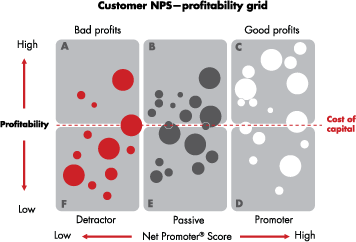 |