


The Visionary CEO’s Guide to Sustainability


|
At a Glance
This article is part of Bain's 2025 CEO Sustainability Guide AI adoption in sustainability has surged in the past year. Companies use AI to cut energy use, reduce waste, enhance workplace safety, and accelerate toward their sustainability goals. Early results are promising. Leaders are uncovering emissions hot spots in real time, optimizing renewables deployment, and transforming employee experience. This is just the beginning. Of the 400 C-suite and sustainability executives recently surveyed by Bain & Company in eight markets, almost 80% say they see high or very high opportunity for AI to contribute to their sustainability agendas. Yet more than 50% are still in the initial stages of piloting and exploring these AI applications—underscoring how much potential remains to scale AI that accelerates real-world progress on sustainability. This is good news, but scaling AI will also bring true environmental and workforce costs that must be carefully managed. Our proprietary climate-economic modeling tool, IntersectSM, finds that, in a high-growth scenario, AI and data centers could emit 810 million metric tons of carbon dioxide annually by 2035, or 2% of global emissions and 17% of industrial emissions. The carbon footprint of AI is closely tied to the source of electricity powering data centers. In regions such as the US, where a higher portion of the grid is still dependent on fossil fuels, the share of AI-driven industrial emissions could increase from 18% in 2022 to more than 50% by 2035. By contrast, Europe’s accelerated transition to renewable energy and more measured AI adoption are expected to keep emissions relatively stable (see Figure 1). While hyperscalers and large data center operators have committed to renewable energy, the urgency of deployment and current build-out constraints mean emissions from AI will likely reflect the regional electricity mix in the near term. To put this in perspective, in this scenario, the emissions added between 2025 and 2035 would cancel out three years’ worth of emissions cuts by the world’s 500 largest disclosing companies.
Figure 1
Notes: 2022 is the latest full year available for all data sources; estimates as of May 2025, prior to passage of the One Big Beautiful Bill Act; methodology assumes regional power mix projections and emissions intensity, and that data center users' energy consumption will broadly align with the regional grid in the near term Source: Bain Intersect(SM)While this setback may diminish as electric grids decarbonize, AI’s impact on employment remains far more uncertain and difficult to prepare for. In the AI era, revenue is increasingly decoupled from workforce growth. Average revenue per employee in real terms rose from $840 between 2016 and 2020 to $1,090 between 2021 and 2024, and that gap is widening. Output is rising without equivalent job creation, reshaping the future of work faster than most organizations are prepared to handle. This is no longer a distant concern; CEOs openly recognize that AI is transforming their workforces, particularly white-collar jobs. While many companies are still grappling with AI’s trade-offs, a small but powerful group is showing what’s possible. We identified these leaders—whom we call “shapers” and who represent about 20% of the companies in our study—based on four criteria: their maturity in scaling AI for sustainability, the breadth of sustainable AI use cases adopted, the value they report from using AI to advance sustainability, and their overall maturity in sustainability. The key differentiator isn’t who leads in sustainability; it’s who leads in AI. Shapers are deeply committed to AI’s potential to tackle complex sustainability challenges. They use AI in sustainability efforts three times more often than laggards and are nearly two times more likely to focus on its long-term value creation (see Figure 2). Although they’re found across industries and regions, shapers are most prevalent in the technology and manufacturing sectors.
Figure 2
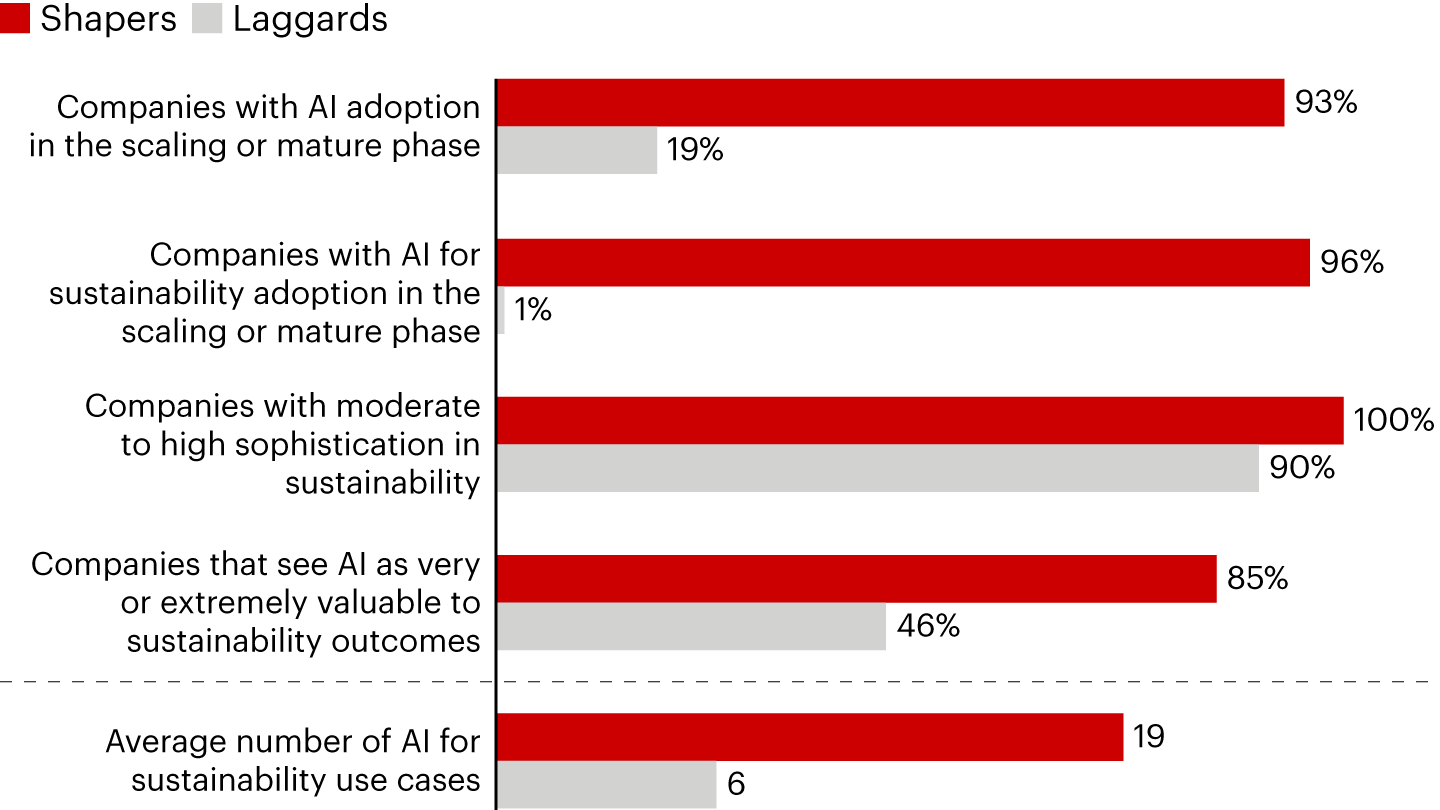

Shapers’ strategies, structures, and behaviors offer a playbook for balancing the sustainability benefits and costs of AI to capture its full potential. 1. Shapers move beyond compliance, using AI to unlock lasting sustainability impactWith more than half of companies still in the exploring or piloting stages, there’s much to learn from those further along. Shapers take a fundamentally bolder approach to selecting, adopting, and getting value from their AI use cases. They prioritize applications with greater potential for long-term impact and enterprise value, such as scenario and risk modeling and sustainable product design—even if the path to returns is slower (see Figure 3).
Figure 3
Notes: Axes have been adjusted for presentation; variance in absolute values is low Source: Bain Sustainable AI Survey 2025 (N=400)Here are four use cases shapers are adopting that focus on both business and environmental goals:
2. Shapers see the risks that others miss—and manage them betterExecutives broadly agree that AI introduces new risks to sustainability, but approaches to address those risks vary widely. Shapers are four times more likely than laggards to perceive high sustainability-related risks from AI. Unlike laggards, they don’t just focus on compliance, privacy, and data security. They look further ahead to the disruptive and still-emerging risks AI poses to their teams (see Figure 4). For example, as AI reshapes roles and requires new skills, employee trust and engagement become critical. If these are not addressed, massive disruptions in productivity, morale, and organizational performance are likely. Shapers are twice as likely to consider sustainability risks when making AI decisions and twice as likely to involve sustainability leaders in AI governance. They hardwire sustainability into AI decision making and governance by embedding it into model design, vendor selection, and oversight processes.
Figure 4


A leading engineering and infrastructure firm is using these types of approaches. Its AI-powered performance management tool that delivers personalized career growth and training recommendations has boosted employee engagement by a factor of five. At the same time, the company is using AI to improve its overall HR function, with AI-powered HR assistants and HR leadership assistants dramatically accelerating analyses and reducing both ticket volume and resolution time. 3. Shapers build an integrated operating systemMost companies are starting to install the basic hardware for AI in sustainability, including data infrastructure, governance, and reporting. Shapers are building something more sophisticated: an integrated operating system. This “OS” embeds sustainability into the way AI is selected, deployed, and governed. It connects internal users and external partners to enable smarter decisions, faster adoption, and broader innovation (see Figure 5).
Figure 5


Shapers focus on three actions to scale sustainable AI effectively:
The path forwardAI has the potential to become one of the most powerful tools in the sustainability playbook. But turning that potential into progress requires more than pilots. It demands focus, scale, and systems built for impact. The leaders we call shapers show what’s possible. Now is the moment to learn from them, raise your ambition, and embed AI for sustainability where it matters most. Read our 2025 CEO Sustainability GuideMore from the report |