


Technology Report


|
At a Glance
This article is part of Bain's 2024 Technology Report. In 2023, many technology service companies supported their clients’ interest in generative artificial intelligence (AI) through proofs of concept aimed at reducing operational costs, completing tasks faster, or improving quality. These pilot programs focused on a variety of topics, including AI-enabled assistants for internal knowledge portal search, high-frequency marketing content generation, sales collateral development, and knowledge interfaces supporting customer-facing agents and enhancing productivity and conversion. Some tech service companies executed dozens or hundreds of these pilots for clients, some with ticket costs up to $1 million. In 2024, these clients are moving beyond the exploration stage, investing to scale up successful pilot programs. The focus this year appears to be on reaping the benefits of those pilots and demonstrating real business value from investments in AI. Bain’s latest global survey on generative AI adoption found that generative AI is a top five priority for 85% of respondents. The percentage of companies planning to spend more than $5 million on generative AI is expected to rise from less than 20% in 2023 to 33% in 2024. Another one-third of companies said that they will spend between $1 million and $5 million on generative AI experiments, up from 15% in 2023. Operate better: Signal expertiseAcross industries, most companies expect their tech service company partners to play a key role in these efforts, particularly if these providers have already developed expertise using generative AI internally (to improve their own operations) or in how they deliver services—faster, more productively, and with higher quality. Among the ways tech service companies are using generative AI:
Deliver better: Improve serviceExamples of tech service companies using generative AI to improve delivery include:
The contributions of generative AI are likely to roll out in waves, each building on the previous accomplishments (see Figure 1). Consider contact centers: Over the next two to three years, half of all nonvoice interactions, 25% to 35% of simple voice interactions, and about 10% of complex voice interactions could be replaced with generative AI.
Figure 1
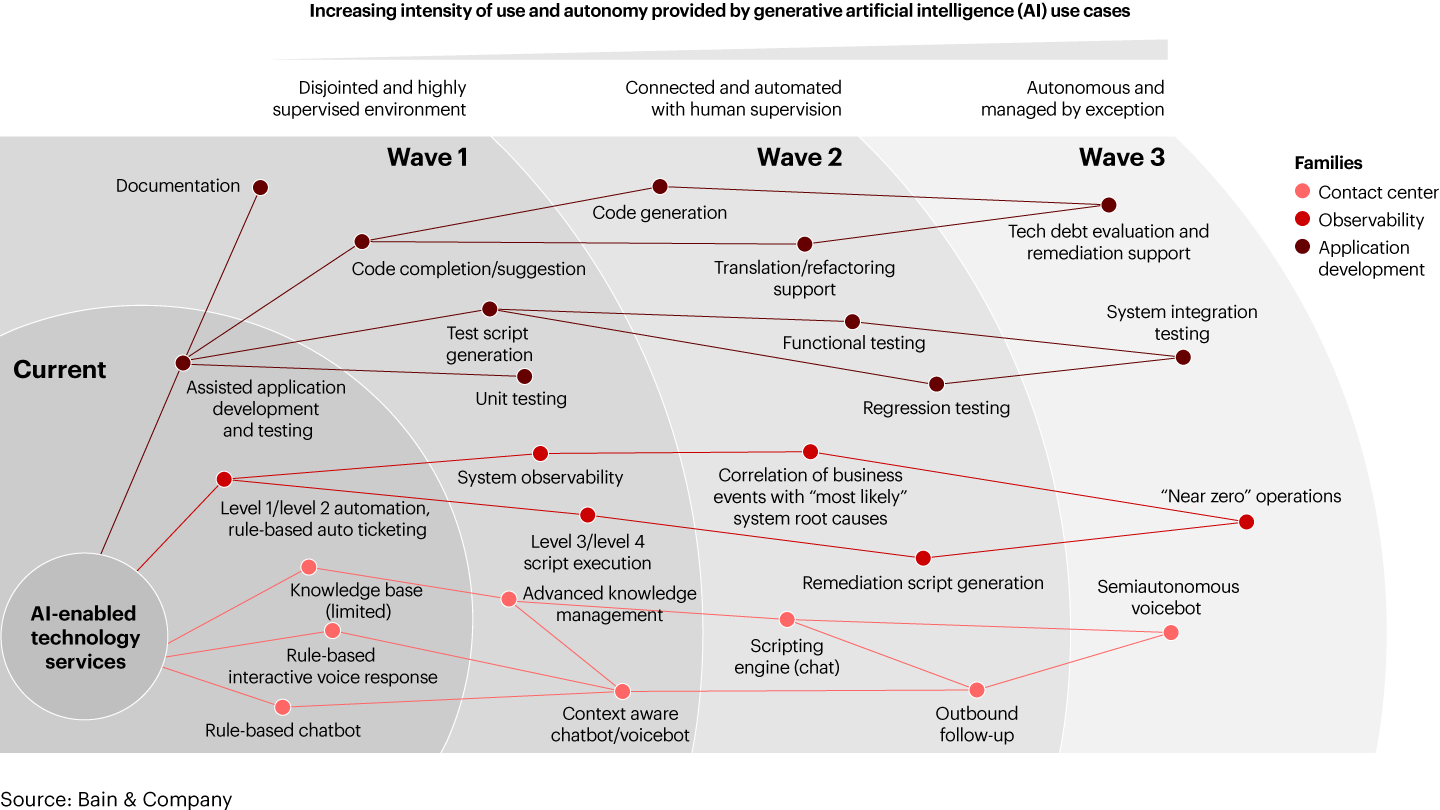

Contact centers had already developed rule-based response engines through chatbots. However, traditional chatbots have limited capabilities when responding to customer-specific questions or providing customer-specific recommendations, often simply offering a link to more information or giving them a callback option. Generative AI’s ability to assimilate and summarize large volumes of unstructured data creates a sharper knowledge management function. This should enable chatbots and chat assistants to provide more context-aware responses to customer queries faster, resulting in happier customers and more productive agents in the first wave of generative AI deployment. By the second wave, generative AI could help develop automated scripts for outbound calling, and in the third wave, we could see semiautonomous voicebots—both enhancements of the first wave rather than ground-up builds. Change the game: Move beyond standalone use casesTech service companies that want to design, build, and deploy generative AI solutions customized to clients’ needs can differentiate their approach by thinking in terms of collections of use cases—what we call use case families. A family is a set of use cases focused on a group of contiguous processes that need to work in tandem or in sequence and that require similar foundational technologies. Use case families can be horizontal, with nuanced variations for different industries, or at the intersection of industries, with processes and geographies. Below are some examples.
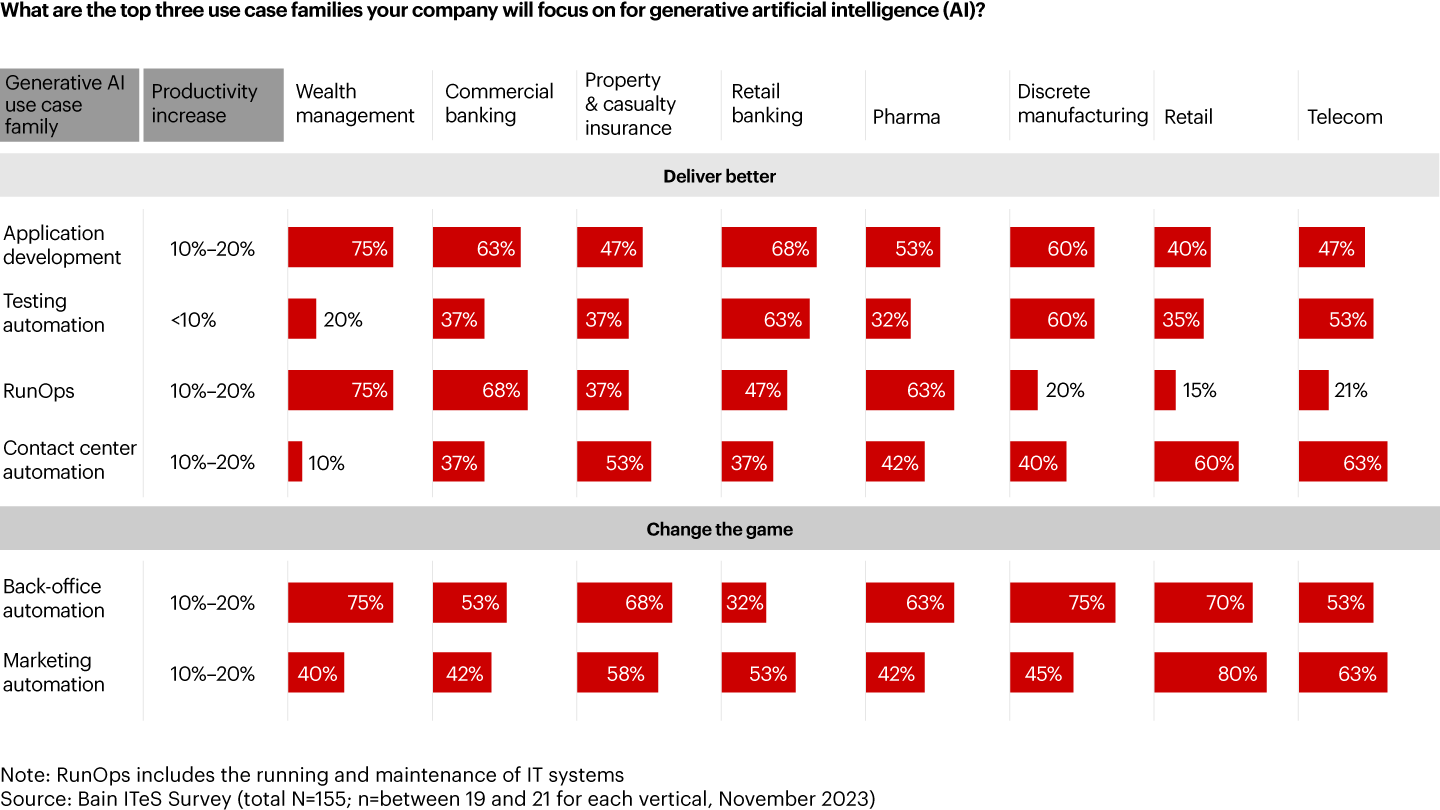
Tech service companies can differentiate themselves by choosing and delivering use case families that combine their domain expertise, process knowledge, and technical prowess to transform customer engagement modules. Families are a better approach because standalone use cases may not address all the sources of value that can be tapped using the same technology investment and enablement. Also, standalone use cases focus on internal productivity improvement while families of synchronized use cases deliver lasting customer value, which can lead to repeat buying, greater sales of the product or service, and new referrals. Bain’s research finds that customers are looking to tech service companies to address a few priority families, some that promise efficient delivery and others that are more likely to change the game (see Figure 2).
Figure 2

Scaling generative AIIn our work, we find that clients are eager to engage with tech service players that have already begun to build their own AI skills and capabilities. Demonstrating expertise, hiring and upskilling talent to build AI capabilities, and developing and deploying solutions at the leading edge are great signals to the market about one’s capabilities and comfort with the technology. Five additional factors will also differentiate tech service players in the race to become preferred partners in generative AI solution deployment:
Using generative AI to operate and deliver better are table stakes now for tech service providers. Significant competitive advantage comes only from providing AI solutions that change the game for customers. But doing so requires not only new skills but also deliberation and focus, because no provider can be everything to everyone. As tech service providers build the capabilities to operate and deliver better with generative AI, they must also be choosing where to build best-of-breed abilities to deliver full potential to their customers. Read our 2024 Technology ReportMore from the report |