


Brief

|
|
Deal making has always been cyclical, and the last few years have felt like another low point in the cycle. But the historical success of M&A as a growth strategy comes into sharp relief when you look at the data. Bain & Company’s analysis strongly suggests that executives will need to focus even more on inorganic growth to meet the expectations of their investors. In the first installment of this three-part series on the coming M&A renaissance, “The surprising lessons of the 2000s,” we looked back at the last 11 years of deal activity and examined why it was a very good time for deal makers who followed a repeatable model for acquisitions. The accepted wisdom paints the decade as a period of irrational excess ending in a big crash. Yet companies that were disciplined acquirers came out the biggest winners. Another surprise: Materiality matters. We found the best returns among those companies that invested a significant portion of their market cap in inorganic growth. In this second part in our series—“What to do with all that cash?”—we look forward. We argue that the confluence of strong corporate balance sheets, a bountiful capital environment, low interest rates and eight great macro trends will combine to make M&A a powerful vehicle for achieving a company’s strategic imperatives. The fuel—abundant capital—will be there to support M&A, and the pressure on executives to find growth will only increase as investors constantly search for higher returns. Some business leaders argue that organic growth is always better than buying growth, but the track record of the 2000s should make executives question this conventional view. The final part of the series highlights the importance of discipline in a favorable environment for M&A. Deal making is not for everyone. If your core business is weak, the odds that a deal will save your company are slim. But if you have a robust core business, you may be well positioned. All successful M&A starts with great corporate strategy, and M&A is often a means to realize that strategy. Under pressure to grow, many companies will find inorganic growth faster, safer and more reliable than organic investments. As M&A comes back, some executives will no doubt sit on the sidelines thinking it is safer not to play. Experience suggests that their performance will suffer accordingly. The winners will be those who get in the game—and learn how to play it well. The world is awash in capital. By Bain’s estimate, about $300 trillion in global financial holdings is available for investment. The time is right to put this money to work, and a lot of it should fund the renaissance in M&A. Why? One reason is pent-up demand. The slowdown in M&A since 2007 was triggered by the financial crisis, and will reverse itself as the world economy recovers. Each M&A boom tends to outstrip the previous one— both in the number of deals and in the total value of acquisitions (see Figure 1). 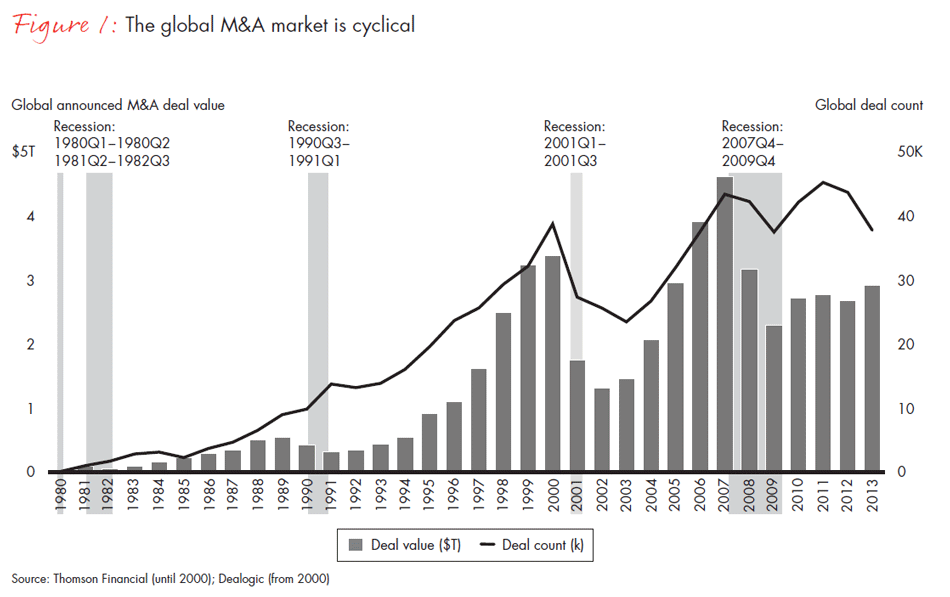
This time around, however, three additional factors will turbocharge the deal-making renaissance:
Together, these factors are likely to push deal making to record levels. Let’s look more closely at the economic environment and the reasons for our belief in an M&A renaissance. A world awash in capital Capital is no longer scarce; it’s superabundant. The $300 trillion in financial holdings is about six times larger than the market value of all publicly traded companies in the world. By the end of the decade, capital held by financial institutions will increase by approximately $100 trillion (measured in 2010 prices and exchange rates)—an amount more than six times the US GDP. All that money needs to be put to work. Capital superabundance produces low interest rates. In the years following the global financial crisis, interest rates in many countries hit new lows, with real rates on low-risk investments hovering around zero. We expect rates to remain low for some time, primarily because of supply and demand: Financial assets have grown considerably faster than real output between the early 1990s and today, a trend that has led to a drop of 4 to 5 percentage points in the global average lending rate during this period. Three interrelated factors reinforce that long-term trend:
Although abundant capital and easy borrowing will probably not feed general inflation, they are almost certain to have one kind of inflationary effect: They will feed the growth of asset bubbles. In a global economy, some assets somewhere are likely to be increasing in price at any given time; it might be metals, agricultural commodities, fuels, farmland, other real estate or indeed nearly any other class of assets. As investors around the world pour their money into these assets their prices rise still higher, and the stage is set for a classic bubble. In the environment we have described, the bubbles will likely last longer and grow bigger before they inevitably burst. High investor expectations Capital is superabundant, interest rates are correspondingly low, demand is muted and growth sluggish. Does all this mean that investors expect only modest returns? Not quite. The data indicates that investors expect companies to grow considerably faster than their historical growth rates. In the US, where this growth gap is most pronounced, companies increased their earnings at an average annual rate of 6% in the period from 1995 through 2013 (see Figure 2). Yearly growth in nominal GDP during the period 2012 to 2016 is likely to be much the same as it was then—but investors expect their companies to grow at about 11% a year. 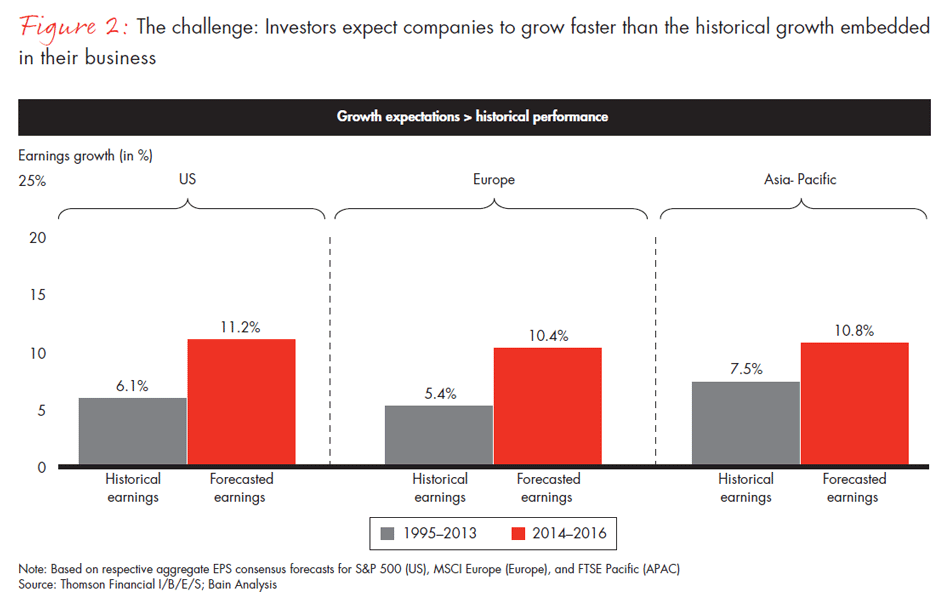
Executives thus find themselves in a challenging situation. Capital is widely available at relatively low cost, including on their own companies’ balance sheets. Companies with investment-grade ratings often find that they can borrow at a lower cost than many sovereign nations, whose bonds were once thought to be nearly risk-free. Companies in zones with highly valued currencies—Europe, for instance—can take advantage of their currency’s strength to invest overseas at bargain rates. The job is to put all this money to work with the goal of creating alpha—performance that outstrips market indexes. By the same token, sitting on cash can be a high-risk strategy when rivals are repositioning themselves for growth. Hurdle rates for corporate investments symbolize this challenge. In our experience, many chief financial officers (CFOs) have kept hurdle rates high relative to interest rates in the post-crisis years, explaining that their caution reflects the general risks of an uncertain world and the specific risk that interest rates would return to historically normal levels. But lowering hurdle rates may actually be a more appropriate move for an era of capital superabundance. Lowering them too far is always a danger, but so is leaving them high. A company with high hurdle rates may wind up perpetually meeting its earnings targets while curtailing investment and sacrificing topline growth—not a formula for making shareholders happy over the long term. CFOs face a further challenge as well. Though they are punished by the market for failing to protect against risk, they aren't rewarded for using the balance sheet strategically to strengthen the business—particularly since such an approach wasn’t necessary prior to the global financial crisis. Macro trends—and the opportunities for growth Against the backdrop of this business climate, we see eight macro trends in the global economy that open up major new growth opportunities (see Figure 3). We won’t discuss them in detail here—for a full account, see our report, “The great eight: Trillion-dollar growth trends to 2020.” This brief summary, with the “great eight” shown in italics, indicates the potential for growth. 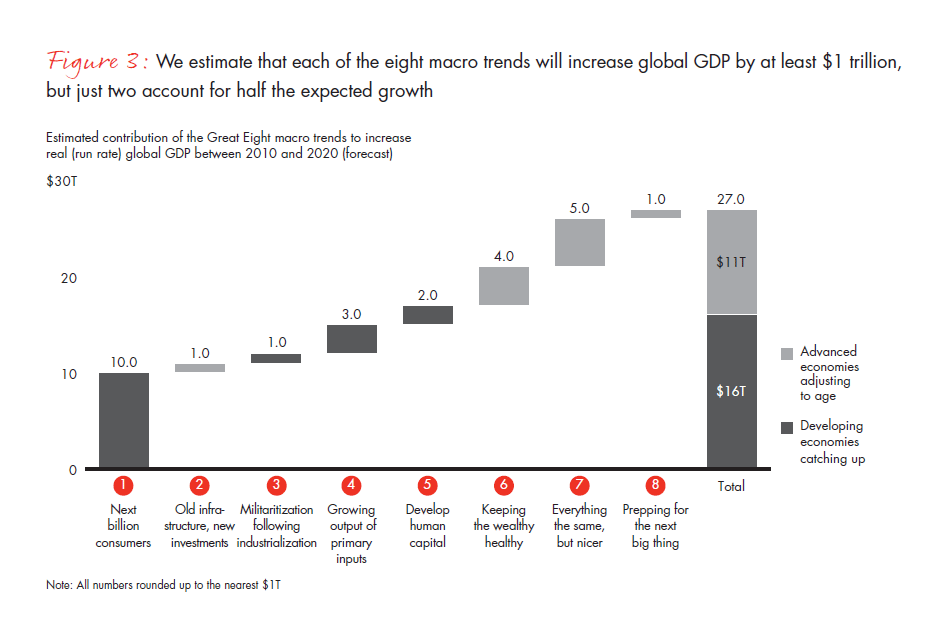
Consumers. By 2020, the next billion consumers in developing nations will join the ranks of the global middle class, earning more than $5,000 a year. Their purchasing power and preferences will be different from those of middle-class consumers in developed nations, but taken as a group they will add an additional $10 trillion to world GDP by 2020. Companies targeting this group need lower cost structures than in use today—and they can’t assume these consumers will move up the price ladder over time. Consumers in developed countries will be looking for more of what they have enjoyed in the recent past— everything the same but nicer, better and more carefully tailored to their tastes and lifestyles. Along with technological innovations such as tablet computers will come “soft” innovations, such as the ability to deliver a new outfit to an online shopper’s doorstep the same day she orders it. Soft innovations enhance and stimulate consumption by providing extra value that buyers are willing to pay for. They are likely to transform whole categories of consumer goods and services, from fashion to food. Government and infrastructure. In developed nations, old infrastructure, new investments will translate into a surge of spending by governments on replacements and upgrades of physical infrastructure. With public funds limited, some of these jobs will be undertaken by public-private partnerships, and are likely to contribute about $1 trillion to world GDP. Meanwhile, militarization following industrialization—arms buildup in the developing world—presents an opportunity for arms developers but, more important, a risk to global business. China has an overarching interest in protecting its supply chain, but the supply chains are shared by Japan and (to some extent) by India. The risk of an attenuated supply chain, in turn, puts a premium on building capacity closer to end markets, which leads many companies to consider moving operations back to the US and Europe. Developing nations face the challenge of developing human capital, and their social infrastructure is likely to require even more investment than their physical infrastructure. The combination of broadening access to education, building effective healthcare delivery systems and strengthening the social safety net will add as much as $2 trillion to world GDP. Additionally, rapid growth in these emerging markets has created a global shortage of management talent that is only going to get worse. In developed nations, meanwhile, new healthcare spending—keeping the wealthy healthy—will likely add $4 trillion to GDP. The next big thing—and the resources to support all of these trends. Major innovations come in waves, and five potential platform technologies—nanotechnology, genomics, artificial intelligence, robotics and ubiquitous connectivity—show promise of flowering over the next decade. New technologies tend to reinforce one another. Prepping for the next big thing should open up unexpected opportunities in both consumer goods and industrial processes. When the next big things arrive, they are likely to accelerate growth. All of these trends require growing output of primary inputs, meaning large investments in basic resources such as food, water, energy and ores. Growing demand will stimulate new investment, but will also lead to spot shortages and price volatility. All told, the primary goods sector will likely add $3 trillion to global GDP. Why M&A? For leadership teams, one vital challenge is how to best position their businesses to take advantage of these emerging trends. A strategy focused on organic growth alone is unlikely to deliver the expanded capabilities or market penetration they need. Most companies will have to rely on a balanced strategy, pursuing M&A as well. In many cases it is faster and safer to buy an asset than to invest in building your own (see Figure 4). 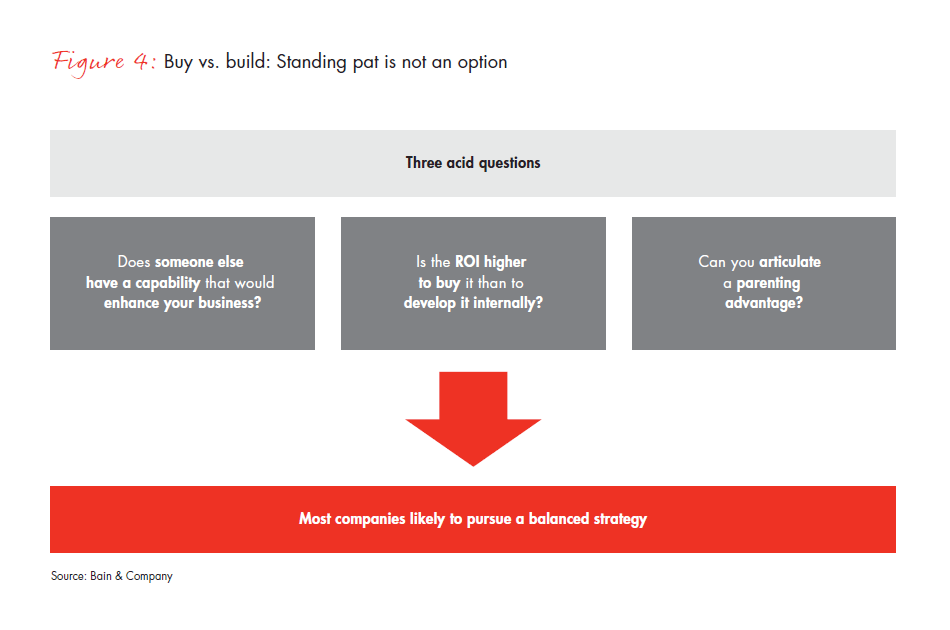
Three essential questions can help companies determine when buying rather than building makes sense for them:
Of course, this analysis raises an obvious question. If the environment for M&A is already favorable, why has the pace of deal making been so slow during the recovery from the financial crisis? The chief reason in our view is that sellers are holding back. Potential divestors expect business valuations to increase, and so are inclined to hold on to their assets for the time being. But this is likely to change quickly, once sellers come to see their assets as fully valued or once they realize that they will be rewarded for prudent divestitures. When a company is planning divestitures, attempts to time the market should take a back seat to a rigorous assessment of strategy and the highest-yielding investment priorities, a topic we examine more fully in our article “How the best divest,” published by Harvard Business Review in 2008. The risks While the environment for M&A will be generally favorable, would-be acquirers have to watch for a number of macroeconomic risks and manage them accordingly. Five are likely to be significant:
While M&A is a good strategy for most companies, it is not easy or simple. The companies best positioned to work through the issues described above in a disciplined manner are those with deep experience in M&A. In Part III of this series, we return to our theme of the virtues of a repeatable M&A model for success, which we will lay out in further detail. David Harding is a partner with Bain & Company in Boston and co-leader of Bain’s Global M&A practice. Karen Harris is director of the Bain Macro Trends Group and is based in New York. Richard Jackson is a partner in London and leader of Bain’s M&A practice in EMEA. Satish Shankar is a Bain partner in Singapore and leader of the firm’s Asia-Pacific M&A practice. |