

Brief
The operations of energy utilities, retail banks and telecommunications providers are, on the surface, quite different, but what they have in common is the requirement that large numbers of frontline staff “do the right thing” within an operating environment that affords a certain level of autonomy. That poses a major operational challenge, yet we have observed companies in these industries and others that were able to create substantial improvement in performance using a common approach.
These companies have seen dramatic results in the form of more loyal customers, fulfilled and engaged employees and better economics. The results have been sustained and even improved over time, as the companies developed the capability to continuously enhance their operations.
At the heart of this approach, which we call the High Velocity Performance System®, is the premise that for any transformational change to succeed, employee behavior must change. In service-intensive industries, it is the discretionary effort of people throughout the organization that improves operational and financial performance. Unleashing discretionary effort is only possible when companies provide people with a compelling purpose for the work they do.
Jeff Melton, practice leader for Bain's Performance Improvement practice in the Asia-Pacific region, explains how the speed and efficacy of feedback to frontline employees can dramatically improve service operations. Using a High Velocity Performance System®, companies can combine the lean principles, behavioral science and digital technology to boost performance.
The high velocity performance system accomplishes this by combining three elements:
• Lean principles to identify the sources of value and eliminate sources of waste
• Behavioral science techniques that make it easy and fulfilling for people to do the right things
• Applied digital technologies to implement process improvements and behavioral change on a large scale
Together, these elements allow employees to see, in real time, how their actions contribute to the greater good.
Lean principles for service operations
Despite the long-term rise of the service sector in most economies, the dominant paradigm for performance improvement still tends to derive from the world of manufacturing, particularly Lean techniques, which originated half a century ago in automotive factories. Lean has proven quite successful in manufacturing settings, and Lean principles do apply to service companies or service-oriented units within manufacturers as well.
Many service organizations, however, have difficulty creating results that they can sustain and improve over time. They may try to import a version of the Toyota Production System without adequately adjusting for a different service environment. Or they may focus ex-clusively on installing an initial set of processes and tools without creating the mechanisms to scale up for continuous improvement across the entire company.
Our work with many service organizations has allowed us to develop an approach designed to make Lean stick. Using this approach, we have helped companies achieve remarkable results across three dimensions:
- Improving financial performance. Companies lower costs, for example, by eliminating waste from operations and getting customer interactions right the first time, reducing rework and shortening decision cycle time.
- Raising customer loyalty. Customer loyalty pays off in growth and profitability, because loyal customers buy more, stay longer and recommend the company to others. More efficient, first-time-right processes tend to delight customers and make them advocates for the company.
- Unlocking discretionary effort by employees. People with clarity about their mission, who receive positive reinforcement for doing the right thing, go the extra mile to deliver. Here again, the high velocity performance system provides the means for engaged employees to direct their energy toward the tasks and outcomes that actually matter. It reinforces a sense of purpose and shifts resources and attention to those things that matter most to customers.
The high velocity performance system allows companies to achieve these three outcomes simultaneously—a “triple play” of performance improvement—as each dimension reinforces the others. Engaged employees are more motivated to devise better ways to do their jobs and thus create better experiences for customers. This, in turn, increases customer loyalty, removes waste and improves business economics. (See below, “How an Asian telecommunications provider turned around its field service performance.”)
The heart of performance improvement involves changing behavior on the front lines—an imperative that many senior executives intuitively understand. A recent survey of nearly 300 executives by Bain & Company and the Economist Intelligence Unit (EIU) found that roughly 75% of respondents rate behavioral change on the front lines as “very important” or “important” for realizing targeted cost savings, their top priority. At the same time, about 45% of executives cite changing frontline behavior—the leading challenge cited—as “extremely difficult” or “difficult” in achieving and sustaining cost savings.
The senior manager’s role
What specifically are senior managers in leading companies doing to change behavior on the front line? Let’s look at the interlocking disciplines of the high velocity performance system in more detail.
Make clarity of purpose a reality for employees. Performance metrics serve as a magnifying glass on priorities. Yet in many service organizations, metrics are disconnected from, or even at odds with, the fundamental purpose of the job.
Consider a call-center agent who applied for the job because she enjoys helping people with their problems. Every day she talks to customers who are frustrated about the company’s products, processes or communication. She does her best to help, but feels constrained by the metrics on which she is evaluated. Every hour she receives an email from her team leader with her average call handling time and call transfer rate, metrics that are supposed to gauge productivity, but which, in fact, do not. To the agent, these metrics clash with the purpose of her job—providing excellent service with a smile. No wonder she becomes disillusioned over time and stops applying discretionary effort.
It is only when performance metrics are simply stated, few in number and linked to the fundamental purpose of the job that employees care about the outcomes of the measurements and apply discretionary effort to improve. These “catalyzing metrics” influence behavior when communicated to employees at high velocity—quickly and frequently. High velocity spurs innovation by stimulating new ideas and encouraging experiments. Ongoing improvements come from seeing what works and doing more of it. High velocity also spurs motivation by making clear what matters, establishing a causal link between actions and outcomes.
Catalyzing metrics can take several forms, such as those targeting actions that will improve customer loyalty. At a telecommunications provider in Western Europe, the call center had emphasized the metric of average handling time. It added two metrics, one on customer advocacy and another on resolving the issue on the first call. At the same time, it diminished the importance of average handling time. Call-center agents now had a daily view of their performance across a small set of metrics that were aligned with the core purpose of their jobs.
The new approach helped to reduce the overall volume of calls by 20% and raise the level of customer loyalty. Employee engagement improved, moreover, as agents felt they were being asked to help customers rather than get them off the phone as quickly as possible.
An energy provider in the UK dealt with different issues that centered on productivity. The performance of its field engineers showed significant variability across and within districts. The company also had a high rate of “bad service calls,” in which engineers’ home-service visits failed to resolve customers’ problems.
The energy company realigned its field engineers around metrics tied directly to productivity, including number of visits plus visit success rate, which reflected the purpose of the job. These metrics and individual performance indicators were sent by text message weekly to each engineer. A year after the program’s implementation, the company had achieved an 18% increase in same-day service, a 17% decrease in revisits to customers’ homes, a 10-percentage-point rise in customer loyalty scores and significant reductions in customer complaints and defections to competitors.
Foster a discipline of learning and experimentation. With the catalyzing metrics in place and presented at high velocity, people throughout the organization will start asking questions about how to improve performance in keeping with those metrics. In many instances, we have seen an intense spike in curiosity. A proven means of channeling curiosity into tangible improvements is to cycle it into what we call high-velocity learning loops (see Figure 1).
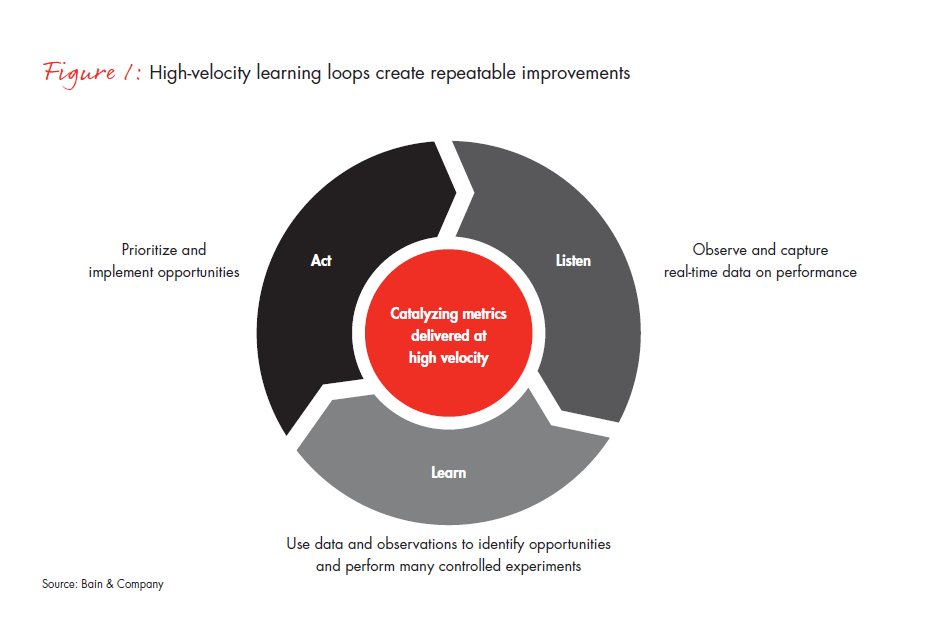
The effective application of learning loops can improve overall financial performance. Among the nearly 380 executives from numerous industries worldwide that Bain and the EIU surveyed, 68% of the high-performing companies said they have an effective process for closed-loop learning, vs. 40% of the average performers and 10% of the low performers.
Having people all across the organization, from the front line to the executive suite, taking the right action quickly can have a powerful cumulative effect. To sustain that effect over and over again, people need rapid feedback on how they are performing in terms of meaningful metrics and in terms of criteria that differentiate between superior and average performance. This critical information needs to be presented quickly, frequently and unambiguously—much like a fighter pilot’s heads-up display.
High velocity is essential, because an employee will vividly remember the circumstances that generated information shared the same or the next day. High frequency offers 365 cycles of potential improvement via daily reports, compared with just 12 cycles via monthly reports.
Simply presenting motivated employees with frequent performance information triggers curiosity about why something happened. A crucial part of a manager’s role, then, is to create an environment that not only supports systematic learning, but also provides appropriate consequences for learning and experimenting with new ideas and initiatives. High-velocity reporting makes it easier to conduct controlled experiments because you can test a process change, a new call script or new software settings and gauge the results almost immediately, and subsequently either abandon the test or tweak it for further improvements.
Recently, learning loops have become more cost-effective and accessible in service organizations because of recent advances in digital technology, such as tiny sensors, GPS trackers, Web-based applications, real-time data processing, and associated extract, transform and load (ETL) and analytical tools. These technologies make it easier and cheaper for service organizations to expand their learning loops on a large scale.
One US electric utility used high-velocity learning loops to raise the productivity of its field operations at a crucial turning point in its business. The utility’s local power distribution business forecast a doubling of work volume over the coming decade, but the field workforce was not prepared to handle that projected increase. The company had no consistent measure of productivity for field work because crews were monitored mainly for their ability to meet safety and compliance requirements. Work-order errors were common, but field accountants would not find them for many months after they occurred, long after a foreman had forgotten about the job.
The utility identified a new set of metrics for catalyzing behavior to raise technician productivity and equipped them with a real-time, weekly “stoplight” scorecard to gauge how each local district was performing. The company then created learning loops in which local process owners undertook root-cause analysis to understand where improvements could be made. It became clear, for example, that work-order time estimates needed to be more accurate and that the field force needed closer coordination with schedulers. The results of these changes were immediately visible in weekly reporting of the new productivity metrics.
At the same time, field accounting organized around a new metric of successful work orders empowered accountants to send back an incomplete or inaccurate field order to the responsible foreman, which significantly reduced costly rework and late work-order processing. The accounting teams tracked individual and team stoplight scorecards, tailored to the work-order metric, which in turn sparked their own learning loops.
Using the high velocity performance system, this utility has seen dramatic results since 2010. Throughput (a measure of efficiency in completing a task) rose from 61% to more than 80%. The work-order error rate dropped from 15% to 1%. Field accounting productivity rose 90% among a unionized workforce, and both order backlog and overtime have decreased.
Behind these positive numbers lies a more motivated and engaged workforce. As one field accountant said, “It’s great knowing what’s expected of me and feeling a sense of accomplishment at the end of the day, rather than just a mountain of work orders that I’m constantly trying to plow through.”
Invest to help employees succeed. Even with learning loops and catalyzing metrics in place, managers will have to help people succeed. By and large, employees want to perform well at their jobs. But improvements will be slow or nonexistent if people constantly battle outdated practices and policies that hinder them from delivering optimal performance.
At banks, for example, a clunky Customer Relationship Management (CRM) system interface, harsh penalty fees and rigid policies that lock customers into unsuitable products make it nearly impossible for branch tellers to provide great customer service. A teller in that situation will likely receive poor customer comments and lose trust in management for expecting her to do the impossible.
By contrast, high-performing organizations use applied behavioral science techniques to make it easy and fulfilling for people to do the right thing (see Figure 2). Applied behavioral science has proven remarkably powerful over the past half century in enabling people to gradually and permanently alter all kinds of behavior, from losing weight to staying sober to reducing energy usage. When a person who is prompted to perform a certain behavior is equipped with the necessary tools and capability, and when that behavior is reinforced with positive consequences, that person is more likely to perform and repeat the behavior.
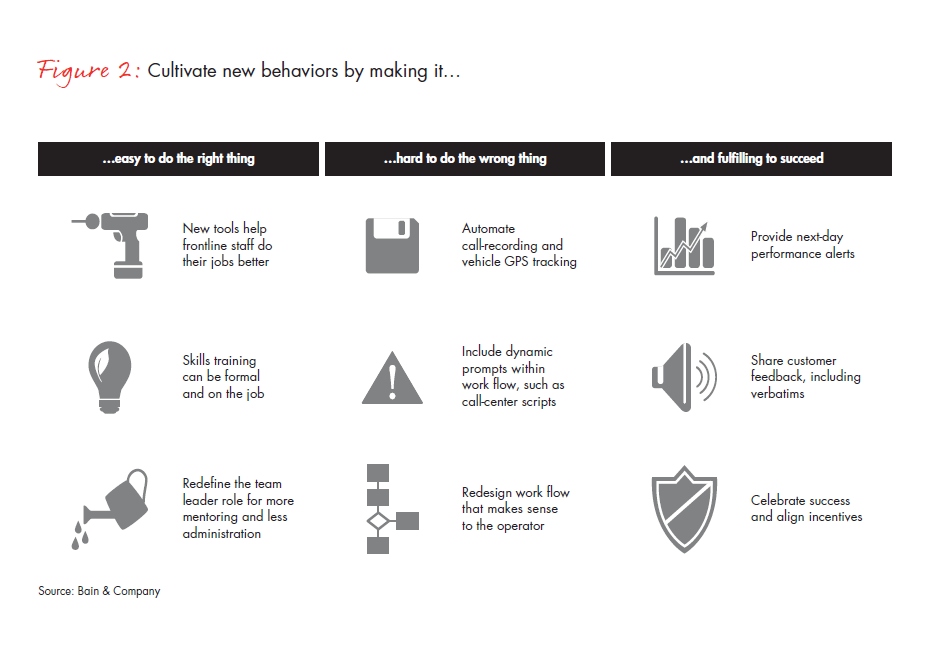
Applied behavioral methods can change service operations, where high performance depends on people exhibiting certain behaviors. In our experience, the most effective application of after-the-fact consequences is about 80% positive and 20% negative, because positive consequences reinforce desired behaviors. That means management needs to develop many more reliable, positive consequences, at a high frequency. Using digital technologies, companies can automate high-velocity capture and communication of performance data to employees, creating a “consequence engine” that greatly increases the desired behaviors (see Figure 3).
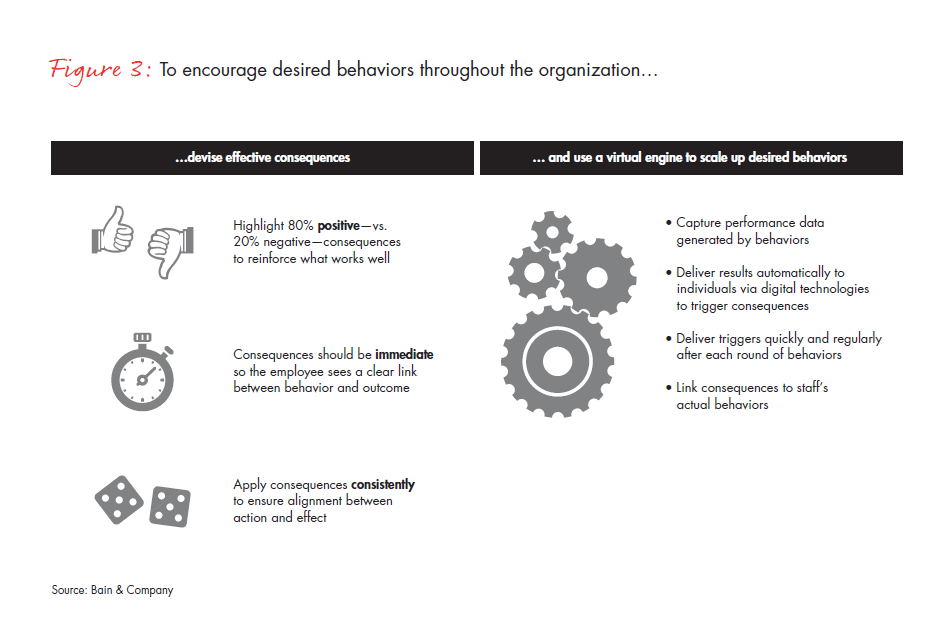
The choice of consequences will depend on the types of employee groups and the specific operational challenges being addressed. In most cases, the knowledge that an employee has done a job well is one of the most powerful positive consequences. As one call-center representative told us about the customer comments reported to him on a daily basis, “Verbatims are the spice of my life!”
Improvements today, the ability to improve again tomorrow
The experiences of select telecommunications providers, utilities, banks and other service organizations illustrate how a high velocity performance system can deliver three valuable outcomes simultaneously—improved financial performance, enhanced customer loyalty and increased employee engagement.
The approach helps embed Lean techniques and tools throughout the entire organization, so that a service organization can achieve rapid, reliable and repeatable performance improvements. It unleashes discretionary effort by giving people high-velocity feedback on the catalyzing metrics, thereby triggering learning, experimentation and demand for action to improve performance.
Each element of this system depends on and reinforces the others. Doing just part of the work often yields none of the results. It does little good, for instance, to select a vital few metrics without also making them visible at high velocity and installing learning loops that enable experimentation and rapid improvement. Full-bore commitments, on the other hand, engender deeper trust among employees so that they will steadily raise performance levels.
Ultimately, this approach enhances a company’s ability to improve. This improvement habit is often a decisive factor for service organizations as they strive to outperform competitors.
Jeff Melton co-leads Bain & Company’s Performance Improvement practice in Asia and is based in Melbourne. Jolyon Dove is a partner in London. John Norton is a partner in Dallas.
How an Asian telecommunications provider turned around its field service performance
Telco, an Asian telecommunications company, was under pressure to significantly improve its financial performance and, at the same time, meet customers’ demands for faster and more reliable service. Senior management decided to focus improvement efforts on the field service organization.
Field service work had become increasingly complex, and the volume was growing steadily each year, while technician performance was erratic and vastly below its potential. Telco’s large-scale Six Sigma program had failed to deliver the desired results. Morale suffered among field technicians, who got little feedback about whether they’d done a good or bad job. They also perceived the lack of the company’s investment in better tools for their trade as a sign that their work was not valued.
Senior managers corrected the situation by doing two things. First, they sought a better understanding of how to gauge value, by identifying those elements of performance that really matter—a central Lean concept. Second, management invested in specific tools and training that would help technicians successfully perform newer types of jobs.
With a better understanding of value and a technician workforce now open to change, Telco selected three metrics to catalyze performance: one for productivity, one for service quality and one for service timeliness. The choice of these three metrics clearly signaled to employees what did and did not matter.
The results were reported the next day directly to the technicians’ mobile phones. Managers received daily performance reports ranking all teams and regions across the three metrics.
Now that managers and technicians could clearly see, at high velocity, the link between an action and its outcome, their curiosity intensified. They experimented with process improvements to remove unnecessary steps. For example, they delivered work orders electronically to technicians who could go directly to customers without having to report in at the depot. Experimentation with new settings in the scheduling software also led to shorter travel times.
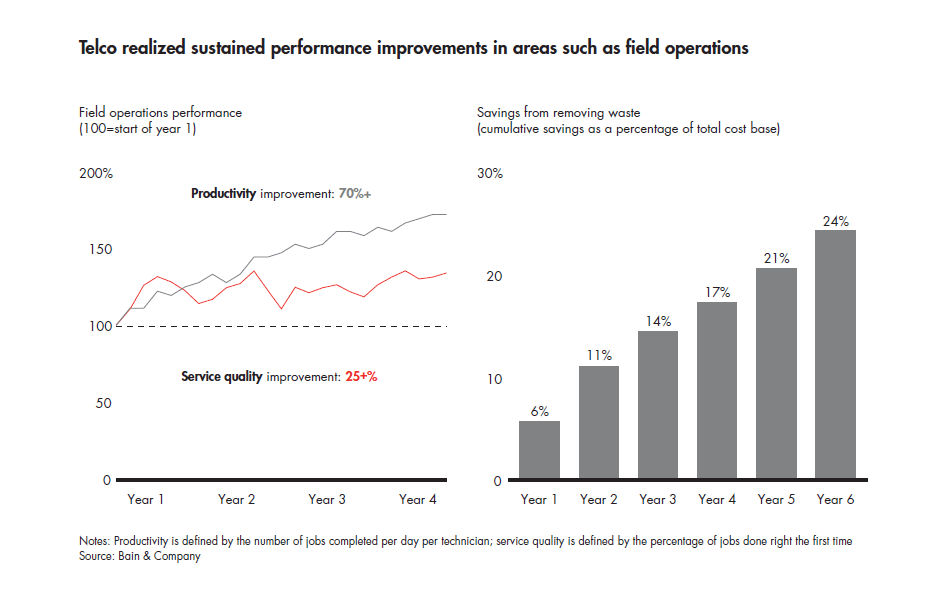
By focusing on value, identifying a handful of catalyzing metrics and embedding high-velocity learning loops, Telco has realized major performance improvements (see Figure). Over four years, service quality has improved more than 25% and productivity has increased more than 70%. For the past six years, Telco has realized a cumulative 24% savings in its total cost base by eliminating waste. At the same time, employee engagement scores have risen steadily despite a shrinking workforce.
First published in mayo 2013